The afternoon had begun to soften, and the Sun was slowly losing its sharpness. We were still beneath the banyan, the river flowing beside us with the same quiet assurance with which it had carried our thoughts through the morning. The traveler had remained with us for some time after our conversation about Sūrya. His little cloth bag lay beside him, and every now and then he glanced towards the river, as though listening to something only he could hear.
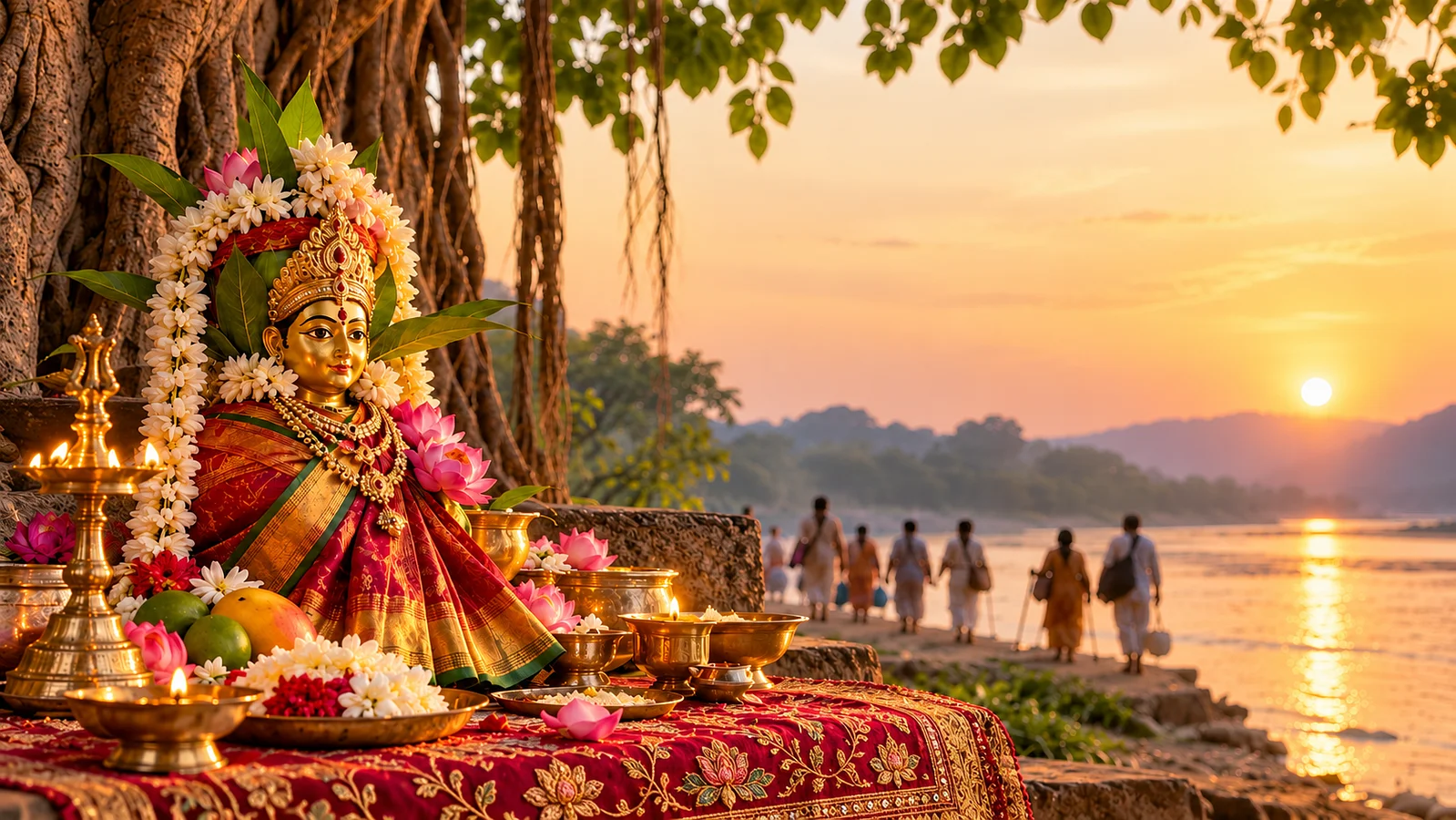
Then came the sound of voices along the riverbank. A group of pilgrims appeared along the path, some carrying small bundles and water pots, others walking quietly or chanting together. There was tiredness upon their faces, but also a certain lightness in their steps. The traveller looked up, and something changed in his expression. He recognised them. A few words were exchanged, a smile passed between them, and he reached for his little bag.
“Where are you going?” I asked, surprised that he was leaving us so suddenly.
“With them,” he said simply.
“But where are they headed?”
He smiled. “That is the journey.”
And before we could ask anything more, he joined the group.
We watched them disappear along the riverbank, their voices fading into the distance until all we could hear was the river and the leaves of the banyan.
I found myself wondering what makes a person leave the familiarity of home, endure heat, rain, fatigue and uncertainty, simply to reach a place considered sacred for generations. Why do we undertake a yātrā? The word means a journey, a going forth from one place to another. Yet in our tradition, it has always seemed to carry something more—the longing to seek what cannot quite be put into words.
Life itself is a yātrā. It begins with our first breath, but we do not know where life will lead us. Companions walk beside us for years; strangers appear for a moment and leave an impression that lasts far longer. Some roads are smooth, others steep. We stumble, rest, and begin again. And sometimes, it is only when the road grows difficult that we discover the strength to take another step. We learn to accept help, to offer it in return, and to recognise that hardship need not leave us broken.
Perhaps that is the gift of a pilgrimage. We return home with the same responsibilities and uncertainties, but something within us has shifted. We may not have found all the answers we sought, yet we have discovered a little more patience, courage and faith in our ability to continue. The destination matters, but so does the person we become along the way.
The river beside us had travelled far, gathering streams, leaving something behind and carving its path through rock and earth. It had changed constantly, and yet it had never ceased to be itself.
Was that not our journey too?
As I sat beneath the banyan, another thought came to me. Must we always leave home to undertake a yātrā? Can a journey unfold without our feet carrying us to a distant place?
An experience from my own life came quietly to mind. We had celebrated Varalakṣmī Vratam that Friday, as we have done every year. For me, the festival carries layers of nostalgia that reach back to childhood, to the days when I would help my mother prepare for the pūjā.
I remember the shopping—the offerings, gifts, tāmbūlam, betel leaves and areca nut, turmeric and kuṅkuma, fruits, combs, mirrors, mehendi cones and blouse pieces. There was an excitement in gathering everything together, knowing that the house would soon take on a different character. Then came the cleaning of the kalaśa, draping it in a beautiful sāṛī, applying turmeric to the coconut and finally placing the face of the Devī. As the preparations progressed, the air within the house seemed to change. It was difficult to explain, but we felt Her presence.

We children would be sent around the neighbourhood to invite the women for ‘haldi-kumkum’. The following day had its own familiar rhythm: the preparation of the naivedya, the aromas filling the kitchen, and the pūjā itself. Rice, dal, morkuzhambu, dal vada, kosambari, dal kheer, lemon rice and modakas would find their way to the offering. At the conclusion of the pūjā, the yellow sacred thread would be tied around our wrists, and we would partake of the feast.
But for us children, there was still the evening to look forward to. The house would come alive once again. The sundal would be ready, we would dress up, and there She would be—the Devī, resplendent in Her finery, almost as though She too were waiting for the guests.
Women from the neighbourhood arrived one after another. There was laughter, conversation and bhajans. They received tāmbūlam, prasāda and the little gifts prepared for them, and slowly, one by one, they left.
And then came my favourite moment.
When everyone had gone, my mother would sit quietly before the Devī. There were no more guests to receive and no preparations left to make. It was just my mother, the Devī and a few moments of silence. She would sit in meditation before that resplendent form, and even as a child I sensed that something had changed. The bustle of the day had dissolved. What remained was stillness.
That little period of meditation is a tradition I have continued without fail. Even now, those few minutes bring with them gratitude, nostalgia, devotion and peace—emotions that are difficult to put into words. Some things, I have come to realise, are not meant to be explained. They are meant to be experienced.
The next day comes the punar-pūjā. The Devī is turned to face north, a gentle indication that it is time for Her to move on, though Her presence remains with us. Then She is carefully placed inside the rice tin to cool down. Even this small act carries tenderness. It is almost as though we are saying, We have not dismantled You. We have simply invited You to remain with us in another form.
I learnt these gestures from my mother, not from a book or a written instruction, but by being beside her, watching, helping and absorbing. Years later, my daughter has become part of this same observance with me. She has watched, helped and participated, and in her own way begun to make these memories her own. I hope that one day she too will sit before the Devī in that familiar silence, remembering the women who came before her.
Perhaps this is how some journeys continue—not through grand declarations, but through small acts repeated with love, carried quietly from one generation to the next.
And this year, as I went through those familiar days, something felt different. Or perhaps I was different. My thoughts were occupied almost entirely with Her. The preparations, the pūjā, the offerings, the invitations, the songs, the meditation and the farewell became one continuous movement towards Her, and then back into the everyday world.
I had travelled nowhere. I had not walked miles or crossed mountains and rivers to visit a distant shrine. And yet, for those days, I had journeyed. I had stepped away from the ordinary rhythm of life and entered a space shaped by attention, devotion, memory and surrender. I had moved from preparation to celebration, from celebration to stillness, and finally to letting go.
If this was not a yātrā, what was it?
I began to understand that a yātrā is not measured only by the distance we cover, but by the depth with which we undertake the journey. A ritual can become a yātrā when we give ourselves to it fully. So can learning, writing, or any experience that asks us to pause, pay attention and allow ourselves to be changed.
And life itself continues to teach us in much the same way. Some lessons come through words, others through experience; some are understood only years later. The people who walk beside us, the traditions we inherit, and even the ordinary moments we barely notice may all hold something for us to discover. We need only remain attentive enough to receive it.
I looked up at the banyan. It had listened to our conversations without once interrupting. The river flowed beside us, and the last light of the Sun rested upon its waters. I thought of the traveller walking with the pilgrims, my mother sitting before the Devī, and my daughter learning a tradition that had travelled through generations to reach her.
The paths were different, yet each carried something beyond the act of walking or worshipping. Each invited us to look a little deeper. Perhaps we do not always need to go somewhere to begin a journey. Sometimes, the journey begins when we look again at what has been with us all along.
The banyan stood quietly beside the river. For a while, I sat beneath its branches, allowing the thought to settle. There would be other questions, other stories, and other teachers to encounter in the days to come. For now, it was enough to sit still and listen.
After all, even a pause can be part of a yātrā.