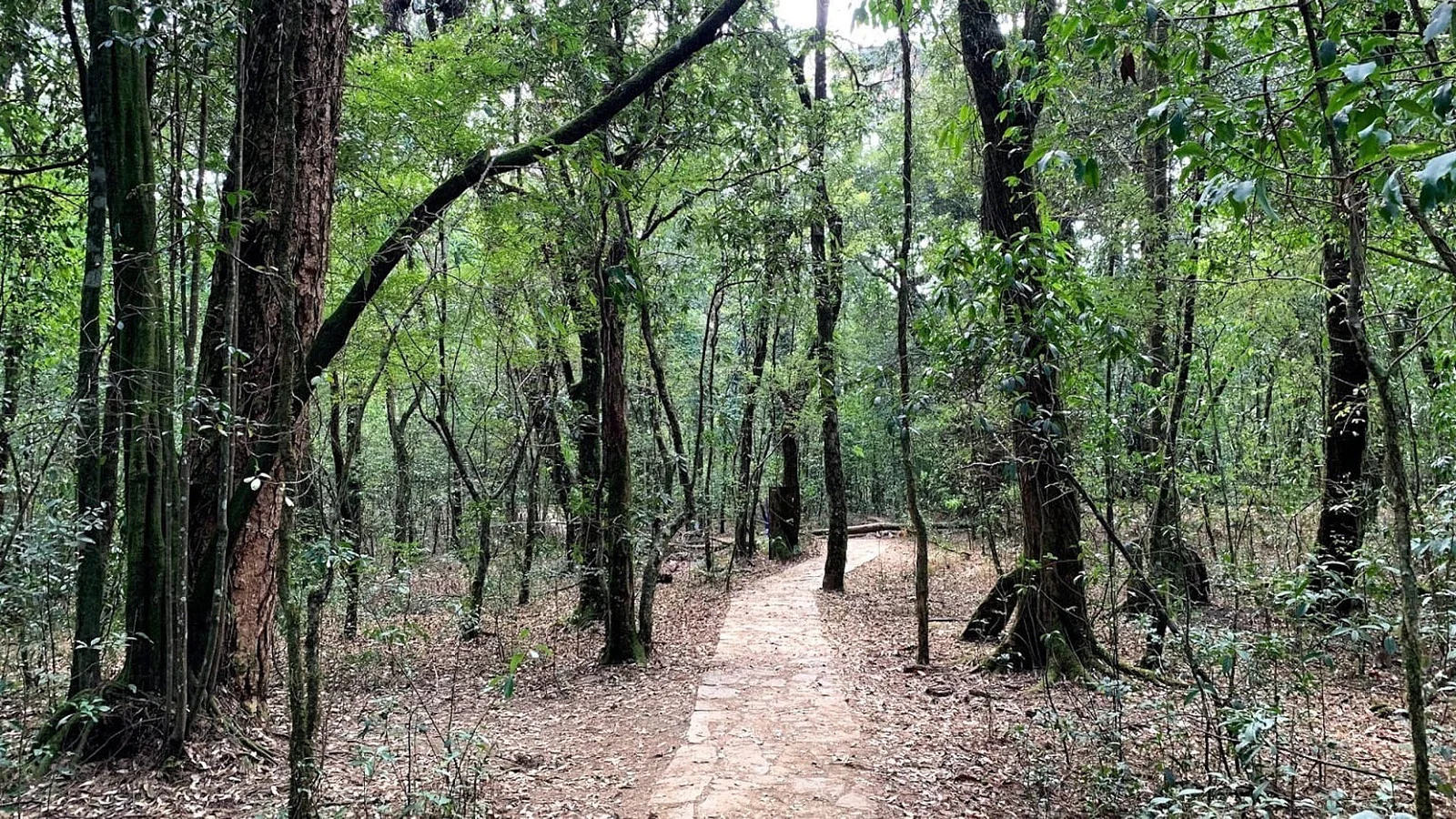
“Nothing ever goes out of this forest.”
This is what the guide told me as soon as I entered the dense forests of Mawphlang, a region in the northeast Indian state of Meghalaya. His tone carried a gravity that intrigued me, despite my skeptical nature.
A few months ago, I embarked on a journey to Shillong, the capital city of Meghalaya. Shillong is one of the most popular ‘weekend getaways’ for people living in north-east India. The city, often hailed as the ‘Scotland of the East’, came into existence in the 19th century with the advent of British rule in the northeast regions. Shillong was one of the iconic ‘hill stations’, designed by the British.
Hill stations initially served as a mere means of escape from the tropical heat of the summer for the colonial rulers. Over time, they became sites of both social and political dominance. They came to be known as ‘summer capitals’ because the British seasonally moved to the hills with their families and entourage of cooks, helpers, and other people involved in administration. Shillong’s landscape serves as a reminder of its historic past. Its colonial charm and pleasant climate offer a ready escape for people in the neighboring regions, especially during the peak summer seasons.
In the month of May, the unbearable heat of Guwahati, my hometown in Assam, compelled me to follow a trick out of the Europeans’ handbook and seek respite in the hills. My earlier visits to Shillong and other parts of Meghalaya were limited to the popular tourist spots- the waterfalls, the caves, and the markets. But I’ve come to realize that certain experiences unfold only when your inner consciousness is ready for them. Perhaps it was this inner readiness for a spiritual journey that ultimately led me to Mawphlang.
I was at a troubled phase of my life. My mind was wandering, and my soul sought a deeper connection even though I hadn't realized it then. I have been an atheist for so long that trusting in a higher presence felt foreign to me. But there it was. In the wilderness. In a place I wasn’t even looking.
When I entered the Mawphlang forests, the weather had turned gloomy. The constant warnings from the locals, combined with the eerie atmosphere around the groves, left me feeling a little nervous. I had already heard a few tales from old visitors before I embarked on this journey. Some said that if I leave the forests with even a leaf stuck to my shoe, I might face serious trouble. But I decided to take the risk anyway. After all, how else do we find the truth if we do not see it for ourselves?
Before entering the forests, I was sure to take notice of the impressive monoliths covered in moss, decorating the gateway. The guide, who belonged to the Lyngdoh clan of the Khasi tribe, mentioned that they had ritualistic significance. The Khasis of Meghalaya are one of the few communities in India that practice matriliny. They had their traditional animistic faith, Ka Niam Khasi, before the arrival of colonialism and Christianity in the 19th century, after which a majority of people became Christians.
Among the Khasis, the monoliths acted as important sites for sacrificial rituals in the past. Monoliths are specially erected in honor of ancestors, kings, warriors, and elders. One can find many monolithic structures of different sizes and shapes across Meghalaya. The vertical monoliths represent males, while the horizontal ones represent women. The monoliths outside the sacred groves were no different. They were believed to be a site where the old kings of the Lyngdoh Clan used to sit for sacrificial rituals. It is believed that in ancient times, the clan used to make occasional sacrifices to appease the local deity, Labasa. The sacrifices were usually made of big animals like bulls. Such traditional rituals are not practiced anymore, and even if they are, the sacrifices use smaller animals like cocks.
The local deity Labasa is held as the ultimate protector of the Lyngdoh clan, and the forests of Mawphlang are regarded as the private ownership of the deity.
Since these monoliths resided in the entryway, the locals would seek permission from the deity to carry out any further rituals inside the forests. The deity residing within the monoliths made appearances in the form of leopards, taken as a sign of a good omen. However, if and when the deity made an appearance in the form of a snake, it was a sign that the rituals must be stopped. The Khasis regard the snake as a bad omen.

Ritualistic Monoliths inside the groves. Photo by author
Once inside, more monoliths caught my attention, each having a unique ritualistic significance. A group of small, flat monoliths, in the shape of stone benches/tables, is laid at the heart of the first track of the forests. Some of these trees are so old, they might as well have been there since the origin of the forests. This makes Mawphlang a rich site of biodiversity hotspots, untouched by humans because of the efforts of the Lyngdoh clan.
The locals narrate the legend of Labasa and the spine-chilling stories of people who have incurred the deity’s wrath by violating the one rule of the forest- Do not take anything from the forest.
According to the stories of the locals, many people tried to break this rule in the past and regretted it for their lives. There is one tale about a group of men who felled a tree and tried taking it with them. However, when they put the wood in their car, the car stopped running. It was only when the men put the woods back in the forests that the car finally started again. In some cases, spirits haunted the people who knowingly took something from the forests back to their homes.
For outsiders, this may be considered as nothing more than a wayfarer’s tale. However, this belief has protected the forest area from human intervention as evidenced by its botanical richness.
As our guide navigated us through the woods, we breathed in the fresh air filled with the fragrance of exotic flowers. Every shrub, and every tree seems to tell a story of its own. More than half of them constitute medical or therapeutic properties.

Acorns inside the sacred groves. Photo by author.
The bark of the Himalayan Yew (a kind of coniferous tree) is believed to have anticancer properties. The beautiful pine flowers and acorns falling everywhere on the ground are considered to be effective in treating migraines and headaches. Apart from this, rhododendrons, rudraksha, and various other uncommon species of flora adorn the forests of Mawphlang. Mawphlang is one of the many instances that testify that the indigenous people are the rightful protectors of natural spaces and that no amount of official intervention can preserve the environment as efficiently as the natives do.
I entered the forests as a skeptic, but I left feeling with a newfound faith. Not in the idols or temples, but in the sacredness of life itself. Life thriving through memories and stories of the Lyngdoh community, within the Mawphlang forests.
.png)
%20(1).png)
%20(3).png)