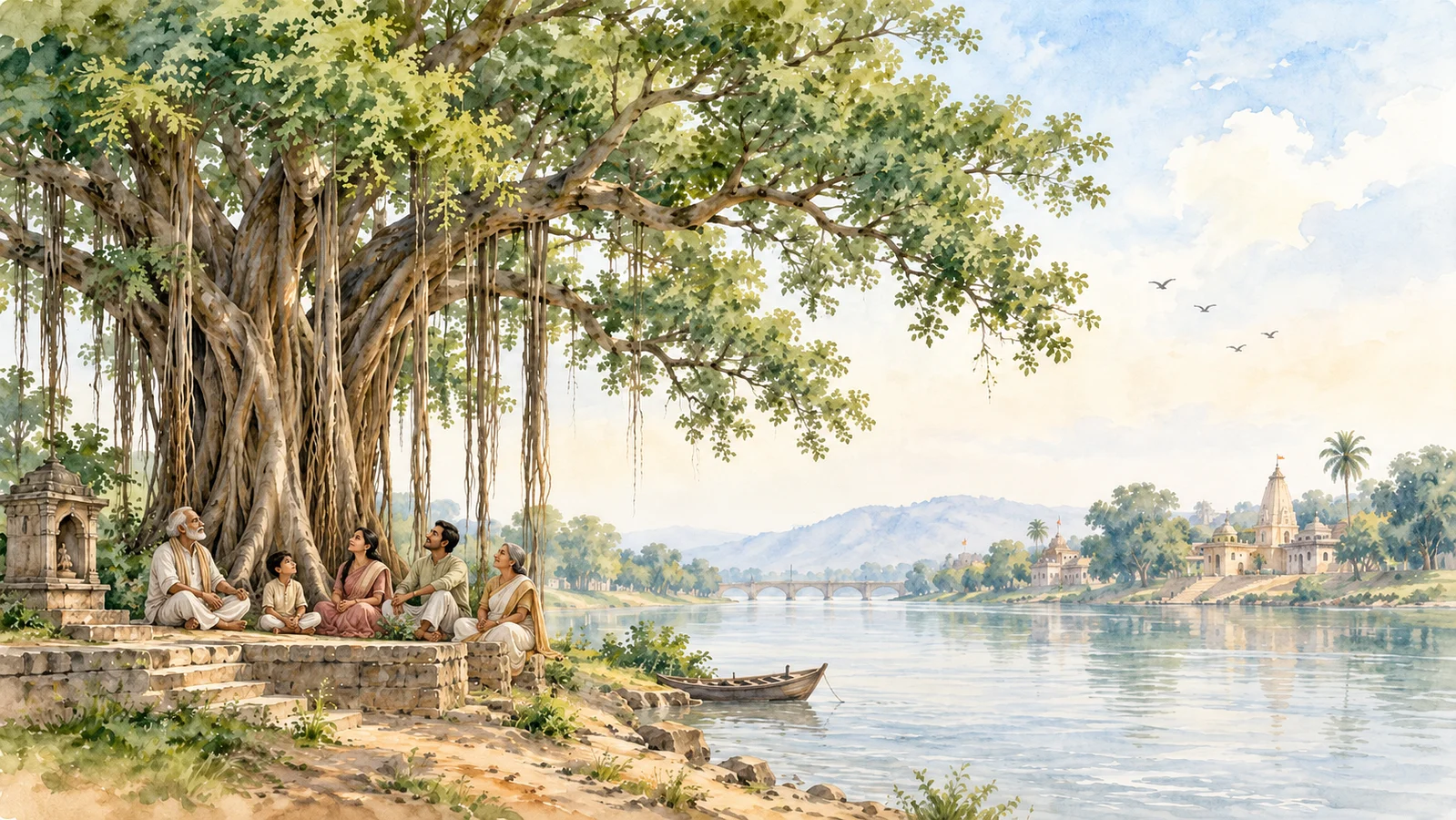
I have been silent for far too long. It was not writer's block, but a seeker's pause—a quiet interval of reflection where words gave way to contemplation. In that silence, I found myself beneath the generous canopy of an ancient banyan tree, on the banks of a gently flowing river. There, as the breeze whispered through the leaves and the river sang its timeless song, thoughts began to arise unbidden. They did not come as answers, but as conversations—gentle reflections that inspired me to write, to share, and above all, to continue learning. This is the beginning of those conversations.
By the Banyan Tree
The river flowed without haste, carrying with it stories older than memory. A cool breeze brushed through fallen leaves, pausing now and then as though reluctant to leave. Above us, an ancient banyan spread its vast canopy, its roots embracing the earth while its branches reached effortlessly towards the sky. We sat in silence, emptying our minds. There was nothing to ask, nothing to prove, nothing to become. Only the gentle murmur of the river remained—a ceaseless hymn accompanying the stillness.
Then, as the leaves whispered in the wind, the banyan spoke.
"Do you know who I am... and why I am revered?"
We looked up.
"I am older than the kingdoms whose names have faded from memory. I have watched sages meditate, children play, travellers rest, kings seek counsel, and weary souls find shade beneath my branches. I have stood through storms without chasing them away and through summers without complaining of the heat. My life has never been about movement, but generations have journeyed to me.
"You admire my branches, but my strength lies unseen. The deeper my roots, the wider my embrace. Remember this. In your own life, let your values be your roots. The world may applaud your achievements—those are the branches everyone can see. But it is your unseen convictions that will keep you standing when the winds grow fierce.
"Have you noticed these aerial roots of mine? When my branches stretch far from the trunk, I do not fear the distance. I simply send new roots downward, and in time they become pillars strong enough to support what has grown. So too must knowledge become wisdom, and wisdom become character. What begins as learning must eventually learn to stand on its own.
"I am sacred not because I am the largest of trees, nor because I live for centuries. People revere me because I give without asking who comes to me. The scholar and the shepherd, the saint and the sceptic, the rich and the poor—all receive the same shade. The sun does not choose whom to warm, the river does not choose whose thirst to quench, and a tree does not choose whom to shelter. Nature has always taught in this way, asking for nothing in return while offering everything it has."

We sat beneath the banyan’s vast canopy, listening not only to the rustling leaves but also to the quiet truths carried upon the breeze. The banyan said nothing more, nor did it need to. Its silence lingered long after its words had faded, inviting us to discover for ourselves what no discourse could fully explain. Perhaps that is why the banyan has been held in such reverence through the ages. It was never merely a tree; it was a Guru.
After a few days of contemplation, we found our place beneath the banyan once again. The river, as though unaware of our arrival, continued her endless journey towards the sea. The breeze carried the unmistakable fragrance of wet earth and, from somewhere beyond the grove, the faint chime of a temple bell dissolved gently into the river's endless song. For a while, there was silence. The banyan and the river seemed content to let the silence settle around us, reminding us that not every meeting begins with words.
It was the river that finally broke the silence.
"You listened to the banyan the last time we met," she said, her laughter dancing upon the ripples. "Today, will you listen to me?"
We smiled.
"Do not think I am any younger than the old Guru beside us," she continued. "I am ancient too... yet I am also an infant."
She lingered for a moment, amused by our bewilderment.
"Confused?" she asked. "Every moment I flow, I grow older. Yet every moment, I am born anew. The water that slipped past your feet a heartbeat ago is already on its way to the ocean. What now greets your eyes has never been here before."
I watched the waters in silence. They flowed with effortless grace, changing from moment to moment, yet remaining unmistakably the same river.
"If you are born anew every moment," I finally asked, "why do we still call you by the same name?"
The river laughed again, though this time there was a quiet tenderness in her voice.
"You have called me by many names through the ages, yet you have always known me. Tell me, then... what is it that remains? Is it the water that changes every instant, or something far deeper that your heart recognises?"
Her question lingered long after her words had dissolved into the current.
As I sat there, it struck me that this was how those who came before us may have learned to see the world. They lived close enough to nature to recognise that change and continuity were not opposites but companions. A river was never the same from one moment to the next, yet it remained itself. Seasons changed, generations came and went, kingdoms rose and disappeared, languages evolved, and customs adapted, yet something enduring flowed quietly through it all, like an unseen current beneath the surface.
This may be why our civilisation never looked upon rivers merely as flowing water. They were mothers who nourished, companions who witnessed, and silent custodians of memory. Villages grew upon their banks, fields drew life from their waters, pilgrims walked beside them, poets sang of them, children played in them, and the departed were entrusted to their embrace. Even before temples rose in stone, these flowing waters had already become sanctuaries, reminding humanity that the sacred was first encountered not within walls, but beneath the open sky, amidst the five great elements that sustained all life.
The river seemed to sense my thoughts.
"For thousands of years," she said softly, "people came to me with folded hands. They drank from me with gratitude because they knew they were receiving a gift, not exercising a right. Somewhere along the way, gratitude became entitlement."
Her waters curled gently around a smooth stone before continuing their journey.
"You call me Mother," she whispered. "If you truly understand why, you will never ask whether I should be kept clean."
Neither of us spoke after that.
The river flowed on, carrying her secrets towards the sea. The old banyan remained silent, as though content that another question had found its way into our hearts. The breeze stirred the hanging roots above us, and once again the distant temple bell became one with the river's timeless song.
We rose quietly and folded our hands to the old Guru before beginning our walk home. Behind us, the river continued to flow, ancient and newborn, unchanged in her purpose and ever changing in her form. Somewhere between her source and the sea, she had left us with a question that would accompany us long after her voice had faded.
We had barely stepped away from the comforting shade of the banyan when the sky announced its presence with a brilliant flash of light, followed by the deep roar of thunder rolling across the heavens. Before we could gather our thoughts, a gentle drizzle began to fall, and within moments the heavens opened into an unexpected downpour.
Laughing like children caught by surprise, we hurried back beneath the generous canopy of the old Guru. The river, delighted by the return of old friends, seemed to sing a little louder as countless raindrops danced upon her surface. The breeze carried the unmistakable fragrance of rain-soaked earth, and from somewhere beyond the grove, the faint chime of a temple bell dissolved into the river's joyful song.
There is something about rain that never fails to awaken joy in everything it touches. Trees stand a little taller, leaves glisten with renewed life, birds find new songs to sing, and even the smallest creatures emerge as though they had been waiting patiently for this very moment. We humans are no different. The gentle pitter-patter of raindrops upon the earth fills the heart with an inexplicable sense of comfort, as though each drop is a quiet blessing descending from the heavens. Almost instinctively, our minds begin searching for familiar comforts—a plate of hot pakodas or crisp samosas, a steaming cup of tea or freshly brewed coffee, and the warmth of those we hold dear. Rain does far more than nourish the earth; it awakens memories. Not merely our own, but memories shared across generations.
When the rain finally passes, the world seems to breathe again. The air feels lighter, cleaner, almost as though the sky has quietly washed away not only the dust that had settled upon the earth but also the dust that had gathered within us. The leaves wear a brighter green, every flower seems to bloom with renewed enthusiasm, and everything around us glistens with a freshness that words struggle to capture.
If, by chance, your path takes you past a temple, pause for a moment and simply look up. A rain-washed gopura standing against a deep grey sky has a beauty that quietly steals your breath away. Somewhere within its ancient walls, a temple bell rings, and a familiar rāga drifts effortlessly through the cool, rain-laden air. You may not know its name, nor understand its grammar, yet something deep within you stirs. For a fleeting moment, time seems to stand still, and you remember... though you cannot quite say what.
Do not brush that feeling aside. Stay with it. Live in that moment. Perhaps it is your grandmother's gentle voice calling you indoors before the rain grew heavier. Perhaps it is the little paper boats you folded with clumsy hands, convinced they would sail across oceans. Perhaps it is the irresistible joy of jumping into puddles despite knowing a scolding awaited you at home. Or perhaps it is that delicious childhood wonder as you gazed into a rain-filled puddle reflecting the endless sky above, secretly believing that if you stepped into it carelessly, you might fall upward into the heavens instead of down into the earth. How extraordinary that a simple puddle could hold both the sky and a child's imagination.
As we grow older, we learn that puddles are shallow, rainbows can be explained, and clouds obey the laws of nature. Yet somewhere along the way, we also stop looking. Perhaps that is why the rain returns every year—not merely to nourish the fields or replenish the rivers, but to gently awaken the child who still waits patiently within us, hoping that one day we will slow down, step outside, breathe deeply, and look upon the world with wonder and reverence once again.
By the time we rose to leave, the rain had softened into a quiet drizzle. The banyan stood as serene as ever, its leaves still holding tiny drops of water, while the river continued her timeless journey towards the sea. Yet something within us had changed. The rain had awakened memories we did not know we still carried—memories of childhood, of home, of innocence, and of a time when wonder came effortlessly. Some memories ask not to be explained but simply to be felt. So let us linger there for a while, carrying with us the fragrance of wet earth, the music of the rain, and the quiet assurance that some conversations beneath the banyan never truly end; they simply continue in the silence of our own hearts until we return once again.
.png)
%20(3).png)
%20(1).png)