%20(1).png)
Read Part One, Two, Three and Four
Introduction
A Civilizational Invitation
A yātrā in Bhārata is an invitation.
To step into the layered stories of the world's oldest living civilization,
To immerse in wonder at the treasures that open up,
To allow one's consciousness to expand in communion with this ancient land.
A yātrā pushes our imagined boundaries. Civilizationally, it is designed to transform and elevate. When we come out on the other side, we are no longer the same.
In this series of evocative photo essays, join Shubham Pal on his journey across Bhārata—through its hallowed millennia-old history, monuments, kṣetras, art and craftsmanship, regional delicacies passed down through generations, and relish with joy his encounters with the large-heartedness of her people and culture.
Come, learn of Bhārata with a yātrī who has chosen to traverse the lesser-known paths.
Author's Introduction & Context Setting
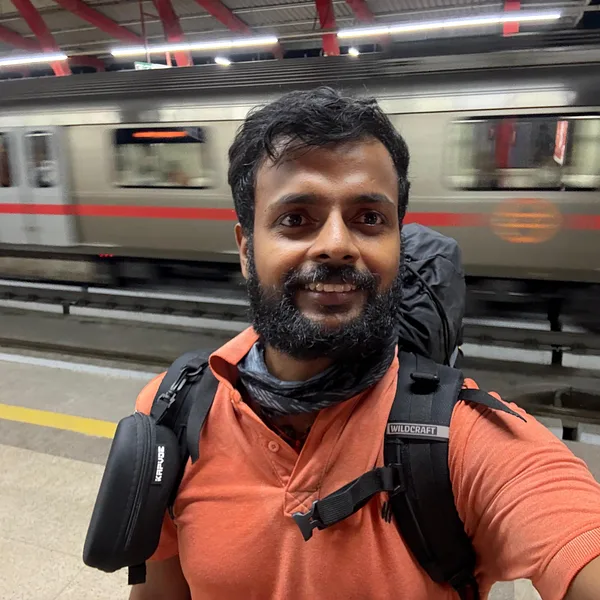
I am Shubham Pal, originally from Varanasi and currently living in Delhi, where I work as an Electrical Engineer. For months, one question stayed with me: How well do I really know Bharat? I had read about its history, traditions, and diversity, but I wanted to experience them firsthand rather than through books or social media. I wanted to meet people from different communities, learn about their crafts, taste local food, understand their way of life, and experience the land at the pace of a bicycle.
Like many young professionals, I had both professional and family responsibilities. Funding a months-long expedition meant that leaving my job was not an option. Fortunately, my job allowed me to work remotely, making it possible to pursue this dream without stepping away from my career or neglecting my responsibilities at home. Carrying my laptop throughout the journey, I balanced my office work with the expedition.
Maintaining both commitments was the most challenging part of the journey. Most days began early in the morning with long hours of cycling, often lasting until evening or sometimes until nights. After reaching my destination and finding a place to stay, I would open my laptop and complete my office work, frequently working late into the night. Most nights, I slept for only four to five hours before beginning the next day's ride. The journey tested not only my physical endurance but also my discipline, resilience, and ability to balance adventure with my professional and family responsibilities.
My interest in Indian Knowledge Systems (IKS) also shaped this journey. I have always been fascinated by the idea that knowledge is not confined to classrooms but is gained through observation, travel, dialogue, and lived experience. I wanted to understand Bharat by experiencing it directly—through its landscapes, its people, its traditions, and its living culture.
This photo essay series is a reflection of that journey. Beginning with Gujarat and continuing along India's coastline, these photo essays showcase the story of the places I visited, the people I met, and the lessons I learned. For me, this expedition was an attempt to understand Bharat not as a tourist, but as a learner. Every kilometre became a lesson, every conversation a classroom, and every village a chapter in understanding the country I call home.
Photo Essay Part Five
28th December 2025
The morning after my Dandi Hanuman Temple visit, I came to the Bet Dwarka Temple and offered my prayers. After exploring the temple, I walked to the seashore.
For a long time, I simply sat there in silence.
I wasn't in a hurry to leave or reach my next destination. I just watched the endless waves, listened to the sound of the sea, and felt the cool breeze. After days of constant cycling, it was one of those rare moments when I did nothing at all.
Sitting by the Arabian Sea, I found myself reflecting on the journey so far—the roads I had ridden, the people I had met, and the experiences that had already become unforgettable memories. Sometimes, the most meaningful part of a journey isn't moving forward; it's taking a moment to pause and appreciate where you are.
That quiet morning at Bet Dwarka remains one of the most peaceful memories of my entire expedition.


29th December 2025
On 29th December, I bid farewell to the Dandi Hanuman Temple and resumed my journey. My first stop was Okha, the western gateway to Bet Dwarka, where I spent some time exploring the coastal town and its peaceful surroundings.
From there, I rode to Shivrajpur Beach, one of India's renowned Blue Flag beaches. The crystal-clear water, soft white sand, and clean surroundings made it one of the most beautiful beaches I had seen on the journey. Instead of rushing ahead, I took my time to enjoy the calm atmosphere, the sound of the waves, and the fresh sea breeze.
After soaking in the beauty of the coastline, I rode back to Dwarka. Although I covered only 54 kilometers that day, it wasn't about covering distance—it was about slowing down and truly experiencing the places I visited. Some days on a journey are meant for adventure, while others are meant simply for appreciating the beauty of the road and the destinations along the way.


30th December 2025
Before leaving Dwarka, I once again visited the Dwarkadhish Temple to offer my prayers. I wanted to begin the next phase of my journey with the blessings of Lord Krishna. After one final pranam, I packed my bags, mounted my bicycle, and started riding towards Porbandar.
By this point in the expedition, something had changed within me. The long distances that had seemed challenging in the beginning were now becoming a part of my daily routine. My body had adapted to life on the bicycle, and I was feeling stronger and more energetic with each passing day.
The ride to Porbandar was smooth, and I covered around 91 kilometers. As I pedalled along the coastal roads, I realized that cycling was no longer just a physical activity—it had become a way of life. Every sunrise meant a new destination, every road brought a new story, and every kilometer made me fall even more in love with the journey.


31st December 2025
I decided to spend the last day of the year in Porbandar, taking a break from cycling and exploring the city's history and spirituality.
My day began with a visit to the ISKCON Temple, where I spent some quiet time in prayer and enjoyed the peaceful atmosphere.
From there, I visited the Porbandar Bird Sanctuary. It was fascinating to watch different species of birds in their natural habitat. Sitting there for a while, observing their movements and listening to their calls, was a refreshing change from the long hours on the road.
Later, I visited Kirti Mandir, the birthplace of Mahatma Gandhi. Walking through the home where the Father of the Nation was born gave me a glimpse into his early life and the values that shaped one of the world's greatest leaders. It was a humbling experience to stand in a place that holds such an important chapter of India's history.
As the sun set on 31st December 2025, I reflected on everything the journey had already given me—new places, unforgettable people, and experiences that would stay with me forever. Ending the year in Porbandar felt special, and I was excited to welcome the new year on the road, continuing my dream of cycling the entire coastline of India.


1st January 2026
The first day of the new year began with excitement and anticipation. I woke up early, eager to visit Somnath, the first of the twelve Jyotirlingas, a place I had dreamed of seeing for a long time.
I packed my bicycle and started riding towards Veraval, covering around 133 kilometers. The journey itself was beautiful. Along the way, I passed rows of lush green coconut trees swaying in the breeze and rode past the serene Madhavpur Beach, where the Arabian Sea stretched endlessly beside the road. The coastal scenery made every kilometer enjoyable.
By evening, I finally reached Veraval, the gateway to Somnath. Knowing that I was just a short distance away from one of India's most sacred temples filled me with excitement. I couldn't wait for the next morning, when I would finally stand before the magnificent Somnath Temple and begin the new year with the blessings of Lord Shiva.


(All photographs attrtibuted to author)
.png)
%20(3).png)