Introduction
In ancient Indian political philosophy, the concept of daṇḍa (literally "the rod" or "staff") represents far more than mere punishment—it embodies the entire apparatus of governance, law enforcement, and the authority that maintains social order. The Kāmandaka Nītisāra, a classical treatise on statecraft, presents a compelling analysis of how the absence of daṇḍa inevitably leads to mātsya-nyāya (the law of fishes), a state of anarchic chaos where the strong devour the weak without restraint. Through a careful examination of verses 39-41 (2nd Sarga) of this text, we can trace both the descent into social collapse and the mechanism by which righteous governance prevents it.
The Descent into Mātsya-Nyāya: A Sequential Breakdown
The Kāmandaka Nītisāra presents a clear causal chain leading to societal destruction when daṇḍa is absent or improperly applied. This descent occurs in distinct stages:
Stage 1: The Primordial Condition—Diversity Without Unity
The text acknowledges that human society is inherently bhinnavartmanaḥ (following different paths). People belong to different varṇas, pursue different occupations, hold different beliefs, and have different temperaments. This diversity is natural and not problematic in itself. However, it creates a social fabric that requires conscious effort to maintain cohesion.
Stage 2: The Rise of Unchecked Desires
When governance weakens or becomes absent (daṇḍa-abhāva), human nature reveals its darker tendencies. The text specifically identifies the forces that begin to dominate: kāma (desire/lust), lobha (greed), krodha (anger), mada (arrogance), māna (pride), and harṣa (excessive delight or envy). These are the internal enemies that, when unleashed, drive individuals toward selfish and exploitative behavior.
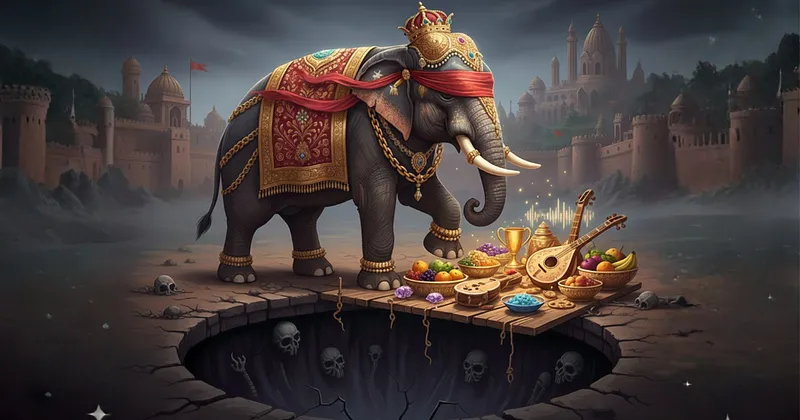
Verse 41 vividly describes this condition: "This world, when overwhelmed by desires like lust and greed, begins to drown into hell (niraya)." The metaphor is significant—society doesn't collapse suddenly but rather sinks gradually, like a person drowning in a swamp.
Stage 3: Mutual Predation—Parasparāmīṣatā
The critical turning point comes when people begin to view each other not as fellow members of a community but as prey or objects for exploitation. This is parasparāmīṣatā—mutual predation. Each person or group seeks to consume, dominate, or extract from others. Trust dissolves, cooperation becomes impossible, and every interaction becomes a zero-sum game.
Stage 4: The Triumph of Mātsya-Nyāya
The final stage is the complete breakdown captured in the powerful image of mātsya-nyāya—the law of fishes. As verse 40 states: "In the absence of punishment (daṇḍa), destruction spreads, and the law of the fishes prevails, where the strong devour the weak."
In a pond without any governing principle, large fish eat smaller fish without restraint. Similarly, in human society without daṇḍa, physical might, wealth, or cunning becomes the only determining factor. The vulnerable are consumed, the weak are trampled, and paridhvaṁsa (widespread destruction) engulfs both moral and social order. The society becomes nirākṛndam—helpless, abandoned, without support or protection.
Daṇḍa: The Preservative Force
Against this grim progression, Kāmandaka positions daṇḍa as the essential force that holds society together. Verse 41 presents a striking image: just as a drowning person is pulled from a swamp with a pole, daṇḍa prevents society from sinking into chaos (niraya). The text uses the verb dhāryate—"is held up, supported, preserved"—indicating that governance is not merely reactive but actively sustaining.
The Dual Foundations: Loka and Śāstra
What makes daṇḍa legitimate and effective? Verse 39 provides the crucial answer: punishment must be lokaśāstrānugaḥ—guided by both loka (societal norms, customs, living traditions) and śāstra (scriptural authority, revealed wisdom). This dual foundation is essential for several reasons:
Legitimacy Through Social Acceptance
Daṇḍa that aligns with loka resonates with the people's understanding of justice. It reflects their lived experience, cultural context, and collective moral intuitions. The Upādhyāya-nirapekṣā commentary provides concrete examples: in the Lāṭa region (near and around present-day Gujarat), not taxing certain groups might seem scriptural but could be seen as unfair by the populace; in Ābhīra regions, certain marriage customs might be socially accepted but violate śāstra.
Authority Through Transcendent Principles
At the same time, śāstra provides universal principles that prevent daṇḍa from degenerating into mere mob rule or the whims of popular opinion. It grounds governance in dharma—the cosmic order that transcends particular circumstances.
Non-Disturbance: The Test of Righteous Governance
The verse introduces a critical criterion: anudvejanaḥ—non-disturbing. Proper daṇḍa does not create fear, agitation, or emotional distress among the people. Instead, it brings śrī (prosperity, welfare, glory). The contrast is stark: disturbing punishment (udvejana) becomes adharma (unrighteousness) and leads to the king's downfall (dhvaṁsa).
This principle reveals sophisticated political wisdom: governance succeeds not through terrorizing the population but through earning their confidence. When people feel secure rather than threatened by authority, when they see punishment as protective rather than predatory, social order becomes self-sustaining.
The King's Responsibility
The Kāmandaka Nītisāra places ultimate responsibility on the ruler (mahīpati, rājā). The king is not merely another powerful actor but the one who wields daṇḍa on behalf of the entire social order. His prosperity and very survival depend on implementing daṇḍa correctly. The text warns explicitly: improper punishment leads to the king's destruction because it undermines the very legitimacy of his authority.
This creates a powerful incentive structure: the ruler who neglects governance invites not only social chaos but his own ruin. Conversely, the ruler who maintains balanced, just, and socially sensitive daṇḍa achieves stability and glory.
Contemporary Relevance
Though composed centuries ago, this analysis remains remarkably relevant. Modern societies continue to grapple with the balance between law and custom, between universal principles and local context, between authority and legitimacy. The warning against mātsya-nyāya resonates in contexts of state failure, where the strong indeed prey upon the weak without restraint.
The insistence that governance must be anudvejanaḥ (non-disturbing) challenges systems that maintain order through fear and oppression. The Kāmandaka Nītisāra suggests that such systems, even if temporarily effective, contain the seeds of their own destruction because they violate dharma and erode public trust.
Conclusion
The Kāmandaka Nītisāra presents daṇḍa not as an optional tool of statecraft but as the fundamental force preventing social collapse. Without it, human society—diverse, driven by powerful desires, and lacking natural unity—inevitably descends into mātsya-nyāya, where mutual exploitation and the tyranny of the strong destroy all semblance of order.
Yet daṇḍa itself must be carefully calibrated. It must harmonize loka and śāstra, customary practice and transcendent principle. It must be firm enough to prevent predation but gentle enough to avoid creating disturbance. When properly implemented, it transforms a collection of self-interested individuals following different paths into a functional society. It holds back the tide of kāma, lobha, and other destructive forces, preventing the world from drowning in its own chaos.
The image from verse 41 captures this perfectly: society, like a person sinking in a swamp, requires the steady support of the pole—daṇḍa to remain upright. Remove that support, and the descent into niraya becomes inevitable. Maintain it with wisdom and justice, and śrī (prosperity and glory) follows. This is the central teaching of these verses: governance is not a luxury or imposition but the very foundation upon which civilized human life depends.