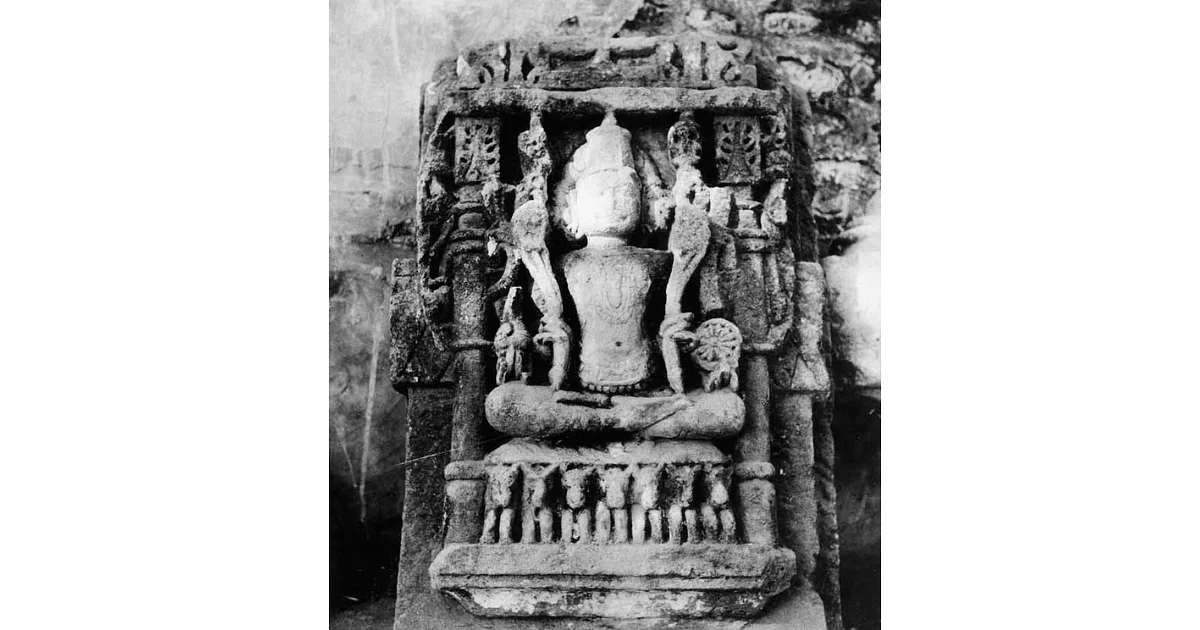
During the medieval period, the Sun God Sūrya was frequently assimilated with the deities of the Hindu pantheon such as Viṣṇu, Śiva, and Brahmā, giving rise to several composite iconographic forms. Among these, the four-fold type labelled as Harihara-Hiraṇyagarbha, also called Harihara-Pitāmahārka appears to be the most prevalent (rare combined figures of Viṣṇu-Sūrya and Śiva-Sūrya have also been found in Hinglajgarh and Nagda respectively). Hariharahiraṇyagarbha is a unique composite image that combines Sūrya with the pantheon of Brahma, Viṣṇu and Śiva. Harihara-hiraṇyagarbha is three-headed and eight-armed, with Sūrya being the central deity. Although the Harihara-Hiraṇyagarbha follows a broadly recognizable iconographic pattern, numerous variations and regional adaptations have been observed and documented. These deviations are primarily reflected in the arrangement of the attributes held in the hands, the identification and placement of the attendant figures, and other particular distinctive iconographic features.
The following verses from the Aparājitapṛcchā, a 12th century text by Bhuvanadevācārya and one of the most influential Hindu treatises on architecture...