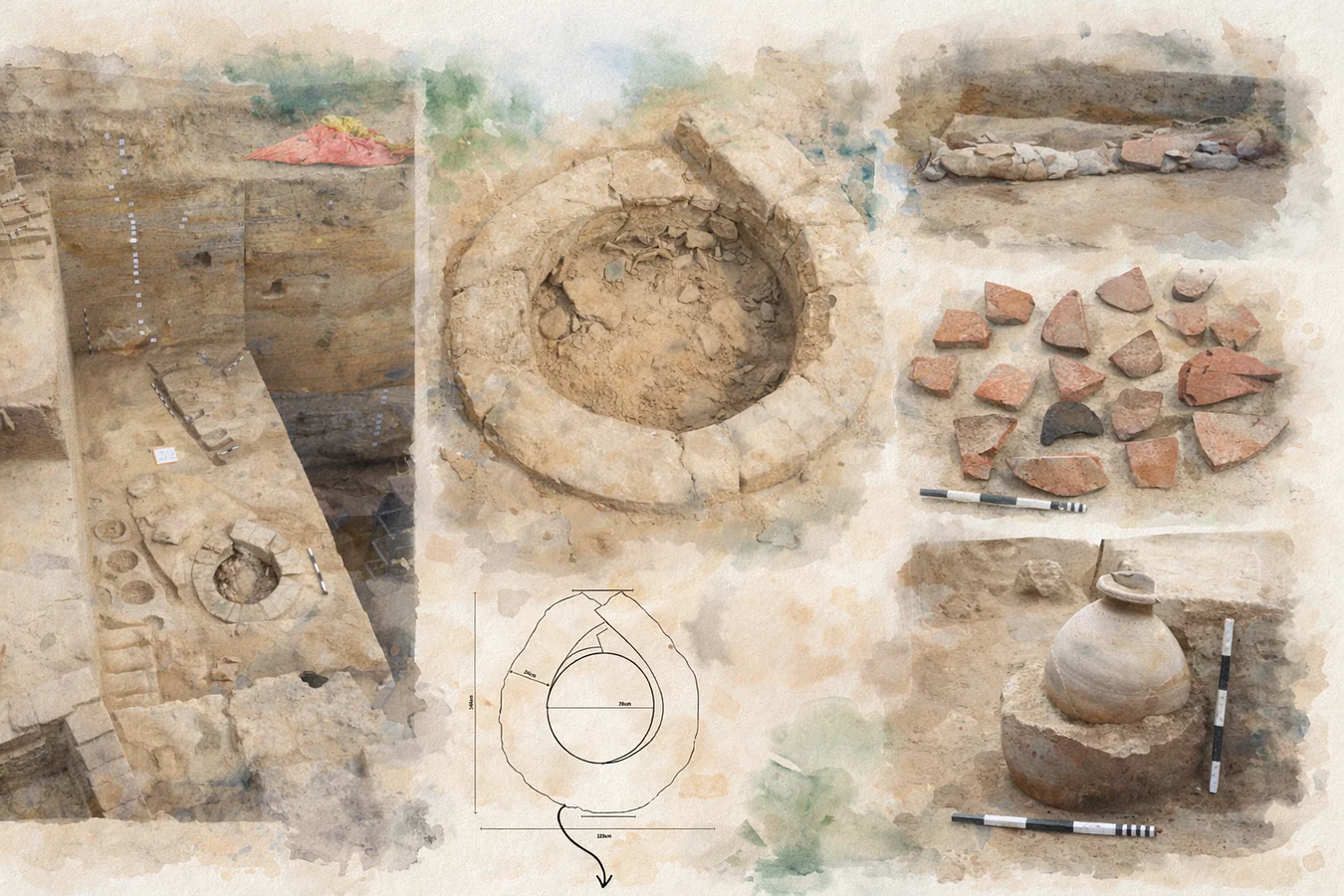
In the final part of this series, we will look at some more evident discoveries made at the site of Bahaj and a conclusive analysis stating the significance of these discoveries and of this Kṣetra overall.
1.Śiva-Pārvatī terracottas:
In terms of religious beliefs, the most significant is the finding of a male and female anthropomorphic figure along with three votive circular discs from the mid to early PGW1 period. These figurines are possible representations of Bhagavān Śiva and Mātā Pārvatī as Gangaur, which is popularly celebrated in Caitra month in Rajasthan and some parts of North India. It is an 18-day festival which culminates on the last day. It is celebrated for the worship of Śiva and Pārvatī. During the festival, women make idols representing Bhagavān Śiva and Goddess Pārvatī using clay or wood. It is quite possible that the discovery of these male and female anthropomorphic figures, along with three votive/offering discs, is actually evidence of Ganagaur pūjā, which would push back the antiquity of Ganagaur to circa 1500 BCE period.
The reason for the identification of terracottas as Śiva and Pārvatī is their physiognomy. The female is a usual Venus-shaped figurine, as are generally found from various ancient cultures, whereas the other terracotta is clearly a male, as discerned by its features; and the intentionally marked ūrdhvaretas confirms its identification as a male figure. Since Śiva is the only deity shown as ūrdhvaretas being the ādiyogī, having utmost control over his desires, the figurine is identifiable as Śiva. This confirms the identification of the female figurine with Pārvatī, as both these deities are worshipped together in India, particularly during the Gannagaur festival. This identification opens a window for identification of various Venus-shaped female figurines as that of Pārvatī herself (Pl. 12).

2. Early Coinage:
Another important piece of information that the Bahaj excavation has provided is related to the early coinage of India. The first and foremost observation about the early coinage is that most of the earliest coins are made of copper, and very few in silver. The punch-marked and uninscribed copper cast coins have been found together. The earliest coins have been found from the pre-Mauryan levels of circa fifth century BCE, a few from inside the ritualistic miniature pots and a lot of stuck coins from regular archaeological deposits. The condition of the coins indicates long usage before their deposition, confirming an earlier date of their manufacture. Thus, the antiquity of coinage in India should easily go back to the sixth-seventh century BCE (Pl. 13).

3. Yajñakuṇḍas:
Another important finding is the presence of Yajñakuṇḍas dug up on a large scale in a linear pattern during the Mahājanapada period, and filling them up with the natural sandy soil and occasionally with miniature pots containing uninscribed copper cast or punch-marked coins. This activity was observed in a section of Trench ZA7 and the deposit of Trench XB8. The sandy soil brought from outside was pure, i.e. without any impurities. The ritual pits were about 40 cm deep, and on their base, the kankars (coarse gravel) were found to have been deposited. The same activity was observed at the same level in some other destroyed sections of the site (Pl. 14).

4. Terracotta votive tanks showing an evolution:
In the realm of Hindu religious practices, Mātṛkā worship through terracotta votive tanks is well-established. The votive tanks, which were found earlier, were dated to the Kushan period and not before that. From the Bahaj excavations, a terracotta votive tank has been reported from the PGW period. The tank has various partitions but is devoid of any figurines. From the Mauryan period, two terracotta votive tanks have been found, one of which has a small bird-shaped figurine placed on the surviving rim part, whereas the other has a plain rim. During the Suna-Kushan period, the terracotta votive tanks evolve further, and now on their rims Mātṛkās are placed either with a human or a bird/animal face. A Kushan votive tank has two surviving stairs in the middle, and on the base are depicted snakes and turtles. The base of the tank represents the physical world full of māyā, and one has to step up on the stairs and cross the saṃsāra vaitaraṇī after completing the climb on these stairs. When Mātṛkās are shown seated on the rim part, they are to be propitiated to achieve this goal (Pl. 15).

5. Stone-rings and a tablet:
From the pre-Mauryan deposit in the Trench XB8, two stone-rings made up of hard jasper stone have come to light. Both the stone-rings are quite broken but survive enough to confirm their typology and dating. Both the ring-stones have a round hole in the center, and there are carvings in the interior section of these holes. Prof. Prithvi Kumar Agrawala (1979: 75-111), who has done a brilliant study of stone-rings, has dated this variety of stone-rings in the pre-Mauryan period, circa early fourth century BCE. This excavation confirms his dating on the basis of stratigraphy.
One of the stone-rings in the central hole/ring has a figure of a standing female deity followed by the depiction of an acanthus leaf. The same two motifs would have been repeated three times as one figure of a female deity is complete, while two partially survive. On the top and periphery, it has two circular decorative bands. The other stone-ring is a quite small fragment in which a mythical animal could be seen. Of the same period is a jasper stone tablet in which a standing female deity, a mythical animal and a dove survive. Such stone-rings are generally found at major city sites like Vaishali, Kausambi, Pataliputra and Taxila. So, finding such stone-rings and a unique stone tablet indicates Bahaj to be an urban settlement even during the pre-Mauryan times (Pl. 16).

6. Early Mauryan seal:
A rare Early Mauryan seal made of jasper stone was unearthed from Trench ZB6 from the deposit of the Kushan period. The seal was found in very finely preserved condition. Overall, it comprises nine symbols or Brāhmī letters with a sound of ‘ṁ’ denoted by a dot as the tenth one. The seal has incised depictions of: a turtle (kūrma), a fish (matsya), a lizard (gṛhagodhā), a stag (mṛga), a peacock (mayūra), a svastika, a nandipāda (or Brāhmī ‘ma’) and Brāhmī letters ‘Śa Nā’. All the symbols have relevance in Sanātana dharma. Kūrma is related to Bhagavān Viṣṇu’s second incarnation, matsya with Viṣṇu’s first incarnation, gṛhagodhā or godhā with Mātā Pārvatī, mṛga with Bhagavān Śiva, mayūra with Kārtikeya, svastika and nandipāda are well-known religious symbols and ‘Śa Nā’ can actually have been ‘Śa Ni’, i.e. name of planetary deity Śani. It seems that the seal was an object of high reverence, which is why it was kept carefully by its possessors for more than three centuries. At the back, there seems to be a knob to hold it, but it is too short and smooth for some unknown reason. The most important aspect of this seal is that such seals and representations are not found in the early historical period. If not for the presence of Brāhmī letters, this seal seems to be in continuity with the Harappan tradition (Pl. 17).

7. A possible Virūpākṣa head in terracotta:
In a rare finding, a human male head in terracotta was found from the Mauryan period deposit. The figure has a moustache and beard and a possible third eye. A torque in the neck has a circlet decoration, and the eyes are also marked as circlets, features which are typical of Mauryan period terracottas. Apparently, till now no such male head has been found from the Mauryan period, and this male head seems to be the representation of terrific form Śiva, Virūpākṣa, as the facial features indicate (Pl. 18).
%20and%20a%20potsherd%20with%20representation%20of%20trisula%20with%20damaru%20tied%20to%20it%20from%20late%20Mauryan-Sunga%20level%20(right).png)
8. Triśūla with ḍamaru symbol:
A very significant find from the levels of circa 200 BCE, which in general parlance is called Sunga period but in actuality may be the late Maurya period, is a potsherd which has a triśūla (trident) with a ḍamaru (pellet drum) tied to it, engraved on it. Firstly, the presence of a trident in that period is quite significant, as we might not have any other example of a trident in sculptural and terracotta art from that early period. Secondly, the presence of ḍamaru is even more exciting as ḍamaru is not found in the iconography of Śiva till a very late time. Ḍamaru is also not part of Saivaite iconography in early religious texts, though ḍamaru in the Indian psyche is well associated with Śiva, and it is believed that from the sound of ḍamaru itself the seven svaras of music have originated. The finding confirms the antiquity and veracity of such Indian religious beliefs (Pl. 18).
9. Terracotta plaques with Navagrahas and Saptarṣi Tārāmaṇḍala; Aśvinī Kumāras; Possible Śani figure among Navagrahas; Brahmāṇḍa; Twin lions:
From the deposit of circa 200 BCE, five unique terracotta plaques have been found, which belong to Trenches XB8 and XB9. The deposit from which these have been recovered is associated with the large furnace activity exposed in these trenches. The concept of nine planets and seven stars (Navagraha and Saptarṣi Tārāmaṇḍala) is quite ancient in Indian as well as western astronomy, but in sculptural art, these are not found represented till the post-Gupta period. For that reason, such an early representation of these concepts in terracotta art is very significant.
Similarly interesting is the finding of the terracotta plaque with twin horse-faced crowned deities who are identifiable as twin Aśvinī Kumāras, mānasaputras of Sūrya named Dasra and Nāsatya. The Aśvinī Kumāras find mention in the Ṛgveda as well as Avestā, so just like the above-mentioned plaque, this plaque also forms part of our shared heritage. Aśvinī Kumāras are also not represented in sculptural art till the post-Gupta period, so the finding of this plaque is again very significant.
The next terracotta plaque is again very interesting. It represents a pot-bellied human-shaped figure with terrific or slightly non-human features in the center surrounded by various planets formed in the shape of concentric circles projecting towards their center. The total number of such planets is eight, and the central figure makes the count nine. It seems to represent the nine planets, with one of them given prominence, who is represented in human form. This prominent planet seems to be Śani because of his human form but terrific facial features.
Another terracotta plaque found from the same deposit is again very interesting. It represents a number of hemispherical structures, with the one in the center given slight prominence. Since some of the terracottas are related to planets on a confirmed basis, this terracotta seems to represent the entire Universe with various planets surrounding a slightly prominent central planet that may be the Sun. We know that the Sun is a star, but in ancient Indian tradition, the Sun was considered one of the nine planets and the most powerful one in the entire Universe.
The fourth terracotta plaque is again unique as it shows a set of twin lions. The plaque is broken, but it definitely had the twin lions as the main theme. In Indian tradition, we do not come across the concept of twin lions, but in Egyptian and Greek traditions, the concept of twin lions is found. Among all these terracottas, none can be said to be related to Indian tradition only; these belong to a common shared heritage, and the plaque with twin lions confirms that these terracottas have a certain outside impact as well. (Pl. 19)
,%20twin%20lions%20(centre%20up),%20Navagraha%20and%20Saptarshi%20taramandala%20(centre%20down)%20and%20Sani%20within%20Brahmanda%20(right),%20ca.%20200%20BCE%20(1).png)
10. A unique ritualistic terracotta pot with an image:
From the deposit of circa the second century BCE in the Trench ZB9, a unique terracotta was found, which on the front has a human-shaped body and on the back is shaped as a pot. The human-shaped figure has its head in the form of a Yakṣa. There is a projecting spout in the centre of its body, which might indicate either navel or penis, but is difficult to confirm. In either case, it is related to the creation of the universe. There is a slit cut on the back side of the pot, also. The Yakṣa like features of the head of the figure and the concept of origin of the Universe indicate that the image might be identified as Śiva, who is called yakṣasvarūpāya and is responsible for the creation of the Universe. The pot is designed to put water in and the spout to put out water. In case the spout marks the navel, it is easily related to the creation, but in case it is a penis, one has to look for the mythological story in which Agni drinks the semen of Śiva during the birth of Skanda-Kārtikeya (Pl. 20).
,%20twin%20lions%20(centre%20up),%20Navagraha%20and%20Saptarshi%20taramandala%20(centre%20down)%20and%20Sani%20within%20Brahmanda%20(right),%20ca.%20200%20BCE.png)
11. Nṛsiṃha terracotta image:
In a unique find, a terracotta image of a deity has been found inside a structure which somewhat appears to be a shrine. The deity has a human body and the face of a lion with moustaches. The deity is wearing a yajñopavīta and seems to be holding someone. From the features, the deity is identifiable as Nṛsiṃha and in that case, he might have held Hiraṇyakaśipu in his arms, but that remains unclear due to the non-survival of any such thing in his hands. The presence of Nṛsiṃha idol during the Kushan period and a possible shrine dedicated to him is very important (Pl. 21).

The site has also revealed evidence of various manufacturing activities in terms of the bone and shell industry during the Suna and Kshatrapa periods. This is evident by the presence of debitage such as both bones and shell, along with various finished products like bone tools, shell bangles and beads, etc. Shell bangle production in the Braj area by the craftsmen is really remarkable. Additionally, a semiprecious stone bead industry was also found.
Conclusions
In the entire Braj landscape, what survives are the ancient mounds on which modern-day settlements are situated and the majority of these settlements without a doubt go back to the PGW period in antiquity. So, in ancient times, the landscape of Braj would have comprised the PGW settlements, the sacred groves, ponds, hills, streams and rivers. The landscape of the whole Braj region is different from other parts of the sub-continent. This can just be understood by the presence of such a high number of ancient settlements in the close vicinity. Even the surrounding landscape of contemporary Kurukṣetra and Hastināpura regions is no match for it in that context. After studying and observing the available data and tradition, it can be inferred that prior to the arrival of medieval reformer saints, few places like Mathura, Vrindavan, Gokul, Mahavan, Baldeo, Govardhan, Kaman, Nandgaon, Barsana were already important and famous, but the rural landscape was not that popular. There might have been a pre-existing tradition of circumambulation of these sacred sites, particularly Mathura, Vrindavan and Govardhan. The form and nature of 84 kos Braj parikramā prior to the sixteenth century is not clear, but it would have existed in some form for sure, otherwise the settlements related to these parikramā places would not have been so old in antiquity.
The excavation at Bahaj has been quite a successful endeavour. This excavation has revealed a very rich regional cultural scenario pushing back the antiquity of the sacred Braj region and Mathura and its surrounding region by at least one or two millennia. Here is a summary of the key findings and their significance:
-
The discovery of a paleo-channel just beneath the archaeological deposit at around 23-meter depth forces a change in the previously held view that the majority of high archaeological mounds in the Braj region are lofty because of being situated on an elevated sand dune. The presence of a paleo-channel indicates that the area cannot be an elevated surface; it would have been a low-lying area.
-
The pottery of the OCP2 period has a striking resemblance to the ceramic assemblage of Bewan, Ganeshwar (in Sikar District) and Atranjikhera (in Kasganj District), thus challenging the previously held view that the OCP of northeastern Rajasthan is different from that of the Doab region.
-
Copper bangles, fish-hook and steatite beads (Pl. 22) have also been found from the OCP deposit.

-
The thickness of the PGW deposit of about 7.25 to 7.75 m is again an unprecedented occurrence, having critical implications for site formation and chronology.
-
The site has also provided evidence of manufacturing activities such as shell bangle production, semiprecious stone bead manufacturing, and bone tool manufacturing.
-
The presence of furnaces along with metal objects suggests that metal processing activities were undertaken by the people of this region.
-
The presence of Paleolithic tools in the lowest cultural deposit is a significant occurrence which requires further research.
The continuity of cultures at Bahaj till recent times with such thick archaeological deposits is a remarkable phenomenon, and the results of various scientific analyses are going to provide some exciting information about our ancient past.
As far as the chronology of various archaeological cultures at the site of Bahaj is concerned, it is possible that the Paleolithic tools found from the lowest deposit belong to the Upper and Middle Paleolithic periods, which may date back between 10000 BP and 1,00,000 BP. The settled archaeological culture of the site, which is being termed the Bahaj-Govardhan Culture, along with the OCP, may date back to the early third millennium BCE as per established dating of Ganeshwar culture. There is a possibility that the Bahaj-Govardhan culture may date even earlier. The dates of BRW3 and PGW may also go beyond the established dates, as the PGW has such a thick archaeological deposit here that has not been found at any other excavated site.
When we delve into the importance of archaeological findings from Bahaj, the most significant is the early dating of the oldest culture. Till now, it was believed that the culture at Mathura and the surrounding region starts with the PGW culture which was dated at Mathura city in the sixth century BCE and at Sonkh in the ninth century BCE and the rise of Mathura as a cosmopolitan city was credited to the influx of outsiders from the north-west of Bhārata in the centuries preceding the Common era and the Kushan period. But Bahaj now challenges this view and confirms that all or most of the settlements in the region date back to the OCP period if excavated properly. The development of settlements in the region is a gradual process, and during the PGW period, this entire area was the most prosperous area of the entire sub-continent in the contemporary world. This prosperity and richness of archaeological deposit of the PGW period gave rise to the prosperity and advancement of the succeeding cultures during the Mahājanapada, Maurya and Sungaperiods finally culminating in the cosmopolitan nature of the Kushan and Gupta periods.
The PGW period is in fact responsible for the religious environment of Mathura, which later on provided opportune conditions for the development of Mathura art and iconography, the religious dogmas and the images. The use of stone as a medium might be credited to the Sunga and Kushan periods, but the tradition of making images was old and quite prevailing but in different mediums, either perishable or the highly expensive metals.
The excavations at Bahaj do more than uncover artefacts; they reveal a deeply interconnected civilizational landscape where knowledge, ritual, economy, and belief evolved in continuity over millennia. The findings challenge long-held assumptions and push back the antiquity of the Braj region, establishing it as a significant centre of early cultural and intellectual activity. What emerges is not an isolated site, but a vibrant ecosystem of lived traditions that shaped later developments in religion, art, and society. This project, therefore, is not merely archaeological in scope; it is a rediscovery of India’s civilizational depth, offering insights that reconnect the present with a richly layered past.
Footnotes:
-
The term "PGW" refers to the Painted Grey Ware culture, an Iron Age culture in Northern India from approximately 1200 to 600 BCE. It is known for its distinctive, fine grey pottery with black painted geometric designs and is associated with the Later Vedic Period.
-
Ochre Coloured Pottery (OCP) is a Bronze Age archaeological culture (c. 2000–1500 BCE) in the Indo-Gangetic Plain. Characterized by red-slipped, ill-fired, and fragile pottery, this culture is often associated with "Copper Hoards". It represents a transitional phase between the late Harappan civilization and early Vedic culture.
Black-and-Red Ware (BRW) is a distinctive ceramic tradition identified by its black interior and rim with a red exterior, produced through a controlled firing technique that creates this dual coloration.
Sources:
-
Image 3 - Excavated Pottery from Sonkh; Courtesy - Mathura Museum
-
Agrawala, Prithvi Kumar. The Early Indian Mother-Goddess Votive Discs. East and West, Vol. 29, No. 1/4, December 1979, 75-111.
-
Agrawala, R.C. and Vijay Kumar. Ganeshwar-Jodhpura Culture: New Traits in Indian Archaeology. Harappan Civilization-A Contemporary Perspective, Oxford & IBH Publishing Co., New Delhi, Bombay, Calcutta, 1982, 125-134.
-
Archaeological Survey Reports (A.S.R.) Nos. I, III, XVII, XX.
-
Archaeological Survey of India Annual Report (A.S.I.A.R.) for the year 1910-11 and 1911-12.
-
Chakrabarti, D.K. et.al. Bateshwar, Mathura and Ahar: Sites in the Agra-Mathura-Aligarh-Bulandshahr Sector of the Upper Ganga-Yamuna Doab in U.P. South Asian Studies, Vol. 20, 2004, pp. 57-69.
-
Chaturvedi, Vasudeva Krishna. 1987. “Vedon mein Braj” Braj-Vibhav (Hindi). Ed. Gopal Prasad Vyas. Delhi.
-
Gaur, R. C. Excavations at Atranjikhera, Delhi, 1983.
-
Gupta, Vinay Kumar. Mathura: An Art and Archaeological Study. Delhi. 2013.
-
Gupta, Vinay Kumar. Identification of Ancient Places and Towns in and around Mathura (Based on Correlation of Archaeological Findings with the Places Mentioned in Ancient Literature and Epigraphs). Heritage: Journal of Multidisciplinary Studies in Archaeology 8.2 (2020): 324-337.
-
Growse, F.S. 1883. Mathura: A District Memoir. Delhi.
-
Joshi, E.B. 1968. U.P. District Gazetteers- Mathura. Vol. 12. Lucknow.
-
Joshi, M.C. 1989. “Mathura as an Ancient Settlement”, Mathura: The Cultural Heritage. Ed. D.M. Srinivasan. AIIS, Delhi: 165-170.
-
Katre, S.M. 1969. Dictionary of Pāṇini, Part III. Poona: Deccan College.
-
Mani, B.R. and V.K. Gupta. 2014. “Rajagriha” History of Ancient India, Vol. VII. Eds. D.K.
-
Chakrabarti and Makkhan Lal. Delhi: 599-608.
-
Mittal, Prabhu Dayal. 1966. Braj Kā Sānskritik Itihās (Hindi). Delhi: Rajkamal.
-
Hartel, Herbert. Excavations at Sonkh. Berlin, 1993.
-
Indian Archaeology 1954-55-A Review
-
Indian Archaeology 1963-64-A Review.
-
Indian Archaeology 1964-65-A Review.
-
Indian Archaeology 1965-66-A Review.
-
Indian Archaeology 1966-67-A Review.
-
Indian Archaeology 1970-71-A Review.
-
Indian Archaeology 1980-81-A Review.
-
Sahi, M.D.N. Aspects of Indian Archaeology. Jaipur, 1993.
-
Sankalia, H.D., S.B. Deo and Z.D. Ansari, Excavations at Ahar (Timbavati). Deccan College, Pune, 1969.
-
Sharma, R.C. 1984. Buddhist Art of Mathura. Delhi: Agam Kala Prakashan.
-
Shesh, Chunni Lal. 1959. “Braj Yātrā kī Paramparā”. Braj aur Braj Yatrā (Hindi). Eds. Govindadas and Ram Narayan Agrawal. Delhi: 91-117.
-
Singh, Purushottam. Excavations at Narhan (1984-1989). Delhi, 1994.
-
Varma, Dhirendra.1954. Brajbhasha (Hindi). Allahabad: Hindostani Academy.
-
Vogel, J.Ph. 1972. Indian Serpent Lore. Varanasi & Delhi.