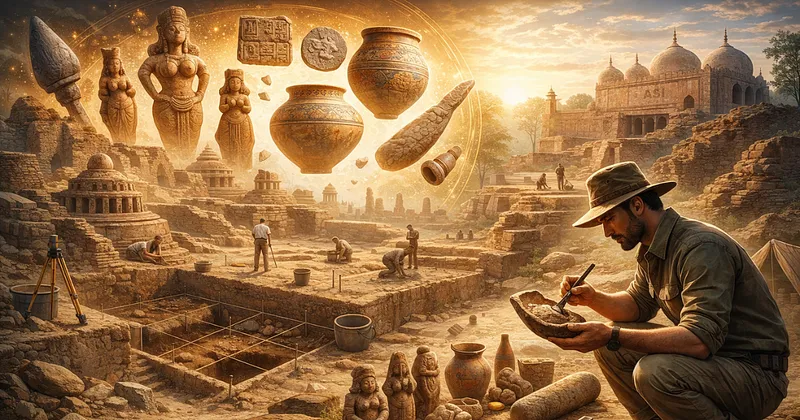
The site of Bahaj has provided some astonishing evidence. Much of the evidence has come to light for the first time in Indian archaeology. Some of these are mentioned below:
1. Paleo-channel:
The first and foremost is the finding of a dried-up paleo-channel at a depth of 21-23 m of the archaeological deposit. During the cutting of the lowest deposit in the Trench ZA7, a deposit of kankar (calcrete) soil was observed for a uniform thickness of about 60 cm. Below this calcrete deposit, riverine silt was encountered. When this silt was further probed for about 30-40 cm, to our surprise, we could observe the water flowing marks of the dried stream in the silt. The calcrete deposit has been found throughout the site as well as outside it, wherever we probed in trial trenches, but the water flowing marks of the dried stream were not observed in any other trench other than ZA7 and ZB6, which are about 25 m apart in the central part of the mound. From the ground level of the surrounding fields, this calcrete deposit is not more than 2 m–3 m deep. The attempts to locate this lost river through remote sensing/ satellite imagery data indicate that this river would have flowed from the north-west of Bahaj to the south-east, somewhat parallel to the Yamuna River. Further scientific studies are being conducted on the sediments and satellite data by the relevant scholars (Pl. 2)

2. Paleolithic tools:
One of the most important findings of the site is the presence of Paleolithic tools below the OCP1 layers as well as within these layers, pushing back the antiquity of the entire Braj region to the pre-Holocene period. The findings have provided some glimpse of a hunter-gatherer prehistoric community surviving in this area. Flake tools belonging to the Middle and Upper Paleolithic period were explored on the Govardhan and nearby hills, and similar flake tools have come up in the lowest deposits at Bahaj, thus pushing back the antiquity of the site to thousands and thousands of years. The presence of Middle Paleolithic and Upper Paleolithic tools in this area, which is adjacent to the Ganga-Yamuna doab, is very significant as far as prehistoric India is concerned (Pl. 3).

3. Bahaj-Govardhan Culture/ OCP Period:
The earliest culture in terms of settled life evidence from the site is that of the OCP/ Bahaj-Govardhan culture. The pottery assemblage includes the Ochre Coloured Pottery (OCP) along with incised ware, chocolate slipped ware, pots with handles, black-on-red ware and a variety of pottery which despite having similarities with Ganeshwar-Jodhpura pottery (Agrawala and Kumar 1982: 125-134) on one hand and Atranjikhera pottery (Gaur 1983) on the other hand has some distinctive types and shapes (Pl. 4).

The thickness of this lowest cultural deposit ranges between 1 m and 2.5 m, and if the AMS dates justify an early dating, the culture can better be termed as the Bahaj-Govardhan culture rather than just being called the OCP culture. The finding of mud structures with proper shape and alignment, and the walls cutting almost at right angles, is a very significant occurrence for this earliest period of the site (Pl. 5).

4. Iron in OCP Culture:
One of the most significant findings of the Bahaj excavations is the presence of iron in the OCP deposit. In Trench XG4, Q2, at a depth of 478 cm, an iron nail has been found. This was not the only occurrence of significance. Iron slags were also found in the deposits underlying this iron nail. The presence of iron in the BRW phase is reported from Atranjikhera (Gaur 1983), but its finding in the preceding OCP phase is very interesting and important. Since there is no cultural break between OCP and BRW2 cultures at any of the spots in the entire area of excavation, it is quite obvious that technology and culture are continuing from the preceding periods, and iron and copper metallurgy are no exception. The finding of iron objects from the OCP period was not reported in other trenches of the site, and also was not found in the lowest OCP deposits of Trench XG4. In any case, the finding of iron in Trench XG4 in the middle to upper phases of OCP is going to have an implication on the dating of iron, and it might go towards the third millennium BCE.
5. Black and Red Ware (BRW) Culture:
BRW culture is already reported from Atranjikhera (Gaur 1983), Jakhera (Sahi 1993), Noh (IAR 1963-64, 1964-65, 1965-66, 1966-67), and Jodhpura (Agrawala and Kumar 1982: 125-134) sites, but not much information is available about this phase. At Bahaj, the BRW phase is coming in continuation of the earlier OCP phase without any kind of cultural break, but the overall pottery assemblage is quite distinct, with possibly only a few shapes and types continuing. In the BRW phase, the fine BRW shows close resemblance with the BRW of the Ahar culture (Sankalia et.al. 1969), but here this fine BRW is giving rise to experimentation and the making of PGW, NBPW, and BSW. The culture at Bahaj is BRW-PGW rather than BRW as identified at the above-mentioned sites. Many of the PGW types at Bahaj in this phase have close resemblance to the BRW identified at Narhan culture sites (Singh 1994), which actually seems to be a variety of PGW only. Similarly, the white painted BRW of the Ahar culture has similarities with the BRW of the Bahaj, including the ones that have white painted strokes. Similar strokes in ochre, black and white colour appear on varieties of BRW and the early PGW (Pl. 6).

6. Painted Grey Ware (PGW)3 Culture:
The site has revealed a rich deposit of about 7.25 –7.75 m of Painted Grey Ware culture in Trenches ZA7 and ZB9, respectively, whereas in all other trenches, the thickness of the PGW deposit ranges between 3.25 m and 4.5 m. In all such trenches, a clear and distinct deposit of BRW culture and Bahaj-Govardhan Culture is also present. Such a thick deposit of PGW is expected to throw some new light on this culture, particularly chronology. The finding of two mud structures built with a base of stones arranged in a somewhat curvilinear pattern in Trenches ZB6 and XF3 is quite significant (Pl. 7).
%20and%20ZB6%20(right).png)
During the late phase of PGW, the finding of a terracotta pipe with circular cross-section is also important (Pl. 8).

7. Earliest occurrence of NBPW4:
In the early-middle levels of PGW culture, Northern Black Polished Ware (NBPW) potsherds were found, which suggest experimentation in producing such deluxe pottery and should have implications for early dating and the spread of NBPW culture. While the early origin of NBPW at this site (or this area) is significant, it is probable that the pottery was not frequently used here even when NBPW was extensively used in Eastern U.P. and Bihar. This experimental stage of preparation of NBPW pottery is observed at a depth of about 3.5 m–4 m of the PGW deposit. This confirms the early experimentation of making PGW and NBPW pottery from the BRW pottery (Pl. 9).

8. Yoni-shaped Yajñakuṇḍa:
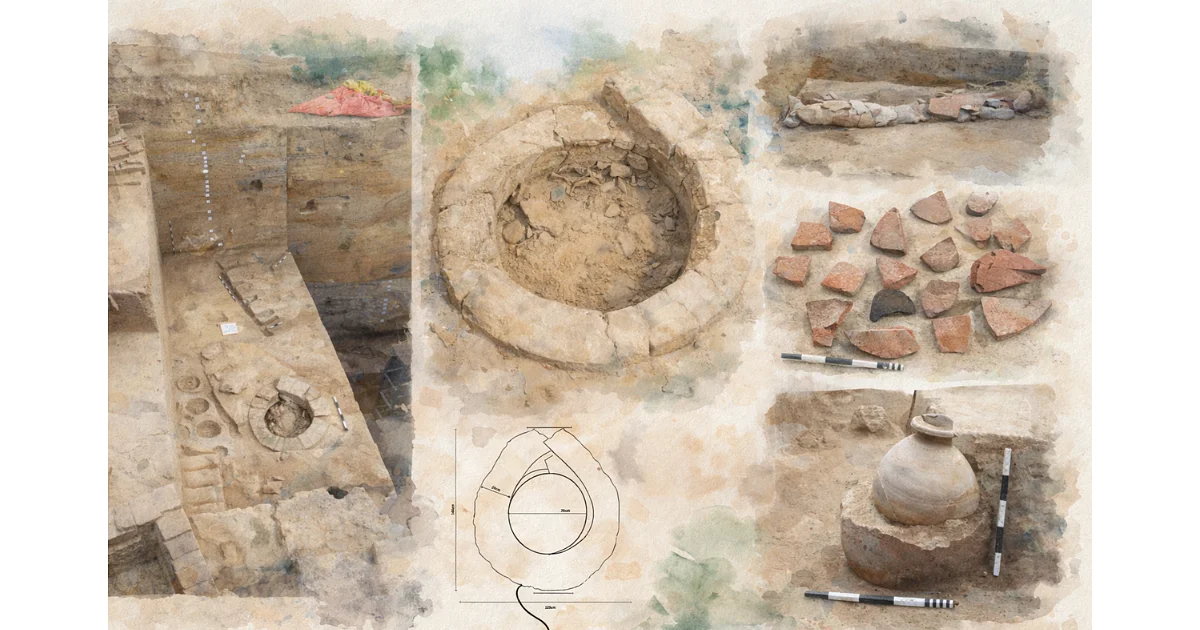
In the upper levels of PGW in Trench XB8, a Yoni-shaped Yajñakuṇḍa was exposed. It was given the proper shape of a Yoni with two courses of burnt bricks and occasional use of mud brick to fill the gap at the junction point towards the north. The burnt bricks are specially designed and prepared to give a proper shape of the Yoni. Below the Yoni-shaped structure, a complete ring-well was dug, which ran for about four meters but did not go down to the level of groundwater. The structure was ritualistic to the extent possible, and on preliminary investigation, grains of moong (green gram) and jau (barley) were found along with bones (possibly sacrificial) and several complete but small pots. A few of the vessels had a hole at the bottom. Results of further investigations are awaited, but finding a ring-well with the Yoni-shaped superstructure for ritualistic activities in the PGW period is very significant (Pl. 10).

9. Comb-pattern sacrificial pits:
At the same cultural level as the above-mentioned Yoni-shaped Yajñakuṇḍa and in the same Trench XB8, a pattern of comb-shaped sacrificial altars was observed. The exact number is difficult to confirm as the activity was continuing inside the northern section. The pits were not regular in plan but had ashy deposits, and on preliminary investigation, the presence of grains of moong and jau was confirmed. Use of these grains with ash confirmed their ritualistic use (Pl. 10).
10. Clay sealings with Brāhmī letters:
One of the most striking finds of the site is the presence of four sealings made of unbaked clay from the upper levels of the PGW period. Such sealings have never come to notice from anywhere in the subcontinent. The sealings are of two varieties. Two of them have similar impressions on four sides, and the remaining two have similar impressions on four sides. One of the impressions has two separate elephant-riding figures (in all possibility deities) and two standing figures who to some extent match the representations of Saṃkarṣaṇa and Vāsudeva on some early Mathura coins (Gupta 1989: 124-139). There are some other devices in the impression, but these are not clearly identifiable. The other type of impression observed on two other sealings is very complex and has yet not been identified, but in all probability seems to depict some religious subject. The most important aspect of these sealings is the presence of three Brāhmī letters on each of the first variety of sealings. The letters on one seal read “Jinaka”, and the other read “Nokhara”. Since the sealings have been found from the upper levels of the PGW period, these are easily datable to circa 600 BCE as per stratigraphy. The Brāhmī characters on these sealings are the earliest known examples of Brāhmī script in the subcontinent (Pl. 11).

This is only the beginning. The site revealed many more remarkable discoveries that continue to reshape our understanding of history and the way people lived in those times. In the next part, we will explore additional finds such as coins, terracotta seals, tablets, symbols, and more.
Footnotes:
Ochre Coloured Pottery (OCP) is a Bronze Age archaeological culture (c. 2000–1500 BCE) in the Indo-Gangetic Plain. Characterized by red-slipped, ill-fired, and fragile pottery, this culture is often associated with "Copper Hoards". It represents a transitional phase between the late Harappan civilization and early Vedic culture.
Black-and-Red Ware (BRW) is a distinctive ceramic tradition identified by its black interior and rim with a red exterior, produced through a controlled firing technique that creates this dual coloration.
The term "PGW" refers to the Painted Grey Ware culture, an Iron Age culture in Northern India from approximately 1200 to 600 BCE. It is known for its distinctive, fine grey pottery with black painted geometric designs and is associated with the Later Vedic Period.
NBPW stands for Northern Black Polished Ware, a highly lustrous, fine pottery from ancient India, known for its smooth, glossy finish, often black or metallic, used as deluxe tableware by elites, reflecting advanced urban life and societal stratification.
Sources:
Image 3 - Excavated Pottery from Sonkh; Courtesy - Mathura Museum
Agrawala, Prithvi Kumar. The Early Indian Mother-Goddess Votive Discs. East and West, Vol. 29, No. 1/4, December 1979, 75-111.
Agrawala, R.C. and Vijay Kumar. Ganeshwar-Jodhpura Culture: New Traits in Indian Archaeology. Harappan Civilization-A Contemporary Perspective, Oxford & IBH Publishing Co., New Delhi, Bombay, Calcutta, 1982, 125-134.
Archaeological Survey Reports (A.S.R.) Nos. I, III, XVII, XX.
Archaeological Survey of India Annual Report (A.S.I.A.R.) for the year 1910-11 and 1911-12.
Chakrabarti, D.K. et.al. Bateshwar, Mathura and Ahar: Sites in the Agra-Mathura-Aligarh-Bulandshahr Sector of the Upper Ganga-Yamuna Doab in U.P. South Asian Studies, Vol. 20, 2004, pp. 57-69.
Chaturvedi, Vasudeva Krishna. 1987. “Vedon mein Braj” Braj-Vibhav (Hindi). Ed. Gopal Prasad Vyas. Delhi.
Gaur, R. C. Excavations at Atranjikhera, Delhi, 1983.
Gupta, Vinay Kumar. Mathura: An Art and Archaeological Study. Delhi. 2013.
Gupta, Vinay Kumar. Identification of Ancient Places and Towns in and around Mathura (Based on Correlation of Archaeological Findings with the Places Mentioned in Ancient Literature and Epigraphs). Heritage: Journal of Multidisciplinary Studies in Archaeology 8.2 (2020): 324-337.
Growse, F.S. 1883. Mathura: A District Memoir. Delhi.
Joshi, E.B. 1968. U.P. District Gazetteers- Mathura. Vol. 12. Lucknow.
Joshi, M.C. 1989. “Mathura as an Ancient Settlement”, Mathura: The Cultural Heritage. Ed. D.M. Srinivasan. AIIS, Delhi: 165-170.
Katre, S.M. 1969. Dictionary of Pāṇini, Part III. Poona: Deccan College.
Mani, B.R. and V.K. Gupta. 2014. “Rajagriha” History of Ancient India, Vol. VII. Eds. D.K.
Chakrabarti and Makkhan Lal. Delhi: 599-608.
Mittal, Prabhu Dayal. 1966. Braj Kā Sānskritik Itihās (Hindi). Delhi: Rajkamal.
Hartel, Herbert. Excavations at Sonkh. Berlin, 1993.
Indian Archaeology 1954-55-A Review
Indian Archaeology 1963-64-A Review.
Indian Archaeology 1964-65-A Review.
Indian Archaeology 1965-66-A Review.
Indian Archaeology 1966-67-A Review.
Indian Archaeology 1970-71-A Review.
Indian Archaeology 1980-81-A Review.
Sahi, M.D.N. Aspects of Indian Archaeology. Jaipur, 1993.
Sankalia, H.D., S.B. Deo and Z.D. Ansari, Excavations at Ahar (Timbavati). Deccan College, Pune, 1969.
Sharma, R.C. 1984. Buddhist Art of Mathura. Delhi: Agam Kala Prakashan.
Shesh, Chunni Lal. 1959. “Braj Yātrā kī Paramparā”. Braj aur Braj Yatrā (Hindi). Eds. Govindadas and Ram Narayan Agrawal. Delhi: 91-117.
Singh, Purushottam. Excavations at Narhan (1984-1989). Delhi, 1994.
Varma, Dhirendra.1954. Brajbhasha (Hindi). Allahabad: Hindostani Academy.
Vogel, J.Ph. 1972. Indian Serpent Lore. Varanasi & Delhi.