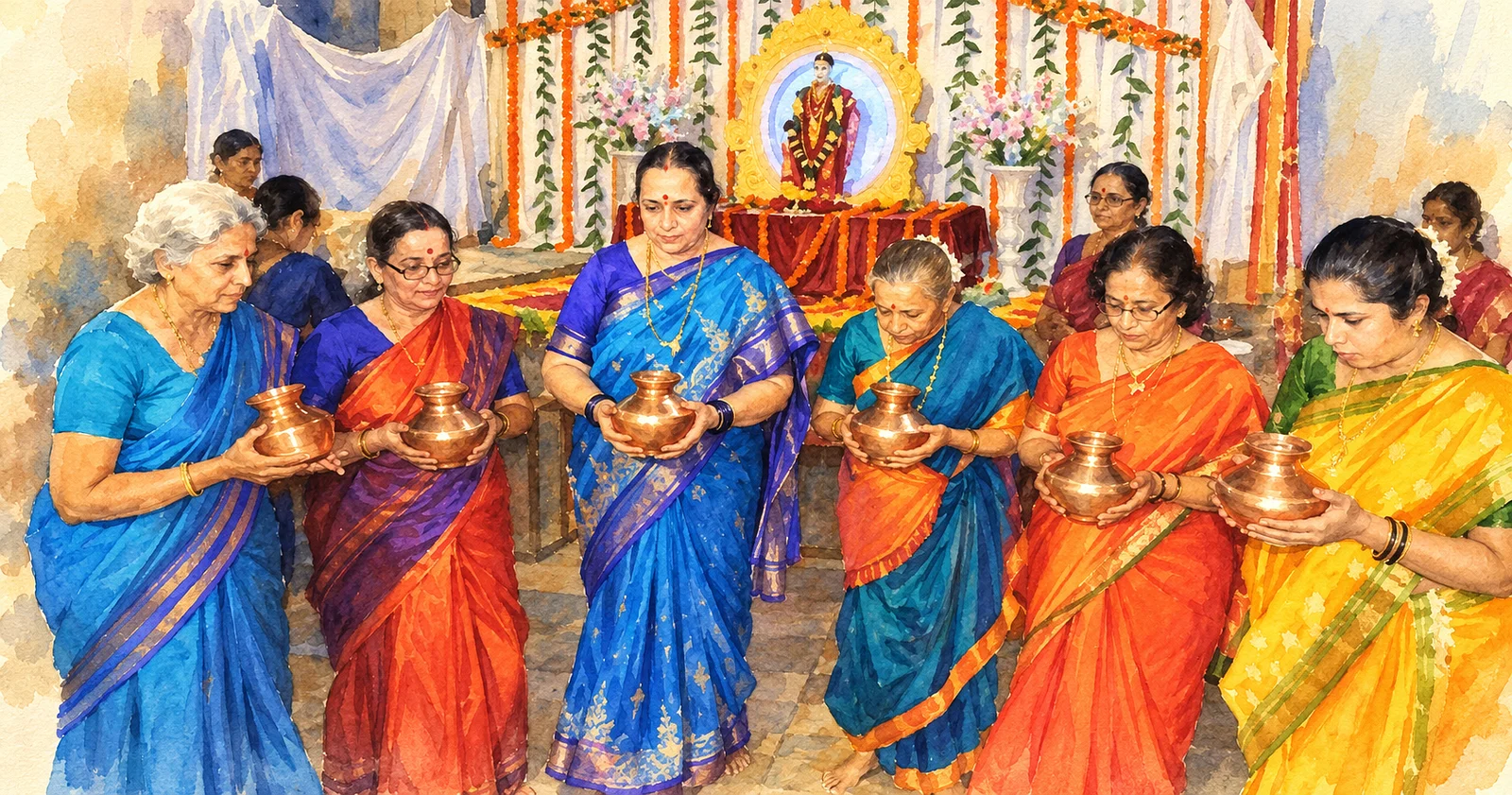
Behind closed doors, in the afternoon, the men of the family reverently shape a face from rice flour. By evening, this will become the face of Mahālakṣmī, the Goddess that everyone will gather before in worship. A sārī, ornaments, and a decorated canopy complete the preparations. Later in the night comes one of the most distinctive parts of our Koṅkaṇ Aṣṭamī celebration: ghāgarī phuṅkaṇe, literally meaning blowing into pots. To someone encountering it for the first time, this may seem unusual. For those of us who practice this at home, it belongs to the familiar rhythm of Navarātra, carrying the fond nostalgia and reverence of a tradition passed down through generations.

Aṣṭamī holds a special place in the Navarātra observances of many Koṅkaṇastha Brāhmaṇa families. Rooted in the coastal region of Mahārāṣṭra, this worship of Mahālakṣmī takes place on Āśvina Śukla Aṣṭamī, the eighth lunar day of the month’s bright fortnight. The day brings together a vrata observed by newly married women, the preparation of the goddess’s image, and collective worship that continues into the night. The nuances differ according to kulācāra, the inherited practice of each family. Even within the same region, these variations are carefully remembered and passed on.

In our tradition, the morning pūjā is performed by newly married saubhāgyavatīs, married women honoured in the ritual as bearers of marital auspiciousness, during the first five years of marriage. They worship a small idol, or some worship the khaḍe, or pebbles, and the doraka, a sacred knotted thread, which are later offered before Mahālakṣmī during the evening worship. These first years also become a period of learning for new brides: how the offerings are arranged, how the thread is prepared, and how the sequence of worship unfolds. Through participation alongside women who have observed the vrata for years, the new bride gradually becomes familiar with the family’s way of performing it.

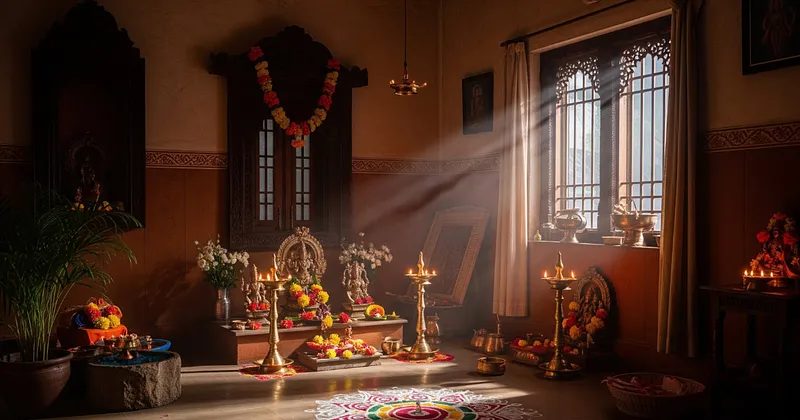
The Mahālakṣmī vrata is understood as a kāmya vrata, an observance undertaken with a particular prayer or aspiration, including the well-being and prosperity of the household. Its ritual description includes drawing a representation of Devī Lakṣmī with sandalwood paste and placing a doraka beside it, made of sixteen strands tied with sixteen knots. The goddess is worshipped through ṣoḍaśopacāra pūjā, sixteen forms of ritual service and hospitality. Sixteen kinds of patrī and flowers are offered, sixteen ghārge, traditional sweet fried cakes, are prepared as naivedya, and sixteen lamps fashioned from flour are used for the āratī. The doraka is worshipped and tied around the left wrist of new brides. Holding sixteen blades of dūrvā grass and sixteen akṣatā, unbroken rice grains used in worship, the devotee listens to the Mahālakṣmī kathā. The repeated presence of sixteen gives the observance a recognisable pattern, held in memory through the gathering, counting, and offering of these materials.
By afternoon, preparations begin for the evening image of Mahālakṣmī. In our family tradition, the face is mainly made by the men of the household, in a closed room and with careful observance of sovaḷe, the customary discipline of ritual purity. Rice flour is cooked into ukaḍ, a soft dough, and shaped into the goddess’s face. Her features are marked with kājaḷ and kuṅkuma. This work requires patience and a practised hand; familiarity with the form is carried forward by watching and learning from those who have made it before. Rice, so closely associated with the fields and kitchens of the coastal region, becomes the material through which Mahālakṣmī is given a visible presence in the home.
The completed face is secured above an utaraṇḍ, an arrangement of stacked vessels, beneath a decorated canopy. The structure is draped in a rich sārī, and specially prepared cloth arms are attached to complete the standing image. Ornaments and the other customary adornments are added with care. The making of the image draws different members of the family into the preparations: the men shape the face, while the vrata and much of the collective worship centre on the women. Together, these responsibilities make the day a shared undertaking, with each person contributing to the welcome offered to the goddess.
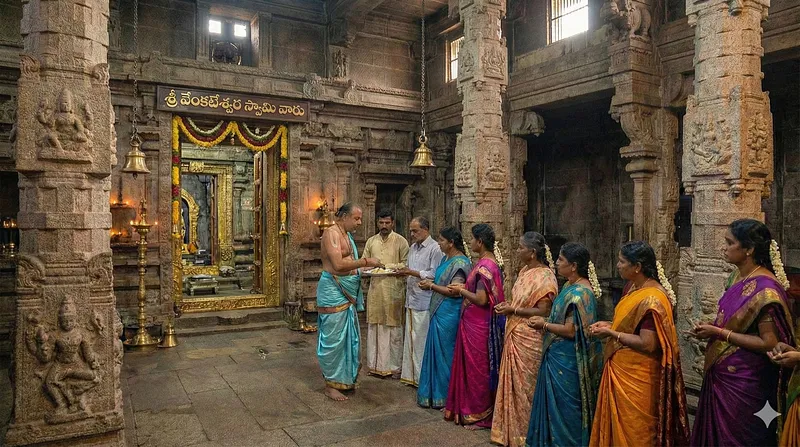
As evening approaches, everyone gathers for the pūjā. In our practice, gomūtra, cow urine used for ritual purification, is sprinkled on those entering the worship space. At pradoṣa, the twilight period, Mahālakṣmī is worshipped in her newly prepared form. The women who performed the morning vrata bring the pebbles and doraka before her and perform oṭī bharaṇe, the customary offering associated with auspiciousness, abundance, and family well-being. As in Maṅgaḷāgaurī Pūjā, women come together to participate in the observance. The prescribed rituals unfold within the warmth of a familiar gathering, where the younger participants receive guidance, and those with experience help carry the worship forward.
After the āratī, attention turns to ghāgarī phuṅkaṇe. A ghāgar, a rounded water pot, is exposed to fragrant dhūpa, traditionally including the resinous incense called ūd. Women then blow into the pots before the goddess, following the manner customary to the household. The sound of the pots, the fragrance of incense, and the movements of the women become part of the night’s devotional expression. For us, the practice is closely associated with the atmosphere of Aṣṭamī itself: the gathering before Mahālakṣmī, the absorption in her worship, and the sense of participating in a legacy received from earlier generations.

During this worship, some women may experience what is called aṅgāt yeṇe in Marathi. Within the tradition, this is understood as the presence of the Devī manifesting through the devotee, a state of spiritual absorption or trance approached with reverence. It is not something experienced by every participant, nor does it need to be made into a spectacle. For families familiar with the practice, it belongs to a devotional world in which the relationship with the goddess may be deeply felt and expressed through the body as well as through prayer. The experience is held within the collective worship of the evening and the community’s faith in Mahālakṣmī.
What stays with us is how much of a region can be held within a single day’s observance. The rice flour, the patrī, the knotted thread, the flour lamps, and the ghāgar all acquire a place in worship. Preparing them calls upon skills and knowledge that remain alive because they are used: someone remembers how to shape the face, someone knows the sequence of the vrata, and someone guides the women observing it for the first time. The annual return of Aṣṭamī gives this knowledge another occasion to be practised, shared, and made familiar to the next generation.
Even when families move far from the Koṅkaṇ, these customs can keep the region present in their homes. Its materials, language, and devotional practices travel with them, finding continuity in new places. Perhaps this is how culture grows through traditions rooted in a region: through the care people give to particular practices and the willingness to bring others into them. Each year, as we prepare Mahālakṣmī’s face and gather before her, we renew our relationship with the Divine Mother, with one another, and with the place that has shaped our way of welcoming her.