In the vast corpus of Bhāratīya political literature, few concepts are as fundamental to righteous governance as vinaya—a term that encompasses humility, self-discipline, and inner restraint. The Kāmandaka Nītisāra, one of the most important texts in the tradition of rājadharma (royal duty), presents a profound understanding of how true leadership emerges not from raw power or political cunning alone, but from the cultivation of this essential virtue.
The Paradox of Power and Humility
इयं हि लोकव्यतिरेकवर्त्तिनी स्वभावतः पार्थिवता समुद्धता ।बलात् तदेनां विनयेन योजयेन्नयस्य वृद्धौ विनयः पुरस्सरः ॥ ६७ ॥
The ancient text presents us with a striking paradox: kingship, by its very nature, tends toward arrogance and separation from ordinary life. As verse 67 observes, pārthivatā (kingship) is inherently proud and elevated (svabhāvataḥ samuddhatā), existing apart from the common way of life (lokavyatireka-vartinī). This natural tendency toward pride makes rulers particularly susceptible to the corruption of unchecked power.
Yet it is precisely this inherent arrogance that must be "forcefully restrained and directed through vinaya," because "for the growth of naya (ethical governance), vinaya must come first." This insight reveals a sophisticated understanding of political psychology: effective policy and governance cannot emerge from an undisciplined mind, no matter how clever or strategically minded the ruler may be.
Vinaya as Royal Ornament
परां विनीतः समुपैति सेव्यतां महीपतीनां विनयो विभूषणम् ।प्रवृत्तदानो मृदुसञ्चरत्करः करीव भद्रो विनयेन शोभते ॥ ६८ ॥
Perhaps nowhere is the transformative power of humility more beautifully expressed than in verse 68, which declares that "for rulers, humility is the finest ornament" (mahīpatīnāṃ vinayo vibhūṣaṇam). This is not merely poetic language but a profound political insight. Unlike material ornaments that can be worn or removed, vinaya is described as an essential and natural quality (akṛtrimam) that beautifies a ruler from within.
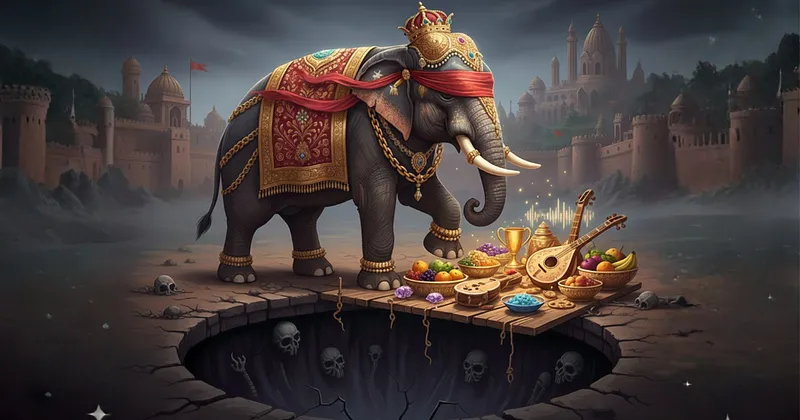
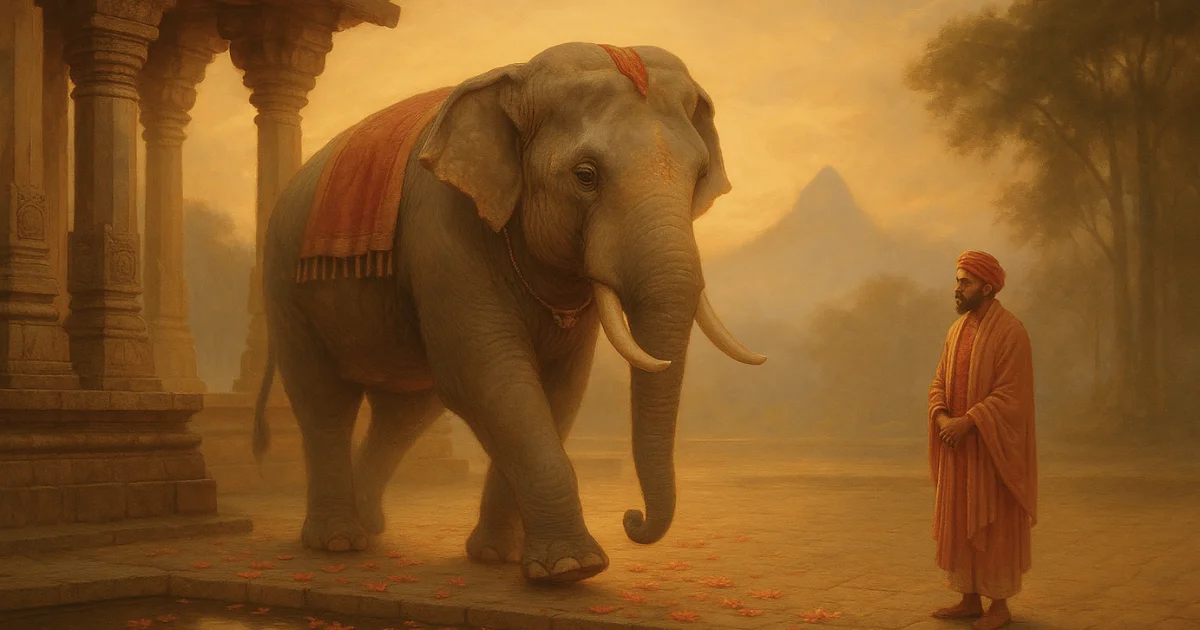
The text employs the metaphor of a noble elephant to illustrate this principle: just as a well-trained elephant moves with gentle steps despite its great power, a truly great king exercises authority with restraint and compassion. Such a ruler is "generous in giving and gentle in collection"—providing for his subjects while collecting taxes with sensitivity and proportion, never through harsh exploitation.
The Epistemology of Wisdom
गुरुस्तु विद्याधिगमाय सेव्यते श्रुता च विद्या मतये महात्मनाम् । श्रुतानुवर्त्तीनि मतानि वेधसामसंशयं साधु भवन्ति भूतये ॥ ६९ ॥
The Nītisāra's treatment of vinaya is deeply connected to its understanding of how true knowledge is acquired and applied. Verse 69 establishes a clear hierarchy: a teacher (guru) must be served for the attainment of knowledge (vidyā), and from scriptural learning (śruti), understanding arises. The doctrines of the wise, when rooted in traditional wisdom and faithful transmission, are "undoubtedly wholesome and lead to welfare."
This epistemological foundation is crucial for understanding why vinaya is so essential. True leadership requires not just information or intelligence, but wisdom—and wisdom can only be acquired through the humble reception of teaching. A proud ruler, convinced of his own superiority, becomes unteachable and therefore unfit to govern wisely.
The Dual Fruit of Disciplined Learning
सुनिपुणमुपसेव्य सद्गुरुं शुचिरनुवृत्तिपरो विभूतये |भवति हि विनयोपसंहितो नृपतिपदाय शमाय च क्षमः ॥ ७०॥
One of the most remarkable insights in these verses is the recognition that proper education under a worthy teacher produces a dual outcome: fitness for both kingship (nṛpati-pada) and inner tranquility (śama). This challenges the modern assumption that worldly power and spiritual development are necessarily in tension.
The text suggests that both outer authority and inner peace stem from the same source: disciplined learning under the guidance of a worthy teacher. A student who sincerely reveres a wise and pure guru becomes endowed with vinaya, which serves as the seed of both effective governance and spiritual composure. This synthesis represents one of the highest ideals of Indian political thought—the philosopher-king who rules not from ego but from wisdom.
The Ultimate Test: Strength Through Apparent Weakness
अविनयरतमादरादृते वशमवशं हि नयन्ति विद्विषः ।श्रुतविनयनिधिं समाश्रितस्तनुरपि नैति पराभवं क्वचित् ॥ ७१ ॥
The final verses present perhaps the most counterintuitive teaching about leadership: that true strength lies not in raw power but in character. Verse 71 starkly contrasts two types of rulers. The undisciplined king, lacking humility and reverence, "is easily overpowered by enemies" despite apparent strength. Meanwhile, one who embraces "the treasure of śruti and vinaya—even if weak or with few resources—never suffers defeat."
This principle finds its validation in the text's assertion that material weakness combined with scriptural wisdom and self-discipline creates a kind of invincibility. Such a leader possesses the "strength of indriya-jaya (self-mastery) and śāstra-niścaya (clarity of purpose)"—making them essentially undefeatable regardless of external circumstances.
Relevance for Contemporary Leadership
The insights of the Kāmandaka Nītisāra remain startlingly relevant for modern leadership challenges. In an era where political discourse often celebrates assertion over reflection, these ancient teachings offer a different paradigm:
- Humility as Strength: Rather than seeing humility as weakness, the text presents it as the foundation of all effective action. Leaders who can acknowledge their limitations and learn from others are far more likely to make wise decisions than those who rely solely on their own judgment.
- Character Before Strategy: While political strategy (naya) is important, it must be grounded in character (vinaya). Clever tactics without an ethical foundation ultimately prove self-defeating.
- Sustainable Authority: True authority derives not from force or manipulation but from the respect that naturally flows toward those who combine competence with humility. Such leaders achieve what the text calls parām sevyatām—supreme reverence freely offered.
- Integrated Development: The ideal leader develops both outer competence and inner composure. This integration prevents the common pathology of power that corrupts character while also avoiding the opposite extreme of spiritual development that remains disconnected from worldly effectiveness.
Conclusion: The Timeless Wisdom of Restraint
The Kāmandaka Nītisāra's treatment of vinaya offers more than historical insight—it provides a blueprint for leadership that is both effective and ethical. In recognizing that kingship naturally tends toward pride and separation, the text does not condemn political power but rather provides the antidote: deliberate cultivation of humility, continuous learning, and service to something greater than oneself.
The king who reaches the "radiant summit of Mount Meru" in terms of achievement does so not by abandoning restraint but by embracing it fully. Like the noble elephant that moves with gentle power, such leaders demonstrate that true strength lies not in the capacity to dominate but in the wisdom to serve—both the higher principles of dharma and the genuine welfare of those they govern.
In our contemporary context, where leadership failures often stem from precisely the pride and separation that the ancient text identifies, these teachings offer a profound alternative: leadership as service, power as responsibility, and greatness as the natural flowering of humility and wisdom combined.