.png)
Returning to First Principles in an Age of Economic Crisis
We live in an era of profound economic paradox. Global wealth has reached unprecedented levels, yet inequality yawns wider than ever. Technological advancement promises abundance, yet ecological collapse looms. Financial markets soar while farmers despair. We produce more than any civilization in history, yet millions lack basic sustenance, and even the prosperous suffer from a gnawing sense of insecurity and meaninglessness in their economic lives.
This paradox signals not merely a crisis of distribution or policy, but something more fundamental—a crisis of conception. The very idea of wealth, as understood and pursued in contemporary economic discourse, appears increasingly disconnected from human flourishing and planetary survival. Wealth has become abstract, financialized, divorced from productive activity and ecological limits. Its accumulation has become an end in itself, severed from considerations of sufficiency, purpose, or virtue. The result is an economic order that generates statistical growth while eroding the actual foundations of prosperity: healthy ecosystems, cohesive communities, meaningful work, and peace of mind.
In such times, revisiting first principles becomes not an academic exercise but an existential necessity. What is wealth, truly? What are its legitimate sources? How does it relate to human well-being, social stability, and ethical living? What economic activities genuinely create value, and which merely extract or redistribute it? How can prosperity be sustained across generations without exhausting the natural and social capital upon which it depends?
These questions cannot be adequately answered within the conceptual frameworks that produced our current predicament. Neoclassical economics, with its assumptions of infinite growth, rational actors, and externalized ecological costs, offers sophisticated models of a fundamentally unsustainable vision. Even well-intentioned modifications—sustainable development goals, ESG frameworks, circular economy models—often remain trapped within the same basic paradigm, seeking to reform rather than reimagine.
This is precisely where returning to alternative civilizational perspectives on wealth becomes invaluable. The Indic intellectual tradition offers not a romanticized past to be nostalgically resurrected, but a sophisticated philosophical and practical framework developed over millennia of reflection on the relationship between economic activity, human purpose, and cosmic order. This tradition conceived of wealth (artha) as one of the four legitimate human pursuits (puruṣārthas), neither to be rejected as spiritually corrupting nor pursued without ethical constraint, but integrated within a holistic vision of human flourishing.
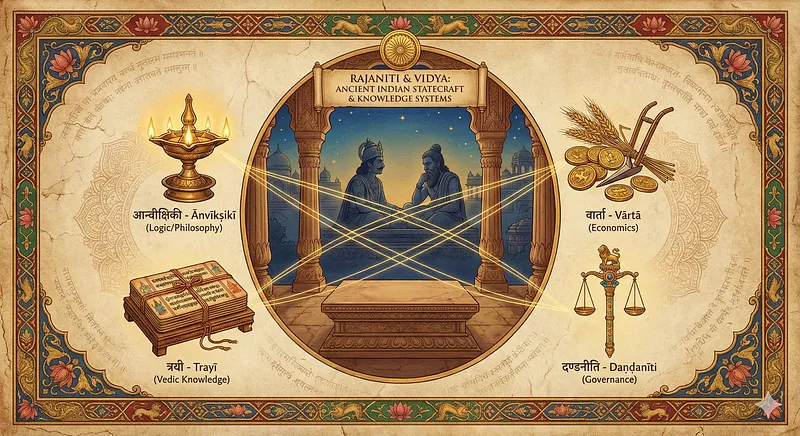
At the heart of this tradition lies the concept of vārtā—a term that encompasses economic livelihood but transcends our modern notion of "economics." Vārtā doesn't merely describe how goods are produced, distributed, and consumed; it articulates how life itself moves, functions, and sustains itself through productive activity. It grounds wealth in tangible practices—the care of animals, the cultivation of soil, the exchange of goods—rather than abstract financial mechanisms. It embeds economic competence within broader frameworks of knowledge, ethics, and ecological wisdom.
The significance of revisiting these first principles extends beyond historical interest. As contemporary society grapples with climate emergency, the automation of labor, the financialization of everything from housing to education, and the growing disconnect between GDP growth and genuine well-being, the Indic conception of vārtā offers crucial correctives:
It insists that wealth must be grounded in productive activities that sustain life rather than speculative transactions that merely shuffle existing value. It recognizes economic activity as embedded within natural cycles and ecological limits rather than exempt from them. It views economic competence not as opposed to ethical living but as integral to it. It emphasizes sufficiency and security over unlimited accumulation. And it situates economic knowledge within comprehensive systems of understanding that integrate technical skill with philosophical wisdom.
These are not primitive ideas awaiting modernization, but sophisticated concepts that modernity may have prematurely abandoned. In what follows, we will explore one particularly rich articulation of this vision: a verse from the Kāmandaka Nītisāra, a classical Saṃskṛta text on statecraft, which defines vārtā through its three foundational pillars and elaborates their relationship to virtuous living and social stability. Through careful examination of both the verse and its classical commentaries, we will discover a framework for understanding commerce and trade not as necessary evils or value-neutral mechanisms, but as potentially dhārmika activities that, when properly grounded, enable sustainable human flourishing.
In an age when economic growth threatens ecological survival, when wealth concentration undermines social cohesion, and when financial abstraction obscures the real foundations of prosperity, perhaps the time has come to ask: What would it mean to rebuild economic life on these first principles? What if we took seriously the ancient insight that vārtā—properly understood and practiced—is life itself?
The Foundational Verse
In the Kāmandaka Nītisāra (2.14), we find a profound articulation of economic philosophy that remains remarkably relevant today:
Saṃskṛta (Devanāgarī):
पाशुपाल्यं कृषिः पण्यं वार्ता वार्ता तु जीवनम् । सम्पन्नो वार्तया साधु नावृत्तेर्भयमृच्छति ॥ १४ ॥
Transliteration (IAST):
pāśupālyaṃ kṛṣiḥ paṇyaṃ vārtā vārtā tu jīvanam | sampanno vārtayā sādhu nāvṛtterbhayamṛcchati || 14 ||
Translation: Animal husbandry, agriculture, and trade—these three constitute vārtā (economic livelihood). Vārtā is life itself. One who is well-established in vārtā lives virtuously and does not suffer from the fear of deprivation or lack of sustenance.
Unpacking the Concept of Vārtā
The term vārtā derives from the Saṃskṛta root-vṛt, meaning "to turn, move, proceed, or exist." This etymological foundation is significant: economic activity is not viewed as a static accumulation of wealth but as a dynamic process that keeps the wheels of society turning. The classical commentaries emphasize this point—the world vartate (moves, functions, lives) through these economic practices, hence they are collectively termed vārtā.
This verse identifies three foundational pillars of economic life:
1. Pāśupālya: The Science of Animal Husbandry
Pāśupālyaṃ encompasses the comprehensive care, breeding, nourishment, and medical treatment of livestock—particularly cattle, horses, elephants, and buffaloes. The Jayamaṅgalā commentary references specialized śāstric traditions that elevated animal husbandry to a rigorous discipline, including works attributed to sages like Gautama and Śālihotra (whose veterinary texts on horses remain legendary), as well as the Hastiśikṣā (elephant training treatises).
This wasn't merely utilitarian animal exploitation but a holistic science grounded in detailed observation, ethical treatment, and sustainable management. Animals were viewed as partners in economic production, deserving specialized knowledge and compassionate care—a perspective that resonates with contemporary concerns about ethical farming and animal welfare.
2. Kṛṣi: The Foundation of Agriculture
Kṛṣi refers to agricultural practice, encompassing ploughing, sowing, cultivation, and harvesting. The commentaries cite texts like those attributed to Sage Parāśara, which provided systematic agricultural knowledge adapted to seasonal cycles, soil types, and ecological conditions.
Agriculture occupies a central position in this economic triad because it directly sustains life. The Indic tradition recognized farming not merely as resource extraction but as a sacred collaboration with natural forces—the soil, rain, seasons, and cosmic rhythms. This understanding embedded sustainability into the very conception of agricultural practice.
3. Paṇya/Vāṇijya: The Domain of Trade and Commerce
Paṇya refers to commodities that are priced and exchanged, while vāṇijya denotes the systematic practice of trade and commerce—the buying and selling (kraya-vikraya) of goods. The Upādhyāya-nirapekṣā commentary emphasizes that this too was a specialized discipline, with treatises attributed to sages and learned kings like those of Videha.
What's particularly striking is that commerce is placed on equal footing with agriculture and animal husbandry, not subordinated or viewed with suspicion. Trade is recognized as an essential mechanism for distributing resources, creating value, and enabling specialization—a sophisticated economic understanding that acknowledges the interconnectedness of production and exchange.
Vārtā as Jīvana: Economics as Life Itself
The verse makes an audacious claim: "vārtā tu jīvanam"—vārtā is life itself. This is not hyperbole but a profound philosophical statement. Economic activity isn't separate from life or merely instrumental to it; rather, it constitutes the very fabric of social existence and human flourishing.
This perspective challenges both ancient and modern dichotomies that separate "spiritual" from "material" or "ethical" from "economic." In the Indic framework, economic competence is interwoven with dhārmika living. The commentaries consistently emphasize that these three practices are supported by śāstric traditions—systematic bodies of knowledge that were simultaneously technical, ethical, and philosophical.
The Virtuous Circle: Prosperity, Virtue, and Fearlessness
The second half of the verse introduces a crucial connection: "sampanno vārtayā sādhu nāvṛtterbhayamṛcchati"—one well-established in vārtā becomes sādhu and lives without fear of avṛtti.
The term sādhu carries dual significance. It means both "competent/prosperous" and "virtuous/morally upright." This linguistic fusion is revealing: in the Indic worldview, economic competence and ethical living are not opposed but mutually reinforcing. A person grounded in sustainable economic practices naturally embodies virtue because such practices require discipline, foresight, care for resources, and consideration of interdependence.
Avṛtti—literally "non-turning" or cessation—refers to economic collapse, loss of livelihood, or the breakdown of sustaining activity. The commentaries interpret this as the fear of want, destitution, or failure in economic life. The verse promises freedom from this fear through mastery of vārtā.
This is not a promise of unlimited wealth or freedom from all uncertainty, but rather a vision of sustainable sufficiency. When individuals and communities are grounded in productive economic knowledge—caring for animals, cultivating land, engaging in fair trade—they achieve resilience and self-reliance. This economic foundation enables fearless living (abhaya), which in turn creates the conditions for pursuing higher human values.
The Indic Ideal of Sustainable Flourishment
What emerges from this verse and its commentaries is a distinctive Indic approach to economic life that we might call "sustainable flourishment"—a vision quite different from both ascetic rejection of wealth and unlimited accumulation.
Key features of this approach include:
Holistic Integration: Economic activity is integrated with ethical, ecological, and social considerations. The śāstric traditions supporting pāśupālyaṃ, kṛṣi, and paṇya combine technical knowledge with dhārmika principles.
Productive Foundation: Wealth creation is grounded in productive activities—animal care, agriculture, and trade—rather than extractive or speculative mechanisms. These activities create genuine value and sustain life.
Knowledge Systems: Each domain of vārtā is supported by specialized knowledge traditions, elevating economic practice to a science. This emphasis on systematic learning and transmission of expertise suggests a culture that valued economic competence as worthy of serious intellectual engagement.
Sufficiency and Security: The goal is not endless accumulation but achieving a state of sampanna—being well-endowed or complete—which provides security (abhaya) and enables virtuous living. This suggests an economics of sufficiency rather than infinite growth.
Interdependence: The three pillars of vārtā are interconnected—agriculture needs animals, trade distributes agricultural produce, and animal products enter commerce. This recognition of interdependence discourages narrow specialization divorced from broader ecological and social contexts.
Ethical Economics: The designation of the economically competent person as sādhu (virtuous) suggests that economic success, when rooted in these three foundational practices, naturally aligns with ethical living. Exploitation, fraud, or environmental degradation would violate the knowledge systems underlying genuine vārtā.
Commerce and Trade in the Vārtā Framework
The inclusion of paṇya (commerce) as one of the three foundational pillars deserves particular attention, for it reveals a nuanced understanding of trade's role in sustainable prosperity. Unlike perspectives that view commerce with suspicion as inherently exploitative or morally corrupting, the Kāmandaka Nītisāra recognizes it as essential to economic life—but within a specific framework.
Trade, in this conception, is not autonomous or abstract but intimately connected to production. It exists to facilitate the exchange of goods produced through pāśupālyaṃ and kṛṣi, distributing the fruits of productive labor across space and time. The merchant (vaṇik) is not a speculator but a specialist in exchange, possessing knowledge of markets, values, seasons, and routes—knowledge codified in treatises just as agricultural and veterinary knowledge was systematized.
This framework suggests several principles for understanding commerce within the ideal of sustainable flourishment:
Trade as Service: Commerce serves production and consumption rather than existing for its own sake. The merchant facilitates the meeting of genuine needs, connecting surplus with scarcity, enabling specialization while maintaining interdependence.
Knowledge-Based Practice: Like animal husbandry and agriculture, commerce requires specialized knowledge—understanding of goods, fair pricing, market dynamics, and ethical exchange. This elevates trading from a mere transaction to a disciplined practice.
Embedded Ethics: The commentaries' emphasis on śāstric foundations suggests that commerce, properly practiced, operates within ethical constraints. Fair dealing, honest weights, appropriate pricing, and consideration of social impact are not external regulations but intrinsic to the knowledge system itself.
Wealth Circulation: The term vārtā (from the root-vṛt, to turn) implies circulation rather than accumulation. Commerce keeps wealth moving, preventing stagnation, enabling the "turning" that sustains social and economic life.
Real Value Exchange: By grounding commerce in the exchange of actual goods (paṇya—things that have been priced), the framework implicitly distinguishes productive trade from purely financial speculation divorced from tangible value.
Contemporary Relevance
In an era grappling with climate change, economic inequality, financial instability, and the quest for sustainable development, the Kāmandaka Nītisāra's vision offers valuable perspectives:
The emphasis on productive economic activities—especially agriculture and animal husbandry grounded in ecological wisdom—resonates with contemporary movements toward organic farming, permaculture, regenerative agriculture, and ethical food systems.
The integration of commerce with production, rather than treating finance as an autonomous realm, suggests the importance of grounding economic activity in real value creation rather than pure speculation. This speaks to current concerns about financialization, where economic returns increasingly derive from financial manipulation rather than productive investment.
The concept of avṛtti—economic collapse or failure of livelihood—is tragically relevant in contexts of farmer distress, unemployment, and economic precarity. The verse's emphasis on knowledge systems and sustainable practices points toward solutions rooted in skill development, ecological restoration, and local economic resilience rather than mere financial redistribution.
The equation of economic competence with virtue (sādhu) challenges purely materialistic measures of success while also rejecting the notion that poverty is spiritually superior. It suggests that sustainable prosperity, grounded in productive knowledge and ethical practice, is itself a form of dharma.
The recognition that vārtā is "life itself" counters the modern tendency to view economic activity as a separate domain governed by its own amoral logic. It insists that how we produce, exchange, and consume is inseparable from how we live, what we value, and who we become.
Conclusion
The Kāmandaka Nītisāra's articulation of vārtā presents commerce and economic life not as necessary evils or purely material concerns but as foundational to human flourishing. By grounding economic activity in three productive pillars—animal husbandry, agriculture, and trade—and by emphasizing the knowledge systems supporting them, this classical text offers a vision of sustainable prosperity that is simultaneously practical, ethical, and ecological.
Vārtā is life itself, the verse declares. In recognizing this truth and cultivating economic practices rooted in productive knowledge, interdependence, and sufficiency, individuals and societies achieve not merely wealth but abhaya—fearlessness, security, and the freedom to live virtuously. This remains, perhaps, the most complete definition of sustainable development: an economic order that enables not just survival but flourishing, not just material success but virtuous living, not just individual prosperity but collective well-being.
In returning to these classical insights, we may find not obsolete doctrine but timeless wisdom for reimagining commerce and trade as instruments of genuine human flourishing—vārtā as it was always meant to be. The crisis of our age is not merely technical or political but conceptual, requiring us to fundamentally rethink what wealth means and what economic life is for. The Indic tradition's answer—that true prosperity lies in productive knowledge, ethical practice, ecological embeddedness, and the sufficiency that brings fearlessness—may prove not a retreat to the past but a pathway toward a viable future.