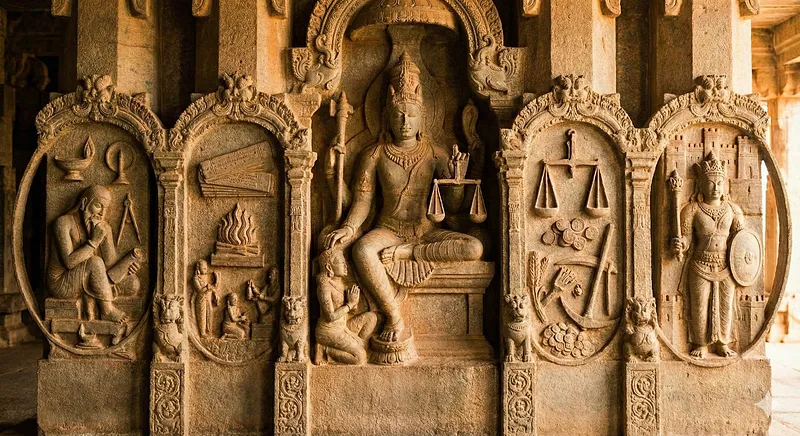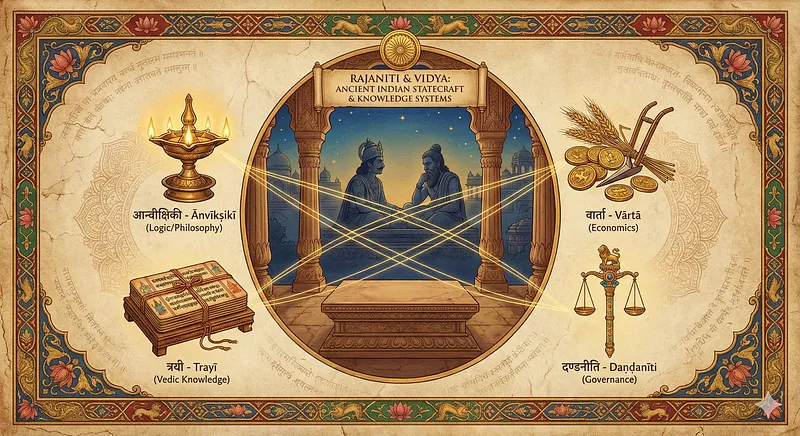
In an age where leadership scandals dominate headlines and public trust in institutions wavers, ancient Bhāratīya texts offer profound wisdom on ethical governance. The Kāmandaka Nītisāra, a classical treatise on statecraft and political ethics, presents four interconnected verses that outline a comprehensive framework for righteous leadership—principles as relevant today as they were centuries ago.
The Foundation: Seeking Wisdom from Elders
वृद्धोपसेवी नृपतिः सतां भवति सम्मतः ।प्रेर्यमाणोऽप्यसद्वृन्तैर्नाकार्येषु प्रवर्तते ॥ ६३ ॥
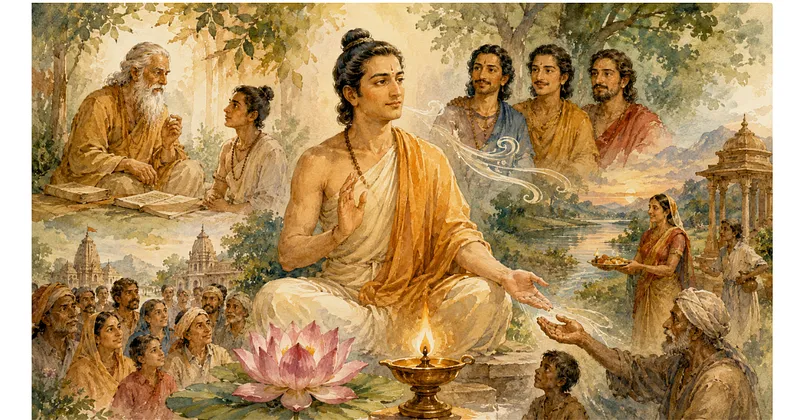
The journey toward exemplary leadership begins with humility and the recognition that wisdom comes through learning from those who have walked the path before us. The first principle emphasizes that a king who serves the wise elders earns the respect of the virtuous. The Saṃskṛta term vṛddhopasevī does not merely suggest casual consultation, but denotes a deep, reverent engagement with those who are rich in vidyā (scriptural knowledge) and life experience.
This elder-seeking approach serves a dual purpose. First, it builds moral clarity and public legitimacy—when leaders consistently learn from the wise, they develop an internal compass that guides their decisions. Second, and perhaps more crucially, such grounding provides immunity to corruption. The text notes that even when pressured by corrupt associates (asadvṛttaiḥ), a leader rooted in wisdom "does not engage in unrighteous acts."
The practical implications are striking. In our contemporary context, this translates to leaders who actively seek mentorship, maintain advisory councils of proven integrity, and resist the echo chambers that often surround positions of power. The verse suggests that good counsel, not merely good intentions, shapes moral governance.
The Discipline: Continuous Learning and Growth
आददानः प्रतिदिनं कलाः सम्यङ् महीपतिः ।शुक्लपक्षे प्रविचरन् शशाङ्क इव वर्द्धते ॥ ६४ ॥
Building upon this foundation of wise counsel, the second principle advocates for lifelong learning. A king who diligently acquires various kalās (arts and disciplines) every day grows steadily, just like the moon waxes in the bright fortnight.
The concept of kalās encompasses far more than mere academic knowledge. The 64 traditional arts include music, warfare, diplomacy, administration, languages, and numerous other disciplines that contribute to well-rounded leadership. The emphasis on pratidinaṃ (daily practice) underscores that this is not occasional self-improvement but disciplined, consistent growth.
The lunar metaphor is particularly elegant. Just as the moon grows in brilliance each night during śuklapakṣa (the bright fortnight), moving from new moon to full moon, a leader's wisdom, grace, and effectiveness expand through continuous learning. This growth is gradual but certain, provided it is guided by consistency and sincerity.
In modern terms, this principle champions the concept of adaptive leadership—leaders who remain students throughout their careers, constantly updating their knowledge, refining their skills, and expanding their understanding of the complex challenges they face.
The Prerequisite: Self-Mastery
जितेन्द्रियस्य नृपतेर्नीतिमार्गानुसारिणः ।भवन्ति ज्वलिता लक्ष्म्यः कीर्त्तयश्च नभःस्पृशः ॥ ६५ ॥
The third verse introduces perhaps the most challenging aspect of ethical leadership: For a king who has conquered his senses and walks the path of nīti (righteous policy and ethics), blazing fortunes and sky-reaching fame arise.
The term jitendriyaḥ (one who has conquered the senses) points to self-control as the foundation of all other virtues. The commentaries clarify that only a self-controlled leader can meaningfully associate with the wise, acquire knowledge, and pursue ethical governance. Without this inner discipline (vinaya), external policies and procedures become mere facades.
The concept of nīti encompasses both scriptural statecraft and applied ethics. It is not enough to know what is right; a leader must consistently practice righteous policies. The text emphasizes that nīti must be followed sincerely and consistently—not selectively or superficially.
The rewards described—jvalitā lakṣmyaḥ (radiant prosperities) and kīrti-yaśas nabhaḥ-spṛśaḥ (sky-reaching fame)—suggest that ethical leadership ultimately attracts both material success and lasting reputation. The commentaries expand on this, noting various forms of prosperity: material wealth (vibhava-śrī), valor (vīra-śrī), beauty (rūpa-śrī), and righteousness (dharma-śrī).
The Summit: Divine-Like Authority
इति स्म राजा विनयं नयान्वितो निषेवमाणो नरदेवसेवितम् ।पदं समाक्रामति भास्वरं श्रियः शिरो महारत्नगिरेरिवोन्नतम् ॥ ६६ ॥
The final verse serves as both culmination and vision: Thus, a king, practicing humility and guided by policy, ascends to that radiant position of prosperity, revered by noble kings—a station as lofty as the peak of the jewel-studded mountain.
This verse ties together all preceding elements: self-mastery (vinaya), wise counsel (naya-anvitaḥ), and consistent practice (niṣevamāṇaḥ). The destination described is not merely worldly success but a position of divine-like authority—padam śriyaḥ naradeva-sevitam—a station revered by other great rulers throughout history.
The imagery of Mount Meru's summit is particularly powerful. In Bhāratīya cosmology, Meru represents the center of the universe, the abode of the gods. A leader who follows this path does not merely maintain order but ascends to the highest plane of royal excellence, where outer grandeur reflects inner virtue.
Timeless Relevance for Modern Leadership
These ancient principles offer a coherent philosophy of leadership that addresses contemporary challenges:
- Accountability through Mentorship: In an era of isolated decision-making, the emphasis on serving elders reminds leaders to seek diverse perspectives and remain accountable to wisdom traditions.
- Adaptive Competence: The focus on continuous learning addresses the rapid pace of change in modern organizations and societies, highlighting that leadership requires constant skill development.
- Ethical Resilience: The emphasis on self-mastery provides a framework for ethical decision-making under pressure, when expedient choices may seem attractive.
- Sustainable Success: The integration of inner development with outer effectiveness suggests that lasting leadership success requires alignment between personal values and public actions.
Conclusion: The Sacred Duty of Leadership
Kāmandaka's verses present leadership not as a privilege to be enjoyed but as a sacred duty (rājadharma) to be fulfilled. They suggest that true greatness comes not from conquest alone but from the harder victories over one's own limitations and the consistent pursuit of righteousness.
In our complex modern world, these principles offer a path toward leadership that serves not just immediate stakeholders but contributes to the larger good. They remind us that the highest forms of authority are earned through service, learning, self-discipline, and ethical practice—qualities that remain as relevant today as they were in ancient India.
The ultimate message is both challenging and inspiring: leaders who commit to this path of continuous growth and ethical practice do not merely achieve success—they create legacies that inspire future generations, their names reaching, as the text beautifully puts it, "sky-touching heights of fame."