Introduction
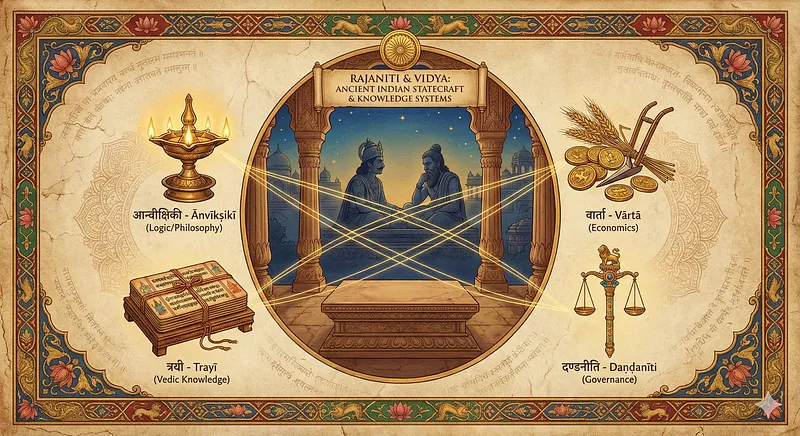
The ancient Indian tradition of knowledge transmission was remarkably comprehensive, encompassing not merely religious texts but an entire ecosystem of learning that addressed every aspect of human existence. Two profound verses from the Kāmaṇḍaka Nītisāra (2.12–2.13), a classical treatise on statecraft and ethics, illuminate this holistic understanding of vaidika knowledge through the concept of Trayī.
The Three Vedas as Foundation
Kāmaṇḍaka Nītisāra 2.12
Sanskrit (Devanagari):
ऋग्यजुःसामनामानस्त्रयो वेदास्त्रयी स्मृता । उभौ लोकाववाप्नोति त्रय्यां तिष्ठन् यथाविधि ॥ १२ ॥
ṛgyajuḥsāmanāmānastrayo vedāstrayī smṛtā | ubhau lokāvavāpnoti trayyāṃ tiṣṭhan yathāvidhi || 12 ||
Translation: The three Vedas—Ṛgveda, Yajurveda, and Sāmaveda—are collectively known as the Trayī (threefold knowledge). One who abides by the Trayī properly and according to prescribed rules attains both worlds—this world and the next.
The Core Meaning
The term Trayī, literally meaning "threefold," initially refers to the three principal Vedas that formed the cornerstone of vaidika learning. These are not merely scriptural texts but practical guides through which dharma (righteousness) and adharma (unrighteousness) are comprehended and distinguished.
The Ṛgveda contains hymns and mantras for worship and invocation; the Yajurveda provides the procedural knowledge for performing sacrifices; and the Sāmaveda presents the melodic chanting traditions. Together, they represent an integrated system aimed at fulfilling a unified purpose—the pursuit and practice of dharma.
The Dual Reward
The verse emphasizes a crucial principle: adherence to vaidika injunctions yields benefits in both realms of existence. The phrase yathāvidhi ("according to proper method") underscores that mere knowledge is insufficient—proper application following prescribed rules (vidhi) is essential.
This disciplined observance results in:
-
Material success in this world (iha-loka): Through righteous conduct, social harmony, and ethical living
-
Spiritual fulfillment in the next world (para-loka): Through accumulated merit and transcendent understanding
The commentaries note that this encompasses the trivarga—the three aims of dharma (righteousness), artha (prosperity), and kāma (legitimate desire)—demonstrating that vaidika knowledge addresses the complete spectrum of human aspiration.
The Expanded Vaidika Knowledge System
Kāmaṇḍaka Nītisāra 2.13
Sanskrit (Devanagari):
अङ्गानि वेदाश्चत्वारो मीमांसा न्यायविस्तरः । धर्मशास्त्रं पुराणं च त्रयीदं सर्वमुच्यते ॥ १३ ॥
aṅgāni vedāścatvāro mīmāṃsā nyāyavistaraḥ | dharmaśāstraṃ purāṇaṃ ca trayīdaṃ sarvamucyate || 13 ||
Translation: The Vedāṅgas (limbs of the Veda), the four Vedas, Mīmāṃsā, extensive Nyāya, Dharmaśāstra, and the Purāṇas—all of these together are called Trayī (the vaidika Knowledge System).
The Comprehensive Framework
In this remarkable verse, Kāmaṇḍaka expands the meaning of Trayī far beyond the three Vedas to encompass an entire educational and philosophical tradition. This expanded definition reveals the sophistication of ancient Indian knowledge organization.
The Six Vedāṅgas
The Vedāṅgas (literally "limbs of the Veda") are six auxiliary disciplines essential for understanding and applying vaidika knowledge:
-
Śikṣā (phonetics): The science of proper pronunciation and articulation
-
Kalpa (ritual procedures): Detailed guidelines for performing ceremonies
-
Vyākaraṇa (grammar): Linguistic analysis, epitomized by Pāṇini's work
-
Nirukta (etymology): The study of word origins and meanings
-
Chandas (metrics): Prosody and the rhythmic structure of verses
-
Jyotiṣa (astronomy/astrology): Calculation of auspicious times and celestial movements
The Four Vedas
While the previous verse mentioned three Vedas, this verse explicitly includes all four: Ṛgveda, Yajurveda, Sāmaveda, and Atharvaveda. The Atharvaveda, often called the fourth Veda, contains practical knowledge including healing practices, protective rituals, and other specialized applications.
Mīmāṃsā: The Hermeneutic Science
Mīmāṃsā represents the systematic interpretation and philosophical analysis of vaidika injunctions. It addresses questions of how to understand vaidika statements, resolve apparent contradictions, and determine proper courses of action based on scriptural authority.
Nyāya-vistara: Logic and Metaphysics
Nyāya-vistara (extensive Nyāya) encompasses not only the Nyāya school of logic but also related philosophical systems such as Vaiśeṣika and Sāṅkhya. These darśanas (philosophical viewpoints) provide rigorous methods of reasoning, epistemology, and metaphysical analysis.
Dharmaśāstra: Normative Law
Dharmaśāstra comprises texts like the Manu Smṛti and other legal codes that prescribe civil, moral, ritual, and social norms. These works translate abstract vaidika principles into concrete guidelines for righteous living across different life stages and social roles.
Purāṇa: Narrative Wisdom
The Purāṇas are vast narrative compositions that teach cosmology, mythology, genealogies of deities and sages, and dhārmika ideals through accessible stories. The commentaries note that great epics like the Mahābhārata and Rāmāyaṇa are also considered part of the Purāṇic corpus, making profound philosophy available through engaging narratives.
The Caturdaśa Vidyāsthāna
The commentaries identify this comprehensive system as the Caturdaśa Vidyāsthāna—the fourteen foundational disciplines of traditional Indian education. This holistic curriculum ensured that scholars were not narrowly specialized but broadly educated across sciences, ethics, language, logic, ritual, and narrative traditions.
The Holistic Unity of Knowledge
What emerges from these two verses is a vision of knowledge that transcends modern disciplinary boundaries. The expanded meaning of Trayī reveals that ancient Indian education integrated:
-
Ritual practice (karma): Through the Vedas and Vedāṅgas
-
Philosophical knowledge (jñāna): Through Mīmāṃsā and Nyāya
-
Devotional wisdom (bhakti): Through the Purāṇas
-
Ethical guidance: Through Dharmaśāstra
This integration reflected a fundamental understanding that human life cannot be compartmentalized. Spiritual practice, intellectual inquiry, social responsibility, and practical action form an organic whole.
Contemporary Relevance
The concept of Trayī as presented in the Kāmaṇḍaka Nītisāra offers valuable insights for contemporary education and knowledge systems:
Interdisciplinary Integration: Modern education increasingly recognizes that complex problems require knowledge from multiple domains. The vaidika model anticipated this by millennia, presenting knowledge as inherently interconnected.
Theory and Practice: The emphasis on yathāvidhi (proper application) reminds us that knowledge divorced from ethical application and practical wisdom remains incomplete.
Holistic Development: The Trayī system addressed material prosperity, social harmony, intellectual development, and spiritual growth simultaneously—an ideal that resonates with contemporary discussions of holistic education.
Textual and Experiential Learning: The combination of memorized texts (śruti), interpretive traditions (smṛti), logical analysis (nyāya), and narrative wisdom (purāṇa) created multiple pathways to understanding, recognizing that learners have different needs and capacities.
Conclusion
The verses from Kāmaṇḍaka Nītisāra present Trayī not as a narrow definition of three Vedas, but as a comprehensive knowledge ecosystem that addresses every dimension of human existence. By properly following this integrated system of learning and practice, one attains success in both worldly affairs and spiritual pursuits—ubhau lokau, both worlds.
This vision of education remains profoundly relevant: knowledge should be comprehensive, ethically grounded, practically applicable, and oriented toward both individual fulfillment and collective welfare. The Trayī, in its fullest sense, represents not just what our ancestors studied, but how they understood the very purpose and structure of human knowledge itself.