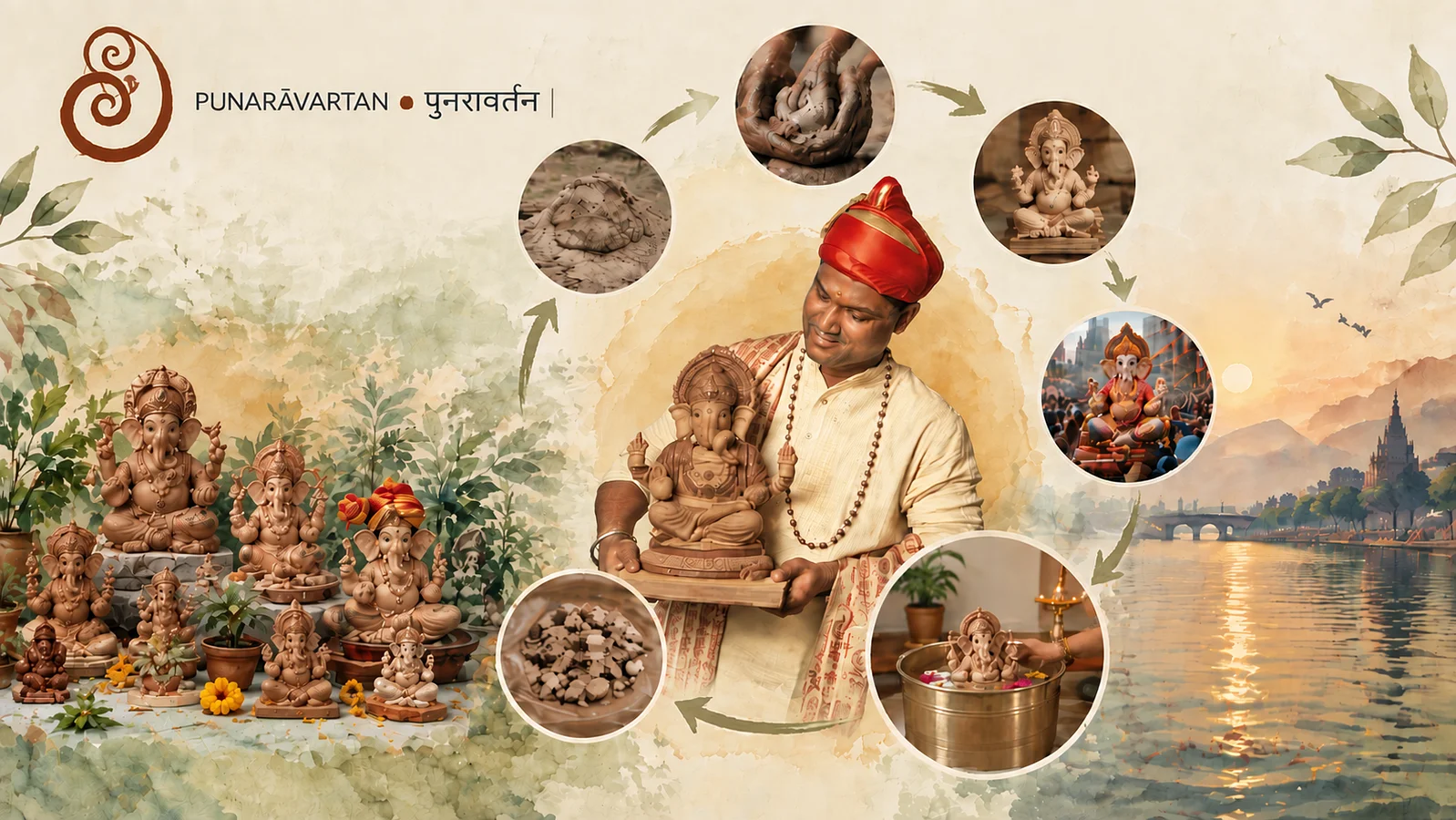
The Saṃskṛta word Visarjana has its roots in the Saṃskṛta विसृज् (Visṛj [1]) and the word has a range of interpretations, such as, ‘to let go’, ‘to dismiss’, ‘to abandon’, ‘to cast away’, ‘to give up’ and so on. When one looks at its usage in various ways, it can simultaneously denote an emergence and release, as well as a dissolution.
Specifically in the context of the Gaṇeśa festival, when the Gaṇeśa idol is immersed, it is with an expectation of His return - ‘kṣemāya punarāgamanāya ca’ (for welfare and return again). This is also understood in the popular cry - ‘Ganpati Bappa Morya Pudhchya Varshi Laukar Ya’, which means ‘Dear Father Ganpati, return to us again early next year’! This act of letting go is done with the belief that what goes now, will return one day - a reflection of the cycles of Nature itself, of creation and dissolution, of life and death. It is an assertion of the belief in rebirth and the acceptance of death as a prerequisite to rebirth.
Effectively, the Gaṇeśa festival enacts the entire cycle, from creation to maintenance for a duration, to dissolution. All of it is a celebration and it allows no despondence. In so doing, it offers us an opportunity to collectively and annually practise , a cyclic approach to all of life. It aligns us with the flow of Nature and repositions us in rhythm.
Where does a circle begin and where does it end? The concept of Anādi and Ananta underpins a circular world view that does not look for origins and conclusions. It knows that what goes around, comes around, and we remind Bappa that he must return just as all things do in Nature, even as we willingly let him go each year.
Similarly, at the end of life, after cremation, the ashes of the human body are also immersed in flowing waters, as a farewell ritual in Hindu practice.
The psychosomatic impact of watching the beloved form of Gaṇeśa dissolve in front of one's eyes, leaves a deep impression on the psyche of the worshipper. This process of letting go results in an inner ease with the process of dissolution itself when practised on a regular basis. When conducted collectively, it is a celebration of the value of detachment and an acknowledgement of the need to restore balance by closing the cycle.
This coming and going, this evolution and involution is experienced by us daily as a spanda, a vibration, in our own bodies, in our breath, in our sleep, in the pauses between our thoughts. The experience of time itself collapses from a linear sequential progression to a simultaneity. The inward and outward movements are ONE, the emergence is IN the dissolution, it does not follow it and it is not separate from it.
How does one return to this circular cyclic world view when everything around us appears to be hurtling at break neck speed towards destruction?
We can do it by paying attention, by witnessing. The ritual of visarjana is a deliberate act of dissolution and yet the power and gift of it is in the stance of the witness. To watch something beloved transform in front of your eyes is an invitation to learn to look deeper at what is simultaneously emerging.
Ironically, most people today have no clue about the meaning and significance of the ritual of Visarjana. In the festival of Gaṇeśa Chaturthi, when the materials used for the idol, such as Plaster of Paris and chemical paints, are not biodegradable, they create a significant amount of water pollution when immersed in natural water bodies. As they do not reintegrate into the natural ecosystems, they are not even closing the symbolic loop.
For some years now, devotees who have become sensitive to the ecological impact of visarjana on natural water bodies, have shifted to conduct this ritual at home. Preferring to immerse their natural clay Gaṇeśa idols in a pail of clean water at home, they still benefit from the act of watching the idol dissolve and experiencing the power of this ritual.
In the Bhagwad Gita, Verse 16 of Chapter 8, we are reminded that all things in Nature follow a circular and cyclic trajectory.
आब्रह्मभुवनाल्लोका: पुनरावर्तिनोऽर्जुन मामुपेत्य तु कौन्तेय पुनर्जन्म न विद्यते ॥ 16॥ [2]
The word Punarāvartana used in this śloka, can be broken down to two terms punar, which means again and āvartana, which is a revolution or a turning around, a repetition.
The cycles in Nature occur at several levels, and at a variety of frequencies, from the microcosm to the macrocosm, varying in time and space. Some cycles are immediately evident such as the cycle of the breath or of night and day, and other vaster cycles are longer in duration and more distant, such as the revolution of the planets in the Solar system.
Taking a clue from this circular world view, and to ensure the cycle is closed at some level, the Punarāvartan campaign [3], encourages the collection and reuse of the clay after the immersion of the clay idol at home. Without losing the benefits of the ritual of visarjana, Punarāvartan offers a practical closure of the loop by returning the clay to the artisans who originally craft the clay idols.
In this way, firstly, the campaign is respectful of the original intent of the ritual, secondly it conserves the clay, which is a non renewable and depleting resource and thirdly, it protects our natural water bodies. Artisans who receive this clay back for free are supported in their livelihoods and an ancient artform of clay sculpture is also conserved. The public response to this effort has been impressive, and in the past six years of the campaign, from 2020 to to 2025, over six years, the campaign has collected 180.1 tons of clay.
Circular action and circular economies are effortless when a culture holds a circular world view. When the inherent value in a material and product is respected, even when it reaches the end of its current function, it can be re- formed into a new āvartana, to take birth once again as something new. In such an approach to natural resources, we do not consider anything as waste. The practice of ‘letting go’ is radically different from the attitude of ‘throwing away’. Biodegradability is critical in this celebration of impermanence. The life span of a product is determined by the lifespan of the material it is made of and not simply by our need for newness.
When birth and death are seen as one and the same and as concurrent processes, our vision finally expands beyond the repetitive cycles, to become witness to the Divine paradigm.
.png)
.png)
.png)