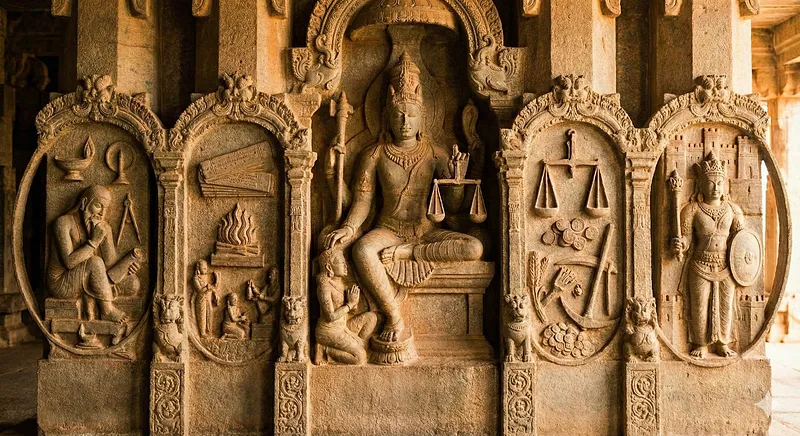
In an era where public leadership is often measured by quarterly metrics and electoral cycles, an ancient Indian text on statecraft offers a radically different framework—one that balances the hard edge of authority with the soft power of empathy. The Kāmandaka Nītisāra (also known as Nītisāra), a classical Saṃskṛta treatise on governance, presents five foundational principles in its third sarga (chapter), verses 1-5, that remain strikingly relevant for modern public leaders navigating complex societies.
The Discipline Paradox: Power as Service
The opening verse introduces a concept that challenges our contemporary understanding of political power. The text speaks of daṇḍa (दण्ड)—literally "the rod" or "punishment"—not as an instrument of domination, but as a tool for nurturing:
A ruler, holding the power of punishment among all beings, should protect and nurture his subjects with impartiality like the Earth itself, and with care like Prajāpati (the creator).
Here lies a profound paradox: the leader must hold coercive power while exercising it with the patience of the earth and the care of a creator. The commentaries elaborate that daṇḍa should function "like a balanced scale—neither too little nor too much."
For today's public administrators, policymakers, and elected officials, this principle translates into a critical insight: enforcement mechanisms—whether regulatory frameworks, judicial systems, or administrative sanctions—must be designed and deployed not for control, but for protection. The head of a public health department wielding quarantine powers, or a financial regulator imposing penalties, must see these tools not as expressions of bureaucratic authority but as instruments for safeguarding the vulnerable.
The earth metaphor is particularly instructive. Earth supports all equally—the righteous and the unrighteous, friend and foe. Modern public leadership demands this same impartiality in the application of rules and the distribution of public goods. Favoritism, whether to political allies or influential donors, violates this foundational principle.
The Conduct of Noble Governance
The second verse outlines what the commentaries call satpuruṣavrata (सत्पुरुषव्रत)—the vow of righteous people—comprising four pillars:
Truthful yet Pleasant Speech: The text uses the Saṃskṛta term sūnṛtā, meaning words that are both accurate and compassionate. In our age of political spin and strategic communication, this principle demands that public leaders resist the temptation to manipulate truth for palatability or to weaponize truth for cruelty. Budget presentations must be honest about trade-offs, yet communicated with empathy for those affected. Policy failures must be acknowledged candidly, yet framed constructively.
Compassion: Not merely as sentiment, but as institutional practice. The commentaries distinguish between general kindness and "special acts of uplifting and protecting those who are helpless." This translates into targeted interventions—social safety nets, affirmative action, crisis response systems—that recognize that blanket policies often fail the most vulnerable.
Charity: The text emphasizes giving "rightly, at the right time and place." For public leaders, this speaks to the effectiveness question that haunts development work and social programs. Resources must reach those who need them most, when they need them most, through mechanisms that preserve dignity and agency.
Protection of Refuge-Seekers: Those "oppressed by others who come for shelter must be safeguarded." This has direct implications for asylum policy, whistleblower protection, and the defense of civil liberties. When citizens approach public institutions seeking protection from private or systemic harm, the institution's response becomes a measure of its legitimacy.
Empathy as Strategy, Not Sentiment
The third and fourth verses introduce what might be the text's most radical proposition for modern governance: that effective leadership requires not just acknowledging others' suffering, but experiencing it viscerally.
A ruler should feel as if he himself is overwhelmed by the suffering of his people, and with great compassion he should lift up and rescue the distressed.
This is not a call for performative empathy—the carefully staged photo-op at a disaster site. The commentaries are explicit: the leader should feel the people's pain "so strongly that it seems like his own suffering."
In contemporary terms, this demands that public leaders build mechanisms for genuine exposure to lived realities. It means city planners regularly use public transportation, health officials working shifts in public clinics, and education secretaries sitting in overcrowded classrooms. It requires creating feedback loops that don't filter pain through bureaucratic abstractions.
The fourth verse goes further, declaring that there are "no beings greater" than those who rescue the distressed from "the mud-ocean of sorrow." This is a values hierarchy: among all possible virtues a leader might cultivate—strategic brilliance, administrative efficiency, personal integrity—none surpasses the act of relieving suffering.
For public leaders, this reframes success metrics entirely. Infrastructure projects are not victories because they come in under budget, but because they improve lives. Regulatory reforms succeed not when they reduce paperwork, but when they reduce barriers for those struggling to access services.
The Integration of Compassion and Duty
The final verse addresses what may be the central challenge in public ethics: how to balance compassion with the sometimes harsh demands of duty.
A king, firmly rooted in supreme compassion without straying from his duty (dharma), should wipe away the tears of the oppressed and the helpless.
The commentaries are careful to note that compassion must operate with viveka—discernment. "In matters of enemies or justice, if he abandons rightful action out of misplaced softness, he strays from his duty."
This speaks to the perennial tension in public leadership between mercy and justice, between individual welfare and collective good, between short-term relief and long-term sustainability. The text's answer is not to choose one over the other, but to develop the wisdom to know when each is appropriate.
A public prosecutor must pursue justice for victims while ensuring fair treatment of the accused. A budget director must maintain fiscal discipline while protecting programs for the vulnerable. A crisis manager must enforce emergency protocols while minimizing their harm to civil liberties.
The key phrase is "wiping away tears"—not merely sympathizing with suffering, but "removing the pain itself, so that sorrow no longer arises." This is a call for systemic solutions, not palliative care. Effective public leadership addresses root causes: not just food banks but living wages; not just emergency housing but affordable housing policy; not just crisis mental health services but preventive community support.
From Ancient Statecraft to Modern Governance
What makes the Kāmandaka Nītisāra relevant fifteen centuries after its composition is not merely its idealism but its realism. The text assumes that leaders will hold power, will need to enforce rules, and will face difficult trade-offs. It doesn't call for the abolition of authority but for its transformation—from domination to service, from control to protection, from distance to empathy.
For today's public leaders—whether elected officials, civil servants, or institutional administrators—these verses offer both challenge and opportunity. The challenge is to recognize that technical competence and managerial efficiency, while necessary, are insufficient. The opportunity is to reclaim a vision of leadership where the highest achievement is not power accumulated but suffering relieved.
In practical terms, this might mean:
-
Redesigning institutions to center the experiences of those they serve rather than the convenience of those who staff them
-
Recalibrating metrics to measure outcomes in terms of human wellbeing rather than procedural compliance
-
Restructuring incentives to reward officials for reducing suffering rather than merely following protocol
-
Rebuilding trust through the consistent demonstration that power exists to protect, not to extract
The ultimate test proposed by Nītisāra is devastatingly simple: Can you feel your constituents' pain as your own? And having felt it, can you remove it?
These are not questions that admit to easy answers or quick fixes. But they are, the ancient text suggests, the questions that distinguish true public leadership from mere public office. In an age of growing cynicism about institutions and deepening inequality, perhaps what we need is not newer frameworks but older wisdom—the recognition that the purpose of power is service, that the measure of governance is compassion, and that the greatest leaders are those who make it their vow to rescue the drowning.