A note from the author:
The method:
This study is built, deliberately and entirely, on the Caṅkam corpus, the oldest stratum of Tamiḻ itself. It argues its case from the Eṭṭuttokai, the Pattuppāṭṭu and the Eighteen Minor Works, and turns to later witnesses only afterward and only as corroboration, precisely to disarm the standard evasion that the "noble" sense of ārya is a late, Bhakti-era Sanskritisation. Part I reads the war-poems and the political vocabulary of the poets; Part II reads the word itself, in the lexicons, the household honorific and the verses where āriyar names an acrobat, a sage and a goddess.
The sources:
Three classes of evidence are kept strictly apart. Verbatim quotations are reproduced exactly from a digitised or printed primary text and are marked as such. Attested glosses are meanings recorded by a standard lexicon (chiefly the University of Madras Tamiḻ Lexicon) that names its nigaṇḍu source, where the full original sūtra is not separately reproduced. Referenced Caṅkam loci are occurrences whose poem-and-line citation is secured by independent concordances (Vaidehi Herbert's index; Tamiḻconcordance.in) and by K. V. Ramakrishna Rao's study "Ariyar in the Ancient Tamiḻ Literature".
The factual core argued here, that race and language are distinct, that the Aryan/Dravidian racial schema is a nineteenth-century overlay, and that Caṅkam ariyar carries no racial sense, rests on cited evidence and is argued without reservation. Questions of modern cultural and political identity that lie outside the textual evidence are not adjudicated here; the argument is about what the verses say.
Six Questions the Racial Reading Cannot Answer
Before the textual argument, six questions. The racial reading of āriyar, that the Caṅkam Tamiḻs were one race who fought, and defined themselves against, an invading "Aryan" race, must answer all six. It answers none.
A scope note, in fairness. These questions concern the meaning of a Tamiḻ word, and the racial reading laid on it, not the separate, genuinely open question of ancient language-spread, which belongs to historical linguistics and genetics, not to the word āriyar. The case below is about the word.
The silence of the conquered. The Caṅkam corpus is thousands of poems soaked in war, defeat, kings and remembrance. If a distinct race had invaded and subjugated the Tamiḻs, where is the memory of it: the lament for a lost freedom, the named race-enemy, the origin-story of a subjugation? There is none. A conquered people does not misplace its conquest.
The missing ethnonym. The poets name specific northern peoples with surgical care: Mauryas, Nandas, Vaḍugar, Kōsar, Yavanar. Why is āriyar never one of these fixed names, but is given instead to rope-dancers, elephant-trainers and wrestlers, and, in the lexicons, to the gods?
The Vaidika victors. The two Tamiḻ houses most celebrated for 'breaking the āriyar', Cēra Seṅguṭṭuvaṉ and the Pāṇḍiya line of Palyāgasālai Mudukuṭumi, are themselves the great performers of the Vaidika yāga (the Rājasūya; "the many sacrifice-halls"). If āriyar were the “Vedic enemy”, the Tamiḻ victors were performing the enemy's own central rite, more lavishly than anyone. Whom, then, did they defeat?
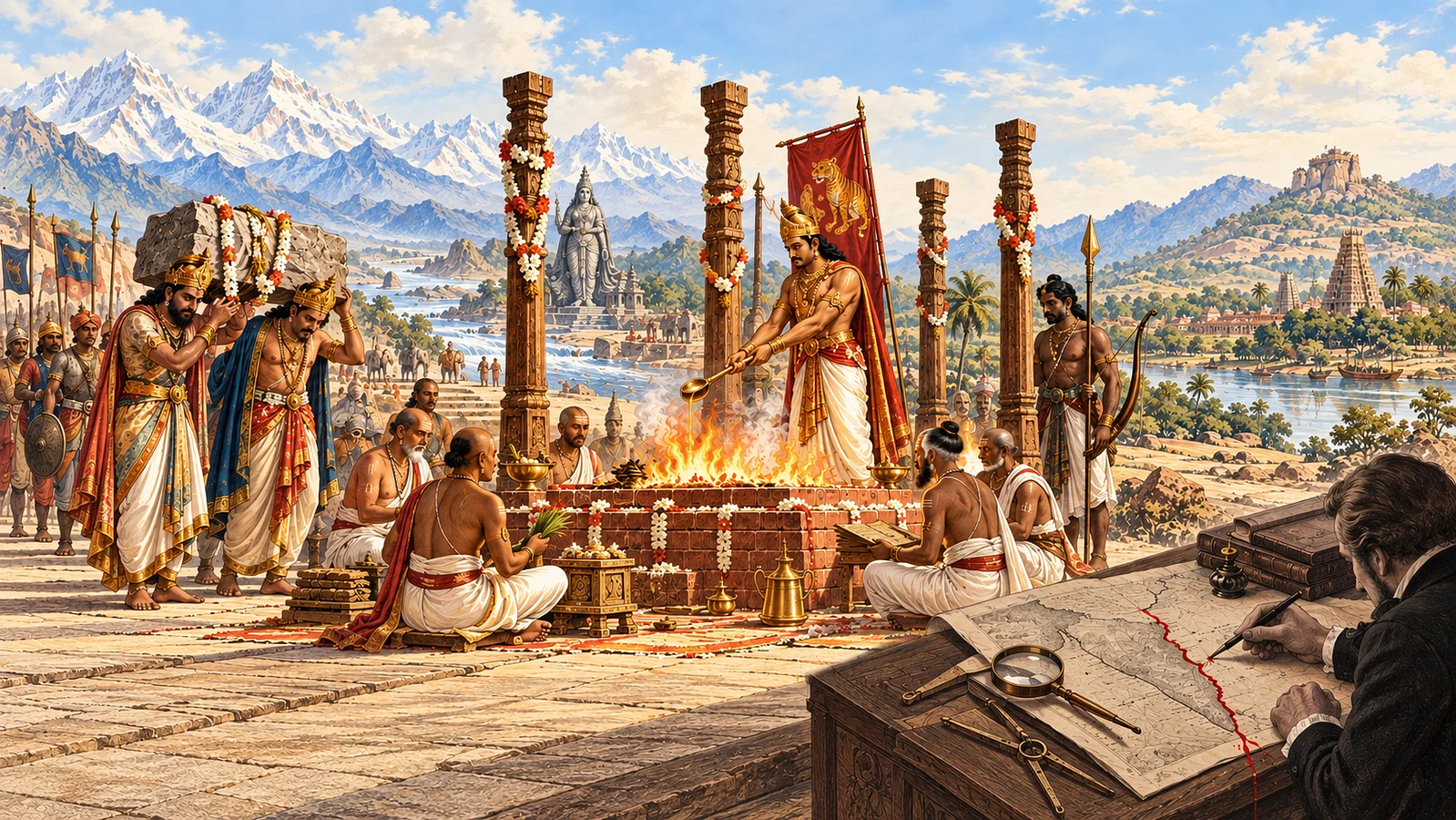
The honoured enemy. In the Cilappatikāram, the Tamiḻs' most triumphant defeat of the "northern āriyar," the vanquished kings are not exterminated; they are made to bear the sacred stone and released, inside a wholly Vedic-Purāṇic frame (the fire-wedding, the Rājasūya, the Gaṅgā). Where is the racial annihilation a race-war produces?
Gentler than kin. Caṅkam keeps its gruesome after-battle detail, plunder, the killing of kings, the queens' satī, for defeated Tamiḻ rivals, and withholds it from the defeated āriyar. A despised alien race is not handled more tenderly than one's own cousins.
The nineteenth-century birth-certificate. If the Aryan/Dravidian racial divide were ancient and indigenous, its vocabulary, its "two races" and its dating would surface somewhere in the Caṅkam. They surface, instead, first in the 1800s: Caldwell's language-family given a racial twist, hardening into Trautmann's "racial theory of Indian civilization".
The race is younger than the railways.
Six questions; not one answer from the racial reading. The rest of this study shows why: the verses said to memorialize a race-war describe, on their own terms, something else entirely.
1. Two Verses, One Misreading
Two lines have done most of the work in the popular claim that the ancient Tamiḻs fought, and defined themselves against, a distinct “Aryan race”.
The first is the Pāṇḍiya royal epithet recorded in the Puṟanāṉūṟu colophons:
ஆரியப் படை கடந்த நெடுஞ்செழியன்
Āriyappaḍai kaḍanda Neḍuñceḻiyaṉ
"Neḍuñceḻiyaṉ who broke the Āriya army." (Puṟanāṉūṟu; this king is named as the author of Puṟam 183.)
The second is from the post-Caṅkam epic Cilappatikāram:
வடவாரியர் படை கடந்து
vaḍa-āriyar paḍai kaḍandu
"Having broken the army of the northern Āriyar." (Cilappatikāram, the Kāl Kōḷ sequence; the form preserved in the aṟumpadavurai, cited s.v. ஆரியன் in the Madras Tamiḻ Lexicon.)
Read through a racial lens, these become a Tamiḻ people's remembered triumph over an Āriyan one, and so proof of a primordial Dravidian counter-identity. The remainder of this study shows the racial sense is not in the verses. It was placed there much later.
2. The Epic Refutes Itself: One Civilisation, Not Two
The Cilappatikāram episode is the decisive case, because the epic refutes the racial reading from inside its own narrative.
The "northern Āriyar" whom Cēraṉ Seṅguṭṭuvaṉ defeats are the kings Kanaka and Vijaya, sons of one Bālakumāra, with their allies Uttara, Vichitra, Rudra, Bhairava, Citrā, Siṃha, Dhanuttara and Śveta. The cause of the war is explicit and personal: they had mocked Seṅguṭṭuvaṉ and disparaged the martial prowess of the southern kings. Provoked by the insult, he marches north, defeats the alliance, and makes Kanaka and Vijaya carry on their heads the Himalayan stone from which Kaṇṇaki's image is carved.
Now observe the frame in which the whole story sits:
-
the epic opens with the Vaidika wedding of Kōvalaṉ and Kaṇṇaki, performed by the sacred fire;
-
the victorious Tamiḻ king's own legitimacy is Vaidika-Paurāṇika: he is Imayavaramban, "he whose boundary is the Himalaya," and he crowns the campaign with a Rājasūya sacrifice;
-
the stone for Kaṇṇaki's deified image is sanctified by bathing it in the Gaṅgā.
Here is the contradiction that undoes the racial reading. If "Āriyar" named a culturally alien race, why is the whole world of the poem, victor and vanquished alike, already vaidika? The defeated kings carry Sanskritic names (Rudra, Bhairava, Vijaya); but the victorious king sanctifies his triumph by the most vaidika of royal rites and by the Gaṅgā; the heroine is consecrated within a Paurāṇika theology of the goddess. A race war requires two civilisations. The Cilappatikāram shows only one: a single Vaidika-Paurāṇika field in which a Tamiḻ king and "northern Āriya" kings are rival players of the same game, quarrelling over honour.
3. The Victor's Altar: the Pāṇḍiya House of Many Sacrifices
The same holds good for the Pāṇḍiya epithet. The "Āriya army" Neḍuñceḻiyaṉ broke is, on the best reading, a specific northern force. The epigraphist S. Ramachandran identifies it with the army of Khāravela of Kalinga, whose Hāthigumphā inscription records a march against a "Tamiḻ confederacy" (Tramira-deśa-saṅghāta) reaching toward Madurai; Ramakrishna Rao reaches the parallel conclusion that the defeated "Āriya" king is a contemporary Andhra (Sātavāhana) ruler. Either way it is a datable political event, not an ethnic one.
And the epithet carries the same self-refutation as the Cilappatikāram, on the Pāṇḍiya side. The king styled Āriyappaḍai kaḍanda Neḍuñceḻiyaṉ, "he who broke the Āriya army," is no stranger to the Vaidika world he is supposed to have fought: he belongs to the very Pāṇḍiya house whose most celebrated forebear is பல்யாகசாலை முதுகுடுமிப் பெருவழுதி — Palyāgasālai Mudukuṭumi Peruvaḻuti, "Peruvaḻuti of the many sacrifice-halls." The epithet is not ornament. The Caṅkam poets remember him precisely as a king who performed yāga after yāga, his country "studded with yūpa (sacrificial posts)," and they praise him for exactly this across Puṟanāṉūṟu 6, 9, 12, 15 and 64, so that "Palyāgasālai," the man of many sacrificial halls, became his standing name. (Early Pāṇḍiya coins bearing a horse and an altar are read by numismatists as the mark of his aśvamedha.)
So the two Tamiḻ royal houses most celebrated for defeating the "āriyar", the Cēra Seṅguṭṭuvaṉ and the Pāṇḍiya Neḍuñceḻiyaṉ, are themselves paradigmatic performers of the vaidika sacrifice. One crowns his northern campaign with a Rājasūya; the other descends from the dynasty whose ancestral hero's name means "many yāgas". If āriyar denoted a rival Aryan-Vedic people, the Tamiḻs would be defeating the very civilisation whose central rite, the yāga, they themselves performed more lavishly than anyone, and named their kings after. That is not a race-war; it is one single ritual world, of which the Tamiḻ kings are among the foremost celebrants. The "two civilisations" premise dissolves a second time, on the Pāṇḍiya side exactly as it did on the Cēra side.
4. The Etiquette of Victory
Yet another significant point- Mark how the vanquished are treated. In the Cilappatikāram they are not exterminated; they are humbled and made to bear the sacred stone, then released upon the instruction of the learned Brāhmaṇas. Ramakrishna Rao notes the same anomaly across the Caṅkam references: of the defeated "āriyar" we hear of no plunder-lists, no killing of their kings, no satī by their queens. The gruesome after-battle detail lavished on defeated Tamiḻ rivals is simply absent.
The most economical explanation is that the āriyar are honoured, code-keeping adversaries within a shared order, kings who fight by the ārya / kṣatriya dharma of righteous war, not captives of an enemy race to be wiped out. The conflict is over provocation, prestige and the politics of conquest, not blood. One does not handle a despised foreign race more gently than one's own cousins. The very story quoted to prove a “Tamiḻ-versus-Aryan” race-war is, in its own ritual fabric and its own etiquette of victory, an argument that no such racial divide existed.
5. A Generic Word Among Exact Names
Here is the strongest philological argument. The Caṅkam poets were lexically exact about specific northern and non-Tamiḻ peoples. For each identifiable group they had a distinct name:
|
People |
Identity |
References |
|---|---|---|
|
Kōsar |
a people of the Tuḷu country, south of the Vindhya |
Akam 15, 90, 113, 196, 216, 251, 262; Puṟam 169, 396; Kuṟ. 15, 73 |
|
Mōriyar |
the Mauryas of the north (their chariots cut roads through the hills) |
Puṟam 175; Akam 69, 251, 281 |
|
Nandar / Nandaṉ |
the Nandas of the north |
Akam 251, 265 |
|
Toṇḍaiyar |
the elephant-people of the Veṅkaṭam hills |
Akam 213; Kuṟ. 260; Perumpāṇāṟṟuppaḍai 450–454 |
|
Vaḍugar |
Telugu-speakers beyond Veṅkaṭam, "who spoke a different language" |
Akam 107, 181, 195, 213, 253, 385, 391; Kuṟ. 11 |
For northern rulers and mountains as such they used plain geographic terms: வடபுல மன்னர் / வடபுலத்தரசர் ("kings of the northern region," Puṟam 31, 52), வடவர் ("northerners"), வடகுன்றம் ("northern mountain," Akam 340), and could even double the word for emphasis: வட வடுகர், "the northern northerners" (Puṟam 378).
Against this precision, Ramakrishna Rao's observation is decisive (verbatim):
"...though the expressions 'vadapulattarasar', 'vadapulamannar' and 'vadakundram' are used to denote the kings of the north and northern mountain, the prefix 'Ariyar' is conspicuously missing… while the word 'Ariyar' is generally used to denote the people of north or the kings of north, the above mentioned words Kosar, Nandar, Moriyar, Tondaiyar and Vadugar are used to denote only particular groups of people who lived in the north of Tamizhagam."
The asymmetry is best stated as a fixed name versus a descriptive title. Maurya, Nanda, Kōsar, Toṇḍaiyar, Vaḍugar are fixed names of identifiable peoples, used where the poet knows exactly who they are and the identity does real work in the line (the Mauryas' chariot-roads, the Vaḍugar's foreign tongue). Āriyar is not a name of that kind at all; it is an open, evaluative word that describes a quality of those it is applied to, not their identity, and it surfaces wherever a precise name is not the point: the unnamed host that "thronged at Mullūr" (Naṟṟiṇai 170), the faceless army "broken at Vallam" (Akam 336), the anonymous kings "between the Himalaya and Kumari" (Patiṟṟuppattu 43). A poet who can tell a Maurya from a Nanda from a Vaḍugar, and who names the "northern mountain" precisely as vaḍakuṉṟam, is not being vague when he says āriyar; he is reaching for a different kind of word. The existence of the precise ethnonyms is the negative proof that āriyar is not one of them: a title is not a race.
And what the title describes is, first of all, conduct, not geography. Notice where two of these defeats happen: at Mullūr, the hill-country of the Tamiḻ chieftain Malaiyaṉ, and at Vallam, beside Tañcāvūr in the Cōḻa land: southern, Tamiḻ ground. The āriyar broken there are not securely "invaders from the north"; they read just as naturally as kings who fought by the ārya / kṣatriya code, adversaries marked out by their manner of war (§4), wherever they hailed from.
That the bare āriyar is not, in itself, a geographic word is shown not by where it points but by where it refuses to point: it falls on a tightrope acrobat (Kuṟuntokai 7), on a champion fighter, āriyap-porunaṉ, whose ariya- honorific marks his skill (Akanāṉūṟu 386), and, in the lexicons, on the dharma-keeping Aiyaṉār and the Goddess herself: uses in which no north is present at all (these are the subject of Part II). Where āriyar does read "northern," the north is supplied by the scene, the Himalaya, the gold-bearing peak, the kings "between Himalaya and Kumari", and is not carried inside the word. "North" is thus a contextual application of "the high" (up = north), one direction the noble may happen to occupy, never the word's fixed sense. This reconciles the verses cleanly: the same poems can set āriyar in a plainly northern frame in one line and on a resident Tamiḻ acrobat in another without any strain, because the constant is height and worth; the geography comes and goes with the context. (A true ethnonym behaves oppositely: Vaḍugar, Mōriyar, Kōsar carry their identity inside them and are used where that identity does work, never as a mere quality a stranger might also possess.)
Āriyar, in short, names a standard of kingly conduct; that the standard was met by northern rulers is a fact about who held the frontier, not about the meaning of the word, and it is the very opposite of an ethnic label, which fixes a people regardless of how they behave. The specifically-named outsiders are, fittingly, often the truly alien: the Vaḍugar "who spoke a different language," the Yavanar (Greeks/Romans), named by tongue and origin, while āriyar is kept for adversaries judged by their conduct within a shared order.
6. The War-Verses, One by One
Every Caṅkam occurrence in which āriyar stands in a northern or military frame follows, quoted in full, set in its situation, and tested against the reductive reading, āriyar as "a northern army" or "a northern race." In every case that reading either adds a homeland the line does not state or falls silent before what the line plainly says.
(Verbatim Caṅkam lines from the compilation of Dr. P. Pandiyaraja, American College, Madurai, reproducing the standard editions; the Fifth-Ten forms corroborated by Tamiḻ Wikisource.)
Naṟṟiṇai 170:
ஆரியர் துவன்றிய பேர் இசை முள்ளூர் பலர் உடன் கழித்த ஒள் வாள் மலையனது ஒரு வேற்கு ஓடியாங்கு
"As the Āriyar thronged at famed Mullūr but fled before the matchless spear of Malaiyaṉ."
Context. The confidante warns that the hero may be lured by a wandering dancing-girl; the girl's troupe, she says, will fail just as the āriyar host broke at Mullūr. The anchoring element is a place and an unnamed host.
Against the reductive reading: Mullūr is the hill-country of the Tamiḻ chief Malaiyaṉ, southern ground, and the host is broken there by a Tamiḻ spear. Nothing suggests this "thronging multitude" is a foreign race rather than code-keeping rivals clashing on home soil; the word marks a famed host humbled, not a bloodline. The line racialises nothing.
Akanāṉūṟu 396 (poet Paraṇar):
ஆரியர் அலறத் தாக்கிப் பேர் இசைத் தொன்று முதிர் வட வரை வணங்கு வில் பொறித்து வெஞ்சின வேந்தரைப் பிணித்தோன் வஞ்சி
"(Seṅguṭṭuvaṉ of) Vañci, who struck the Āriyar till they screamed, engraved his bow-emblem on the ancient, famed northern mountain, and chained the wrathful kings."
The governing image is the வட வரை, the northern mountain: geography, not descent.
Against the reductive reading: the line's freight is a place the victor brands and "wrathful kings" he chains, not a race he clears; and the victor is the Rājasūya-performing Seṅguṭṭuvaṉ (§2), of the same ritual world as the kings he binds.
Akanāṉūṟu 398:
ஆரியர் பொன் படு நெடுவரை
"The tall mountain where the Āriyar's gold is found" (the Himalaya).
Here āriyar is barely more than the genitive of a place.
Against the reductive reading: to make this a "race" is to racialise a mountain's name for gold; the word is doing the work of "the northern heights," nothing more.
Akanāṉūṟu 336:
…வல்லத்துப் புற மிளை ஆரியர் படையின் உடைக என் … வளையே
"May my bangles shatter as the Āriyar's army broke at the guard-forest by the fort of Vallam, before the bow-host of the Cōḻa."
Against the reductive reading: Vallam lies in the Cōḻa country, southern, Tamiḻ ground. An army broken there is as readily a code-keeping force met at home as a "northern race"; the verse grieves a rout at a named fort and racialises nothing.
Puṟanāṉūṟu 183:
ஆரியப் படை கடந்த நெடுஞ்செழியன்
"Neḍuñceḻiyaṉ who broke the Āriya army," the Pāṇḍiya named as the poem's author.
Against the reductive reading: this is a datable political army, Khāravela's or a Sātavāhana's (§3), not an ethnos; and the king who broke it descends from the yāga-performing Pāṇḍiya line, so the "Vedic enemy" reading collapses at the victor's own altar.
Patiṟṟuppattu 43 & patikam (Fifth Ten):
ஆரிய அண்ணல் ("chief of the Āriya kings"), ஆரிய அரசர் ("the Āriya kings"), the kings ruling between the Himalaya and Kumari.
Against the reductive reading: "between the Himalaya and Kumari" is a territory, and these are its kings: a polity named by its reach, not a pedigree named by its blood.
Patiṟṟuppattu 11 & patikam (Second Ten):
ஆரியர் துவன்றிய பேர் இசை இமயம்
"The famed Himalaya, thronged with Āriyar," whom the commentators read both as northern kings and as முனிவர், ṛṣis; the patikam adds that Imayavaramban "made the Āriyar bow before him." Here the northern place turns, in the commentators' own hands, into the ascended sage. It is the hinge where height-in-space becomes height-in-attainment, and where the "northern army" reading runs out of road: no army can be read into the ṛṣis of the mountain.
By contrast, where the Caṅkam poets speak of named northern peoples and plain northern geography, Kōsar, Mōriyar, Nandar, Toṇḍaiyar, Vaḍugar; vaḍapula mannar, vaḍakuṉṟam (§5), the prefix āriyar is, in Ramakrishna Rao's word, "conspicuously missing." The word is reserved for the evaluative-and-vertical, never for the ethnic-and-specific.
7. The Colonial Manufacture of "Race"
If the racial sense is not in the texts, where did it come from? It is a nineteenth-century import, and the history is well documented.
Robert Caldwell (1856) in his seminal work A Comparative Grammar of the Dravidian or South-Indian Family of Languages established Dravidian as a language family. As Ramakrishna Rao states (verbatim), "Caldwell's linguistic invention was given a racial twist by the westerners and Indian scholars, though the concept of race and language are two separate entities."
Thomas Trautmann (Aryans and British India, 1997) names the resulting framework "the racial theory of Indian civilization": India produced by "light-skinned civilizing invaders (the Aryans)" mixing with "dark-skinned barbarian aborigines… identified as Dravidians." Trautmann shows that 'Aryan' began as a category of linguistic kinship and was only later "redefined in narrowly 'white' racial terms" by Victorian race-science.
Even Max Müller, who popularised the term, repudiated its racial use: to speak of an "Aryan race, Aryan blood, Aryan eyes and hair" was as great a blunder as for a linguist to speak of "a dolichocephalic dictionary." (Müller, Biographies of Words, 1888;)
Against this background the epigraphist R. Nagaswamy argued that ārya means ‘noble/ cultured’, and does not denote a specific race, that the great Caṅkam kings themselves performed Vaidika sacrifices, and that the “Aryan–Dravidian divide’ is "speculative at best."
The sequence is therefore the reverse of what the racial reading requires. The verses came first, and they speak of a datable northern force, a quarrel over honour, a Himalayan boundary and a mountain of gold. The "race" came eighteen centuries later, from a philology that confused a language family with a bloodline, and was then read backward into lines that had never contained it.
Conclusion: a Datable Event, Not a Race
The war-poems of the āriyar, read on their own terms, describe one civilisation and not two. The Tamiḻ victors sanctify their triumphs by the Rājasūya and the Gaṅgā, descend from a house named for its many sacrifices, and treat the defeated āriyar with an honour they never extend to their own Tamiḻ rivals. The poets who could name a Maurya, a Nanda and a Vaḍugar, and who called the northern mountain plainly vaḍakuṉṟam, never made āriyar a name of that kind; they used it where a fixed name was not the point, for a host, a frontier, a code-keeping adversary, and, at the Himalaya, for the ṛṣis themselves.
What remains is a word that judges a standard rather than an origin. Why the Tamiḻ language should have such a word, why it also names an acrobat and an elephant-trainer, why the oldest Tamiḻ thesaurus files it among "the wise" beside "the superior" and "the exalted," and why the same word came to name the guardian-god Aiyaṉār and the Goddess, is the subject of Part II. Here it is enough to have shown that the race-war is not in the verses said to remember it. It was written into them afterwards; and any reading that must rewrite its own evidence to survive has already lost the argument.
Sources
K. V. Ramakrishna Rao, "'Ariyar' in the Ancient Tamiḻ Literature" (Indian History Congress, 1990; The Aryan Problem, Bharatiya Itihasa Sankalana Samiti, 1993).
P. Pandiyaraja (American College, Madurai), "ஆரியர், மோரியர்": verbatim āriyar lines from the Caṅkam editions; Vaidehi Herbert, "Historical References"; Tamiḻconcordance.in.
Cilappatikāram (Seṅguṭṭuvaṉ and the northern kings; the Kāl Kōḷ sequence); the aṟumpadavurai form cited s.v. ஆரியன் in the University of Madras Tamiḻ Lexicon (DDSA).
Palyāgasālai Mudukuṭumi Peruvaḻuti, the Vedic-sacrificing Pāṇḍiya: Puṟanāṉūṟu 6, 9, 12, 15, 64; on his many yāgas, the yūpa-studded land and the coinage, V. Vasudevan, Vedic Ritual Tradition of Tamiḻ Nadu (Vedic Heritage portal). S. Ramachandran on the Khāravela identification; the Hāthigumphā inscription (Tramira-deśa-saṅghāta).
Thomas R. Trautmann, Aryans and British India (University of California Press, 1997); Robert Caldwell, A Comparative Grammar of the Dravidian or South-Indian Family of Languages (1856); R. Nagaswamy, Mirror of Tamiḻ and Sanskrit (Tamiḻ Arts Academy, 2012) and Tamiḻ Nadu: The Land of the Vedas (cited for ārya = noble and for the Vaidika rites of the Caṅkam kings; Nagaswamy's broader "Tamiḻ via Sanskrit" thesis is contested and is not relied upon here).
Provenance: the Caṅkam loci (Naṟṟiṇai 170, Akanāṉūṟu 336/396/398, Puṟanāṉūṟu 183, Patiṟṟuppattu 11 and the Fifth-Ten forms) are quoted verbatim from the editions named above.
.png)
.png)