When thinking of what is fundamentally different between a Hindu worldview and Western one, a few primary points come to mind. Here, by Western we refer in specific to the Judeo-Christian worldview, which also includes the Islamic and is alternately called the Abrahamic worldview.
The seeming difference of a monotheistic conception vs. a polytheistic one is relatively superficial, in that it more describes an outcome of the fundamental than the fundamental itself. But deeper within, it elides the occurrence in one a healthy comfort with the very idea of multiplicity, and in the other an existential antagonism to it. This difference reveals itself beyond theological windows - for instance in the discipline of history.
On the Multiplicity of Time
Stalwarts such as Prof. Balagangadhara, Dr. Adluri and Dr. Bagchee have detailed how contemporary enterprises such as Indology and philology are stymied by a uni-linear notion of time, itself derived from the historicism that was necessary to uphold the Judeo-Christian worldview. How this happens can be understood as a series of steps human trajectory has taken in the past ~2000 years.
- The prior state - of many cultures, many traditions, and equally as many histories ie - as many stories of a people about their own past.
- The emergence of Judaism - a specific community with a specific tale about its own past.
- The breakaway of Christianity from Judaism and consequently, its move towards becoming a global religion ie - making itself available to the Gentiles, or non-Jews, such as Greeks, Romans and others.
- The necessity then, from the above, of identifying a world history, where the multiple histories of multiple cultures had to be mapped to a singular and specific Christian story of creation, man and God's interventions in the world.
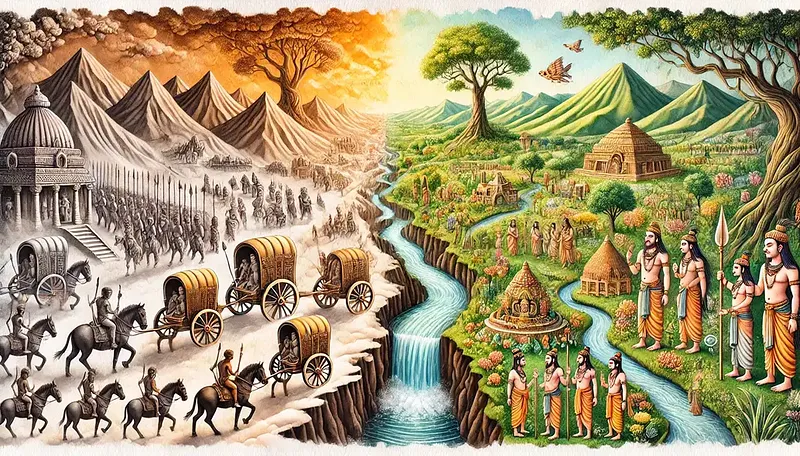
- The resultant clash of a variety of views on history and time - cyclical, helical, non-linear - against the monistic, linear view of time, which presumed that all other views could be methodically sanitized to extract their proper place in the new, Christian world history.
- The inheritance of this linear view of time by the natural and social sciences developed in Europe, particularly in history and philology, culminating in -
- The absolute butchery of Indian tradition at hands of those schooled in such sciences to produce not only a philology that does not understand the culture it studies, but also a history that does only injustice to the subject of its own contents - India, Indian history, Hinduism, etc.
Under the critique of Balagangadhara, Adluri and Bagchee, this has also created within India the misguided and oft-damaging enterprises of historical chronology, text-historicism, and attempted reconciliations of Paurāṇika literature with the world history. These endeavors fall to the same trap - of seeing time as a singular, linear thread - and fail to understand:
1) an intrinsic atemporality to the tradition, and 2) the use of temporality as a narrative device in the corpus.
This fundamental difference in how time and the past are understood creates a cognitive dissonance in the modern Hindu - who is generally educated into the linear view and out of the native view that is more adaptive and plural. It results in a near inability in the modern times to not ask - did the Mahābhārata or the Rāmāyaṇa really happen?
That emphasis on 'really' points to an even deeper difference in the Hindu and Abrahamic worldviews. A difference in core metaphysics. It reiterates the rift that is perceivable at more symptomatic layers as monism vs. multiplicity. And it is of specific concern in this essay because it helps reveal Hinduism's essential difference with even a range of secular, modern -isms, as we will see.
The Rift in Core Metaphysics
For the Abrahamic paradigm, the singular, linear view of time has second-order implications.
Everything happens only once
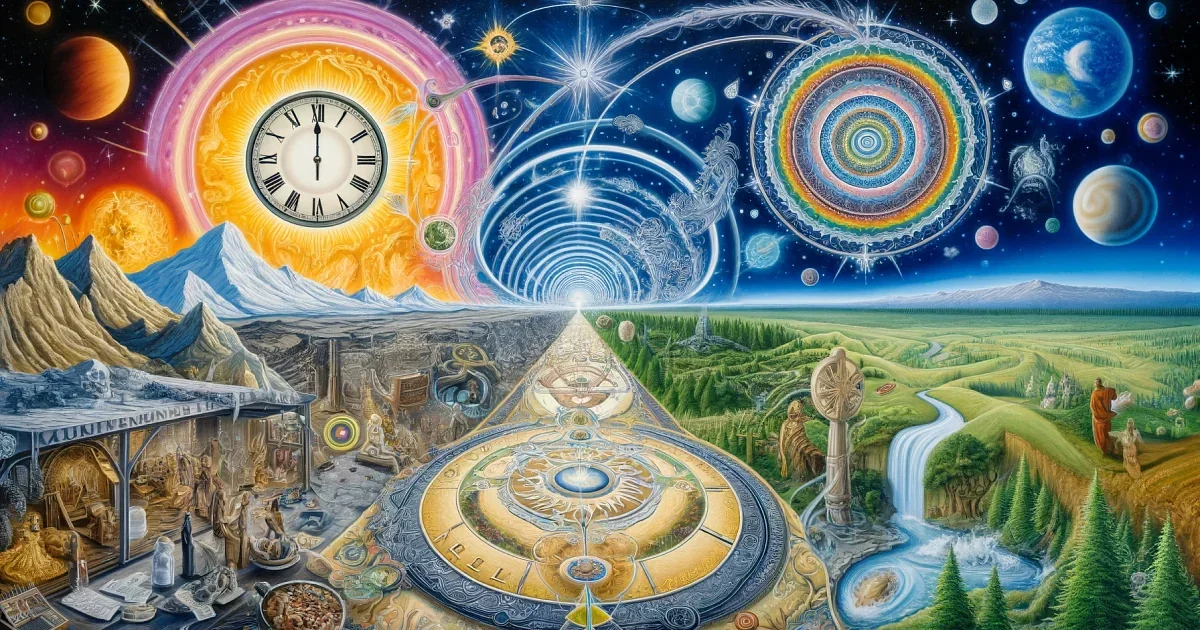
The universe was created - once, in the deep past. God spanned his creations across his realm and set in motion the cosmic clock - once. That clock has been running unbroken, down to our time, and our future converges with it completely towards the end of time. That end too will come only once. Only one category in this ontology exists outside this arrow of time - the realm of judged souls which is divided between a heaven and hell. There can be an eternal damnation which implies something beyond temporality - but even that is a singular, only one unit of its kind. And all that you are in this moment will at some point end up, only once, in that transcendent realm of judged souls.
The Hindu mind would easily find this a very narrow, limited view of reality. All of this has happened before, and all of this will happen again, was a mythic aphorism in the science-fiction show Battlestar Galactica, and in its cyclical view of time it homages the Hindu view not unfairly. Hindu cosmology understands an aspect of time which theoretical physics has more recently intuited as a process of Big Bang and Big Crunch, the latter itself fueling another Bang of Creation.
This difference in metaphysics is fundamental, for it has serious impact on both eschatology and teleology
Eschatology refers to the part of theology that concerns itself with the final events of history, the ultimate fate of humanity and human events, and in general the events of end times. Teleology is an explanation of things by the purpose they serve. In a paradigm where everything happens only once, such as the Abrahamic, a deep urgency and desire for accelerationism is seeded into the metaphysics. Since the journey is known, its final days described and anticipated, why not rush there faster? The ultimate fate of humanity then is to in fact prepare for the end times, and eschatology becomes the teleology - the purpose of human affairs is to set course for the end and arrive there appropriately primed.
The consequence of any action in such a setting is magnified by its singular existence on the arrow of time. Soon comes the day of judgement, and to heaven or to hell we shall be marched. A sin then that prohibited deed we commit, a blasphemy that skeptical word we utter. A glory to God the brother we recruit into his faith, a service to the end times each disbeliever we rid the earth of. This is what we mean by eschatology that becomes teleology. The very purpose of human life and society is defined by its service to the final events of history.
It is easy to see why these impulses will not arise in a metaphysics where the only singular is the One- Brahman. Everything else is, by definition, an emergence of the many from this one, and all of reality is but a cycle of sleeping and waking states. Sṛṣṭi emerges outwards, like the infinitely blooming petals of a lotus, in Brahman's awakening. And the petals close back into themselves as Laya when Brahman returns to rest. Bṛṃh-manin -> Brahman, literally the outpouring, the spreading out (bṛṃh/बृंह्).
In such a metaphysics accelerationism appears naive, absurd even. And teleology is given the kind of breathing space that can produce a whole, rounded and profound understanding of humanity - the puruśārtha
We do not live only once - we are born again and again, and the consequence of deed is accumulated over lifetimes as karma. The events of history are only materially understood through their reconstructed actuality, and in reality they are but the reflections of more cosmic, paratemporal events. The Mahābhārata and Rāmāyaṇa are made real not because they really happened. They are real because the divine really manifests in them. They are real precisely because they speak of things belonging to the eternal, the Sat (सत्).
This difference in a single-life metaphysics and a multiple-life metaphysics explains Hinduism's divergence from the modern -isms: capitalism, communism, atheism, scientism, rationalism, materialism, etc.
The Single-life Metaphysics of Modernity
Whether explicitly or implicitly, the modern -isms are premised on the 'one life, everything happens only once paradigm'. Capitalism and communism may be non-theological, but both implicitly believe in a material, objective reality with 1) a discernible past, and 2) a future we can create. And both are dangerously accelerationist. Communism is inherently disruptive, for its eschatology requires the revolution of the proletariat and the collapse of incumbent order. Without being theological it ends up with the same incidence of eschatology becoming teleology.
Capitalism may not explicate an eschatology, but it nonetheless contains one. The free hand of the market is supposed to, eventually, bring about a utopia of equity and balance. Give capitalism a sufficiently long reign over this one, singular arrow of time that we live in, and the gods of laissez-faire and their invisible hand will bring us collective good. One that presumably justifies the horrors some of us may experience along the journey. And so emerges a teleology that values disruptive innovation, a culture that designs and creates things with values-agnosticism. A planet where the smartest species accelerates ecological collapse and through its own metaphysics brings the final days of humanity - the end times.
Scientism, rationalism and materialism may diverge from the Abrahamic worldview in critical ways, but their inheritance nonetheless remains that of a unitemporal, monodimensional reality. The very logic of empiricism and the process of reductionism it engenders leads these modern -isms to flatten existence into a strictly materialist plane - one where consciousness and subjectivity are considered mere epiphenomena arising from physical processes, and any transcendent, non-material realms are summarily dismissed as unreal.
In this strictly singular plane that they landmark, the mind is produced by the brain as an emergent property, and consciousness arises from neural computation - a complex series of purely physical events occurring within one finite lifetime. There are no past lives acknowledged, no rebirth accepted, and human existence is confined entirely to this singular iteration from birth to death. This is the quintessential single-life metaphysics that all modern -isms share, despite their variances in other philosophical tenets and truth claims.
The multiple-life metaphysics of the Hindu traditions stands in marked resistance to such a reductionist flattening of all of existence. It views consciousness not as an emergent epiphenomenon, but as fundamental - a quality intrinsic to reality itself. The Ātman or individual self is thought to temporarily inhabit a succession of material bodies across multiple lifetimes, accumulating karma through its volitional actions and making gradual spiritual progress over these repeated rebirths. The ultimate metaphysical goal is to transcend this cycle of birth and death (saṃsāra) and attain mokṣa - the complete merging of the individual self with the supreme reality of Brahman.
This expansive, multiplex view of reality as proposed by the Hindu darśanas allows for far greater depth, nuance and wisdom in our understanding of the human condition than the extremely limited, monistic single-life view. It does not seek to accelerate towards any final terminus or eschaton, but embraces the eternal recurring cycles and yugas of existence, each emerged and unmade in the cosmic tūriya of Brahman's breathing. It conceives the outer material reality, with all its details and intricacies, as nothing but constantly shifting reflections and refractions of inner spiritual truths - the inseparable līlā.
The grand Itihāsa narratives and Pāurāṇika literatures are understood as real not because they depict a certain linear chronology of historical events, but because they symbolize eternal metaphysical verities through potent mythology, allegory and storytelling of the highest art. It is their timeless wisdom regarding the human condition, their insights into the deepest layers of existential truth, that is considered most precious - not any imagined historical timeline or accelerationist grand narrative pushing humanity towards some materialistic End Times.
In its profoundly singular, unitemporal metaphysics in the mode of the Abrahamic religions before it, modernity by contrast lacks the expansive spaciousness to facilitate any profound exploration of humanity's purpose beyond the narrow prescriptions of a this-worldly utopia. It restricts the vast potential of human existence to a single short lifespan, which must then be anxiously preoccupied with serving and accelerating its own eschaton - whether that be the revolutionary upheaval of the proletariat, the end of history, the geometric growth of capitalism's invisible hand, or the materialist singularity of apocalyptic scientism.
The Hindu multiple-life view, by contrast, expands the possibility of human potential across an unhurried, infinite series of lifetimes engaged in the puruṣārthas. It allows the permanent essence of the individual, the Ātman, to gradually unfold across yugas towards the experience of our true divine nature without any rush towards a final judgment and without any single governing telos dictating the strict trajectory of human civilization.
In this way, Hinduism's metaphysical divergence from both the Abrahamic religions as well as modern ideologies allows it to offer a path of innermost freedom - one that does not aim towards any final revolution or preordained utopia, but facilitates the eternal unfolding of the individual soul in alignment with the cosmic rhythms of Brahman's play. It is this expansive multiple-life metaphysics, premised on the fundamental truth of consciousness rather than its materialist dismissal as an epiphenomenon, that remains Hinduism's most unique, precious and indispensable philosophical contribution to the human experience.