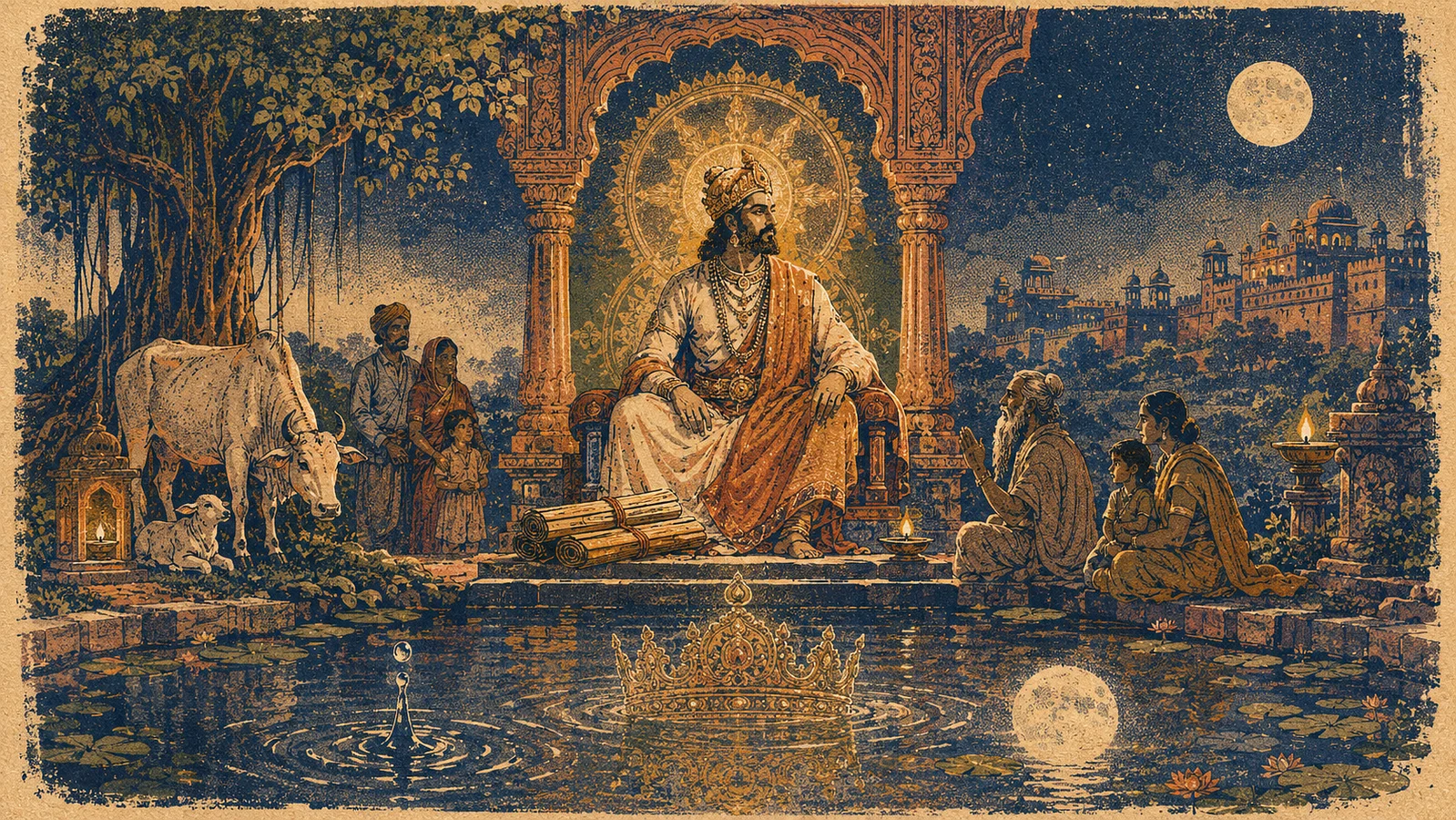
Introduction
Among the classical treatises on statecraft (rājanīti) that Bhārata bequeathed to the world, Kāmandaka's Nītisāra occupies a singular place. Composed in the tradition of Kauṭilya's Arthaśāstra, yet suffused with a deeper ethical sensibility, the Nītisāra addresses not merely the mechanics of governance but the inner constitution of the leader himself. The third Sarga (tṛtīya sarga) in particular contains some of the most penetrating verses on the philosophical foundations of righteous leadership. Five of these — ślokas 9 through 13 — form a coherent meditation on impermanence, self-mastery, noble company, and the imperative to act with dharma as the unyielding anchor of statecraft.
What follows is an exploration of each of these five verses as a teaching on leadership — relevant not only to the king of ancient Bhārata, but to any person entrusted with power and responsibility.
Śloka 9 — The Body Is Not Worth Oppressing Others For
ādhivyādhiparītāya adya śvo vā vināśine |
ko hi nāma śarīrāya dharmāpetaṃ samācaret ||
"This body, surrounded by mental and physical afflictions, is perishable today or tomorrow. Who then, for the sake of such a fleeting body, would commit unrighteous acts like oppressing the weak?"
Kāmandaka opens this sequence with a sobering anatomical fact, not of biology, but of existential reality. The body (śarīra) that a leader inhabits is not some impregnable fortress; it is, in the poet's precise language, ādhivyādhiparīta — "surrounded by ādhi (mental anguish, grief, anxiety) and vyādhi (physical disease)." The word parīta — encircled — is telling: the body is besieged from all sides, and there is no wall it can build against decay.
The political implication is direct and devastating. A ruler who oppresses the weak (kṛpaṇa-pīḍana) does so, ultimately, for bodily comfort — for power, pleasure, and self-preservation. But if the very body for whose sake this cruelty is exercised is itself impermanent (vināśine) — vanishing today or tomorrow (adya śvo vā) — then the entire logic of oppression collapses. The means do not serve the end because the end itself is illusory.
The Jayamaṅgalā commentary underscores this with characteristic precision: the body is "unstable and full of faults," and to harm others for its sake is dharma-apeta — devoid of righteousness. For the leader, this is the first lesson: governance rooted in self-preservation at the cost of the governed is not governance at all — it is elaborate self-deception.
Śloka 10 — The Cosmetic Illusion of Power
āhāryairniyamānaṃ hi kṣaṇaṃ duḥkhena hṛdyatām |
chāyāmātrakamevedaṃ paśyed udakabinduvat ||
"This body, made pleasing only for a short while through external ornaments, perfumes, and dress, is in truth just a shadow — fragile and fleeting like a drop of water."
If śloka 9 addressed the body's vulnerability to affliction, śloka 10 addresses its deceptive attractiveness. The word āhāryaiḥ is crucial — it means "that which is brought from outside," i.e., artificial, non-inherent. The body's beauty is āhārya, imported from without: fine clothes, perfumes, cosmetics, ornaments. Strip these away, and what remains is, as the Upādhyāyanirapekṣā commentary dryly notes, "full of sweat, odor, and decay."
For a leader, this teaching strikes at the very heart of the performance of power. Pomp, ceremony, royal insignia, the apparatus of prestige — all of these are āhārya. They are maintained with effort (duḥkhena) and they last only a moment (kṣaṇam). The body — and by extension, the political identity built upon it — is chāyāmātrakam, "merely a shadow." It is udakabinduvat, like a water drop: there in one instant, gone in the next.
The leader who has internalized this truth governs differently. He does not confuse the pageantry of office with its substance. He does not mistake the robes of kingship for the reality of his own accountability. Authentic leadership, Kāmandaka suggests, begins with seeing through the cosmetics of power — understanding that the grandeur of the throne is as fleeting as a droplet on a leaf at dawn.
Śloka 11 — The Great-Souled Cannot Be Seduced
mahāvātāhatibhrāntameghamālātipelavaiḥ |
kathaṃ nāma mahātmāno hriyante viṣayāribhiḥ ||
"Just as a cluster of clouds, scattered by a great storm, cannot be moved by something fragile — how can the great-souled be led astray by the weak enemies that are sense-objects?"
This śloka introduces the concept of the mahātman — the great-souled leader — and it does so through one of the most vivid metaphors in the entire text. A storm of enormous force (mahāvāta) scatters cloud formations across the sky. Those cloud masses, already set in violent motion by that storm, cannot be further displaced by anything flimsy (pelavaiḥ — fragile, tender, light). The contrast of scale and force is the point: what has been shaped by immense power cannot be undone by the trivial.
The viṣayāḥ — sense-pleasures — are called ari, enemies. This is not incidental language. In the classical Indian tradition of leadership, the ṣaḍripu (six inner enemies) — desire, anger, greed, delusion, pride, and envy — are considered more dangerous to a king than any external foe. They are enemies precisely because they are intimate: they operate from within, wearing the disguise of pleasure, comfort, and gratification.
The rhetorical question kathaṃ nāma — "how is it even possible?" — expresses the philosopher's astonishment that the great-souled, those forged by discipline and wisdom, could be undone by such petty forces. This is not naïve idealism. Kāmandaka acknowledges that alpa-sattva individuals — those of weak inner constitution — do fall prey to sensory lures and consequently oppress others. But the truly great leader, tempered by viveka (discernment), remains unmoved. The mark of genuine leadership, this verse teaches, is not immunity to temptation by external circumstance but by the depth of one's inner formation.
Śloka 12 — Act Well Because Life Is Brief
jalāntaścandracapalaṃ jīvitaṃ khalu dehinām |
tathāvidhamiti jñātvā śaśvat kalyāṇamācaret ||
"The life of embodied beings is as fleeting as the unsteady reflection of the moon in water. Knowing this, one should constantly perform good and righteous deeds."
Here, Kāmandaka pivots from diagnosis to prescription. The preceding verses have established the impermanence of the body and the triviality of sensory pleasures. Now comes the logical response: not despair, not withdrawal, but ceaseless righteous action.
The image of jalāntaścandracapala — the reflection of the moon trembling inside water — is among the most beautiful in Saṃskṛta philosophical poetry. The moon is real; the reflection is not a lie, but it is utterly unstable. A breath of wind, a stone dropped nearby, a ripple from a passing fish — any disturbance destroys it instantly. Such, says Kāmandaka, is the life (jīvitam) of every embodied being (dehinām). The word khalu — "without doubt," "certainly" — lends the verse an air of unflinching lucidity. This is not poetry of lamentation; it is clear-eyed recognition.
And the response? Śaśvat kalyāṇam ācaret — "Let one always perform kalyāṇa." The word kalyāṇa encompasses auspicious, beneficial, and righteous deeds. For the leader-king, the Jayamaṅgalā commentary specifies this concretely: the greatest kalyāṇa is to protect those who come seeking refuge (śaraṇāgata-rakṣaṇa). The awareness of life's brevity is not an argument for passivity but for urgency in doing good. A leader who truly understands that his time is finite will not squander it in cruelty, vanity, or indulgence. He will act — constantly, consistently — for the welfare of the people entrusted to him.
Śloka 13 — The Transformative Power of Noble Company
jaganmṛgatṛṣā tulyaṃ vīkṣyedaṃ kṣaṇabhaṅguram |
sajanaiḥ saṅgatiṃ kuryāddharmāya ca sukhāya ca ||
Seeing that this world is fleeting and as unreal as a mirage, one should keep the company of good people, for such association brings both righteousness and true happiness.
The final verse in this sequence turns outward — toward community, toward the relational dimension of leadership. The world (jagat) is mṛgatṛṣā tulya — comparable to a mirage (mṛgatṛṣā, literally "the thirst of the deer," the desert illusion that the deer chases in vain). It appears substantial, desirable, and real; yet it is kṣaṇabhaṅguram — shattered in a moment, moment by moment.
Given this recognition, what is the leader's resource? Kāmandaka's answer is sajanaiḥ saṅgati — the company of good people (sajjana). The sajjana are the wise, the virtuous, those who have themselves faced reality with courage and clarity. The Upādhyāyanirapekṣā commentary identifies them as "the wise, the learned, the virtuous elders." Association with such people (satsaṅga) yields, the verse promises, both dharma (righteous living) and sukha (true happiness, not the pleasure of the senses but the deep contentment of a life aligned with truth).
This is a counsel of profound practical importance for any leader. No ruler governs in isolation. The people he keeps close — his advisors, his friends, his counselors — shape the quality of his decisions, the calibration of his moral compass, and the tenor of his court. A leader who surrounds himself with flatterers, opportunists, and those who confirm his biases is, in Kāmandaka's framework, choosing the mirage over reality. A leader who deliberately seeks out noble, wise, and honest companions is building the conditions for dhārmika governance. The inner circle of a leader is, in this reading, not a matter of politics but of metaphysics: it determines what reality the leader is capable of seeing.
Synthesis: What These Five Verses Teach the Leader
Taken together, ślokas 9 through 13 of the Nītisāra's third Sarga compose a coherent philosophy of leadership built on five pillars:
1. Sobriety about the body (śarīra-viveka). The leader must not let the demands of bodily comfort, vanity, or self-preservation become the justification for unjust action. The body is afflicted and impermanent; no crime committed on its behalf is worth the cost.
2. Seeing through the performance of power. Titles, ceremony, and the trappings of authority are āhārya — borrowed from outside. The genuine leader holds them lightly, knowing that what endures is not spectacle but the quality of one's conduct.
3. Inner mastery as the precondition of outer governance (ātma-jaya). Before a leader can govern a kingdom, he must govern himself. The viṣayāḥ, the sense-enemies, are the real threat. The mahātman — the truly great-souled — is not easily seduced because his inner formation is deep.
4. The urgency of righteous action (kalyāṇa-karma). The impermanence of life is not a reason for nihilism but for moral urgency. Knowing that time is short, the wise leader acts — constantly, wholeheartedly — in service of the welfare of those he governs.
5. Noble company as a structural necessity (satsaṅga). The company a leader keeps is a governance decision of the highest order. Surrounding oneself with the wise and the virtuous is not a luxury; it is the very condition of dhārmika leadership.
Conclusion
Kāmandaka's Nītisāra emerged in a Bhārata that had long understood that statecraft without ethics was not power but peril. These five verses from the third Sarga are remarkable not for their political instruction — they give little in the way of policy — but for their insistence that the interior life of the leader is the foundation of everything. A ruler who does not reckon with his own impermanence, who has not seen through the illusions of bodily pleasure and political grandeur, who has not mastered the viṣayāri (sense-enemies) within, and who has not sought the company of the wise — such a ruler, however magnificent his kingdom, is building on sand.
The enduring gift of this tradition is the reminder that dharma — righteousness, duty, and compassionate truth — is not a constraint on effective leadership. It is the substance of leadership, the only ground on which anything genuinely lasting can be built. In the language of Śloka 12: śaśvat kalyāṇam ācaret — let one always act for the good. That, in essence, is the entire science of governance these five verses teach.