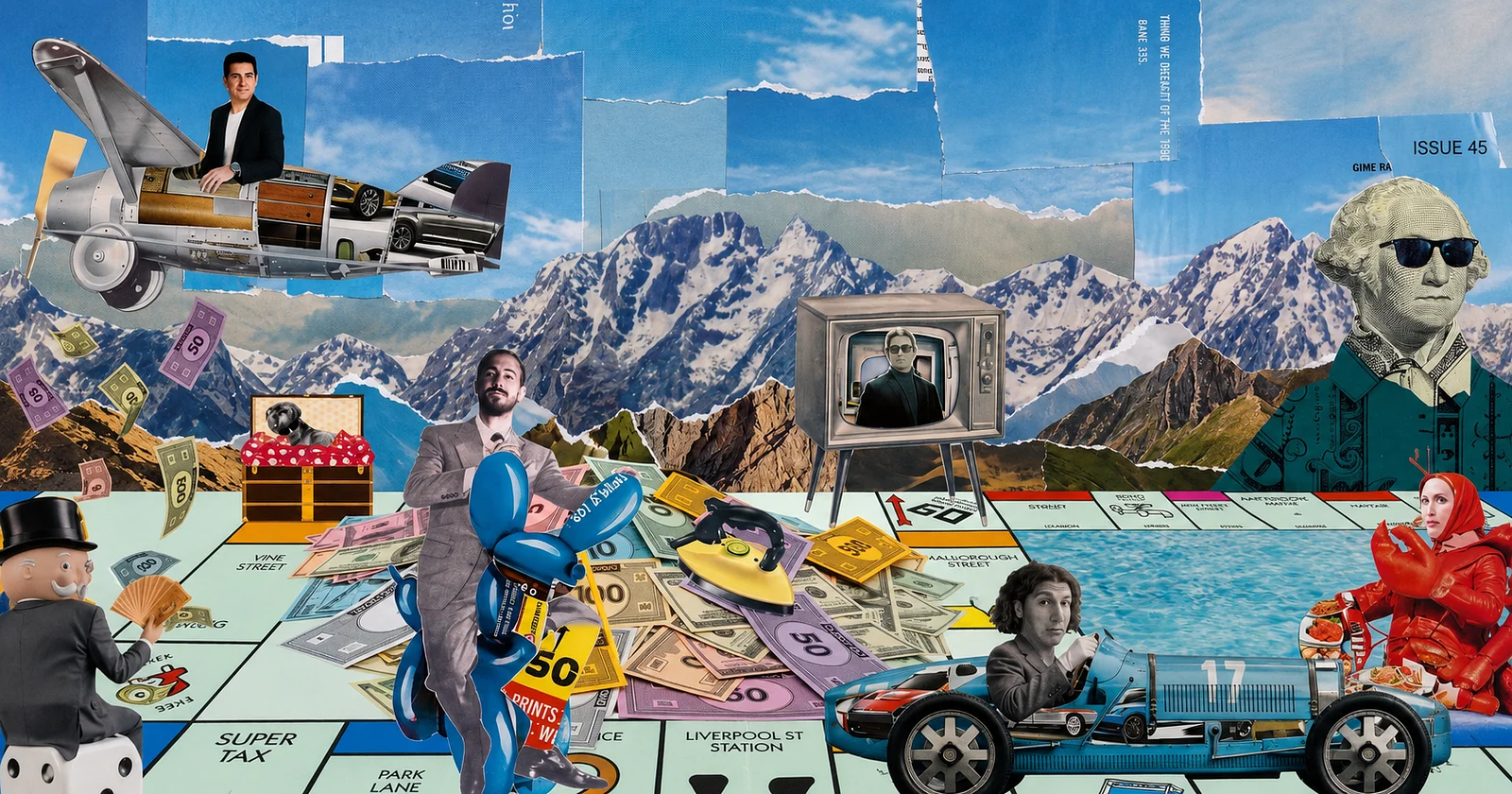
Indian billionaires are chasing new frontiers of clout. They’ve swarmed the Met Gala, held at the Metropolitan Museum of Art in New York, wearing 800 crores worth of diamonds, under the delusion that someone might take them seriously. In the same vein, Jeff Bezos and his wife, Lauren Sánchez, reportedly spent 10 million dollars in order to become the lead sponsors and honorary co-chairs to this year’s Gala. In both cases, the obscene display of their wealth does not buy them what they so desperately seek — cultural capital.
Protesters gathered outside the Met condemned Jeff Bezos’s involvement in the Met Gala as a calculated attempt to launder the reputation of a billionaire whose fortune was built on exploitative labor practices, tax avoidance, and unchecked corporate power. Demonstrators argued that Bezos’ financial backing of the Fala transformed one of fashion’s most elite cultural events into a spectacle of oligarchic influence, where immense wealth could purchase prestige, cultural legitimacy, and proximity to high society. Slogans of “Boycott the Bezos Met Gala” cast the event as a monument to modern inequality. The criticism levelled was that the gala was no longer a celebration of art or fashion, but a stage on which tech billionaires could recast themselves as enlightened patrons of culture, while insulating their public image from scrutiny. Arguably, the Met Gala has always been an odious display of wealth under the pretence of charitability — self-serving flamboyance disguised as philanthropy, which benefits the donors and does little for public good. Though the Gala itself was instituted in order to raise funds for its Costume Institute, the event has morphed into a cultural cache and a global spotlight for celebrities and designer brands.
This is not all. Earlier this year, Donald Trump filled his administration with billionaires and multimillionaires, reinforcing the perception that immense private wealth now sits at the center of political power. One of the defining images of his inauguration was the prominent display of Silicon Valley elites — the “PayPal Mafia”, if you will — including Mark Zuckerberg, Jeff Bezos, and Elon Musk, whose presence symbolized the growing fusion of Big Tech, capital, and the State. Parallels in India are seen with the close relationship between Adani, the Ambanis and the Center.
As in centuries past, wealth alone is rarely enough for the super-rich. Status symbols eventually lose their novelty, and what begins to matter most is the desire to be remembered. Reputation becomes a project in itself, a carefully crafted masterclass in PR and brand management. The murkier the path to wealth, the stronger the urge to reinvent oneself as a statesman, philanthropist, or pillar of respectable society, imitating the cultural manners of older aristocracies and established elites. When it comes to extreme wealth, entitlement and victimhood often coexist. A belief in one’s innate superiority is frequently accompanied by a deep sensitivity to criticism and an obsessive hunger for public validation.
Back in the day, across most civilizations, the wealthy once believed that immense privilege carried spiritual and moral consequences. Conscious that lives of excess, indulgence, and greed endangered their personal salvation, they sought redemption through acts of public patronage — funding cathedrals, temples, libraries, museums, opera houses, charitable institutions and civic works that outlived them. The deal was to barter cultural immortality in return for investment in society. Over centuries, this evolved into a broader moral expectation captured in the French articulation of noblesse oblige — the belief that extraordinary wealth imposed extraordinary responsibility. Society tolerated private luxury so long as a portion of that wealth visibly served the public good. The elite understood that public frivolity in the face of suffering could provoke moral outrage, instability, or even revolution. In India, for example, the Nagarathar community — also known as the Nattukottai Chettiars — embodied a distinctly dhārmic model of mercantile capitalism bound to sacred and civic obligation. Being powerful financiers and maritime traders during the Chola era, the Nagarathars, through the tradition of Tiruppani (holy service), spent a fortune to renovate and expand temple complexes. Without dependence on kings or state patronage, they developed a highly organized and self-funded philanthropic system, reportedly contributing nearly ₹4.5 crore during the pre-modern and early colonial periods toward major Śaiva institutions such as the Naṭarāja Temple and the Mīnākṣi Amman Temple. Their patronage extended to Vedic schools, water-management systems, feeding houses, rest houses, etc.
Similarly, the wealthy Ayyavole 500 and Manigramam merchant guilds or ṣreṇis of medieval South India financed temples, irrigation infrastructure, roads, caravanserais, and centers of learning. Affluent Jain mercantile communities in Rajasthan and Gujarat directed immense commercial wealth toward the construction of monumental temple complexes, stepwells, libraries, animal shelters, and dharmaśālas. In Renaissance Europe, the Medici family funded churches, universities, hospitals, scholarships, and the arts, thereby shaping the intellectual and artistic efflorescence of Florence. Their patronage sustained figures such as Michelangelo and Leonardo da Vinci, embedding private wealth within a broader project of cultural production and urban prestige. Likewise, in imperial China, prosperous Confucian merchant lineages frequently invested in bridges, academies, granaries, clan temples, and hydraulic infrastructure, using philanthropy not merely as charity but as a means of securing moral legitimacy, social status, and integration within the Confucian civic order.
Modern billionaires, however, no longer operate within this moral or spiritual framework. Detached from religious accountability or concern for posterity beyond reputation and influence, they pursue accumulation as an end in itself, often at immense social and environmental cost. Their wealth itself is their legacy, and excessive accumulation of it is seen as a virtue — for instance, fictional figures such as The Wolf of Wall Street's Jordan Belfort, who amass wealth and swim in excesses, are lionised. Today's billionaires need not build cultural or religious institutions that outlive them and leave a lasting impact on society, in order to achieve cultural immortality; they simply need to be enormously wealthy during culturally remarkable moments in order to be remembered, and surprisingly, even admired.
On the subject of amassing wealth: Andrew Carnegie, one of the robber barons of the Gilded Age, authored a work titled The Gospel of Wealth which has become something of a sacred text for the modern billionaire class. After selling his steel empire in 1901, devoted the rest of his life to philanthropy, arguing in his book that the rich had a moral duty to use their fortunes for the public good rather than die wealthy. He funded nearly 3,000 public libraries across the English-speaking world, supported universities, scientific research, music, pensions, and peace initiatives, and helped establish institutions such as Carnegie Mellon University, Carnegie Hall, and the Carnegie Corporation of New York. His legacy is tinged with contradiction — the same man who championed libraries and education also imposed harsh labor conditions on workers in his steel empire, and some historians view his philanthropy as paternalistic social control. However, by his death in 1919, Carnegie had given away most of his fortune ($350,695,653, worth approximately $6.9 billion in 2025) and helped establish the modern model of billionaire philanthropy — one that sought to justify extreme wealth through public giving. He wrote in his 1889 essay, The Gospel of Wealth, “Man does not live by bread alone. I have known millionaires starving for lack of the nutriment which alone can sustain all that is human in man, and I know workmen, and many so-called poor men, who revel in luxuries beyond the power of those millionaires to reach. It is the mind that makes the body rich. There is no class so pitiably wretched as that which possesses money and nothing else. Money can only be the useful drudge of things immeasurably higher than itself.”
The work attempts to explain not only how great men become rich, but how wealth itself becomes a justification for greatness. Carnegie championed the familiar ultra-capitalist doctrines of wealth creation — flexible labour markets, low taxation, and minimal regulation; but, influenced by Herbert Spencer and the social Darwinist currents of the age, Carnegie came to believe that immense wealth was not accidental, but evidence of superiority and progress. If certain men rose above the masses, there must, he argued, be a civilizational purpose behind their ascent. Wealth therefore carried with it a moral obligation: the rich were to redistribute their fortunes through philanthropy during their lifetimes, shaping society according to their own vision. The enduring genius of Carnegie’s argument is that it provides the billionaire class with a moral vocabulary through which power can redeem itself. Within this framework, the origins of wealth matter far less than its eventual deployment. Fortune accumulated through ruthless competition, monopolistic expansion, or exploitation can later be softened, even sanctified, through charitable giving and public benefaction. Reputation can then be something that can be engineered after the fact. It is no coincidence that Warren Buffett once gifted his friend Bill Gates a copy of this book.
Echoing this principle are billionaire “philanthropists” Warren Buffett and Bill Gates, who have come to see themselves as better stewards of wealth than the state itself. Implicit in this worldview is the belief that money retained in private hands — rather than absorbed through taxation into public budgets — can be deployed more intelligently, efficiently, and creatively. These technological titans assume that the same intellect and innovative capacity that built global corporations can also be redirected toward solving humanity’s deepest crises, from disease to poverty. Gates, echoing the ethos that shaped Microsoft, once remarked: “If you take innovation and smart people, you can pull together some pretty smart things.” With the conceited belief that elite expertise triumphs over democratic institutions when it comes to engineering social progress, Gates positioned himself as a “philanthrocapitalist”, a private architect of global health, education, and agricultural policy — shaping public priorities without democratic mandate. Gates’ most egregious actions of late are his funding of trials of a controversial HPV vaccine in India, and genetically engineered mosquito and tick projects that are both ethically and ecologically risky.
In his famous line from The Great Gatsby — “The rich are different from you and me” — F. Scott Fitzgerald described the psychological and emotional condition that the rich inhabit, shaped by insulation and inherited security. Fitzgerald observed that the rich are so insulated from the anxieties of an ordinary life that it produces a diminished capacity for empathy: when consequences can be escaped through money, status, or influence, other people become abstractions rather than moral equals. In the end, what separates many pre-modern elites from the billionaire class of today is not merely the scale of wealth, but the moral imagination surrounding it. Barring some exceptions that revelled in their own excesses, most merchants, financiers, guilds, and aristocracies of yore grasped the obligation to nourish the world that had made such fortune possible. At least a portion of their wealth returned to society as manifestations of duty, piety, legitimacy, and civilizational continuity. To clarify, this is distinct from the expected duties of kings, states, or political rulers, for whom the use of the public exchequer toward public welfare is intrinsic to governance itself; rather, it concerns the moral and civilizational obligations voluntarily assumed by private mercantile and financial elites operating beyond the formal responsibilities of the state.
Today, unfathomable wealth exists, yet is untethered from any higher ethic or good. The modern billionaire floats above society rather than embedded within it — protected by financial abstraction, corporate distance, and public-relations machinery while communities fracture, cultures erode, and ecological systems collapse beneath the weight of unchecked extraction. Philanthropy, where it exists, is little more than image management, reduced to a corporate checklist. The growing public hostility toward billionaires is therefore not reducible to envy or resentment. It reflects a deeper civilizational intuition — that power without obligation and wealth without stewardship ultimately lack moral legitimacy.
Related: also read our essay A Cultural Critique of Capitalism, which argues that the crisis of modern capitalism is not merely economic, but civilizational: by severing wealth from dharma, moral obligation, and cultural rootedness, contemporary society has transformed accumulation into an end in itself, producing spiritual emptiness, social fragmentation, and ecological decay.
References:
https://www.economist.com/science-and-technology/2010/07/29/the-rich-are-different-from-you-and-me

.png)