In an era where leadership crises dominate headlines and educational institutions struggle to produce ethical leaders, ancient Bhāratīya wisdom offers a remarkably relevant solution. The Kāmandaka Nītisāra, a classical treatise on statecraft and ethics, presents two profound verses that illuminate the path from disciplined learning to enlightened governance. These verses reveal a sophisticated understanding of human development that connects personal transformation with societal leadership.
The Quest for Noble Goals
The journey begins with a fundamental recognition of life's priorities:
वर्द्धयन्निह धर्मार्थौ सेवितौ सद्भिरादराद् ।निगृहीतेन्द्रियः साधु कुर्वीत गुरुसेवनम् ॥ ६१ ॥
This verse captures a universal human aspiration—the desire to grow in dharma (righteousness) and artha (prosperity). Yet it immediately establishes conditions: these goals must be pursued as the noble do, with reverence and respect. The text recognizes that dharma and artha are not merely individual achievements but foundational pillars that support all human aspirations. When dharma flourishes, mokṣa (liberation) becomes possible; when artha is righteously acquired, kāma (desires) find their proper fulfillment.
What makes this ancient wisdom particularly striking is its insistence that only those who have mastered their senses can truly embark on this journey. The phrase "nigṛhītendriyaḥ" points to a truth that modern neuroscience confirms: self-regulation is the cornerstone of all higher learning and achievement. The Brahmacaryam ideal—maintaining self-restraint until learning is complete—reflects an understanding that scattered attention and uncontrolled impulses are incompatible with deep wisdom.
The Sacred Teacher-Student Bond
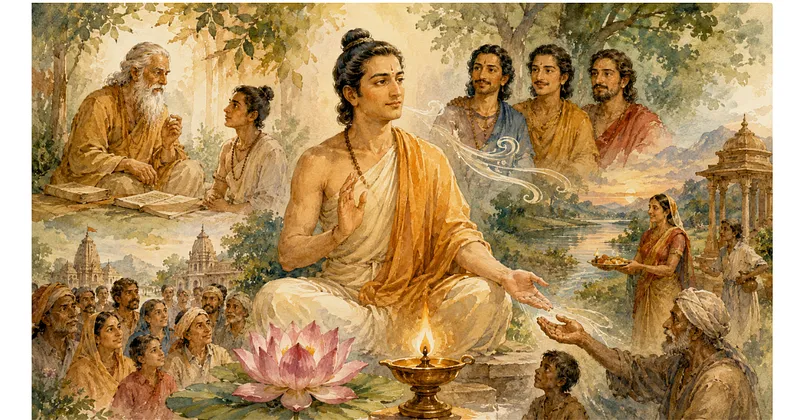
The verse's call for "gurusevanam"—service to the teacher—might seem antiquated to modern ears, yet the commentaries reveal its profound psychological insight. The Jayamaṅgalā commentary explains that someone who has conquered their senses becomes capable of receiving śāstra-vidyā, scriptural knowledge that transforms understanding. This is not mere information transfer but a fundamental reshaping of consciousness.
True guru-sevā, the text reveals, manifests through specific behaviors: rising when the teacher arrives (pratyutthāna), offering respectful salutations (abhivādana), and maintaining discipline and humility (vinaya). These practices might appear ritualistic, but they serve a deeper purpose—they cultivate the receptive state necessary for profound learning. As the śāstra declares, "discipline and regulation in studenthood come from the authority of one's guru."
The Upādhyāya-nirapekṣā commentary adds another layer: guru-sevā is not merely about acquiring knowledge but about building the foundation for righteous living. This transforms the teacher-student relationship from a transactional exchange into a transformative commitment—a sacred journey toward becoming fully human.
The Architecture of Transformation
The second verse reveals the systematic nature of this transformation:
शास्त्राय गुरुसंयोगः शास्त्रं विनयवृद्धये ।विद्याविनीतो नृपतिर्न कुछ्रेष्ववसीदति ॥ ६२ ॥
Here, the text unveils a precise sequence: association with a guru leads to śāstra, śāstra cultivates vinaya (disciplined humility), and this combination produces leaders who remain unshaken even in crises. This is not accidental but represents a carefully designed developmental pathway.
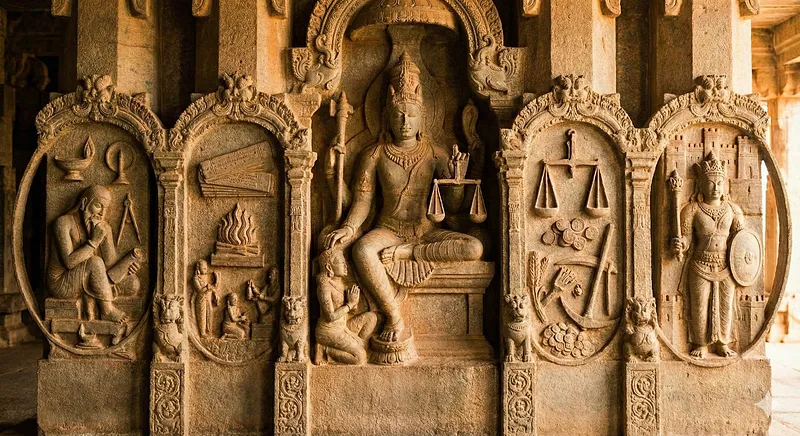
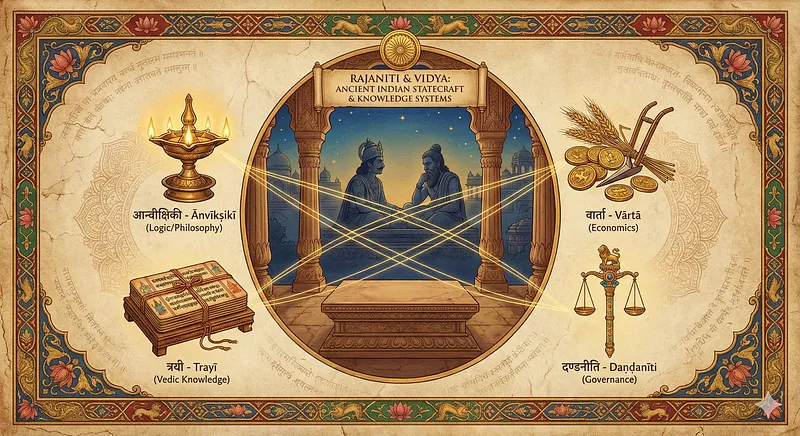
The concept of śāstra here encompasses four domains of knowledge: ānvīkṣikī (logical reasoning), trayī (vaidika wisdom), vārtā (economics and commerce), and daṇḍanīti (governance and justice). This comprehensive curriculum recognizes that effective leadership requires both intellectual rigor and practical wisdom, spiritual insight and worldly competence.
The Paradox of Power and Humility
Perhaps most remarkably, the text argues that śāstra's ultimate purpose is cultivating vinaya—disciplined humility. This presents a fascinating paradox: the more one learns, the more humble one should become. The commentaries explain that vinaya represents internalized wisdom, sometimes present from past impressions but always requiring cultivation and strengthening through study.
Kauṭilya's observation, cited in the commentary, adds nuance: "Training can enhance natural traits, but cannot create them from nothing." This suggests that education works best when it aligns with and develops existing potential rather than trying to impose foreign qualities.
The Unshakeable Leader
The verse's culmination—the vidyāvinīta nṛpatiḥ, the ruler who is both learned and disciplined—represents the ideal toward which this entire system points. Such leaders possess a remarkable quality: they do not falter (na avasīdati) even in the harshest circumstances (kṛcchreṣu). This stability does not come from rigid inflexibility but from the deep integration of knowledge and character.
The text suggests that this integration protects leaders from the emotional overwhelm that leads to impulsive, harmful decisions. When faced with crises, such leaders maintain clarity and composure, drawing upon both their learning and their cultivated discipline to respond wisely rather than react blindly.
Ancient Wisdom for Modern Challenges
This ancient framework speaks directly to contemporary leadership challenges. In an age of information overload, the text's emphasis on disciplined learning becomes crucial. In times of rapid change, the importance of unshakeable character becomes apparent. In contexts of complex global challenges, the integration of diverse knowledge domains—from logical reasoning to spiritual wisdom, from economics to governance—becomes essential.
The guru-śāstra-vinaya progression offers a model for educational institutions seeking to produce not just knowledgeable graduates but ethical leaders. It suggests that true education must integrate intellectual development with character formation, that learning divorced from moral development produces incomplete human beings.
The Timeless Path
The Kāmandaka Nītisāra's vision extends beyond individual development to societal transformation. It recognizes that stable, just societies require leaders who have undergone this transformative journey—from sense-control through disciplined learning to integrated wisdom. This is not merely an educational philosophy but a blueprint for civilizational development.
In our current global context, where leadership failures often stem from the divorce of knowledge from character, these ancient insights offer a path forward. They suggest that sustainable solutions to complex challenges require leaders who embody both learning and humility, both competence and dharma.
The text's greatest insight may be its recognition that true strength comes not from domination but from integration—the integration of all aspects of human development into a coherent whole. The vidyāvinīta nṛpatiḥ represents not just an individual achievement but a model for the kind of leadership our world desperately needs: learned yet humble, strong yet flexible, grounded in eternal principles yet responsive to contemporary challenges.
This ancient wisdom reminds us that the path to effective leadership begins not with ambition but with discipline, not with assertion but with service, and not with accumulation but with integration. In these timeless truths, we find guidance for navigating the complexities of our modern world while remaining anchored in the deepest sources of human wisdom.