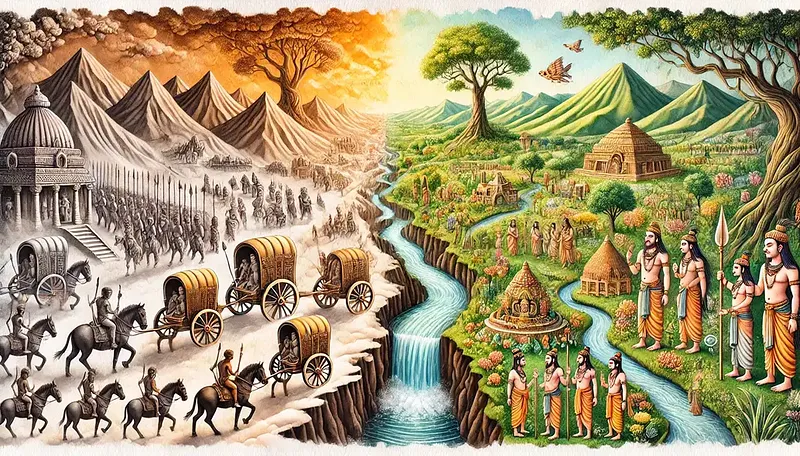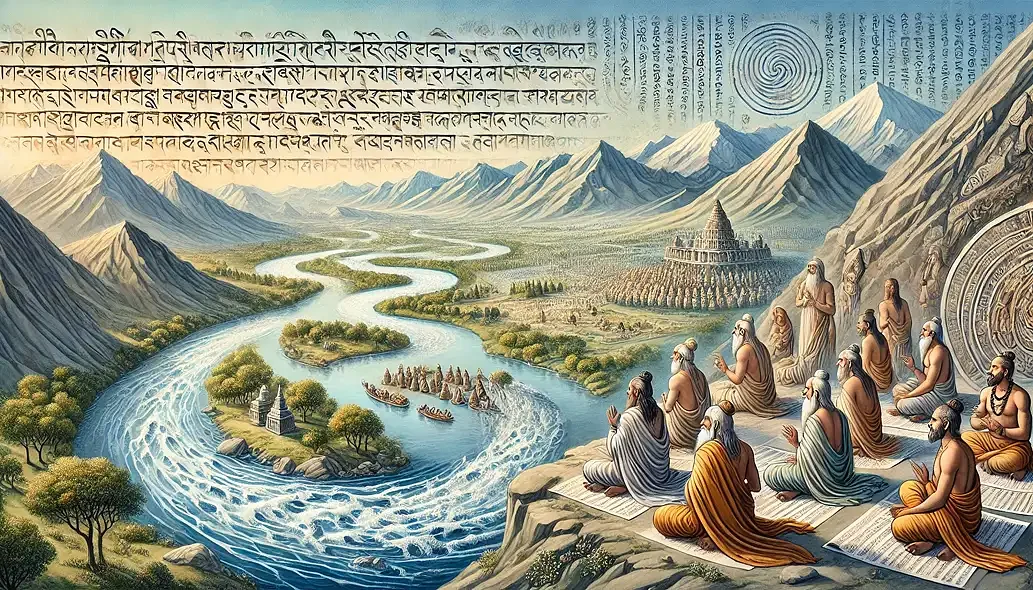
This is part 2 of our detailer on the out-of-India model of Indo-European linguistic origins and dispersals. In this section we examine textual evidence on the matter. Part 1 can be read here.
Textual
Fortunately for any researcher, textual analysis of the AIT problem suffices from the reading of a single book- the Ṛgveda. Unfortunately however, this is neither a book in a true sense nor in a language readily understandable. Further it is highly encoded, in that every word carries multiple meanings and entire verses can be interpreted from different schools of thought. For example, at one level the devas of Ṛgveda are personifications of natural phenomenon. This yields an interpretation of Ṛgvedic hymns as appeasements to the gods of nature. In another interpretation, devas are psychological phenomenon such that the same hymns are now internal calls to action, a drive to harness mental powers and direct them towards intended actions. Add to this the supremely vexing problem of Saṃskṛta itself. It has no alphabet case, no tangible way for us to differentiate between proper nouns, common nouns and adjectives. Take the word daurgaha. Daurgaha can be the name of a person, the name of a horse, a patronymic and also the property of being fast like a horse. Which meaning applies in which hymn, which interpretation to use for what verse?
On the surface this may look like an insurmountable problem. But the truth is that all of the above interpretations are correct and none are wrong. The Ṛgveda has its primal position in Hindu canon not because it’s a random bunch of prayers to gods that later Indians did not even care for. It occupies that place because it’s a Rorschach device. Its composers used phonetics and language in way that wrapped multiple layers of meaning into the same syllables, making the Ṛgveda a kind of tesseract that reflects light at several different angles. Armed with a knowledge of metre and etymology, anyone in any age could gaze upon the Ṛgveda and find meaning relevant to their epoch. This is what made Ṛgvedic hymns magical, and their composers magicians or ṛṣis.
A literal interpretation of the Ṛgveda is thus as valid as a metaphysical one, both different angles of light reflected from the same original monument of language. But when we search for proper nouns, names, tribes and places in the Ṛgveda we must remember that it’s not a historical document. It’s a collection of prayers important to the culture that engaged in them, framed in a perfected version of their native dialect. But it’s also the only text that can give us any information at all on the early Aryans, their living conditions, locales, friends and enemies, language, origins and fate. Further, the immaculate method of its preservation over the millennia has ensured that even in its current form it’s akin to a “tape-recording” of its era. This allows us to take the historical that we can find in it and assign to it a great degree of certainty. We may still summarise some inherent problems in extracting history from the Ṛgveda:
- The supremely vexing nature of Saṃskṛta. Ṛgvedic Saṃskṛta is archaic even compared to Pāṇini’s classical Saṃskṛta, and no two independent translations of the Ṛgveda have ever been the same. In a historical context, the problem is of differentiating between proper nouns, common nouns and adjectives. An example is in the Ṛgveda (RV) 7-33-14 (i.e., Book 7, Chapter 33, Verse 14) where we find the word pratṛdo. Griffith translated this as oh pratṛdas, while Jamison-Brereton (JB) read it as thrusting forth. Adding a piece of Paurāṇika genealogy to Griffith’s translation, Talageri understands pratṛdo as descendants of Pratardana (though the patronymic should be Prātardāneya). The difference comes from taking pratṛdo as a proper noun vs. an adjective. Who is correct, Griffith/Talageri or JB? Linguists, philologists, scholars and experts will tell us that they understand archaic Saṃskṛta well enough to know what the correct interpretation is. I disagree. The reality is ambiguous and points to the Ṛgveda’s multi-faceted nature. Historical readings are as correct as naturalistic or philosophical ones, though they rightly invite greater scrutiny.
- Historicity of the Anukramaṇīs. The Ṛgveda comes with a convenient index, a component in the mnemonic transmission of Vedic literature down the ages. For each of the 1,028 Ṛgvedic hymns the anukramanīs/indices give 1- the composer of each hymn or verse, 2- The deity that hymn/verse is addressed to and 3- The meter of that hymn. These indices lend themselves to a variety of historical and linguistic analysis, but they’re not considered part of the original text. This is debatable. Is the information contained in these indices part of the original tape- recording that was later compiled into anukramaṇīs? Or are the anukramaṇīs complete fabrications of a later era? Witzel criticises Talageri for taking anukramaṇīs as historical, but he actually does accept their data (composers, deities, meters) as part of the original tape-recording!
- Chronology of the Ṛgveda. Despite decades of contrary evidence, Ṛgvedic chronology is stuck in a paradigm established by a scholar who disclaimed it himself prior to his death. Motivated by a historical and cultural paradigm revealed in the letters he wrote back home, Max Muller assigned an arbitrary date of 1200 BC as the terminus date for Ṛgvedic composition. He arrived at it by linear back-dating of Brāhmaṇa and Upaniṣad texts, and was bound by his own paradigms for how far back Indian history was allowed to go. Towards the end of his life he admitted that this was a working chronology, but the paradigm has remained essentially unchanged since. Reputationists accept that the Ṛgvedic people lived along the Sarasvatī but refuse to identify the Ghaggar-Hakra river system with Ṛgvedic Sarasvatī, because a significantly large body of scholarly work on Ṛgveda and Aryans is rendered quite useless when the implications of the Sarasvatī evidence is properly understood.
Debates on the above issues are not settled. The reader must not take following conclusions as is simply because this paper says so. Neither is authority any reliability of evidence. Danino and Witzel are equally authoritative and credentialed in their fields, but while the former affirms Ṛgvedic Sarasvatī and expresses doubts on hypothetical PIE, the latter insists on the validity of PIE and is skeptical on Sarasvatī. Who is correct? The reader must decide basis their own journey to the truth. This context established, the first question we may ask of the Ṛgveda that has direct implications for AIT is this- where did its composers live? And the best answer to this comes from the 75th hymn in the 10th Book, called the Nadistuti Sūkta (Hymn in Praise of Rivers). Starting with the Gaṅgā, it moves westwards and lists the rivers of Vedic people such: Gaṅgā, Yamunā, Sarasvatī, Śutudrī, Paruṣṇī, Asiknī, Marudvṛdhā, Vitastā, Arjīkīyā, Suṣomā, Tṛṣṭamā, Susartū, Rasā, Śvetyā, Sindhu, Kubha, Gomatī, Krumū, Mehatnā.
This list is in perfect order if we move west from the Gaṅgā, the only ambiguity coming from Sarasvatī, no longer a living river. Historians such as Irfan Habib have insisted that the Ṛgvedic Sarasvatī is the river Helmand (Haraxvati) of Afghanistan. There are two problems with this. For one, anyone claiming that the Helmand is Sarasvatī needs to explain why it’s listed in the Nadistuti Sūkta so out of order, when every other river is well placed on an east-to-west movement. AIT explains this by positing that the Aryans, on their way to north India, came upon the Helmand first, named it Sarasvatī, crossed a host of other rivers including the mighty Sindhu (which they just named ‘River’!) before reaching another river which they named Sarasvatī in memory of the Helmand. The history of AIT is littered with examples of special pleading, and this is one of them.
A second problem in treating Helmand as Sarasvatī is how it breaks known linguistic connections. Sarasvatī stems from the root sarasa which itself is a compound of sa and rasa. In Avestan, the sa sound becomes the ha sound, which is why the Sindhu became Hindu (dha also becomes da in a loss of ‘aspirative’ sounds- a technicality we need not get into). If the Haraxvati was the original Sarasvatī, we should expect ha, raha and haraha to be similar roots in Avestan, but they are not. The full word sarasvatī only emerges from Saṃskṛta roots, and in Avestan those roots are divorced. For this and other reasons we can be certain that a population that knew the Indian Sarasvatī eventually migrated towards Afghanistan and, coming upon the Helmand, gave it a name to memorialise the river of its ancestors- not the other way around. Other evidence piles on here to make Helmand so untenable we need wonder why it was ever suggested- the Ṛgvedic Sarasvatī met the ocean, the Helmand does not! The Mahābhārata happens along a drying Sarasvatī and is decidedly around modern Haryana, distant Afghanistan known to it as Gāndhāra.
The Sarasvatī evidence considered, the Nadistuti Sūkta alone is enough to show that the Ṛgvedic Aryans were native to north India. Supplement this with the fact that there’s absolutely nothing in the entire Vedic literature to indicate any migration from outside. If anything, combining the Vedic and Paurāṇika literatures suggests that the ancestors of the Vedic people (though not all Indians) came from eastern UP or Bihar.
Textual analysis thus indicates that the Aryans we talk of had no memory of being foreign to India. This point needs elaboration, for across world history migratory populations have shown memory or evidence of said migration in their traditions. This is not necessarily conscious memory, but that extractable from their religion/culture/ myths- a point ignored by reputationists when they cite the example of European gypsies, who have no conscious memory of having migrated from India. Only in the case of Aryans in India would we have to plead that a group of people migrated from central Asia, retained their gods, motifs, archetypes and language, but forgot all about this trying journey by the time their descendants established themselves in north India. We should add here that in other cases- Greeks, Nordics, and more- memories of migration can be gleaned from their mythologies. In fact, even to the Greeks that came with Alexander, the first Dionysus (or patriarch) of their myths hailed from India!
That the Ṛgvedic Aryans lived in India is not disputed even by reputationists, for the Aryan invasion occurs prior to the Ṛgveda. According to it the ancestors of those who composed the text lived outside India, and brought in both language and culture with them- which was crystallised in the Ṛgveda. So a question we can ask is- do we see a movement in the Ṛgveda? Given that it was composed over a few centuries we should see in it a west-to-east geography- in the earlier stages the composers should have been familiar with India’s northwest, and only later with central and eastern India. Is this what the text reveals?
The Ṛgveda is a collection of 10 books, or maṇḍalas. Linguists, philologists, reputationists and revisionists are all in agreement over a broad periodisation of the Ṛgveda. The books 2-7, which are also called family maṇḍalas, represent an earlier period than the remaining books 1, 8, 9 and 10. There is no linear or discrete progression here. It’s not that that book 2 was composed, then 3, then 4 and so on. Instead the periodisation concludes, on basis of extensive structural study of the text, that the early books and later books are of relatively different periods. This is helpful for historical analysis, for example in the case of movement of the Aryans. If they did indeed come to India from the west, then in the early books we should see a western geography and no knowledge of the eastern geography. The eastern should come into horizon by the later books.
Reputationists criticise such analysis using strawman arguments. For example, Witzel criticises Talageri for assuming a linear progression among the books, which the latter absolutely does not. Instead, Talageri uses the same broad periodisation that’s well accepted by reputationists themselves. This is what the analysis reveals:
- Rivers in early books: Gaṅgā, Yamunā, Sarasvatī, eastern tributaries of the Sindhu
- Rivers in later books: Eastern and Western tributaries of the Sindhu
The above is a broad simplification. For one, Witzel denies the presence of Gaṅgā in early Ṛgveda. This hinges on a disagreement on the meaning of Jahnāvī, which Witzel reads as daughter of Jahnu. Talageri retaliates that such a patronymic for a female is absent in all of Vedic literature, whereas the Jahnāvī is a known name for the Gaṅgā even in later times. What the analysis reveals is that in the early period the Ṛgvedic composers were familiar with the eastern geography of India, while the western sphere opened only in the later books. This analysis of early and later periods makes the evidence clinching. Talageri doesn’t stop here. He analyses all kinds of geographical data- animals, plants, trees to find that:
- Eastern geographical references are distributed more or less evenly throughout the Ṛgveda, while,
- Western geographical references appear only in the later books and are completely absent in the early ones.
Unless one’s a reputationist, the textual evidence above is embarrassingly clinching- the Ṛgvedic people were unfamiliar with western geography in the early period, the very direction they supposedly came from! It’s why Koenraad Elst validly declares that Talageri has single-handedly won the AIT debate. Textual analysis should also define Aryan itself, for the word is derived from the Ṛgvedic Ārya as an anglicisation of it. Here the crucial facts are two- fold:
- The word Ārya is used in the Ṛgveda only for members of the Pūru- Bharata tribe, never for anyone else even if an ally.
- The word Ārya is used even for enemies, but only if they are Pūru- Bharata.
In other words, Pūru-Bhāratas are the unmistakable Āryas of the Ṛgveda. And similarly in the Zend Avesta, Airya (lending itself to later Airan or Iran) is used as a self-appellation by the Kavi tribe. As the word for us vs. ‘them.’ There is an ethnic character here, for the Pūru-Bhāratas are a separate tribe from others, and they use Ārya only to define themselves. But equally do the Iranians use the term for ethnic self-designation. Even if we stick to mainstream narrative and imagine that Aryans came to India after 1500 BC, we would have to explain why only one specific tribe used the label for itself and not any other. If Pūrus, Druhyus, Ānavas and others all migrated to India together, why did the rest become non-Ārya?
Understanding the contextual usage of Ārya in the Ṛgveda helps see the great fallacy in any Aryan invasion scenario. There never really were any people called Aryan who rode into north India on horse- pulled chariots and dislodged an urban civilisation. The idea came into existence and finds sustenance even today owing to the European search for its own glorious origins. Their modern languages compel them to accept a linguistic origin, the archaeological record shows a near domination of Corded Ware culture and descendants over ancient Europe, and genetics proves that much of European DNA can be traced back to the Steppe. Aryan is the great answer to these European questions. Racism and chauvinism ensured initially that the Aryan could never have been conceived as Indian, and reputationism in the modern era continues to deny the obvious.
In the Ṛgveda we see that Vedic Saṃskṛta is a dialect of the Pūru-Bhāratas, while other tribes have somewhat different dialects such that they are called people with “bad-speech” or using “garbled speech.” Thus the Aryan Pūru-Bhāratas are already speakers of a PIE- descendant, and could not have been the PIE people themselves. Since the Pūru-Bhāratas are the Aryans, any people before them were at best proto-Aryans and not Aryans themselves. The Pūru-Bhāratas are indigenous to north India and have no memory of foreign ancestors. Their ancestors appear to have come from the Gangetic Plains to the Sarasvatī, only later moving towards the Sindhu. Any people that migrated/invaded India before their time can, by definition, have nothing to do with Ārya. We should keep such examples in mind when attempts are made to equate language with genetics or culture.
The above alludes to a specific critique of Talageri’s Ṛgvedic analysis. His description of the Ṛgvedic pañcajana or five tribes- Yadu, Anu, Druhyu, Pūru, Turvaśa- as a PIE scenario and the assertion that Druhyu-Anu tribes are linguistic ancestors of IE language groups has been taken as a misunderstanding of the entire PIE landscape. Arnaud Fournet alleges that Talageri, rather than accepting a PIE language and homeland, only imagines a pre-existing dispersed state of different PIE-descendant dialects that Talageri equates with Ṛgvedic tribes. The critique is entirely misplaced. Talageri takes the Ṛgveda as the only available evidence, and thus makes only the conclusions possible from within it. If the Ṛgveda, with its prime focus on Sudās and his dynasty, alludes to an already dispersed state then that isn’t the text or scholar’s fault.
Instead, unless Talageri’s specific conclusions are refuted the implication of his interpretation places the PIE homeland (4000 BC – 3000 BC) at the Sindhu-Sarasvatī-Gangetic Plains, with extensive contacts to the north through modern Afghanistan, Tajikistan and Tibet. Talageri’s analysis in any case shows the PIE split to happen in modern Punjab and Haryana, but the PIE speakers hail originally from the Gaṅgā. But readers are encouraged to read original papers and studies and come to their own conclusions. Let not authority or secondary reference guide us in excavating true Indian history, which is but the history of our ancestors.
Textual analysis of the Ṛgveda doesn’t stop here. An entire body of work has been created to analyse the material culture of the Ṛgvedic people in order to place them in time and to understand their relationship to PIE speaking people. This is a field rife with contention, prejudice, distortion and all kinds of aberrations that hinder honest, intellectual discovery. Sarasvatī itself gives us an example. The Ṛgvedic people are based around the Sarasvatī, it’s their primary river and is even deified as a goddess. They describe it as a perennial river, and tell us that it flows between the Yamunā to the east and the Indus’ eastern tributaries to the west. Geological surveys since the early 19th century, now supplemented by satellite data, have established the Ghaggar-Hakra river system as the erstwhile Sarasvatī. We know that the river did actually exist, and it dried up over a few phases such that by around the Mahābhārata era it disappeared into the desert. The AIT has Aryans arriving into India after 1500 BC, but if they knew the Sarasvatī as a bounteous river, how could they have arrived after it had already dried up? Some resolve this by the Sarasvatī = Helmand argument we’ve refuted earlier. The correct resolution is that the people of the Ṛgveda were in India long before 1500 BC.
The Aryans arriving into India after 1500 BC paradigm is in any case an old hangover. So compelling is this paradigm that all theories of PIE origins work back from this date. If the Ṛgvedic Aryans were in India by 1500-1200 BC, then tracing their journey backwards we arrive at around 3000 BC as the date for their placement in the Pontic Steppe. Turning full circle in logic, any cultures found in central Asia at that time are then candidates for the original PIE culture! It’s accepted among scholars however, as we saw in the preceding section on linguistics, that PIE split somewhere in the 4th-3rd millenniums BC. This gives a linguistic hard date for when to place the PIE Aryans.
Circular logic also makes people swoon at any genetic influx into India around this time and claim that the Aryan invasion has been scientifically proven (though they engage in sophistry and are sure not to call it Aryan or invasion). But a genetic influx is just a genetic influx, it carries no information on the language and culture of those people. Pots don’t speak, and neither do genes. Whoever these people were, we know that they could not have been Ṛgvedic Aryans who were already established in India in 3000 BC, when the Sarasvatī was the kind of river described in their prayers. A small point is to be made against the critique that Sarasvatī is described as a snow-fed river, while the modern Ghaggar-Hakra is a monsoon fed system. This really is a weak argument, flimsier even than the Helmand = Sarasvatī one. India’s northern rivers are both snow-fed and rain-fed, and while the primary ones descend from the mountains many tributaries are entirely rain-fed. The river system hinted by the modern Ghaggar-Hakra would have been elaborate with several criss- crossing streams that changed course every now and then. This kind of system benefits both from melted snow and rain.
It’s telling that while the combined body of archeologists and geologists has no problem in identifying the Ghaggar-Hakra as Ṛgvedic Sarasvatī, resistance to this comes from reputationists of a linguistic origin alone. But why should linguistics reign supreme in the identification of a river system, when in the main it hasn’t even been intellectually honest about the Sarasvatī vs. Haraxvati debate? Another point to this is made by the evidence of iron, or the lack of it in the Ṛgveda. The Ṛgveda uses the word ayas which, though commonly translated to copper, could mean any metal in general. Yet it becomes clear that iron is not known to the Ṛgvedic people when only in later texts do we find kṛṣṇa ayas or iron. Ṛgvedic technology is decidedly pre-Iron Age, and Iron Age commenced in India sometime during the 2nd millennium BC. This again means that we must date the Ṛgvedic people to before that. But as is the case with Indian archaeology, dates are always being pushed back. Already we have evidence of iron in India even in 1600 BC, and meteoric iron has been found in Harappa dated to 2600 BC. We can be assured however that no amount of such evidence will ever be clinching for reputationists.
Apart from material culture, we can look to the evidence of flora and fauna. It’s best to pick the animal that’s considered the greatest thorn in the OIT argument- the horse. The horse, or aśva, is considered the totem animal in the Ṛgveda, and from here it’s been equated as the animal-par-excellence of the Aryans- giving rise to imaginations of horse-pulled chariots descending into an unsuspecting Indus valley and uprooting its civilisation. Modern iterations of AIT avoid this line of argument, primarily because chariots entering into India has been archaeologically invalidated. But the horse argument remains enduring in the general public eye, so here are some details that emerge from text:
- Aśva is not necessarily the true horse, equus caballus. It could be a generic name for equid that includes donkeys, onagers and mules- all of which are found in India.
- Aśva is also used metaphorically to mean anything with great speed and mobility. It’s used once even to refer to a deer.
- In a Ṛgvedic description of deities and their chariots, the chariot of the Aśvins (horse deities if Aśva = horse) is pulled by donkeys!
- The real animal-par-excellence of the Ṛgveda is the cow, bos indicus and by extension the bull, vṛṣabha. Cow and bull motifs are found across the world, including in the Harappan civilisation. And the cow was evidently a staple of the common Indian household since the Mesolithic.
- An archaeological point- true horse remains have been found in the Harappan civilisation. But true to their nature, reputationists dismiss/refute all non-linguistic arguments that destroy their linguistic hypothesis. Further, horses were found in the ancient world both in the regions of Afghanistan and Tibet- directly in the Indian neighbourhood.
In other words, the entire equation ‘Ṛgvedic Aśva = Horse; no horses in India; thus Ṛgvedic Aryans foreign to India’ is utter disinformation. Not only have horse remains been found in India, the horse isn’t even as totem in the Ṛgveda as we’re led to believe. Similar contentions are found in the case of other animals- leopards, tigers, monkeys, elephants and more. But the holistic picture that emerges is that Ṛgvedic geography, material culture, flora and fauna are all indigenous to India. Witzel conducts similar analysis to arrive at the conclusion that the PIE homeland was of a temperate climate unlike that found in India, which we’ve addressed in the previous section.
To sum up the textual evidence, no analysis of the Ṛgveda indicates that its composers were from outside India, or that they had any memory/knowledge of lands outside the Indian horizon. Analysis of internal evidence clearly shows an east-to-west movement prior to the Vedic period, from the Gangetic Plains to the Sarasvatī-Sindhu plains. Further, analysis of material culture reveals both the likely date for the Ṛgveda and its complete indigenity to Indian geography. A final point remains to be explored- Ṛgvedic Dāsas/Dasyus- the purported enemies of Ṛgvedic Aryans. This is crucial because the AIT rests on an Aryan vs. Non-Aryan platform. It assumes a necessary conflict between the invaders and the native, so textual analysis must address this conflict. We’ve seen how Ārya in the Ṛgveda refers exclusively to the Pūru-Bhāratas, whether enemy or ally, and never to any other even if they’re allies. These Āryas are in conflict with the Dāsas and Dasyus.
AIT tells us that Dāsas and Dasyus are the indigenous people of India- the Dravidian, Austroasiatic and Language X speaking people that were displaced by IE speaking Aryans. This of course feeds into the divisive paradigms of brahmanical vs. Dalit; Aryan vs. Dravidian; foreign vs. indigenous etc. that mar honest narratives of Indian history. It’s telling that even Dr. Ambedkar rejected the idea that Dāsas were linguistically non-IE, and concluded (correctly) that they were in fact just other (linguistically) Ārya communities. If it’s not so, then in Dāsa and Dasyu names we should find Dravidian/Austric/ other influences. But that has not been the case. In fact the Ṛgvedic Dāsas are also IE people- primarily proto-Iranians. Avestan equivalents of Dāsa and Dasyu (Daha, Dahyu) are found in proto- Iranian personal names. The Dahae (Avestan Dāsa) were a prominent Iranian tribe even in Greek times, and where Dāsa is used in the Ṛgveda in a favourable sense it’s for Dāsas who conducted donor sacrifices. It’s contained in the name of Ṛgvedic kings such as Divodāsa (though not Sudās, which has a different etymology). The Ṛgveda does not use Dāsa for alien people completely different from the Pūru-Bhāratas. It uses Dāsa for its immediate neighbours to the west, the proto-Iranians, who also speak an IE dialect different from Vedic Saṃskṛta. Witzel uses the example of names such as Balbutha and Bṛbhu to argue for symbiosis between Aryan and some kind of non-Aryan culture. Far from being incompatible with OIT, this is well explained in Talageri’s theory, which has other IE language speakers as well as Dravidian/Austroasiatic speakers placed around the Ṛgvedic Āryas.
This Ārya-Dāsa conflict is recorded even in Zoroastrian texts and reflected in the peculiar inversions of religion found therein. Ārya Devas become Iranian demons (Daiva) and Ārya Asura Medha becomes the Iranian god of light (Ahura Mazda). Āryas throw things into the fire, Dāsas don’t. Āryas worship Indra, Dāsas demonise him. Insofar as we want to find religious/ideological/ethnic conflicts in the Ṛgveda, we need not go further than the obvious. Āryas and Dāsas are both IE speaking people, descendants equally of those who spoke PIE. And the Dasyus are specifically Dāsa priests, like ṛṣis are for the Āryas. This is why the Ṛgveda reserves most of its animosity for Dasyus, while Dāsas are still spoken of favourably at times. Funnily enough, mapping this scenario to history confirms some suspicions of early AIT. The Harappan civilisation in some parts might have been peopled by Ānava (or proto-Iranian tribes, or Dāsas), and in the Ṛgveda they are in conflict with Bhāratas such as Divodāsa and Sudās. There were indeed battles between “Harappans” and “Aryans,” except these were political conflicts for control between native tribes of a common area- Indian ādivāsis all.
On the count of Dravidian names, an interesting addenda here is the names of two late Ṛgvedic composers- Irimbiṭhi and Śirimbiṭha. Even to an untrained eye these feel more Dravidian than Sanskritic, and such is confirmed linguistically. If this doesn’t seem apparent, rendering them as Irimbidi and Shirimbidam might help. There is a town in Kerala named Irimbiliyam even today, and the Keralite community of Nambūdiri Brāhmaṇas preserve the most archaic form of Vedic practices. When looking for Dravidians in the Ṛgvedic age, we find them not among enemies but among composers. It bears reiteration that both Dravidian and Aryan are only linguistic terms. They do not map onto ethnicity or culture in the ways we’re led to believe.
The above then is a summary of the textual situation. In this we have primarily looked at the textual reasons that make AIT untenable. The Ṛgvedic Aryans are firmly located in India and have no memory of a migration from outside whatsoever. Even if people lose such memories, their movements should reveal the direction. Internal analysis of the Ṛgveda shows that its composers moved from east to west. Even if the PIE homeland is outside India, it must be before the Gangetic Plains- the Tibetan Plateau for example.
There is admittedly a bit of circular logic at play here. Once we establish the paradigm, based on a Preservation Principle and the weight of archaeological evidence, that the PIE homeland was in or near north India, then we can map any number of stories in Indian literature that support ‘dispersal scenarios’ for PIE or PIE descendants. Talageri equates this with the Ṛgvedic Battle of Ten Kings- the final dispersal event for PIE- but it’s the only mapping that has legitimacy. Talageri’s understood the profoundly linguistic nature of AIT. He realises that PIE homeland theories are linguistic at best, and that linguistic reputationists themselves insist that no other disciplines can correct or confirm their conclusions. As the only linguistically valid tape-recording of the past, the Ṛgveda is the only valid document for PIE-related analysis. And the picture it shows is indeed irrefutable and clinching.
He is not alone in this. Shorn of reputationist agenda, when scholars approach the field with fresh eyes they frequently arrive at an out-of-India model. Recent examples of this are Alexander Semenenov and Igor Tonoyan-Belyayev, arriving from archaeology and linguistics respectively. Tonoyan-Belyayev (TB) uses a concept of ‘archaic periphery and innovative center.’ Under this principle, archaic linguistic elements travel to the periphery and, being placed furthest from the center of innovation, retain their original nature. The center of innovation on the other hand continues to develop new linguistic features, each of which disperse out in waves along previous dispersal routes. TB considers India to have been the original PIE innovation center, and in a later era the center shifted north/northwest to modern Iran, Afghanistan, Pakistan and Tajikistan.
To him this dispersal happened along two traditional migratory routes. The western one, leading through Iran and Anatolia to Greece, he calls Western Silver/Lapis Lazuli route. The northern, headed via Afghanistan to Central Asia, was the Northern Birch/Cattle route. The first wave was between 3700-3300 BC, when proto-Anatolian and proto-Tocharian dispersed west and northwest respectively. The second dispersal was of proto-Italic, proto-Celtic and proto-Balto-Slavic between 3300-2800 BC, a period TB poetically names the Varuṇa-Dyaus-Prithvī period. The third migratory wave was during the classical Vedic period of Indra-Agni-Soma between 2600-1900 BC, which dispersed proto-Armenian, proto-Greek and proto-Thraco-Phrygian. At this point India lost its status as a center of innovation, though it retained its position as the original pool. A final wave of proto-IE language dispersals happened from the new center of innovation between 1900-1500 BC.
TB’s work and Talageri’s are broadly in agreement with each other, though both arrive at their conclusions independently and from different backgrounds. The Ṛgvedic Aryans, who can conclusively be identified with Pūru-Bhāratas, are affirmedly indigenous to the Sarasvatī river system and have no memory of migration- nor should there be for a people who did not migrate from outside! Analysis also confirms that none of the Ārya-Dāsa or other conflicts indicated in the Ṛgveda point to any ethnic Aryan vs. Dravidian clash. A reasonable picture can be painted for the kind of PIE dispersal phases that linguists have always looked for, but ones that even Mallory- Adams concede have never been found conclusively. Within Indian history this part is problematic given the abundance of lore. Any number of eras/reigns/periods can be equated with PIE formation to dispersal scenarios. If done solely through the Ṛgveda then the answer stands evident. Unmistakably it emerges that between modern Tajikistan in the north to Haryana in the south, Afghanistan in the west to UP in the east lay the broad PIE homeland, where PIE existed likely between 3500-3500 BC and dispersed onwards from there.
This concludes part 2 of our detailer on the out-of-India model of Indo-European linguistic origins and dispersals. In the next part we will examine archaeological and genetic evidence.
References
- Cavalli-Sforza, LL et al. The History and Geography of Human Genes. Princeton University Press.
- van Driem, G. The Prehistoric Peopling of Southeast Asia.
- Danino, M. The Indo-European Cloudland.
- Mallory, JP and Adams, DQ. The Oxford Introduction to PIE and the PIE World. Oxford University Press.
- Talageri, S. The Rigveda and the Aryan Theory: A Rational Perspective.
- Kazanas, N. Indo-Aryan Origins and Other Vedic Issues. Aditya Prakashan.
- Elst, K. Ever Closer to Bhāropīyasthān- State of the Art of Out of India Debate. Etudes Classiques vol.88, Université de Namur 2020, p.85-108.
- Talageri, S. The Chronological Gulf Between the Old Rigveda and the New Rigveda.
- Tonoyan-Belyayev, IA. In Search of the Oldest Common Indo-European Urheimat: Preliminary Linguistic Evidence from Dravidian.
- Tonoyan-Belyayev, IA. A Note on PIE and Nuclear Nostratic - Preliminary Report.
- Sudarshan, TN and Madhusudan, TN. The Science and Nescience of Comparative Linguistics. Fount of Culture, Proceedings of Swadeshi Indology Conference Series, 2017.