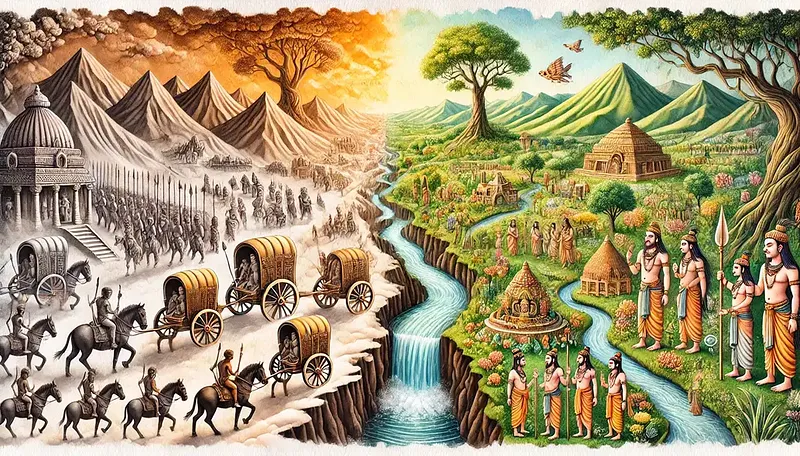
Simply put, what the Aryan Invasion/Migration/Trickling-in Theory (AIT) claims is this: After 2000 BC, a tribe or tribes of Indo-European language speakers invaded/migrated into India, bringing with them the precursors to Saṃskṛta and the Vedic culture. This claim has a number of implications attached to it. One, it implies that there exists an indigenous vs. invader divide in India, such that some of us are ādivāsi (original inhabitant) while others are not. Two, it implies that there exists a Dravidian vs. Aryan divide, roughly dividing India into a north and a south. Three, it implies that Vedic culture and religion are derived from foreign imports, meaning we should not begrudge overmuch the ravages of later foreign cultures, nor claim nativity to our own traditions.
Refuting such a theory and its claims is not an act of nationalistic chauvinism. One should have no aversion to accepting this theory and necessary implications, if but they were true. Any attempts to refute the theory are labelled ‘indigenist’ or ‘revisionist,’ implying that such attempts are agenda-driven from the outset and further- that the existing paradigm is the result of objective, non-dogmatic methodology. In fact, if attempts to refute AIT are revisionist, we must remember that any dogmatic dismissal of this is ‘reputationist.’ Decades of careers, university positions, book deals and reputations have been built on the AIT (and its receding successors). If refuting it is a revisionist act, surely dismissing revisions is a reputationist act. In a world where students can access any information on the internet instantly, a reputationist must work doubly hard to keep his position secure. Another ruling paradigm is the invasionist/migrationist one, which sees all cultural changes as the result of intrusions or influx from outside. This is a necessary paradigm for a culture that’s own expanse has been based on it, for it not to have cognitive dissonance.
In reality only the truth matters. It’s of no consequence what one’s agenda is, if the truth can stand on its own. This is why when even non-Indians have approached the problem without reputationist concerns, they’ve found compelling reasons to either refute AIT or to argue for variations of an out-of-India model (Colin Renfrew, Michel Danino, Alexandr Semenenko, Igor Tonoyan-Belyayev, Nicholas Kazanas, Koenraad Elst to name a few).
There is a partly jocular rule when it comes to the AIT. The rule is that the original Indo-European homeland tends to be close to the author’s native land. On this count I must disclaim- I was born in Benaras, and for millennia my ancestors have dwelt on the Gaṅgā’s banks, though I personally haven’t. Clearly I am motivated and could be possessed of a chauvinistic agenda. But let’s see what the truth says about itself.
Of the many mysteries to human origins, perhaps the most baffling is language. Unlike the wheel or agriculture, we cannot find archaeological ‘evidence’ for language origin, and till the advent of writing we have little to go on in visualising human speech and communication. Some like Noam Chomsky attribute language to a chance mutation that occurred in our ancestors at a single point in time. Others like Steven Pinker are inclined towards a continuum, where language emerged from precursors among our primate ancestors. Also unlike the wheel or agriculture, which are known to have emerged multiple times across different populations, linguists favour a single-origin model of language. This makes sense given that we link language to genetics, and the work of Luigi Luca Cavalli- Sforza1 does show that “the family tree relating human populations corresponds to another relating the languages of the world.” The correlation is not a congruence however, and linguist George Driem2 cautions that “linguistic ancestors are not the same set of people as genetic ancestors.”
A specific protein called FOXP2 is commonly called the language gene, because of its association with the development of speech and language in humans. The gene appears in many vertebrates, and in birds it drives birdsong while in bats it’s behind echolocation. We know that Neanderthals too possessed this gene, but that other genes are also necessary for human language development. Yet the association of FOXP2 with language reflects the intuition of a single origin of language. This intuition is reflected in the Judeo-Christian myth of the Tower of Babel, where the human survivors of a great flood originally speak the same language, but are then scattered around the world by God, their speech confounded such that they no longer understand each other. We now know that such myths are grounded in reality, and by the 18th century AD European linguists had conceptualised an Uralic language family which linked Finnish, Estonian, Hungarian and other languages together. Thus both mythical paradigm and scientific precedence were well established when Europeans first discovered Saṃskṛta.
Yet Saṃskṛta opened the doors like they’d never been before. In its archaic preservation, in its immaculate structure as presented by Pāṇini, its deep study of grammar, syntax and pronunciation- Saṃskṛta was a key that unlocked the whole field of linguistics.
Linguistic terms that put off the lay reader- gutturals, retroflexes, labio-velars and others- are but how Saṃskṛta and other Indian languages have always presented and organised their alphabet. The study of Saṃskṛta helped early linguists map language inter- relationships to a hitherto unprecedented degree, birthing an entire field called Comparative Linguistics (CL). Prior to this there was no systematic grammar, no formal understanding of language. But after CL emerged filial relationships between language groups- Celtic, Italic, Germanic, Baltic, Slavonic, Albanian, Greek, Anatolian, Armenian, Tocharian, Iranian and Indo-Aryan. Of these, the last two are groups where the term Aryan is attested. It’s contained in the very name of Iran, and in India it first appeared in the Ṛgveda as ārya. Indo-Aryan is not called Indian to avoid confusion with other Indian language families such as Dravidian.
It was established through the work of successive linguists that these language groups descended from a common mother language, called proto-Indo-European (PIE). And the groups themselves are now referred to as the Indo-European (IE) language family. More than 40% of modern humans speak a language from this family, making it the single largest language group by far. This makes consequent questions all the more important, for they have deep implications in the history of humanity. If a language such as PIE existed, where did it exist? Who spoke it? When was it spoken? And in what way did it disperse from this original homeland to all the regions where its descendants are now extant?
Notice the assumptions built into such questions. We assume that the moment in time represented by PIE also represents origins for all the culture, religion and lifestyle possessed by PIE-speaking people. In other words, PIE is implicitly taken not just as a mother-language but a mother-culture. But if Vedic culture- described by Saṃskṛta- is inherited from PIE, what proves that PIE culture wasn’t inherited from its own mother language? The search for a PIE homeland is in fact Western civilisation’s search for its ultimate roots.
If we place the PIE homeland within India, our speculations can be clubbed as the out-of-India theory (OIT). If we place the homeland, as is usually done, anywhere outside India, the theory for India is by definition that of Aryan Invasion (AIT). We won’t involve ourselves with academic sophistry that modifies AIT as a model of Aryan migration instead. The necessary implication of AIT, that Vedic culture and Saṃskṛta were brought to India from outside and gained dominance over a demographic majority, mandates that this happened through a kind of invasion. We should keep in mind that AIT was formulated well before the discovery of Harappan civilisation, and the latter’s discovery first prompted images of chariot-riding Aryans destroying peaceful Harappan cities.
When no evidence of this invasion was found, the Aryan arrival was dated to follow the Harappan demise such that a small, foreign population somehow managed to establish its language and culture over a demographic heavyweight shifting its base from Sindhu-Sarasvatī to Gaṅgā-Yamunā. Everything that such models imply requires a domination/invasion, and cannot be achieved by peaceful migration. Both in any case are untenable and without evidence.
Throughout this text, when we say AIT we refer to the gamut of invasion/migration/trickling-in/peaceful-resettlement/touring theories that all nevertheless imply the same things.
A refutal of AIT is not predicated upon refuting PIE itself. While there are conceptual problems with CL, we accept the basic linguistic implication that Saṃskṛta is a sister language to the other IE languages- not a mother. This means that Saṃskṛta was not PIE but an equal descendant of it, even if more archaic or closer to the original. In our examination of AIT we’ll stick to the facts of the case, and it need not be important what the motivations of early Europeans were. Some like Voltaire had no problem admitting to Indian antiquity and civilisational greatness. Others like Muller viewed all things Indian through a narrow Christian lens. We will of course have to consider the motivations of modern reputationists, for they form the dam (with deepening cracks) that holds back true narratives of Indian history. The current IE situation is best expressed by Michel Danino3 in his paper ‘The Indo-European Cloudland’:
“Although the Indo-European (IE) homeland theory has taken many forms and colours, it rests on the central assumption of an isolated, single proto-language in an isolated, single homeland, from which, at some point in time, Proto-Indo-European (PIE) people burst out in almost every direction to sow their linguistic seeds. But no one knows for sure where, when, why or how: after two centuries of intensive studies and often acrimonious debates, Indo-Europeanists cannot agree on the particular homeland or the date of the great dispersal.”
It’s pertinent to note that the PIE and AIT theories are linguistic at heart. Indeed, linguists insist that questions on PIE and its homeland can be answered by linguistics alone. Another way to put this is that “pots don’t speak.” Which means that archaeology can tell us nothing about the languages of people, their origins or their dispersals. While AIT in India need be discussed in the contexts of textual, archaeological, genetic and astronomical evidence as well, let us consider the linguistic first. If linguists are right about the primacy of their field in settling the debate, the following section should suffice to establish OIT.
Linguistic
Here we have The Oxford Introduction to PIE and the PIE World by JP Mallory and DQ Adams4 as a guiding light. In this eminently accessible text for the lay-reader, they examine the evidence of linguistics to explain how hypothetical PIE is reconstructed and what it implies about aspects of PIE people and their culture- physical landscape, flora and fauna, kinships and family structures, settlement/ dwelling patterns, material culture, diet, religion, mythology and ultimate origins. We get an insight into the ever-changing nature of CL, indeed of PIE itself, through Schleicher’s Tale. August Schleicher, a founding father of CL, attempted to write a complete story in reconstructed PIE. Reconstructed PIE is a hypothetical language that CL builds from its understanding of present or historically attested languages. The first sentence of Schleicher’s Tale was:
avis, jasmin varnā na ā ast, dadarka akvams.
Which translated to- “A sheep that had no wool saw horses.”
In 1939 Hermann Hirt provided an updated version- owis, jesmin wbl!nā ne ēst, dedork’e ek’wons. This came after Hirt removed the “clear sign of predominance of Saṃskṛta in reconstruction.” The first reconstruction predominantly uses the a vowel, but by the second reconstruction o, e and i gain primacy. This reflects the linguistic position that PIE used a number of vowels, which Saṃskṛta later reduced to a single a sound. But we have the real example of Romani, the IE language of gypsies which is known to have migrated out of India. Its predecessor possessed only the a vowel, while Romani possesses o, e and i as well. So we know that the change can happen in any direction.
An updated reconstruction was made in 1979 by Winfred Lehmann and L. Zgusta- owis, kwesyo wȴhnā ne ēst, eǩwons espeǩet. If this doesn’t appear arcane, the current reconstruction that was provided in 1997 by Douglas Adams should interest the reader- h2ówis, kwésyo wȴh2néh4ne (h1é) est, h1éǩwons spéǩet. Needless to say, we are asked to accept every step as hard science. Granted, there is some merit to it. The predictive power of CL was tested in a reconstruction of Latin from Romance languages- to test whether the reconstruction would be similar to actual Latin, which is well attested. It was, and linguists have been emboldened ever since to lead us to the truth through their science alone.
It’s interesting that of all the nations and civilisations in the world, India is the only country where our history is told to us by linguists, who incidentally developed their field through analysis of Saṃskṛta. IE languages dispersed across Eurasia, but this hasn’t made some Germans more indigenous than others, or some Englishmen ādivāsi over the rest. The histories and population divides of these countries are formed through a composite of several disciplines, but in India linguistic theories decide real divisions. Let’s accept for now that linguists can indeed reconstruct entirely hypothetical languages of the past. Doing so allows us to examine the conclusions made by Mallory-Adams about the original PIE homeland, its climate, flora, fauna and other conditions.
On the physical landscape of PIE, the authors conclude that:
“The picture provided by the reconstructed lexicon is not very informative concerning the physical environment of the speakers of the ancestral language, although there have been scholars enough who have tried to press the slender evidence into revealing the precise location (or type of location) inhabited by the Proto-Indo-Europeans.
AIT theories should be on shaky ground given the above conclusion alone. When a detailed, often arcane, reconstruction of PIE yields nothing conclusive about the precise location of the PIE people, how are we to already conclude the invasion/migration of an Aryan tribe in India after 2000 BC? Interestingly, a great deal of reputationist effort has gone to linguistically proving that the PIE homeland cannot have been in India. Much salience is given to the field of linguistic palaeontology, which reconstructs environment, flora and fauna to imagine the PIE world. For example, Mallory- Adams conclude that PIE did not originally have a word for sea, and that an existing word for an inland lake was instead projected to the ocean. This implies that the PIE homeland was not near the coast but in a landlocked area. Such a conclusion excludes India from consideration, for Indians based whether in the peninsula or along Sarasvatī, Sindhu and Gaṅgā knew where these rivers met the ocean. Simultaneously, it affirms any theory that places the PIE homeland around the Caspian Sea or the Pontic Steppe.
The PIE word in question here is *mori, and the question is whether it was originally a word for an ‘inland lake’ that got transferred to the ‘sea’, or the other way around. The asterisk before a word indicates that it’s reconstructed in a hypothetical language. It’s not a real word per se, but an approximation of what the word might have been in the hypothesised language. Mallory-Adams use the example of English, which is a maritime language, where the equivalent words moor and marsh refer to an inland body of water, and not the sea. This evidences to them that *mori was originally used similarly, and that there was no PIE word equivalent for the sea. But Shrikant Talageri5 points out that there is a PIE antecedent for sea in the Proto-Germanic *saiwa. Modern German uses see for lake and meer for sea, while Dutch uses meer for lake and zee for sea. Clearly, using the singular evidence of English to make a larger conclusion on PIE itself is untenable, yet Mallory-Adams do not stop there.
They conclude that words for sea in other IE languages such as Greek or Indo-Aryan must have been borrowed from non-IE sources. This renders the word samudra, though patently Indo-Aryan, a loanword from a non-Indo-Aryan language in their reckoning. But Talageri again points to the word mīra (pronounced similar to German meer) in Pāṇini’s Uṇādi Sūtras, which Pāṇini translated as samudra. By Pāṇini’s own admission, mīra was a word his rules could not derive, implying that it was more archaic than the Saṃskṛta lexicon of his time. Since mīra here means the sea, its antiquity suggests that this was the original meaning of the PIE *mori, and invalidates Mallory-Adams’ conclusion that the PIE homeland was a landlocked region which only knew inland lakes.
Samudra comes from sam + udram, where sam means together with or altogether and udra means water. Between an ocean and a lake, it’s the former where all the waters truly come together. The ‘sea- argument’ thus does nothing to refute an OIT model, nor does it offer anything to prove an AIT one. Geographical information from reconstructed PIE tells us nothing about the homeland, nor excludes India from consideration.
On the PIE climate, Mallory-Adams again concede that “(the reconstructed words) attest a basic range of atmospheric phenomena but nothing decisively as to where precisely the proto-Indo-Europeans lived.” But they point that words such as *ćaka (thin ice), *ćäke (hard snow), *kum3 (thin snow) and *kura (fine snow) indicate a cold environment. Here again AIT is not necessarily vindicated. From the Himālaya to the Pamir Mountains and the many ranges that snake out from this roof of the world, snow in all forms was familiar to the ancient Indians. We need not posit an invasion from Pontic Steppe or Siberia to explain these reconstructed words in the PIE lexicon. The current leading AIT doyen (though he calls it not an invasion), Michael Witzel, insists that the PIE homeland was situated in a temperate climate. He uses this to dismiss any out-of-India scenario because, as we all know, India is a tropical country.
Apart from Witzel’s reliance on a “cold” place familiar with “wolves and snow,” we do not really know what he means by a temperate climate. But here is a map of temperate locations in the world according to the Koppen climate classification, the most widely used climate classification system in the world:

The map above shows locations of the world with degrees of temperate climate. It’s only for the recent decades, and the climate situation in 2000 BC or earlier could have been very different. But this map is a helpful indicator that no classification of the PIE homeland as a temperate/cold place necessarily eliminates India from consideration. In any case, when we say ‘India’ here we mean a very large geography that includes the Tibetan Plateau as well as the Pamir Mountains.
The eastern Himālaya are already speculated to be the homeland of two other language groups, Tibeto-Burman and Austroasiatic (the latter is not conclusive, and its homeland could be anywhere between the eastern Himālaya and Southeast Asia). The modern Indian states of UP, Bihar, Jharkhand, Orissa, West Bengal, Assam and Arunachal Pradesh, along with the regions of Tibet and Xinjiang, have long been a global thoroughfare, with all kinds of peoples, languages and cultures both originating and travelling through here. No conclusions on the PIE climate necessarily exclude the Tibet/Terai/north Gangetic Plains from consideration. Notice also in the above map that neither the Pontic Steppe nor Anatolia proper are classified temperate.
From the reconstructed lexicon of PIE flora and fauna, Mallory- Adams conclude that the PIE people “possessed a Neolithic economy with extensive references to domestic livestock (cattle, sheep, goat, pig; possibly horse).” Note how different this image is to that of nomadic chariot-warriors raiding urban settlements with horse cavalries, and also that the above description might as well be talking about early Jhusi, Lahuradewa or Bhirrana-like cultures. Witzel argues that words such as wolf and snow are necessarily the linguistic memories of a colder climate and prove the AIT, though it’s left unanswered why Indians familiar to the Himalayan ranges or Greater Tibet would not have possessed these words. Talageri uses evidence of reconstructed PIE words for the tiger, lion, leopard, monkey, elephant and horse to firmly establish an OIT model as the only viable scenario.
Mallory-Adams caution against using negative evidence, that is, the absence of evidence as the evidence of absence. But if we are to, as is done in the wolf and snow argument, then it should be noticed that you will not find elephants and monkeys in the Steppe, nor tigers and wolves in Anatolia. But you will find them all in India. Similarly, the reconstruction of a typical PIE settlement as that made of timber, wattle and daub and wholly prior to the use of bricks has been used as an argument in favour of AIT. The Indus Valley Civilisation widely used baked bricks, or iṣtakās- a word not found in the Ṛgveda. Taking this to be a confirmation of AIT is a result of confusing the chronology and timeline of the Ṛgveda. Ever since Max Muller, the Ṛgveda is dated to around 1200 BC, leading to the narrative of Aryans arriving in India by 1500 BC, bringing Saṃskṛta and Vedic culture. The lower limit here is set by iron, or its absence in the Ṛgveda, indicating it preceded the Iron Age. The upper limit comes from the lack of baked-bricks.
Both the upper and lower limits for the date of the Ṛgveda are set by taking absence of evidence as evidence of absence. Incidentally, using this principle also indicates that the Ṛgvedic people knew ghee but not milk (since the Ṛgveda is familiar with the former but does not refer to the latter). Such is the flimsy and frankly shoddy intellectual ground that AIT theories rest on. Further, wattle-and- daub structures relying on timber were the primary settlement mode in the Gangetic Plains from at least 7000 BC. Once again- none of this necessarily excludes them from consideration as the PIE homeland (where the homeland extends north to Tibet).
A reconstruction of PIE words for basic kinship ties deserves special attention. Not only because it shows clearly the relationship between IE family branches, but also because it demonstrates a linguistic principle that confirms the OIT model. Consider the following table (rendered without IAST):

The similarities between mother, father, brother and sister are clear in the above languages, even on basic sight and sound. But what of son and daughter, where for Saṃskṛta modern Indo-Aryan speakers would instead wager putra and putrī? The apparent connections between IE languages are not just phonetic or visual. They’re based on a deeper connection in shared root sounds or syllables. Since words can often be borrowed between languages, mere phonetic similarity doesn’t suffice to establish a connection. On this account, the connection between an English son and a Dutch zoon would not have been apparent without the discovery of the Saṃskṛta sūnu.
Stemming from the root sū, which meant to birth or beget, sūnu meant one who birthed- pushed the family line forward- and also one who sowed or begat seed in the earth. Once the Saṃskṛta sūnu was discovered, a reconstructed PIE word could be established and connections mapped to other IE languages. The roots of daughter too are evident only from an investigation of Saṃskṛta, where it stems from the root duh, which meant to milk, and indicates that the daughter’s role was to milk the cow in the PIE household (incidentally, this confirms that the early PIE state was Neolithic, with animal husbandry and proto-agriculture). Alternately, duh meant to milk, in the sense of a daughter that was of child-bearing age. Both sūnu and duhitṛ are thus built atop biological and vocational roles of the PIE son and daughter. The linguistic principle at play here is what Nicholas Kazanas refers to as the Preservation Principle (PP). Before we define it, let us look at another table, this time of the comparative theonyms (names of gods) in some IE languages:

The above list only considers languages that have retained a considerable set of IE theonyms, but each theonym listed is certain to be IE. We know this because each theonym is present in at least three different families- a situation that could not arise if it were independently developed. In the case of Parjanya, we have the additional evidence of Perkunu from the Slavonic family. Saṃskṛta is presented in the first column to make clear its all-inclusiveness. Of all the IE language families, it has preserved the largest set of theonyms. Further, no two non-Saṃskṛta families have preserved a theonym that is not also present in Saṃskṛta. Now have a look at the earliest that the IE language families have been attested in history:

The current theory has the PIE people originate in the Pontic Steppe in ~3000 BC, spread to Europe over the next thousand years, and begin their journey to India in ~2000 BC- where five centuries later they compose the Ṛgveda. Is it not strange that the IE languages of the original homeland (Balto-Slavic) are attested the latest, only five hundred years ago? And if the PIE people were migrating to Europe between 3000 and 2000 BC, why is it that the first attestations there are found only after 1000 BC? The intellectual deceit here should be obvious. How is it that in the place where the PIE people went first- Europe- the languages are attested much later and only a few IE theonyms present, while in the place where the PIE people went later- India- the language is attested much earlier and that too with the full theonym set? Only in India in fact do the PIE people arrive just in time to compose the largest attested corpus in any IE language- the Vedic- whereas in mainland Europe they did no such thing!
This is where we should bring the Preservation Principle, which Nicholas Kazanas6 defines such- the people or culture that has preserved the most has moved least. In his words,
“It is a well known fact of history that people on the move for a long period tend to lose elements of their culture while their language suffers changes, as they meet with other cultures and/or have little leisure to pass their lore to the new generations.”
Both in the case of sūnu/duhitṛ and of the IE theonyms, Saṃskṛta scores highest on the Preservation Principle, indicating that it has moved the least. This brings the PIE homeland to northern India, Pakistan and Afghanistan. Kazanas supplements this with observing PP even in the sphere of poetics. “There is hardly a major poetic device in the various IE branches that is not also present in the Ṛgveda.” Koenraad Elst7 sees additional evidence come in this regard through Nick Allen, who showed that Indian traditions have retained both gross and subtle layers, while others only the gross. The principle extends to Saṃskṛta as a whole, and Kazanas quotes another linguist, Burrow:
“Vedic is a language which in most respects is more archaic and less altered from original Indo-European than any other member of the family.”
The above comes from a linguistically rigorous analysis of roots, stems and etymologies, examples from which have been discussed above. Here too the principle is evident, and while we can never linguistically prove or disprove a specific homeland, it becomes clear that this homeland was closest to north India than it was to any other purported homeland. Linguists with different PIE homeland leanings reject this principle. To them these aspects of Saṃskṛta at best evidence its archaic nature, and not that it moved least from the homeland. Kazanas goes a step further, and argues that the archaic nature has been preserved because Saṃskṛta has moved the least from the PIE homeland.
We can understand this better by trying to apply the principle to a different homeland, say the Pontic Steppe. The IE languages native in this geographical area are Baltic and Slavic. If we posit the Steppe as the PIE homeland, we have to explain why the Slavic languages lost Agni, Varuṇa and Yama, while the people who eventually reached north India managed to retain the full set despite their generations- long, arduous journey. This is supplemented with the evidence of Finno-Ugric, a language family containing Finnish, Hungarian, Estonian and others. Finno-Ugric has a number of loanwords from PIE, but PIE has no loanwords from Finno-Ugric. This can happen only when a section of PIE speakers live near Finno-Ugric speakers, but so far away from the original PIE homeland that no words are transmitted back. Placing PIE in the Pontic Steppe does not fulfil this condition. Placing it in India does (so does placing it in Anatolia, but Anatolia as the PIE homeland is untenable for other reasons).
Mallory-Adams criticise the Preservation Principle on grounds that Slavic has suffered many ravages over the years, including the ravage of Christianity. It’s unfair to compare a language as preserved as Saṃskṛta to Slavic in this view. Some might argue that languages could have existed before their first appearance in attested history- an argument that actually makes the case to antiquate Saṃskṛta more than we do! Though Saṃskṛta underwent ravages for a much longer period, and though later words such as samudra or putra came into vogue, the memory of mīra and sūnu wasn’t lost. Such a memory, Kazanas reminds us, is lost only when a people are on the move for a long period. This implies that Saṃskṛta was able to retain a link to archaic PIE roots that other languages lost. Linguists insist that the answers to PIE-questions will come from linguistics alone, yet Mallory-Adams’ tome is unable to posit either a concrete PIE homeland nor establish any AIT scenario. Using the same conclusions as them however, and supplemented with a rigorous analysis of the Ṛgveda a la Talageri or the Preservation Principle a la Kazanas, we’re able to articulate a linguistically valid OIT model.
A linguistic argument used against OIT is the presence of Dravidian language loanwords in Saṃskṛta, which are not present in IE languages outside India. This is used to posit that PIE originated elsewhere, and only Saṃskṛta came into contact with Dravidian. But Talageri8 has shown that Dravidian influences into Saṃskṛta are evident only in the later layers of the Ṛgveda, and are absent at early layers. The PIE split, though not a single event in history, occurred prior to the emergence of Dravidian influences. This means that other IE languages had already dispersed out of India by the time Saṃskṛta and Dravidian came into cultural contact. Add to this recent work by Tonoyan-Belyayev9, which not only asserts that Dravidian influences in Indo-Aryan are an adstratum (co-existent) and not a substratum (influx of one over another), but also that there are Dravidian influences to be found in other IE language families as well. As is the case with all compelling AIT arguments, they’re well resolved even in an OIT scenario. Further, PIE theory is only that of descent. It looks at the IE language families and posits a common ancestor. It makes no comment on what happens to these families after descent. Saṃskṛta, as we have agreed, is not PIE itself. It’s a daughter language, and nothing prevents it from taking on influences from other languages after its birth, while its sisters moved out of the Indian homeland.
Another example of reputationist deceit appears in the above case. Finno-Ugric languages have PIE loanwoards, but PIE does not have Finno-Ugric loanwords, yet this does not stop reputationists from positing the Steppe as the homeland. If this were true, then PIE should have Finno-Ugric loanwords, but the argument is used in the Dravidian case to exclude an Indian homeland. If PIE originated in/near/north of the Gangetic Plains, its split into daughter languages happened prior to its encounter with Dravidian languages.
In any case, this confusion on loanwords and non-IE influences rests fundamentally on a chronology of PIE. Most linguists favour a period between the 4th-3rd millenniums BC for the split of PIE, but they express valid caution in being certain about when it originated or when exactly it split. In fact, while CL can define the internal chronology of languages, it’s not equipped to define absolute chronologies- which can only come through supplementary evidence from fields like archaeology. Further, the split was not a single event that created all IE groups instantly. Some insist that Anatolian is not a daughter of PIE but a sister, meaning that both PIE and Anatolian descend equally from a proto-Anatolian-PIE. Add to this the Nostratic hypothesis which speculates to the original Tower of Babel, the hypothetical proto-language from which descended all the major language families of humanity. New questions emerge instantly- who were the Nostratic people? Where was the homeland? What was their material culture like? How much of PIE culture and genetics was inherited from the Nostratic gene, similar to how we’re told of the Aryan gene bringing Indo-Aryan languages to India? When did Nostratic split into proto-Anatolian-PIE?
Looked this way, the issue of language family origins and dispersals begins to look as contentious as that of hominid family origins and dispersals. The date of origin for our own species is consistently pushed back by newer findings. There is evidence that the Neanderthals too might have possessed language, and increasingly it looks like our family tree mated with theirs. Every new hominid fossil triggers a debate on whether it belongs to an ancestor species or to a sibling species. No neat chronology can be established from the common ancestor we share with chimpanzees, running through the many hominid species down to us, such that we know exactly when each species arose and was replaced by another (nor was the journey necessarily discrete). Neither are we clear on whether species that once diverged always remained so or whether they re-intertwined.
The landscape is ever changing and increasingly complex, and if the linguistic family tree is indeed correlated to the genetic one then it’s bound to be equally uncertain. Pointing these facts out is not a denialism of evolution by natural selection, and thus it’s equally not a denial of the entire field of Comparative Linguistics. But reputationists like to portray that critique of their work is akin to dismissal of CL itself.
More to the point, the AIT that we deal with in India is scarcely a linguistic theory alone. It has over the decades acquired ethnic, racial, cultural, genetic and archaeological layers, such that in its latest avatar the influx of particular type of DNA is taken as proof that all of Vedic culture, literature and language are a foreign import, and by extension everything under the umbrella of “Hinduism.” PIE originated in one part of the world and spread across Eurasia, but only in India do we find books with the title ‘Which of Us are Aryans.’ The problem is that language does not map congruently to ethnicity, race, culture or genetics. For example, the introduction of a new kind of potteryware in the archaeological record does not necessarily mean the arrival of a new language, and the converse is equally true. In India today, even within localised regions, we find several different languages, dialects and ethnicities coexisting in various degrees of overlap. In imagining PIE we must ask- would it have existed in isolation? Would it not have had other languages in its neighbourhood? Could the PIE homeland have been rich in other language families?
A curious implication emerges from the correlation between languages and genetics. In the latter field, an area with the largest genetic diversity is considered the origin point for that genetic trait. In a very broad application, that Africa contains the maximum variety of great apes- humans, gorillas, chimps and bonobos- attests that it’s the origin of the great ape genus. This conclusion is based on the observation that the longer a trait survives in a region, the likelier it is to evolve mutations. Thus the longer that ancient apes survived in Africa, the more they diverged into different species. Applying this principle to IE languages reveals that of the 445 living IE languages today, 313 are of the Indo-Iranian branch (Iranian and Indo-Aryan). Should this not lead us to conclude that Indo-Iran was the original homeland? New research on the PIE in any case, led by Johanna Nichols, has brought the homeland to the Bactria Margiana Archeological Complex (BMAC), an area just north of Kashmir. Nichols is almost there, as we’ll shortly see. Igor Tonoyan-Belyayev argues that the BMAC was a secondary source of PIE dispersals, coming into prominence some time after the original center in India.10
English dispersed across the globe and has become a primary language in India, but very few Indians have British genes. The religion and worldview of one tribe in the Middle East, in a few centuries, spread across the planet, but Arabian genes are not found in Muslims outside Arabia, nor is the expansion of Islam today accompanied by the dispersal of ethnic Saudi tribes. Chenghis Khan’s raid across Eurasia is said to have left his genes among many of us, and Mongols were lords of the land for a long time. But the Mongolian language does not exist today outside of a small tract of land wedged between Russia and China, and 50% of the current populace there follows a religion originated elsewhere (Buddhism). Mongols that conquered India are not even represented with Mongoloid features, their rulers acted out in Bollywood by the likes of Hrithik Roshan. When India acquired the culture of cricket it came with an internal terminology rooted in English, but that didn’t turn Indian genes British. Similarly, the spread of chess from India did not include the injection of Indian genes into all chess players. Language, culture and genes are inherited in the same way- from our parents. But they change and flow very different to each other.
But AIT proponents wants us to believe that linguistics can tell us all of this. Theories on language origin and dispersal have been conflated with race, genetics and ethnicity, and circular logic is used to prove a priori narratives. An example of this comes from the case of Brahui, the language spoken by a Balochistani tribe of the same name. When it was discovered that Brahui is a part of the Dravidian language family, AIT proponents happily proclaimed this as clinching evidence of the standard AIT narrative- that IE speaking Aryan people invaded north India and the Harappan civilisation, forcing the latter’s Dravidian people into peninsular India (notice the implicit equation of language with ethnicity). Brahui was a remnant of that Dravidian populace, we were told. But linguists such as HH Hock and Joseph Elfenbein later showed that Brahui was the relic of a recent northward migration of Dravidian-speaking people, likely between 1000 and 1500 AD (other linguists continue to disagree, leaving it for us to decide how much weight to place in any linguistic conclusion). In other words, Brahui in Balochistan has nothing to do with Aryans of 1500 BC or earlier! It was only circular logic, a kind of fatal tautology, which allowed AIT proponents to take the evidence of Brahui and fit it into an a priori narrative.
More recently this has been done with genetics. Much has been made about an influx of an R1a haplogroup in India after around 1500 BC. This lines up well with the a priori narrative of AIT- that Aryan people with Vedic languages and culture invaded India after 1500 BC (it may be called a migration but the result is the same). Viola! This R1a-Z93 is then equated to be a kind of Aryan gene, and its influx after 1500 BC is taken as proof of AIT. But as we will see, whoever the Aryans were, they were already indigenous to India in 3000 BC, so it could not have been them entering after 1500 BC. Further, Indian tradition records the influx of all kinds of Central Asian tribes- Kambojas, Hūṇas, Śākas, Yavanas, Uttarakurus and more after 1500 BC and especially in the 1st millennium BC. This R1a influx could as easily have been them, and genetic influx in itself tells us nothing about the language or culture of the people who brought it. To add to this, genetics now speculates that the R* macrofamily first originated in India and spread to Europe. Even if it originated elsewhere, its parent clade P* decidedly originated in India. What are we to make of that? Should this be used as proof that ancient Indians spread Saṃskṛta and Vedic beliefs across Eurasia? Of course not, for circular logic is just that, and genetic dispersals should not be conflated with linguistic or cultural ones.
In fact, genetic data can neatly map onto any number of imagined scenarios. Take the example of a break in the genealogical record between the Ṛgvedic Pūru-Bhāratas and the Mahābhārata’s Kuru-Bhāratas. Very little information is available around Kuru, the Kaurava patriarch, and his descent from a Bhārata prince is wrapped in myth and mystery. If we date the Mahābhārata to somewhere in the middle of the 2nd millennium BC, the Kuru dynasty’s founding dates to 2000-1900 BC. Tradition also informs us of the Uttarakurus, a tribe living north of Kashmir that Talageri equates to Tocharian. But the more common reading is Northern Kurus, while their connection to Indian Kurus is unclear. The Uttarakurus area roughly corresponds to the Russian regions east of the Urals. It could be imagined that the Kurus are migrant descendants of the Steppe Uttarakurus who enter India in 2000-1500 BC, and that they are composed primarily of elite male warriors.
This (unsupported) imagination concedes to a kind of elite- dominance invasion- the Kuru bloodline is originally foreign to India, but establishes itself in major kingdoms and emerges as the primary dynasty. But it also shows that speculation can take many routes, and the same genetic data can be used to support any number of narratives. The foreign-Kurus fabrication allows for foreign cultural and technological aspects to enter India through them, and none of it need posit an AIT like scenario. Add to this theories on origin of the proto-Turkic people, which favour an origin near modern Xinjiang- Mongolia in the late 3rd millennium BC and a dispersal west in the following millennia. The genetic story of humanity is hardly complete, yet enthusiasm to tell India its history on the basis of a few genetic immigrations is curiously replete.
On this note let’s acknowledge that we do in fact know what an Aryan invasion could look like, for we have the complete trail and record of this in Europe. The genetic composition and material culture in central Europe changed drastically in around the 4th-3rd millennia BC. Populations were replaced by newcomers from the east, bringing with them a new culture and physical type. This culture was the same as later found among Celts, Germans and Italics- indicating that it dispersed further into Europe. The current theory has these people emerging from the Yamnaya culture in the Pontic Steppe, and they have been equated to Aryans. Whether or not the last part is true, we know that when a small, primarily male, elite band invades a local, settled populace, then the signs are evident in material culture.
In India, this is a rare case where the absence of evidence is indeed the evidence of absence, so consummate is said absence. Europe might not even have been invaded just once. From 4400 BC in Varna, Bulgaria have been found hundreds of graves which show stratification between the natives (at lower levels) and an intrusive elite (at higher levels). While nothing here indicates an invasion per se, it shows that Europe faced successive immigrations from the east that replaced existing populations and cultures. These elements are not found in the Indian subcontinent at all, and it explains why reputationists pounce on a genetic influx with an “I-told-you-so” desperation.
The Yamnaya culture’s enduring association to PIE reflects Western civilisation’s search for its ethnic and linguistic genesis. Reputationist sophistry should not make us think that indigenism is unique to Indian thought. Close to 50% of European genes (on average) are comprised of the R1a haplogroup that spread there between 3000-2000 BC, and entered India in the late 2nd millennium BC. Even if scholarly circles work with dispassion, the European mind is still fascinated by the idea of horse-riding, meat-eating, well-built warrior classes invading from the Steppe and dominating the European landscape. Even now there’s a reluctance to consider that Yamnaya ancestors might have come from further east, that the true cradle of pre-Christian European culture, language and genetics could be in a country such as India.
Unfortunately for this vision however, tracing upwards the family tree of R1a leads one to India. Archaeological migration patterns in Eurasia have a clear east-to-west direction. And on linguistic grounds Michel Danino’s critique stands unchallenged. After two centuries of work linguists have not been able to agree on a PIE homeland or nature of dispersal. Options are the Steppe, Anatolia, the BMAC and India. When we bring in additional evidence from text and archaeology the weight points overwhelmingly to India. But a final point about Comparative Linguistics and its relevance to understanding Indian history is captured by Sudarshan and Madhusudan in their paper The Science and Nescience of Comparative Linguistics,11 where they assess the history of this discipline from various angles to conclude what we’ve seen examples of:
“A sober analysis of the field will highlight that much of the methods and conclusions are driven by selective data, arbitrary methods and flawed interpretations.”
Even JP Mallory agrees-
“A solution to the IE problem will more than likely be as dependent on a re-examination of the methodology and terminology involved as much as on the actual data themselves.”
What we have here then is a case of an Aryan Invasion, which under the lack of evidence was modified to a Migration, and in modern settings is the harmless dispersal of language and culture with innocent populations, based primarily on a field where critique argues a reassessment of the entire methodology and interpretations to begin with! It should be clear that rather than getting lost in AIT vs. AMT debates, we should settle for a single terminology and point instead to the absurdity of the entire narrative. In this paper we prefer Invasion since it better expresses what’s implied in any scenario- domineering foreign imports that have no evidence.
This concludes the first part of our detailer on the out-of-India model of Indo-European linguistic origins and dispersals. In the next part, we will examine other lines of evidence, beginning with the textual evidence in the Ṛgveda.
References
- Cavalli-Sforza, LL et al. The History and Geography of Human Genes. Princeton University Press.
- van Driem, G. The Prehistoric Peopling of Southeast Asia.
- Danino, M. The Indo-European Cloudland.
- Mallory, JP and Adams, DQ. The Oxford Introduction to PIE and the PIE World. Oxford University Press.
- Talageri, S. The Rigveda and the Aryan Theory: A Rational Perspective.
- Kazanas, N. Indo-Aryan Origins and Other Vedic Issues. Aditya Prakashan.
- Elst, K. Ever Closer to Bhāropīyasthān- State of the Art of Out of India Debate. Etudes Classiques vol.88, Université de Namur 2020, p.85-108.
- Talageri, S. The Chronological Gulf Between the Old Rigveda and the New Rigveda.
- Tonoyan-Belyayev, IA. In Search of the Oldest Common Indo-European Urheimat: Preliminary Linguistic Evidence from Dravidian.
- Tonoyan-Belyayev, IA. A Note on PIE and Nuclear Nostratic - Preliminary Report.
- Sudarshan, TN and Madhusudan, TN. The Science and Nescience of Comparative Linguistics. Fount of Culture, Proceedings of Swadeshi Indology Conference Series, 2017.