The first light of autumn in Bengal has always carried a promise. Long before the city's trams clattered through its streets, long before the British built their forts, the people of this delta had been calling upon the Mother Goddess. The name Durgā appears in the oldest layers of the Vedas. By the 5th–6th centuries CE, the Devīmāhātmya had woven her into the devotional imagination of the subcontinent. Terracotta plaques from the early centuries of the Common Era already show her as Mahiṣāsuramardinī, slayer of the buffalo demon. By the 15th and 16th centuries, landlords in Malda, Dinajpur, and later in Kolkata's own rājabāṛīs, were hosting grand autumnal Durgā Pūjās that fused scripture, sovereignty, and community. It is this ancient festival, with its deep textual and archaeological foundations, that finds one of its most important contemporary expressions in the clay idols crafted in Kumortuli, Kolkata. Every year, as the monsoon recedes and the air in Kolkata turns crisp, a quiet neighbourhood on the banks of the Hooghly River begins to hum with a different kind of energy. In the narrow, winding lanes of Kumortuli, hundreds of artisans, known locally as kumhārs, are deep in the work that has defined their families for generations shaping the clay forms of Goddess Durgā.

A Neighbourhood Built On Clay
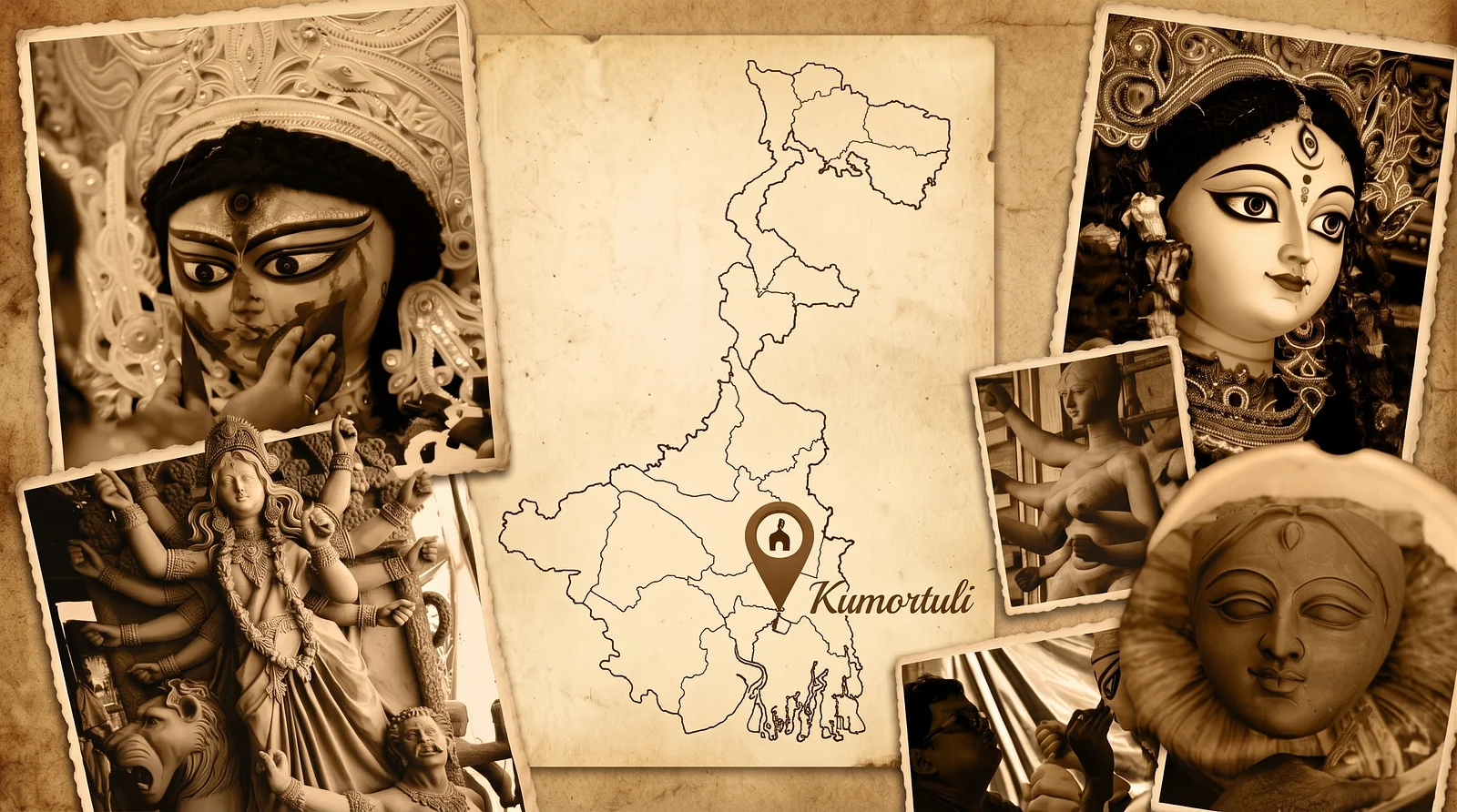
Kumortuli sits on the eastern bank of the Hooghly River in northern Kolkata, in the heart of the city's historic Jorasanko and Shobhabazar neighbourhoods. The name “Kumortuli” translates to “the potters’ quarter” in Bengali (kumor means potter, and ṭuli refers to easily walkable localities within a quarter or half a mile), and one may say it is a name well-deserved. This neighbourhood has been home to a community of talented artisans for centuries, whose primary occupation is crafting clay idols of Hindū deities, particularly Goddess Durgā.
The story of Kumortuli begins in the 17th and 18th centuries, when the first public Durgā Pūjā was organised by the Śobhābāzār Rājabāṛī family and potters from Krishnanagar in Nadia district were brought to Kolkata for their expertise in clay modelling. They settled near the river, where the alluvial soil was ideal for their craft. Over time, the area became synonymous with idol-making. Today, it remains one of the most important centres for Durgā idol craftsmanship in Bengal, with artisans creating more than 4,000 idols each year that travel not just across Kolkata but to diasporic communities in the United States, the UK, Germany, and beyond.
The neighbourhood's origins are tied to the larger history of Kolkata itself. When the British East India Company required the land at Gobindopore to build Fort William in the late 17th century, the inhabitants of that area migrated further up the river to Sutanuti, the precursor to modern-day North Kolkata. Later, when Kolkata began to grow as a major port city, talented potters from Krishnanagar and other parts of Nadia district migrated here to supply household clay items to British merchants and local households. The kumor families trace their roots to Krishnanagar in Nadia district of West Bengal, known for its clay modelling craft. The kumhārs came here in the British era to create idols of the goddess for Durgā Pūjā and eventually settled here.


Hands That Carry The Tradition
The kumhārs of Kumortuli are more than craftsmen. They are custodians of a living tradition. Their work is deeply interwoven with ritual, memory, and skill passed down from father to son, mother to daughter. While many families trace their roots to Krishnanagar and Nadia, the historic heartland of Bengal's clay artistry, Kumortuli today is a mosaic of migration. The rural–urban migration within West Bengal brings artisans from districts such as Birbhum, Bankura, North 24 Parganas, Midnapore, and Hooghly. Inter-state migration adds more diversity, with workers arriving from Bihar, Odisha, and Uttar Pradesh to join the seasonal rush of idol-making. As family involvement has waned in some households, workshops increasingly hire labour from outside without distinction of caste or religion, transforming Kumortuli into a pluralistic workspace where skill matters more than origin.
The idol-making industry in Kumortuli is predominantly male-dominated, with only about 16 percent of workers being female. Many of the businesses have operated for generations, with over 40 percent of shops being over 60 years old. During Durgā Pūjā, 88 percent of additional labour comes from within the state, with 58 percent being temporary workers.
Women in these families often contribute crucial yet under-recognised labour such as preparing the clay, decorating the idols, and painting the delicate features that give each goddess her expression. The process is laborious and exacting. Artisans build a basic frame from straw, then apply several layers of clay to create the body and finer features. The final touches are the painting of the eyes, and the adornment of jewellery and fineries, done with a reverence that transforms clay into divinity. As one observer put it, the workers of Kumortuli breathe the mud that they create with, they eat it and they die in it, a life wholly devoted to their craft.


The Folklore Of Inclusion
There is another layer to this story, one that lives more in whispered lore than in printed manuals. No Durgā idol is complete without a handful of puṇyamṛttikā, “blessed soil,” from the threshold of a niṣiddha pallī, a “forbidden quarter.” In Kolkata, this often means the bustling lanes of Sonagachi, Asia's largest red-light area. According to popular legend, a priest or senior potter must visit a sex worker's home and humbly ask for soil from her doorstep. She gives it freely, and the priest chants a mantra to energise the earth before it is mixed with Ganges clay, cow dung, and cow urine to form the sacred paste that will become the goddess. The belief, which is repeated in countless tellings, is that men leave their virtue and righteousness outside the brothel's door when they enter; what remains in the soil is thus pure, worthy of the Mother.
Another version holds that Durgā herself would be displeased if her worshippers did not seek the blessings of those whom society marginalises. This custom is widely recounted in oral traditions, travel writing, and popular media, but its exact origins remain lost in myth and story rather than documented in classical ritual manuals. What is clear is the symbolic power of the practice. It insists that the goddess belongs to all, that no one is outside her embrace, and that even the most stigmatised members of society have a share in her making. For the artisans of Kumortuli, whether or not every workshop still follows this rite to the letter, the idea of puṇyamṛttikā endures as a quiet reminder that divinity is woven from the whole of human experience, sacred and profane, honoured and hidden.

An Idol Is Born
The idol-making process in Kumortuli unfolds in three broad stages: making the kāṭhāmo (bamboo and wooden frame), preparing and applying the clay, and finally colouring and decorating the idol. This process, refined over centuries, combines technical precision with ritual significance, transforming ordinary materials into sacred forms.
Step 1: The Bamboo Skeleton
The process begins with the preparation of a wooden and bamboo framework known as the kāṭhāmo. The first step in making a Durgā idol is the foundation or skeleton structure. Artisans buy wood and bamboo from the market, cut and join them with pins, and tie them together with ropes to build the skeleton structure of the idol. Once the kāṭhāmo is complete, it is tied with straw to give it a rough shape. The straw is methodically bound together over it using other pieces of straw or string, creating a rigid yet flexible base. Before touching the dry bamboo sticks for the first idol of the season, artisans perform a ritual on Caitra Saṅkrānti, the last day of the Bengali year, invoking blessings for the work ahead. This ritual marks the beginning of the new working year and is considered essential for ensuring the success and sanctity of the idols to be created.
Step 2: The Alchemy Of Clay
Once the framework is ready, the real alchemy begins. Artisans collect sacred clay from the Ganges riverbank that is believed to bless the idol with purity and life. Firstly, the clay dug out from the riverbed of the Ganges River is kneaded and pounded until the right consistency is achieved. To remove impurities, the potters first stomp on the mud with their feet. Eṇṭel māṭi (sticky clay) is then mixed with tuṣ (rice husk) and applied all over the straw frame. This mixture is left to dry for three to four days.
The straw figurine receives the first coat of watery clay which helps fill the crevices. After that, river clay is applied on the foundation structure. The second layer is less watery and gives prominence to the figure. Once dried, the idols often show cracks, which are smoothed by strips of cloth and more layers of soft clay. The next step is known as do meṭe, whereby another layer of fine-grained clay, known as bele māṭi, is carefully applied to give a smooth and rounded structure to the idol. When the body of the idol is ready, the face, palms, and feet which are made separately are attached to the torso. The artisan renders the final shape to the idol at this stage, sculpting the features that will give the goddess her distinctive expression. The idol is then put out in the sun to dry for a few days before paint is applied, ensuring structural stability.
Step 3: Bringing Her To Life With Colour
Once the clay structure is complete, the figure is painted with white earth colour followed by coats of pink or yellow. The completion of the drying procedure gives way to colouring, which begins with a base coat of white water-soluble paint mixed with a thick sticky layer of tamarind seed paste. The eyes are then painted and other detailing done by the leading artist of the team. Traditional, matte, glossy, antique, or customized colour themes are applied based on modern preferences. Finally, the idol is decorated with clothing, ornaments, and other details that bring it to life. Each artist brings their own interpretation to the goddess's form, resulting in idols that vary in expression, posture, and adornment.


The Gift Of Eyes
There is one moment in the making of a Durgā idol that stands apart from all others. It is called cakṣurdāna (or chokkhudān in Bengali), the gift of eyes. For weeks, the idol remains faceless, its eyes left unpainted, covered, or only roughly sketched. Then, in the pre-dawn hours of Mahālayā, the day that marks the end of pitṛpakṣa (the fortnight of the ancestors) and the beginning of devīpakṣa (the fortnight of the goddess), the most senior artisan in the workshop takes up a fine brush dipped in black kājala. In a single steady stroke, sometimes after a few moments of silent contemplation the artisan paints the goddess's eyes.
It is said that until this moment, the idol is mṛnmayī, made of clay, exquisitely crafted yet unawakened. The instant the eyes are complete, she becomes cinmayī, filled with consciousness, energy, and presence.
The sculptors mostly add finishing touches to the eyes at the pāṇḍal, and for the devotees, this is a significant ritual. It is believed that after the eyes are drawn, the idol becomes ready to be worshipped. The cakṣurdāna is not entrusted to just anyone. Only the most experienced artisan, often the head of the family or the leading master of the workshop, can perform it.
Many begin their work each season with a short prayer, and the painstaking care given to every fold of drapery or curve of expression is regarded as a form of worship carried out through skilled hands rather than words. The eyes are considered the gateway of the divine; through them, Mā Durgā's power and blessings are said to reach her devotees. Mahālayā marks the shift when Durgā is believed to descend to earth, beginning her visit to her devotees, and cakṣurdāna is the visual, living sign of that arrival.

Durgā Pūjā’s UNESCO Heritage Status and the Road Ahead
What begins in the cramped workshops of North Kolkata ends up lighting up community pāṇḍals (temporary shrines) across the world. Each year, hundreds of idols are shipped abroad, carrying with them the cultural essence of Durgā Pūjā for Bengali communities who eagerly await them. “Handmade in Kumortuli” has become a mark of authenticity and reverence, solidifying the neighbourhood's role as both a cultural beacon and a bridge connecting communities across the globe. The global demand for Kumortuli idols has grown significantly in recent decades, driven by the expansion of Bengali diasporic communities and the increasing recognition of Durgā Pūjā as a UNESCO Intangible Cultural Heritage.
Artisans in Kumortuli now create idols not just for local pāṇḍals but also for communities in the United States, the United Kingdom, Germany, Australia, and the Middle East. This international reach has brought both opportunities and challenges, as artisans navigate the logistics of shipping fragile clay structures across long distances while maintaining the quality and sanctity of their work.
Kumortuli’s Challenges
Despite its cultural significance, Kumortuli faces mounting challenges. The riverbank on which the potters' quarter sits is prone to erosion, threatening both homes and workshops. In 2026, crucial restoration work was undertaken at the Kumortuli Ghat to stabilise the embankment and protect the artisans' livelihoods. Urbanisation and changing economic conditions have also taken their toll. Many younger members of potter families are seeking more stable employment in other sectors due to the seasonal nature of the work, physical demands, and modest financial returns. The cramped, unsanitary working conditions in the narrow lanes pose health risks, while rising costs for raw materials (bamboo, clay, straw, paint) strain workshops operating on razor-thin margins. Many artisans depend on middlemen who take a significant cut of the profits. In recent years, however, there have been renewed efforts to strengthen the craft. Public policies, local initiatives, and NGOs have started offering training programmes to help artisans diversify their skills, explore new markets, adopt sustainable practices, and leverage e-commerce to reach customers directly.
As Kumortuli looks to the future, several key issues will determine the trajectory of this historic neighbourhood and its craft. The balance between tradition and innovation remains a central concern, as artisans navigate the demands of a changing market while preserving the core techniques and values that define their work. Sustainability is another critical consideration. The environmental impact of idol-making, particularly the use of non-biodegradable materials in decoration and the disposal of idols after the festival, has become a topic of increasing concern. Some artisans and organisations are exploring eco-friendly alternatives, such as natural dyes and biodegradable materials, to reduce the environmental footprint of the craft.
The economic viability of the craft for future generations is perhaps the most pressing challenge. Without adequate support and investment, there is a risk that the knowledge and skills accumulated over centuries could be lost as younger people seek more stable and lucrative employment opportunities. In order to address these challenges, it will require a multi-faceted approach that combines financial support, skill development, market access, and cultural promotion.
The Mother And The Promise Of Return
Kumortuli is more than a place where idols are made. It is a place where faith is given form, where the hands of the humble shape the face of the divine, and where a city finds its heart every autumn. The kumhārs who work here, along with sculpting the clay, sculpt memory, belonging, and hope. Their fingers, stained with river mud and paint, carry the weight of centuries and the lightness of devotion. When the drums begin to beat and the dhunucī dancers sway in the smoky air, when the goddess is carried to the river and returned to the waters from which she came, something quiet and profound happens in the lanes of Kumortuli. The workshops fall still. The straw and bamboo wait. The clay rests. And the artisans, weary but fulfilled, know that their work is done for this year, for this life, for this fleeting moment of grace. But the promise remains. Next monsoon, next autumn, next season of longing and celebration, the hands will rise again. The river will give its mud, the forbidden thresholds their soil, and the mothers, sisters, and daughters of Bengal will once more welcome Durgā home.
In that promise lies the enduring power of Kumortuli- it is not just to make a goddess, but to remind a people that they are never alone, and that the Mother returns, year after year, to the sound of drums and the scent of śiuli flowers, to the narrow lanes where her face is born from the hands of those who love her most.


.png)
.png)