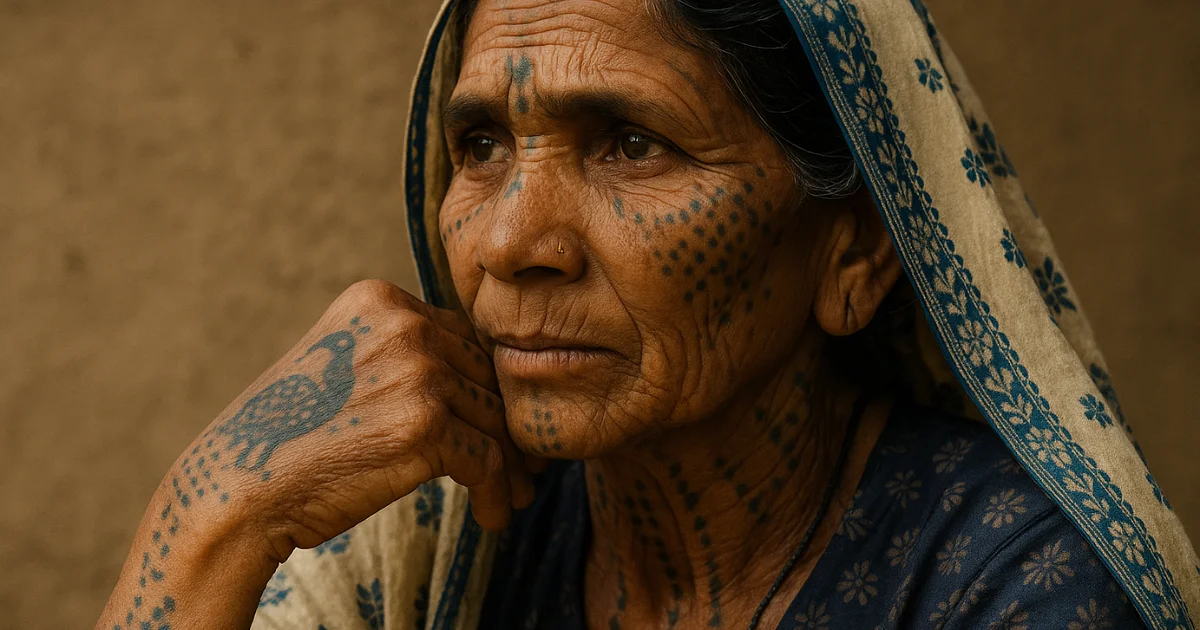
The first tattoo I ever noticed was on the wrist of a Rabari woman in Kutch. The sun had just slipped behind the salt flats, and she was sitting outside her mud house, rolling tobacco with a calm so complete that time itself seemed to pause. Her wrist bore a peacock made of tiny blue-green dots. The pigment had faded, merging with the lines of age, but it still glowed faintly when the light caught it. Seeing my curiosity, she smiled and said, “These are my jewels. They will not leave me even when I die.”
That sentence has stayed with me for years. In it was an entire cosmology: permanence amidst impermanence, wealth that cannot be looted, beauty inseparable from being. Over the past decade, while working with communities across India, I have come to see tattoos not as decoration but as a living philosophy. In deserts, forests, and mountains, ink has recorded cosmologies, kinship, and devotion. In a time before archives, the body was the text.
Western anthropology once regarded tattoos as signs of “primitiveness.” The ethnographic gaze saw them as curiosities of the savage body rather than expressions of knowledge. Alfred Gell later challenged this view, proposing that tattooing be understood as “a technique of the body” and “an art of agency” (Gell, 1993). Michael Taussig (2006) went further, reading tattooing as an act of mimicry and resistance within colonial modernity. Both are vital, but when I began to listen to tattooed women in India, I found something even deeper: the tattoo as pedagogy, as the skin’s memory of belonging.
The Body as Archive
Across India’s diverse communities—pastoral, forest-dwelling, artisanal, nomadic—tattoos, known by names such as godna (godanā), traṭṭu, or bhīlna, served as living records. In regions where literacy was marginal, the body carried what the page could not. The anthropologist Alfred Gell (1993), studying Polynesian tattooing, described tattoos as a “technology of enchantment”; a means through which art acts upon the world rather than merely representing it. Indian tattooing followed a similar logic: it was not ornament but ontology.
Women in desert communities, forest tribes, and hill regions bore tattoos that encoded kinship, jāti, and cosmology. These were not idle marks. They offered protection from spirits, fertility for crops, and remembrance of the dead. Tattoos were pedagogy in motion, inscribed on flesh.
When missionaries, colonial officers, and later development planners encountered these practices, they often misread them as superstition or barbarism. Yet, as the folklorist Kapil Tiwari (2007) observed, every design carried “the intelligence of the lived environment,” a visual grammar connecting person and place. The ink was not isolationist but ecological.
Kutch: Geometry of the Desert
The arid landscapes of Kutch, Gujarat, host one of the subcontinent’s most intricate tattoo traditions. Among Rabari, Meghwal, and Ahir women, tattooing served both aesthetic and metaphysical roles. Circles represented the sun, triangles symbolized fertility, and dots invoked protection against the dṛṣṭi, or evil eye. Designs were transmitted orally, without written manuals, from one tattooist to another.
Early twentieth-century ethnographers recorded that young women were tattooed before marriage, carrying with them marks of identity as they crossed into new families. Tattooing also functioned as portable wealth in a community that valued imperishable adornment. In an environment where drought and migration threatened stability, tattoos became the only ornaments that could not be lost.
By the mid-twentieth century, these practices began to decline. Westernized ideals of beauty, public health warnings, and urban aspirations rendered tattooing “backward.” Yet the motifs endure. Designers in Bhuj and Anjar have begun reinterpreting Rabari geometry in textiles and jewelry. As one artisan told the Times of India in 2019, “What our grandmothers wore on skin, we now weave on cloth.” The translation from skin to fabric signals both loss and revival; the pattern survives, but its pain, its pedagogy, its permanence have been displaced.
Ramnamis of Chhattisgarh: The Theology of Ink
Perhaps the most powerful example of tattooing as resistance comes from central India’s Ramnami Sampradāya. Originating in the late nineteenth century in Chhattisgarh, the movement turned the act of tattooing into a radical theology. Denied access to temples and scriptures, devotees began inscribing the name of Rāma across their bodies.

British administrators, puzzled by this “fanatic sect,” cataloged them in ethnographic surveys. Yet their practice was less a cult than a profound political theology. The Ramnamis transformed the body into scripture, asserting that divine access required no mediation. Each Rāma tattooed on skin was a defiance of social exclusion.
Today, few young Ramnamis tattoo themselves fully, though they may still mark a small Rāma on the forearm or chest. In public life, these marks remain contested; admired by anthropologists, stigmatized by employers, and quietly revered within the community. The ink that once challenged social hierarchy now negotiates modernity’s ambivalence. As one scholar wrote, “The Ramnami body is at once sacred and subversive, both archive and argument” (Kumar, 2012).
Bhils: The Cartography of Kinship
Among the Bhils of western and central India, tattooing represents an embodied geography. Traditional bhīlna designs mirror agricultural life; diamonds symbolize fields, lines stand for rivers, and clusters of dots represent stars guiding ancestors. Women’s tattoos are especially elaborate, covering arms and legs with patterns that mark lineage and territory.
Verrier Elwin’s early writings mention how Bhil women tattooed their faces to ensure recognition in the afterlife. Local myth holds that Yamarāja, the god of death, identifies souls by their tattoos, allowing them safe passage. Tattooing, then, was both protection and passport; a cosmological insurance policy.
With industrialization and migration, this symbolic geography has fractured. Younger Bhils often conceal or forgo tattooing, citing mockery in schools and workplaces. Yet faint traces persist: a mother marks her child with a dot of soot to ward off evil, a man tattoos his wife’s initials before leaving for a distant city. These gestures, though stripped of ritual depth, preserve the idea that memory must live in the body when land and lineage are lost.
Baigas: Pain as Pedagogy
The Baigas of Madhya Pradesh and Chhattisgarh have perhaps the most philosophically intricate tattoo tradition in India. For Baiga women, godna is an essential rite of passage. Without it, one remains incomplete. Each design corresponds to a life stage: dots on the forehead at puberty, serpentine lines on the arms after marriage, complex chest motifs following childbirth.
British administrators banned Baiga tattooing in the early twentieth century, describing it as “self-inflicted injury.” Missionaries condemned it as heathenism. Yet ethnographers who looked deeper found that godna carried both medical and spiritual dimensions. The soot, often mixed with cow’s milk, was believed to prevent skin ailments; the ritual pain was seen as fortifying the body’s prāṇa.

For the Baigas, tattooing is not aesthetic but ontological. It inscribes one’s relationship with the divine. The marks are permanent precisely because they accompany the soul beyond death. As one Baiga woman told anthropologist Ghosh (1974), “Jewels stay behind. The tattoo goes with us.”
Ravindra Sharma Guruji, the late philosopher of traditional knowledge systems, often invoked Baiga godna to illustrate the Indian idea of sahana-śakti, the strength to endure. “Every act of making,” he wrote, “requires patience and pain. The needle of the potter and the needle of the tattooist teach the same truth: creation is endurance.”
Dongria Kondh: Ecology and Embodiment
In Odisha’s Niyamgiri hills, the Dongria Kondh community carries tattooing into the terrain of ecology. Their facial tattoos, composed of vertical and dotted lines, echo woven bamboo baskets and forest vines. Traditionally, girls received tattoos at adolescence to signify maturity and alliance with Niyam Rāja, the mountain deity who sustains their world.
When multinational corporations sought to mine bauxite in Niyamgiri, these marks took on political meaning. Photographs of tattooed Dongria women became icons of resistance. Yet within their own cosmology, the tattoos were not political slogans but spiritual commitments. “Without these marks,” one elder said during a community meeting recorded by local activists, “the mountain would not recognize us.”
The anthropologist Tim Ingold (2011) describes making as “a correspondence with the world.” The Dongria practice embodies that idea: tattooing is correspondence between skin and soil, between body and mountain. The ink marks not defiance but relationship; a covenant written on skin.
Tholu Bommalāta: The Puppeteers’ Code
In Andhra Pradesh, tattooing intersected with the art of shadow puppetry known as Tholu Bommalāta. Among the traditional puppeteer jātis, performers tattooed frogs, lizards, or celestial motifs on their hands and arms. These marks invoked rain and ensured skill in performance.
In one account from the 1950s recorded by folklorist Anant Rao, a puppeteer explained that the frog tattoo kept his voice steady during monsoon plays. The ink, he said, connected his body to the rhythms of nature. During performances, the tattooed hand manipulating the puppet would glow behind the screen, merging human and shadow.
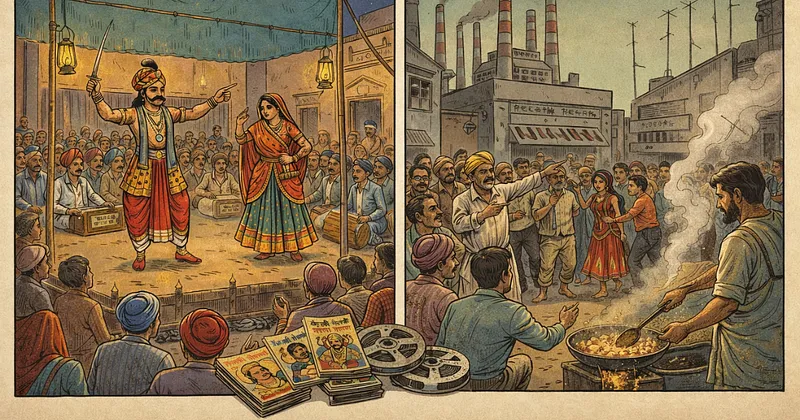
As folk theater declined under the weight of cinema and television, these tattoos faded. Yet in some villages, puppeteers still paint temporary designs during rain festivals. The motif survives, reinterpreted as nostalgia rather than necessity. As Kapil Tiwari observed in a later essay, “When performance ceases to be ritual, it becomes memory, but even memory performs.”
Konyak Nagas: From Valor to Heritage
Far to the northeast, the Konyak Nagas of Nagaland once wore tattoos as badges of valor. Facial and chest tattoos marked warriors who had taken heads in battle. The ink, a deep indigo made from tree sap and soot, symbolized both courage and community.
Christian missionaries, arriving in the early twentieth century, discouraged tattooing as “pagan.” By the 1950s, the practice had nearly vanished. Today, tattooing among the Konyaks survives only as heritage, displayed in festivals like Aoling. Young artists replicate ancestral designs on cloth and skin, not as proof of conquest but as homage.
The transformation is profound. Tattoos that once celebrated warfare now signify cultural continuity. Anthropologists note that in contemporary Konyak discourse, the tattoo is no longer a mark of violence but of remembrance. “Our ink has changed,” a young Konyak artist told the Hindu (2019), “but our story has not.”
The Global Skin: Colonialism and Reclamation
The Indian history of tattooing resonates with global trajectories. In Polynesia, tatau signified genealogy and rank until missionaries banned it. In West Africa, scarification performed similar roles of lineage and healing before colonial administrations outlawed it. Among Native Americans and Indigenous peoples of the Andes, tattooing and body painting encoded cosmologies tied to land.
Silvia Rivera Cusicanqui (2010), the Aymara scholar, has described the body as “the first territory of colonization and resistance.” Colonialism sought to erase indigenous marks, to replace embodied memory with written law. To tattoo oneself, therefore, was to reclaim sovereignty over the body.
Michael Taussig (2006) called this “the nervous system of colonialism”—the way power operates through the control of visibility. Tattoos, in this sense, disrupt colonial visibility. They make the subaltern body visible on its own terms.
Indian practices mirror this politics of embodiment. The Ramnamis turned exclusion into a sacred inscription. Dongria women transformed ecological kinship into resistance. Baiga women carried metaphysics in pigment. Each tradition enacts what James Clifford (1988) called “traveling cultures”: ways in which ideas, symbols, and bodies move through colonial modernity without surrendering their core.
Between Erasure and Revival
In contemporary India, tattooing lives at the intersection of loss and revival. Urban tattoo studios borrow tribal motifs stripped of meaning, while rural youth abandon traditional designs under pressure to “modernize.” Yet there are also countercurrents. Artists and scholars have begun documenting indigenous tattoo practices as living heritage.
In Gujarat, design collectives collaborate with Rabari elders to preserve traditional motifs. In Odisha, activists organize “Godna Festivals” celebrating Ādivāsī aesthetics. In Chhattisgarh, Ramnami elders conduct workshops for younger generations. These efforts mark a shift from salvage ethnography to participatory preservation. The communities are no longer objects of study but agents of revival.

Still, one must ask what is lost when ink moves from body to museum, from ritual to archive. Alfred Gell’s insight that art mediates relationships rather than represents objects is instructive here. When tattoos are photographed or stylized for galleries, their agency transforms. They become images of something once alive, not living relationships themselves.
The Philosophy of Permanence
Tattooing’s persistence challenges the metaphysical hierarchy between body and spirit that underlies much of modern thought. In Indian philosophy, the body (deha) is transient, while the soul (ātman) endures. Tattooing inverts that hierarchy: it invests the body with continuity. The mark endures beyond the skin’s decay.
Ravindra Sharma Guruji interpreted such acts through the lens of sahana śakti—the aesthetic of endurance. For him, every act of making, whether carving wood or inscribing skin, involved moral discipline. “Pain is not to be escaped,” he said, “it is to be refined.” The tattoo embodies that principle.
Tim Ingold’s notion of “correspondence” between humans and their environment deepens this idea. Tattooing is correspondence made permanent. It inscribes on the skin what already lives in relationship: the rhythm of the desert, the hum of the forest, the silence of the mountain.
Reading the Skin
To read the history of Indian tattoos is to read a subcontinent written in flesh. Each region’s marks tell a different story: in Kutch, permanence against impermanence; in Chhattisgarh, devotion against exclusion; in Madhya Pradesh, geography against displacement; in Odisha, ecology against mining; in Nagaland, memory against forgetting.
If one sees beyond the anthropological categories of tribe or caste, what emerges is a civilizational idea: that knowledge must be embodied. Kapil Kapoor (2012) wrote that in one of his essays, vidyā (knowledge) and deha (body) were never separate. To know was to live, to carry, to enact. Tattoos are that principle written literally: knowledge as incision.
The Baiga woman who told a visiting ethnographer, “Jewels stay behind, tattoos go with us,” was not speaking metaphorically. She articulated a cosmology of continuity. When a tradition survives colonization, conversion, and modernity through marks on skin, it proves that memory is not only in archives or monuments. It is in the body that remembers.
The Closing Ink
In a world obsessed with erasing marks of age, of jāti, of history, the Indian tattoo stands as quiet defiance. It insists that meaning is not in purity but in permanence. When the Rabari woman said her tattoos were her jewels, she was offering a philosophy: that value lies in what cannot be separated from the self.
Tattooing in India, like in many Indigenous worlds, reveals an epistemology of endurance. It teaches that art is not made for display but for continuity, that knowledge is not stored but lived, that the body is not a prison of the soul but its companion in remembering.
The ink may fade, but its philosophy endures. The marks on India’s skin remain; subtle, resilient, waiting to be read again, not as remnants of the past but as quiet lessons in how to inhabit the world with memory.
References
- Clifford, J. (1988). The predicament of culture: Twentieth-century ethnography, literature, and art. Harvard University Press.
- Cusicanqui, S. R. (2010). Ch’ixinakax utxiwa: A reflection on practices and discourses of decolonization. Tinta Limón.
- Elwin, V. (1943). The Aboriginals. Oxford University Press.
- Gell, A. (1993). Wrapping in images: Tattooing in Polynesia. Clarendon Press.
- Ghosh, M. (1974). Folk life and custom in central India. Anthropological Survey of India.
- Ingold, T. (2011). Being alive: Essays on movement, knowledge and description. Routledge.
- Kapoor, K. (2012). Dimensions of Indian culture. D.K. Printworld.
- Kumar, S. (2012). Embodied devotion: Caste and the politics of the Ramnami movement. South Asia Journal of Culture, 5(2), 45–61.
- Sharma, R. (2003). Rural knowledge systems and the living tradition. Chetna Samiti Archives.
- Taussig, M. (2006). My cocaine museum. University of Chicago Press.
- Tiwari, K. (2007). Lok kala aur loka ke sangeet. Bharat Bhavan Publication.
Note: The images are AI-generated.