Introduction: When Bengal Wakes Up to Mā Durgā
There are festivals, and then there is Durgā Pūjā.
In Bengal, Durgā Pūjā is not merely a religious celebration. It is an emotion that lives in the heart of every Bengali. It is the sound of dhaak in the autumn air, the fragrance of shiuli flowers in the early morning, the glow of lights illuminating familiar streets, the excitement of new clothes, and the warmth of families coming together. Above all, it is the feeling of welcoming Mā Durgā home.
For Bengalis, the arrival of Durgā Pūjā begins long before the first day of the festival. It begins with Mahālaya , a morning that carries a unique magic. It is the moment when the atmosphere changes, when autumn begins to feel sacred, and when the countdown to Mā's arrival truly starts.

From Mahālaya to Daśamī, every day has its own significance, rituals, and emotions. The celebrations are filled with devotion, but they are also deeply personal. They connect generations, bring communities together, and remind us of the eternal victory of good over evil.
To understand Durgā Pūjā in Bengal, one must look beyond the magnificent pandals and elaborate idols. One must experience the rituals that give the festival its soul.
1. Mahālaya: The Dawn of Devī Pakṣa
For many Bengalis, Mahālaya is one of the most emotionally significant mornings of the year.
The day begins before sunrise. Homes that are usually quiet at that hour come alive with the familiar voice of Birendra Krishna Bhadra narrating Mahiṣāsura Mardinī . Through his powerful recitation, Saṃskṛta chants, devotional songs, and descriptions of the divine battle between Mā Durgā and Mahiṣāsura , generations of Bengalis have welcomed the beginning of Devī Pakṣa.
For many families, listening to Mahiṣāsura Mardinī on the radio has been a cherished tradition. Today, people may listen on televisions and mobile phones, but the emotion remains unchanged. Parents introduce the experience to their children, while older generations revisit memories of their own childhoods.
Mahālaya marks the transition from Pitṛ Pakṣa to Devī Pakṣa in the traditional Hindū calendar. It is also associated with Tarpaṇa, the ritual offering of water to one's ancestors, performed by many devotees to express gratitude and remember those who came before them.
As the darkness of night gives way to the first light of dawn, something changes within us. The familiar chants awaken a sense of anticipation. The streets begin to prepare for the celebrations, artisans put the finishing touches on their idols, and the entire state seems to draw a breath of devotion.
Mahālaya is more than a date on the calendar. It is the announcement that Mā is on her way.

2. Bodhon and the Beginning of the Main Festivities
Although Mahālaya marks the beginning of Devī Pakṣa, the main Durgā Pūjā festivities traditionally unfold over the days of Ṣaṣṭhī, Saptamī, Aṣṭamī, Navamī, and Daśamī.
The arrival of Mā Durgā is celebrated with the belief that she returns to her parental home in Bengal, accompanied by her children: Lakṣmī, Sarasvatī, Kārttikeya, and Gaṇeśa .
This imagery makes Durgā Pūjā deeply intimate. Mā is not only the supreme divine power who destroys evil; she is also a daughter returning home, a mother surrounded by her family, and a beloved presence welcomed into the lives of her devotees.
On Ṣaṣṭhī, the ceremonial welcoming of the Goddess takes place. One of the important rituals is Bodhon, the invocation or awakening of the Goddess, traditionally performed according to the prescribed ritual procedures. The Adhivāsa and Āmantraṇ rituals are also associated with invoking and welcoming the divine presence.
The idol, which has been carefully crafted and worshipped in anticipation, becomes the centre of the community's devotion.
From this point onward, the celebrations grow more intense. The sound of the dhaak becomes louder, the pandals fill with visitors, and the neighbourhood begins to feel like one large family preparing to welcome its most beloved guest.
3. Saptamī: Nabapatrikā, Kolā Bou, and the Ritual of Ghaṭa Sthāpana
Saptamī marks one of the most important mornings of Durgā Pūjā. For many Bengali communities, the day begins early, with preparations for the rituals that formally establish the worship of Mā Durgā.
One of the most distinctive traditions of Bengali Durgā Pūjā is the worship of the Nabapatrikā, popularly known as Kolā Bou.
The Early-Morning Journey to the Water
In many neighbourhoods, members of the pūjā committee and local residents gather before sunrise and walk together towards a nearby pond, lake, or river. The atmosphere is filled with devotion and quiet excitement. The early-morning air, the sound of the dhaak, and the sight of neighbours walking together make this ritual unforgettable.
The Nabapatrikā is prepared using nine plants or plant parts, traditionally representing different forms of sacred and agricultural abundance. These are bound together, with the banana plant forming the most recognisable part of the arrangement.
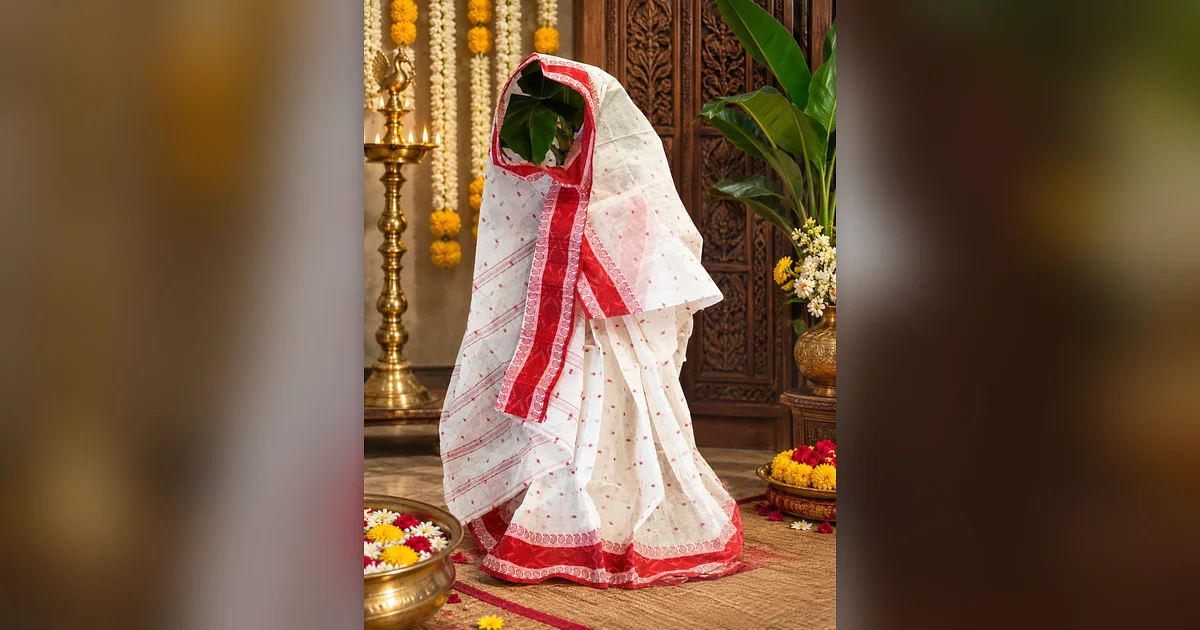
The Nabapatrikā is then bathed in water in a ritual commonly known as Nabapatrikā Snan. Afterwards, it is dressed in a sāṛī, often creating the appearance of a newly married Bengali bride.
It is carried back to the pandal with care and reverence. The sight of the Kolā Bou being carried in a ceremonial procession is one of the most recognisable scenes of Saptamī morning.
Who is Kolā Bou?

The name Kolā Bou literally evokes the banana plant dressed as a bride. In Bengali popular understanding, she is often described as Gaṇeśa's wife. However, in the ritual tradition, the figure represents the Nabapatrikā, a sacred grouping of plants associated with the Goddess and the worship of nature's abundance.
The nine plants are commonly interpreted in connection with nine divine forms, though explanations can vary across ritual traditions.
The Nabapatrikā is placed beside Gaṇeśa's image in the pūjā arrangement. This placement, together with the bridal appearance, has made the Kolā Bou one of the most beloved and distinctive features of Bengali Durgā Pūjā.
The ritual reminds us that divinity is not confined to the human form. It is also honoured in vegetation, fertility, harvest, and the natural world that sustains life.
Ghaṭa Sthāpana and the Establishment of Sacred Presence

Another important element of the pūjā is the ghaṭa or ghaṭ or kalasha, a sacred pot used in ritual worship. Depending on the community's tradition and the specific pūjā procedure, its establishment and worship may take place at different points in the sequence of rituals.
The ghaṭ symbolises sacred presence, auspiciousness, and the life-sustaining power of water. It is prepared with prescribed ritual materials and worshipped with mantras and offerings.
Although the exact order of the rites varies, their purpose is the same: to create a sacred space in which the Goddess is invoked and worshipped with reverence.
For the people of the neighbourhood, Saptamī is also about participation. Children watch the rituals with curiosity, elders guide the younger members, and neighbours work together to make every arrangement possible.
The rituals bring the community together, reminding everyone that Durgā Pūjā is both a spiritual practice and a shared cultural inheritance.
4. Aṣṭamī: Añjali, Fasting, and the Heart of Devotion

If Mahālaya awakens the emotion of Durgā Pūjā, Aṣṭamī brings devotion to its most intense expression.
For many Bengalis, Mahā Aṣṭamī is the spiritual heart of the festival. The morning carries a special stillness, even as the pandals begin to fill with devotees dressed in their finest traditional clothes.
Women arrive in beautiful sāṛīs, men wear kurtās, and families gather before the Goddess. The fragrance of flowers and incense fills the air, while the sound of mantras and dhaak creates an atmosphere that feels different from any other day.
Puṣpāñjali: Offering flowers to Mā
One of the most cherished rituals of Aṣṭamī is Puṣpāñjali, the offering of flowers to Mā Durgā.
Devotees gather with flowers, often accompanied by bel (bilva) leaves or other prescribed offerings, as the priest recites Saṃskṛta mantras. They repeat the mantras and offer the flowers at the appropriate moment, surrendering their prayers, hopes, gratitude, and wishes to the Goddess.
For many people, this is not simply a ritual to be completed. It is a moment of connection.
Some pray for the well-being of their families. Others seek strength, wisdom, protection, or peace. Many simply stand before Mā with a full heart, grateful to have reached another year of this sacred celebration.
The familiar call of the priest, the collective chanting, and the simultaneous offering of flowers create a powerful sense of unity. For a few moments, individual worries seem to dissolve into a shared act of devotion.
Why do many devotees fast on Aṣṭamī?
Fasting is another important tradition for many Bengali devotees on Aṣṭamī. Some observe a strict fast until the completion of añjali , while others follow a form of fasting suited to their family traditions and personal circumstances.
The practice is understood as a way of expressing devotion, discipline, and dedication to the Goddess.
However, fasting is not universal, and the exact observance differs from family to family. The essential spirit of the day lies in sincere worship rather than in comparing how strictly someone observes a particular practice.
The emotion of wearing a sāṛī on Aṣṭamī
For Bengali women, especially those who grew up participating in Durgā Pūjā with their families, dressing in a sāṛī on Aṣṭamī can carry a special emotional significance.
A mother may help her daughter drape her first sāṛī. Sisters may get ready together. Friends may gather to take photographs before heading to the pandal. A sāṛī inherited from a mother or grandmother can carry memories that are as meaningful as the celebration itself.
The beauty of Aṣṭamī lies in the way devotion and everyday life come together. Rituals, clothing, family memories, and personal prayers become part of one larger experience.
Sandhi Pūjā: The Sacred Transition
Another major ritual associated with Durgā Pūjā is Sandhi pūjā, performed at the transition between Aṣṭamī and Navamī.
The ritual takes place during the final 24 minutes of Aṣṭamī and the first 24 minutes of Navamī, together forming the sacred 48-minute Sandhi period.
According to a widely followed account in the Devī Mahatmya, the Goddess manifests the fierce form of Cāmuṇḍā to destroy Caṇḍa and Muṇḍa , two forces associated with Mahiṣāsura's army. Sandhi pūjā commemorates this divine victory.
In traditional worship, the period is marked by special offerings and prescribed rites. Many pūjās include 108 lamps, 108 lotuses, or other offerings according to local custom and the resources available.
The atmosphere during Sandhi pūjā can be extraordinary. The rhythmic beating of the dhaak, the glow of lamps, and the concentrated devotion of the worshippers make this one of the most powerful moments of the festival.
It reminds devotees that divine strength can emerge at the decisive moment when darkness appears most threatening.
5. Navamī: Family, Food, and the Joy of Togetherness
After the intensity of Aṣṭamī, Navamī brings a different kind of happiness. The devotion remains, but the day also becomes an opportunity to gather with family, share meals, and enjoy the final hours of Mā's stay.
For many Bengali households, food is an essential part of the celebration. A festive meal is not simply about satisfying hunger; it is a way of expressing affection and preserving family traditions.
Homes fill with the aroma of familiar Bengali dishes. Depending on the family, the menu may include luchi, cholar dal, pulao, labra, alur dom, fish preparations, chutney, and sweets such as sandesh or rosogolla. Some families prepare entirely vegetarian meals for the occasion, while others follow different culinary customs.
There is no single menu for every Bengali household. What matters is the pleasure of sitting together, serving one another, sharing stories, and enjoying food prepared with care.
Navamī is also a time for relatives and friends to visit one another. Children play together, elders exchange memories of earlier Durgā Pūjās, and conversations continue long after the meal is finished.
Pandal hopping: A tradition of celebration
As evening arrives, another beloved tradition takes centre stage: pandal hopping.
In Bengal, neighbourhoods transform into extraordinary displays of creativity. Some pandals recreate historical architecture, others explore contemporary themes, and many showcase traditional craftsmanship, intricate lighting, and elaborate artistic installations.
Families and groups of friends set out to visit as many pandals as they can. Some plan their routes carefully, while others simply follow the crowds and discover new places along the way.
The experience is about much more than viewing idols. It is about walking together beneath illuminated streets, tasting festive snacks, taking photographs, meeting familiar faces, and discovering the imagination of local artists.
Even people who have moved away from Bengal often return during Durgā Pūjā because these experiences are difficult to reproduce elsewhere.
Navamī carries a bittersweet beauty. Everyone knows that the farewell is approaching, but for now, the night belongs to celebration.
6. Daśamī: Sindūr Khelā, Dhunuchi Naach, and the Farewell to Mā
Daśamī is perhaps the most emotionally complex day of Durgā Pūjā.
It is a day of celebration, ritual completion, and farewell. The Goddess has been worshipped with devotion, welcomed with joy, and surrounded by the love of her devotees. Now the time has come for her departure.
For many Bengalis, the thought of saying goodbye to Mā is difficult even before the rituals begin.

Devī Baraṇ: A farewell filled with affection
One of the important Daśamī customs is Devī Baraṇ, also commonly called Durgā Baraṇ.
Traditionally, married women perform this ritual before the immersion of the Goddess. They offer items such as sweets, betel leaves, betel nuts, and other auspicious materials according to local custom. They may apply vermilion to the Goddess and pray for the well-being of their families.
The ritual is an expression of affection and reverence, almost like accompanying a beloved daughter as she prepares to leave her parental home.
The Goddess is not simply an idol being taken away. In the emotional world of Bengali Durgā Pūjā, she is the daughter who has spent several days among her loved ones and must now return to her divine abode.
Sindūr Khelā : Sharing the Goddess's blessing
Following Devī Baraṇ, many Bengali communities celebrate Sindūr Khelā, a tradition particularly associated with married Hindū women.
Women dressed in traditional sāṛīs gather before Mā Durgā. They offer vermilion to the Goddess and apply it to her forehead and cheek, according to local practice. They then apply vermilion to one another, exchange greetings, and seek blessings for their families.
The red Sindūr is associated with marital auspiciousness, and the ritual has traditionally been connected with prayers for the long life and well-being of husbands and families.
Today, the celebration is also experienced as a moment of solidarity, affection, and shared identity among women. The images of women laughing, embracing, and smearing one another with vermilion have become iconic representations of Daśamī in Bengal.
Yet beneath the colour and celebration lies a tender emotion. Every application of Sindūr carries the awareness that Mā is about to leave.
It is a way of sharing affection with the Goddess and with one another before the farewell.
Dhunuchi Naach: Dancing in Devotion
Among the most spectacular sights of Durgā Pūjā is Dhunuchi Naach.
A dhunuchi is a traditional incense burner, commonly made from earthenware, in which coconut husk or other combustible material is used to produce fragrant smoke, often with incense. During the dance, participants hold the dhunuchi and move rhythmically to the beat of the dhaak.
Dhunuchi Naach is often associated with the evening worship of the Goddess, including the festive atmosphere of Aṣṭamī and Pūjāvamī. In many communities, it also features prominently in Daśamī celebrations and farewell gatherings.
The dance is both an offering and a celebration. The smoke rises in swirling patterns, the dhaak beats with increasing intensity, and the dancers move with a mixture of concentration, energy, and devotion.
Some dancers perform with remarkable skill, while others join simply because the music is impossible to resist. For spectators, the moment is unforgettable.
Dhunuchi Naach captures the spirit of Durgā Pūjā beautifully: devotion that is not confined to silence, but expressed through movement, music, and collective joy.
Bisarjan: Accompanying Mā to the water
Finally comes Bisarjan, the immersion of the Goddess's idol.
The community gathers to accompany Mā Durgā towards a nearby pond, lake, river, or designated immersion site. The procession is often filled with the sound of dhaak, devotional calls, and emotional farewells.
People raise the familiar cry, Aschhe bochhor abar hobe — next year, it will happen again.
The words offer hope in the midst of sadness. They acknowledge that the celebration must end, but they also promise that the separation is temporary.
The idol is immersed in water as part of the traditional conclusion of the worship. The physical form returns to the elements, while the Goddess's presence remains in the hearts of her devotees.
For many people, the most emotional moment comes after the immersion, when the crowds begin to disperse and the streets gradually grow quieter.
The lights may still be on, the decorations may remain, and the dhaak may still be heard in the distance. But something has changed. The homecoming is over.
7. Bijoya Daśamī: The Celebration Continues Through Relationships
Although the immersion marks the end of the main public festivities, the spirit of Durgā Pūjā continues through Bijoya Daśamī and the days that follow.
Families exchange greetings, visit relatives, offer sweets, and seek blessings from elders. Younger members bow to their elders, while friends and acquaintances embrace and wish one another well.
These customs strengthen the relationships that make Durgā Pūjā so meaningful. The festival may centre on the worship of Mā Durgā, but its blessings are carried forward through the love, generosity, and goodwill people share.
In this sense, Bijoya is not simply the end of a festival. It is a reminder to carry the values of the celebration into everyday life.
8. The Deeper Meaning of Durgā Pūjā
Durgā Pūjā commemorates the victory of the Goddess over Mahiṣāsura, symbolising the triumph of divine power over destructive forces. Yet its meaning extends beyond a single story of good overcoming evil.

The rituals offer different ways of understanding this victory.
The invocation of the Goddess reminds us to recognise the sacred. The worship of the Nabapatrikā honours nature and its life-giving abundance. Puṣpāñjali encourages surrender, gratitude, and prayer. Sandhi pūjā recalls the decisive power required to overcome darkness. The gatherings, meals, and shared celebrations strengthen community bonds.
And Daśamī teaches us something equally important: how to say goodbye while holding on to hope.
Durgā Pūjā also brings the divine into the rhythms of ordinary life. It connects spirituality with food, art, music, family, friendship, and community participation.
For Bengalis, these connections are not separate from the religious significance of the festival. They are part of the way the festival is lived and remembered.
Conclusion: Mā Leaves, but the Emotion Remains
When Daśamī arrives, every Bengali heart seems to carry two emotions at once: gratitude for the days spent with Mā and sadness that the celebration is ending.
We return home after the immersion with tired feet, vermilion-stained hands, memories of the pandals, and photographs of moments we wish could last a little longer.
The dhaak slowly fades. The festive lights eventually come down. Everyday responsibilities return, and the streets begin to look familiar again.
But Mahālaya will come once more.
The early-morning chants will awaken memories. The shiuli flowers will bloom. The artisans will prepare their clay and straw. The pandals will rise, and the sound of the dhaak will once again fill the autumn air.
And Bengal will wait for Mā Durgā to come home.
Because Durgā Pūjā is not only about the days when the Goddess is among us. It is also about the anticipation before her arrival, the devotion we offer during her stay, and the promise we carry after her departure.
Mā ashchhen. Mā eshechhen. Mā abar ashben.
Mā is coming. Mā has arrived. And Mā will return again.
That is the eternal emotion of Durgā Pūjā in Bengal.
(Photos from author's personal collection)