.png)
Introduction: Returning to the Foundations
In an age where governance is often reduced to policy mechanics, electoral strategies, and bureaucratic management, we rarely pause to ask the foundational questions: What is the essential purpose of government? What makes authority legitimate? Why do societies need enforcement mechanisms at all? These are not merely academic inquiries—they are questions that determine whether a state serves its people or exploits them, whether power uplifts or oppresses, whether civilization flourishes or crumbles.
Ancient Indian political philosophy, particularly as articulated in the Arthaśāstra tradition, offers us a remarkably sophisticated framework for understanding these first principles. The Kāmandaka Nītisāra, a classical Sanskrit text on statecraft, provides a crystalline exposition of these ideas. At its heart lies the concept of daṇḍanīti—a term that encompasses far more than its common translation as "the science of punishment. It represents a complete theory of governance, one that begins with the hard realities of human nature and social order, yet aspires toward the highest ideals of justice and collective welfare.
What makes this ancient wisdom particularly relevant today is its refusal to romanticize either human nature or political power. It acknowledges that governance arises from necessity—from the need to restrain destructive impulses and create the conditions for human flourishing. Yet it also insists that this power must be exercised with wisdom, restraint, and an unwavering commitment to the protection of knowledge and culture. In examining daṇḍanīti, we encounter not just a historical curiosity, but a living conversation about the permanent questions of political life.
The Etymology of Power: Understanding Daṇḍa
The Kāmandaka Nītisāra (2.15) presents us with a profound meditation on the nature of authority itself:
दोमो दण्ड इति प्रोक्तस्तात्स्थ्याद् दण्डो महीपतिः ।
तस्य नीतिर्दण्डनीतिर्नयनोन्नीतिरुच्यते ॥ १५ ॥damo daṇḍa iti proktas tātsthyād daṇḍo mahīpatiḥ |
tasya nītir daṇḍanītir nayanonnītir ucyate || 15 ||
Translation: Discipline (dama) is referred to as daṇḍa (punishment or enforcement). By association with this daṇḍa, the king himself is called daṇḍa. The policy or system governing the proper use of daṇḍa is called daṇḍanīti, which means the art of guiding (nayana) and elevating (unnīti) society.
This verse operates on multiple levels of meaning, each revealing something essential about the nature of governance. The word dama—restraint or discipline—is identified as the root of daṇḍa. This is not accidental. The tradition recognizes that all social order begins with restraint, with the channeling of human impulses toward constructive rather than destructive ends.
But notice the progression: dama (the principle of restraint) becomes daṇḍa (the instrument of enforcement), which then transfers to the mahīpati (the king or ruler) through tātsthya—a relationship of metonymic identification. The ruler is not merely someone who wields the rod of authority; he becomes the embodiment of daṇḍa itself. This is a brilliant insight into the nature of political authority: the sovereign and the principle of order are inseparable.
The Fourfold Strategy and the Primacy of Enforcement
The commentaries reveal a sophisticated understanding of the methods available to a ruler. The Jayamaṅgalā commentary acknowledges that while daṇḍa encompasses various strategies—sāma (persuasion), dāna (gifts or incentives), bheda (creating divisions among opponents), and punishment—it is enforcement that typically proves most effective. Why? Because of a clear-eyed assessment of human nature.
The tradition cites a telling maxim:
The whole world is restrained by daṇḍa; few are truly pure. Out of fear of daṇḍa, the entire world becomes fit for enjoyment.
This is not cynicism but realism. The text does not claim that all humans are inherently wicked, but rather that self-governance (sva-dama) is rare. Most people, most of the time, require external structures of accountability. Without the credible threat of consequences, social cooperation breaks down. This is why daṇḍa, understood as the enforcement mechanism, becomes the primary instrument of statecraft.
Yet—and this is crucial—daṇḍanīti is explicitly defined not merely as punishment, but as the art of nayana (guiding) and unnīti (uplifting) society. The purpose of enforcement is not cruelty or domination, but the creation of conditions in which people can live in harmony and pursue their legitimate ends. Daṇḍa is meant to restrain adharma (injustice, disorder) so that dharma (righteousness, proper order) can flourish.
The Protector of Knowledge: Governance as Cultural Guardianship
The second verse (Kāmandaka Nītisāra 2.16) shifts our attention from enforcement to preservation:
तयात्मानं च शेषाश्च विद्याः पायान्महीपतिः ।
विद्या लोकोपकारिण्यस्तत्पाता हि महीपतिः ॥ १६ ॥tayātmānaṃ ca śeṣāś ca vidyāḥ pāyān mahīpatiḥ |
vidyā lokopakāriṇyas tatpātā hi mahīpatiḥ || 16 ||
Translation: By that (daṇḍanīti), the king protects both himself and the remaining branches of knowledge. Since knowledge serves the welfare of the world, the one who protects it is rightly called the ruler of the earth.
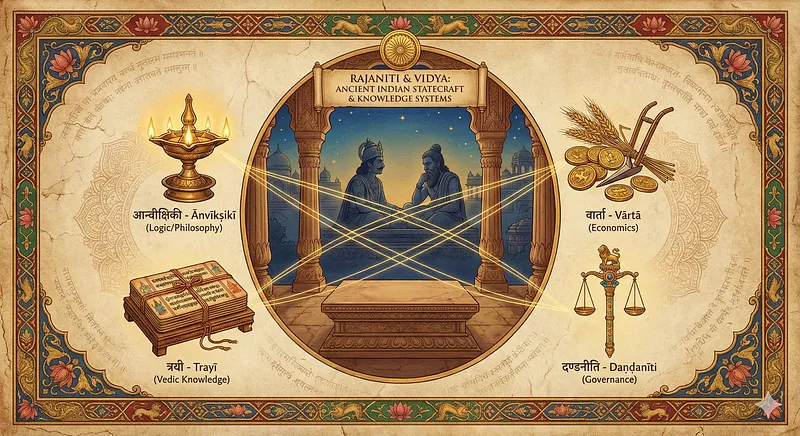
This verse transforms our understanding of what governance is for. The purpose of daṇḍanīti is not simply to maintain order or suppress rebellion—it is to create the conditions in which knowledge systems can flourish. The text specifically identifies three other vidyās (branches of knowledge) that the ruler must protect:
-
Ānvīkṣikī – logic, reasoning, and philosophical inquiry
-
Trayī – vaidika and ritual knowledge
-
Vārtā – economic sciences: agriculture, animal husbandry, and trade
These are described as lokopakāriṇyaḥ—"beneficial to the world," serving the welfare of all people. Here we see a profound insight: legitimate governance is ultimately cultural guardianship. A ruler who fails to protect these knowledge systems—who allows philosophical inquiry to be suppressed, sacred traditions to decay, or economic productivity to collapse—has failed in the fundamental duty of sovereignty.
The Jayamaṅgalā commentary makes this point starkly: without this protective function, the title mahīpati (lord of the earth) becomes meaningless. How can one claim to rule a land while neglecting the very sources of its sustenance and dharma?
Self-Protection as Precondition
Both commentaries emphasize that the king must first protect himself (ātmānam). This is not selfishness but necessity. One who cannot maintain their own security and integrity cannot effectively protect others. There is a practical wisdom here that extends beyond kingship: any system of governance must ensure its own stability and continuity if it is to serve its protective function over time.
This principle has profound implications. It suggests that the legitimate self-interest of the state—its survival, its capacity to function—is not opposed to the welfare of the people, but is rather a precondition for it. A state that cannot protect itself from internal subversion or external conquest cannot protect knowledge, cannot maintain order, cannot serve as the guarantor of dharma.
The Dignity of Kingship: Power in Service of Higher Purpose
The final insight of these verses concerns the ground of political legitimacy itself. The Upādhyāya-nirapekṣā commentary concludes: "Thus, daṇḍanīti is not only about punishment, but about creating a safe and stable space for knowledge systems to flourish, for the welfare of all beings."
This is the complete vision of governance articulated in the tradition of daṇḍanīti: power exists not for its own sake, but to serve higher purposes. The ruler's dignity comes not from the mere possession of force, but from its wise and righteous deployment in service of dharma and collective welfare.
The system is remarkably balanced. It begins with unflinching realism about human nature and the necessity of enforcement. It recognizes that fear of consequences is often what motivates compliance with social norms. But it refuses to stop there. The ultimate purpose of daṇḍa is not control but cultivation—the creation of conditions in which knowledge can be pursued, culture can be transmitted, economic life can flourish, and human beings can pursue their highest possibilities.
Conclusion: First Principles for Our Time
What can we learn from daṇḍanīti in our contemporary context? Several principles emerge with striking clarity:
Governance arises from necessity. Social order does not emerge spontaneously from human goodwill alone. It requires institutions capable of restraining destructive behavior and enforcing accountability.
Enforcement must be purposeful. Power is legitimate only when exercised in service of higher goods—justice, the protection of culture, the welfare of the people.
Protection precedes progress. Before a society can achieve great things, it must first create the conditions of security and stability. This includes protecting both physical security and the institutional foundations of civilization.
Cultural guardianship is essential. A government that fails to protect knowledge systems, intellectual inquiry, sacred traditions, and economic productivity has failed at a fundamental level, regardless of what else it might accomplish.
Legitimacy flows from function. The title of ruler is earned through the performance of these protective duties, not through birth, election, or conquest alone.
In returning to these ancient principles, we are not engaging in nostalgia or attempting to transplant an archaic system into the modern world. Rather, we are excavating permanent truths about the human condition and the perennial challenges of political life. The specific forms of governance may change across cultures and centuries, but the underlying questions remain: How do we create order without tyranny? How do we exercise power without corruption? How do we serve both security and freedom, both stability and progress?
Daṇḍanīti offers no easy answers, but it provides a framework for asking the right questions—and that may be its most valuable gift to contemporary political thought.