Also see the companion visual story here.
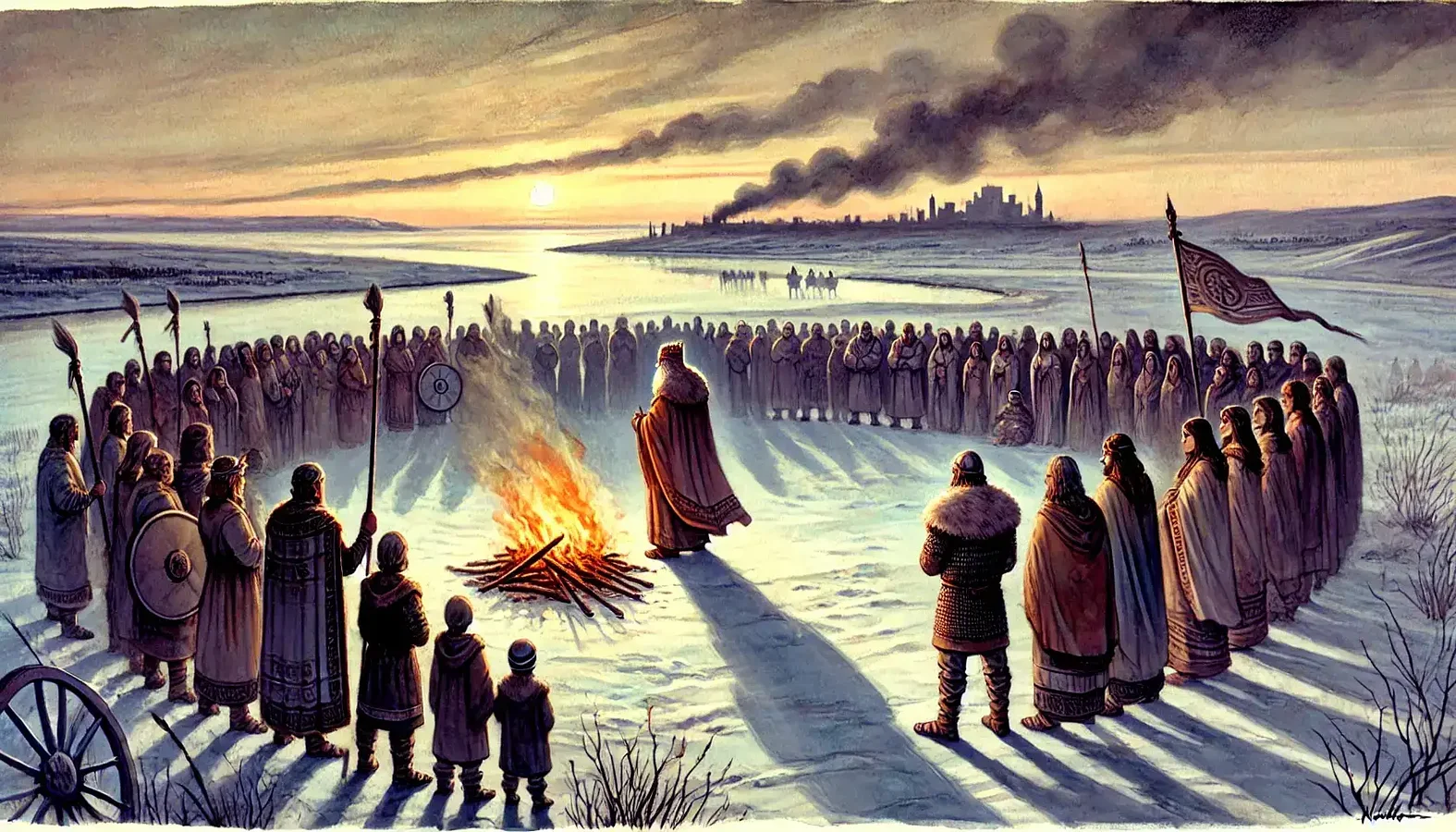
A wholesome musculature once filled Ajamidha’s armors and made them tight. Now the armor felt heavy to his frail bones, hiding numerous cuts, scars and lasting injuries from decades of warfare. He felt frequently out of breath and leaned heavy on his walking stick. Most of his pate was bald, the dense beard that once covered his face now survived by wispy, cotton-like puffs. The sun was out today, but its rays hidden under the winter mist that wafted from the confluence. Ajamidha shivered but held his ground, surveying the gathering around him with the proud eyes of a grand patriarch.
He thought of his late wife, Maitri- the mother of his three children. Ajamidha had a long list of achievements to his name, but now, at the age of eighty-four, no achievement seemed greater than the one that spread out in front of him- his vast family and descendants. His janapada. The Bharata janapada. He silently thanked Maitri, wishing she could have been here to see the day he stepped down and gave the janapada to his elder son. One of his great-grandsons, the twelve-year old Samvarna, broke into his thoughts- “When will you give your speech, great-grandfather?”
Still lost in memory, Ajamidha had to ask Samvarna to repeat himself- “Mother said that it will end when you give a final speech. Then we can go play.”
Samvarna’s teeth chattered in the cold but the boy was unmindful. The families of Ajamidha’s janapada were spread over three major cities, and it wasn’t always that the young ones got to get together. He chuckled, counting his blessings for the privilege of seeing his great-grandchildren grow up. He took reassurance from this, knowing that the janapada would survive after him, held together by strong sons and daughters. “Well, we cannot waste any time then, can we?” he said to Samvarna. “Come, I will make my speech now. Gather everyone around, young one.”
Winter wasn’t too comfortable a season here. A dense fog emerged from the forest to the south, hiding the sun and forcing people to congregate around pyres erected for warmth. They huddled around the central pyre now, located at the edge of the confluence. The Yamuna and Ganga merged just ahead of them, the dividing line between their colors visible for a while before the ruddy-browns of the Ganga took over completely. Despite the cold, Ajamidha enjoyed this time of the year. Decades ago, he’d established the city in winter, at the end of a long and arduous Ashvamedha sacrifice. He associated both the city and the season with peace, with the culmination of sacrifice. Accordingly, he had named it Prayaga.
Beyond the family that gathered around in the immediate circle were people of the larger tribe, some among them his aides and generals for decades. There were senanis here that had served under him, and then under his sons. One day their children would serve under his grandsons.
“My dear family and friends,” he began, ignoring the cold in his bones, “Thank you for being here today. As mortality bears down heavier and heavier, I find myself thinking often whether my life has meant anything. But I only have to look around me today to know that it has. The sight of you all, your own families and your children brings joy to my aging heart. The rishis tell us that we exist in an endless cycle of life and death, fuelled by desire and regret. What we do not acquire in one life pulls us back for another. If that is true, I feel certain that I will have my liberation. I have no unfulfilled desires, no lasting regret.”
But at that last part his eyes darted to his younger son- Sunahotra. Sunahotra, who looked so much like him. Sunahotra, who always and still was his favorite son. Sunahotra, who at the age of fifty still looked like a boy to his father. Sunahotra, who deeply hurt him all those years ago. Then he turned to his firstborn, his daughter Jahnu. Born to him when he was only sixteen years old- an unintended consequence of adolescent indulgence that he had never regretted.
“Jahnu, my dear daughter, I thank you for everything,” he said, eyes leaking sincere affection. “You have suffered with me, you have sacrificed for me. I am because you are, and this janapada owes itself to you. One day, your grandson will grow up to be a valorous scion for the clan.”
Jahnu bowed in acknowledgment, knowing that her father needed no words in response. This was his time to speak, his words a blessing for whomever they were addressed to. But beside her the young grandson in question beamed, taking the grand patriarch’s words to heart- Samvarna. Ajamidha smiled at his eldest great-grandson, nodding to reiterate his words. Then he turned to his elder son- Suhotra. Suhotra, the first pillar of his strength. Suhotra, the spitting image of his beautiful mother. Suhotra, the dutiful, the obedient, the deserving.
To him Ajamidha said- “They say that sons give a man strength in his adult life, and grandsons vitality when he is old. On both accounts you have done me well, my son, and more. This janapada was established on the back of your victories, this very spot soaked in your blood. When I see your sons and their families, my heart swells with pride and joy. Their children have filled my home with laughter, and I thank you for this. You’ve been a patient man, humoring your old man while he clings to a seat that should have gone to you long ago.”
To the gathering Ajamidha said- “You have likely heard this story many times before, but indulge me one last time. Suhotra was only twenty-two when he led my Ashvamedha sacrifice. He captured Pratisthana for our janapada, after a battle more arduous than any I have ever waged. You call me rajan, but I would not be your leader without Suhotra.”
Ajamidha was cut short by a bout of coughs, and dutiful Suhotra was beside him instantly with a cup of water. He drank it gratefully, placing a hand on his son’s shoulder for support. “Suhotra, the elder, is rajan after me,” he announced. “To the senanis who have loyally served the janapada for decades, this is my final directive- serve Suhotra as you have served me. To Suhotra, my son, I say this- serve your janapada well. Protect it, take care of it.”
A hushed celebratory murmur rippled through the gathering at Ajamidha’s announcement. Suhotra’s succession was not a surprise but its formal announcement was momentous nonetheless. But Ajamidha was not done, and the most difficult part yet remained. He waved a hand weakly, requesting for silence. “The horse did not stop at Pratisthana,” he said, referring to the Ashvamedha thirty years ago, “It continued along the Ganga, spreading the following army thin. Suhotra stayed back at Pratisthana to consolidate, and Sunahotra, my younger son, followed the horse. It finally stopped a small fishing village, a place where Sunahotra decided to settle a new city.”
The atmosphere turned perceivably tense, everyone present knowing the history between Ajamidha and his second son. Ajamidha paused to take another sip of water, the memories too painful to bear. “I used to think then that I had two loyal sons,” he finally said, looking directly at Sunahotra. “But fifteen years ago, you proved me wrong.”
Sunahotra was unfazed under his father’s stare. “I told you after the Ashvamedha, father,” he said with narrowed eyes. “New Kashi was my reward. You got Pratisthana, you founded Prayaga, you established your janapada. New Kashi was for me.”
It was well past evening now, and the setting sun’s feeble rays took with them whatever warmth did exist in the air. Ajamidha shivered, tightening his grip on Suhotra’s shoulder. “I know,” he said to Sunahotra. “It’s why I let you keep it when you rebelled fifteen years ago. But today I make my final decision as rajan, and the janapada goes to your elder brother. This includes Kashi.”
“Suhotra rightfully deserves the janapada after you,” Sunahotra said, making it clear he did not contest the succession. “He can have your janapada, but Kashi stays with me.”
Ajamidha shook his head. “You call this my janapada, but my janapada includes you and your progeny. Your daughter, the beautiful Kashi, whom you named after the city, is my grand-daughter. Your son, Shala- my grandson. Their children are my great-grandchildren. Through them, the janapada will prosper even in Kashi.”
There was a time when Sunahotra had loved his father and couldn’t have imagined a time when he did not. Now he wasn’t so sure, and his dry smile did not reach his eyes when he replied- “You speak with such ego, father. Everything is about you- your children, your grandchildren, your descendants. Yet you don’t even notice their absence.”
Suhotra tensed at that, reflexively scanning the gathering to realize that Sunahotra was right. The younger Bharata’s family had silently disappeared during the interchange between him and father, only Sunahotra’s son Shala remaining beside him. Suhotra’s eyes widened in alarm as the complete realization dawned on him. Memories of a violent night fifteen years ago flooded back to him, his hands going to the sword in his sheath.
Grand patriarch Ajamidha felt tired and weak, the pyre in front of him doing nothing for the cold soaked in his bones. Sunahotra was stubborn, but he’d taken that trait from his father. “No,” Ajamidha said as imperiously as he could manage. “The janapada is one, the rajan is one. Kashi will be a part of it.”
Sunahotra expected that, and he addressed Suhotra now- “There is no quarrel between us, brother. Never has been- you know that. But I will not let you have Kashi.”
Suhotra looked to his father, not knowing what to do. But Ajamidha’s face was set determined, the father as unmoving as the brother. Suhotra sensed the inevitable before it happened. He saw, as if in a dream, his brother take out his sword and several soldiers coming into motion behind him. Sunahotra’s second rebellion erupted before anyone could react, clan members and possible foes alike clashing into each other. Suhotra’s concern went for his father, automatically shielding him with his own body. Amid the arrows that whizzed past from either side, Suhotra scanned for his sons and was reassured to see them taking their places in the conflict. Purumidha, his uncle, marshaled the women and children to safety. When some of the old guard had formed a perimeter around Ajamidha, Suhotra pushed out looking for his brother. In this melee, he bumped into his nephew Shala- Sunahotra’s son.
“What madness is this, nephew! Violence will bring nothing.”
“It will bring us Kashi, uncle,” Shala replied, pointing his sword at Suhotra.
Suhotra knew there was no point appealing to his nephew. This battle was between his father and brother, and only Sunahotra could be persuaded to stop it. “Step aside, Shala. Let me make way to your father.”
Shala tightened his grip. “I cannot do that, uncle.”
Men clashed around them, Bharata against Bharata. Arrows rained from both sides, the battle spreading across the confluence and into darkness. Instinct reassured Suhotra that women and children had been removed from the scene. But Ajamidha was still in the middle, protected by his veterans. Suhotra’s eyes scanned for his brother, and in the chaos his son Divodasa found him.
“Father!” Divodasa panted, his sword primed. “Are you okay?”
Suhotra nodded, patting his son’s shoulders. “I am fine, son. But madness has taken hold of your cousin here.”
Divodasa turned to Shala. “I will deal with him, father,” he said, eyes still on his cousin. “Go to uncle Sunahotra and stop this.”
Pushing his reluctant father away, Divodasa took his place at the pointed end of Shala’s sword and grinned. “You remember when we did this for play, cousin?”
“Play was different,” Shala reassured him. “But today’s no game, Divo. We will keep Kashi, and I will take my father away from here safely. No blood need be shed.”
Divodasa fumed. “Look around you, Shala! Blood has already been shed- Bharata blood! The rajan has declared that the janapada will be one. If you defy his directive, you leave me with no choice.”
“It’s the rajan who leaves us with no choice,” Shala retorted, charging at Divodasa to attack. Divodasa blocked the advance, feeling a wave of sympathy pass through him. He’d grown up with Shala, he knew his cousin’s ability well. But Divodasa was the better fighter, and he knew his cousin’s weaknesses well too. He grabbed Shala by the wrists, using his bigger mass to hold him in place. “Stop this, Shala, I say it again. You said it so yourself- today is no game. A wrong swipe can bring your blood spurting out, and life might follow.”
Shala pivoted and broke free, swiping at Divodasa from another angle. “Words and more words, cousin,” he taunted. He was no less a Bharata scion, movement smooth and stance precise. But Divodasa was seven years the elder, and vastly more experienced. He silently admired Shala’s skillful swings, playing the defense game and he imagined the sort of warrior Shala could become. But the scream of yet another arrow victim brought Divodasa back to the present. The longer this played out, the more lives were likely to be lost.
“Enough, Shala!” Divodasa commanded. “Loyal janapadins die around us while we play this internecine game. Lay your sword down, or I will be forced to remind you that I am the eldest of the line, direct scion of the grand patriarch.”
Shala was undaunted. “Do it!” He challenged, muscles tensing for another charge. This time, Divodasa was in no mood to defend. As Shala’s sword rained down, Divodasa blocked it with his own. But with his powerful left hand he landed a hard punch into Shala’s solar plexus, knocking the wind out of him. Dazed, Shala tightened his grip on the sword and made to charge again. Divodasa reacted before his cousin, slicing his sword across Shala’s outstretched thigh in one clean swipe. Blood spurted out from the gash and Shala fell to his knees, sword hanging limp in his hand.
“Incapacitated, but not dead,” Divodasa said to him. “Press the wound and stop the blood, you may survive yet.” He whistled sharply and waited for a senanis to join them. “Tend to him,” Divodasa instructed, watching with sad eyes as his cousin struggled to ebb the flow. Then, in the distance, he heard his grandfather’s wail. Divodasa ran towards him, finding rajan Ajamidha on the ground, cradled by his elder son. Some distance ahead of them, the younger son Sunahotra lay with an arrow inside his chest.
Watching his younger son bleed out in front of him, Ajamidha felt his chest tighten. The night’s intense cold was forgotten, instead Ajamidha now felt a deadly heat course all through him. Men clamored around Sunahotra, but Ajamidha knew there was no hope. The arrow had pierced straight to his son’s heart, making a wound there was no coming back from.
“Let,” Ajamidha struggled, unable to inhale.
“Yes, father,” Suhotra said, cradling Ajamidha in his arms. “A vaidya is coming. It’s going to be okay.”
“Let me,” Ajamidha tried again, but both breath and words failed him.
Suhotra leaned closer, putting ears to his father’s lips.
“Let me see him,” Ajamidha managed to whisper.
Understanding his father’s intent, Suhotra shouted out. The clamoring parted to let rajan Ajamidha look at his younger son, whose injury was clearly beyond redemption. Men kneeled around Sunahotra vainly, knowing that pulling the arrow from his chest would lead to further damage. With every breath that Ajamidha struggled to take, he knew that his son breathed his last. His chest went impossibly tight, and if he couldn’t breathe before he was positively choking now. The grand patriarch realized it was his end moments before it came. He managed to inhale deeply, giving himself enough energy to hear the coming message.
“The rest have escaped. Kashi and the children- we need to get them.”
“No…”
The men in shock, it was Suhotra who took charge. “Send riders out,” he commanded. “This ends today.”
“No…”
“What? Father? Did you say something?”
“Kashi…”
“Father?”
“Kashi, it was all for Kashi…”
Suhotra frowned, uncomprehending. But he raised his arms, gesturing for his sons to pause. “Yes, we’ll get her, father.”
“No…”
“Father?”
“Not Kashi, Kashi.”
“Father?”
“All for Kashi,” Ajamidha moaned. “All for Kashi.”
Suhotra finally understood what his father was trying to say. “Yes, for the town. For Kashi. That’s why he did this.”
“Kashi.”
“Yes, for Kashi, father,” Suhotra reassured. “But we’ll get them. We’ll end this.”
“No…”
“Father?”
“No. Not Kashi.”
The danger had passed, Sunahotra the rebel lay dead before them. Later, Suhotra would find time to grieve for his brother. But right now, he only wanted his father to feel better. “Yes, not Kashi,” he said agreeably. “No harm will come to her, father.”
“Not Kashi, Kashi.”
Suhotra leaned closer still. “What do you want, father?”
“Leave them alone,” Ajamidha croaked. “Leave Kashi alone.”
“But, father…”
“No, no more.”
“But Kashi-”
“Leave Kashi alone, leave Kashi alone.”
Those were grand patriarch Ajamidha’s last words. Even in the chaos, even in his confused state, he left no room for interpretation. There was Kashi- the rebel Sunahotra’s daughter, and there was Kashi- the town he named her after. Leave Kashi alone, leave Kashi alone. Suhotra couldn’t go after the daughter, nor the town. As he comprehended this, he felt his father’s body go limp. Pushed into a state of daze, he knew his father was dead even without checking the pulse. Suhotra’s kinsmen gathered around him, and beyond them the senanis who retained their loyalty to the elder son. One of them a silent hero- his arrow felled the rebel instigator, a son of Bharata no less. Years later this hero would embellish and relate the tale to his grandchildren. He would tell them of how rajan Suhotra was not strong enough. Leave Kashi alone, leave Kashi alone- that had been the grand patriarch’s final directive. And rajan Suhotra took it to heart. He left Kashi alone, and he left Kashi alone.