Introduction
In 2025, news of the return of a historical textile drew attention to a forgotten part of Assamese cultural identity. Known as the Vrndavani Vastra, this unique silk object made a long journey from its birthplace, first to Tibet and later to the British Museum. Erased from history and popular memory, the Vastra resurfaced in scholarly works from the late 20th century, leading to its revival in recent times. This textile acquired different meanings across changing historical and cultural conjunctures.
What is the history of this textile? How did it reach Tibet and ultimately end up in the British Museum? The following essay answers these questions. Beyond reconstructing this trajectory, the essay also examines how material objects function as carriers of spiritual meaning within religious traditions.
Local Roots, Global Footprints:
Before discussing the origins of the Vrndavani Vastra, a backdrop to the society and the devotional movement of medieval Assam needs to be considered. This historical textile took birth with Śaṅkaradeva, who initiated the neo-Vaishnavite movement in Assam in the late 15th century. The movement emphasized social and cultural reforms of Assamese society through exclusive devotion to Kṛṣṇa (Eka-śaraṇa-nāma-dharma). Śaṅkaradeva propagated this faith through congregational worship (namghar and satrā), vernacular compositions, art, and theatrical performances (Bhaona). He emphasized the teachings of the Bhāgavata Purāṇa, which he translated into Assamese. Although the use of idols is prohibited in Neo-Vaishnavism, sacred objects, especially textiles, are an inseparable part of this faith.
Referred locally as Gokhain Kapor (literally meaning ‘cloth meant for God’), fabrics and textiles of the neo-Vaiṣṇava faith in Assam can be used to construct an alternate understanding of socio-cultural, economic, and political conditions of the time when they were produced and circulated. The term ‘gokhain kapor’ can include any piece of textile or fabric associated with the rituals and spiritual practices of the neo-Vaiṣṇava faith. This could include Gamusa, Chandratap, and so on. The importance of these objects reveals a complex relationship between materiality and spirituality.
Objects are an indispensable part of sacred space. Objects, by virtue of their tangibility and visibility, mediate the spirituality of the followers. As Mark Bender argues, objects are “multivalent transformational beings, with both pronounced physical and spiritual-ness”. Contrary to Emile Durkheim’s understanding of the ‘sacred’ and ‘profane’ as two separate entities, the study of religions has often revealed that the material culture is inseparable from the ritual and spiritual world in which it exists. The differences between religions are most evident through their unique material identities. Therefore, one must raise these important questions when dealing with objects: Why do they become important? What do they mean, and how are they made? Objects are perishable and ephemeral. Moreover, when placed in different socio-cultural contexts, their meanings also change. As Appadurai claims, objects have no meanings of their own. Their meanings are socially constructed and a result of interactions with the people.
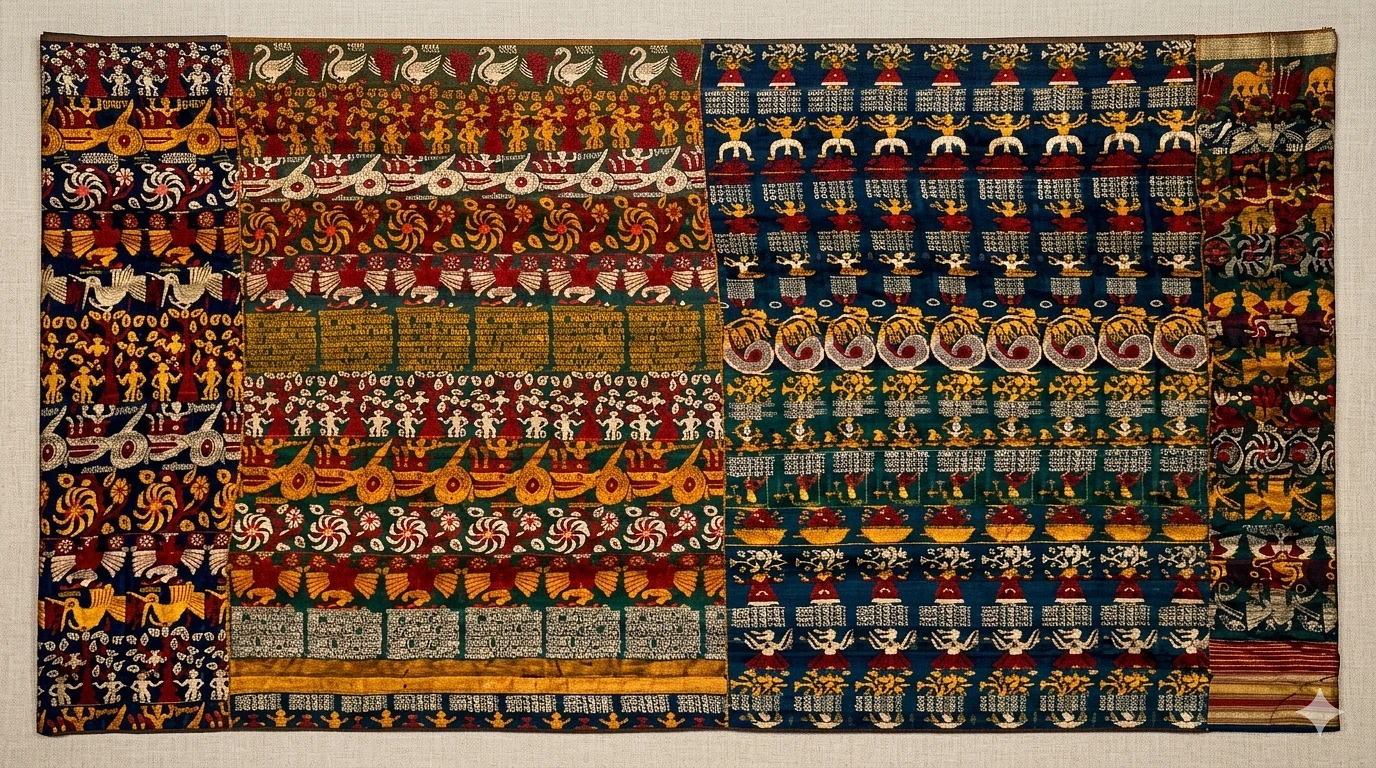
The Vrndavani Vastra, a sacred textile of 120 cubits or 180 ft., was produced at the behest of the Koch king and the neo-Vaiṣṇava saint, Śaṅkaradeva’s royal patrons, Nara Nārāyaṇa and his brother, Chilarai. The king and his brother had become great patrons of neo-Vaishnavism, especially during the last two decades of Śaṅkaradeva’s life. They wanted Śaṅkaradeva to acquaint them with Kṛṣṇa’s līlās in visual storytelling form. The entire process of creating this historical masterpiece, beginning with weaving to delivering the product to the patron, is recorded in the Kathāgurucarita, the biographical account of Śaṅkaradeva. It visually depicted the exploits of Kṛṣṇa, for instance, the killing of the crane-demon Bakāsura, dancing on top of the five-headed serpent, Kāliya, hiding the gopis clothes in the tree, and so on. It also portrays images of flora and fauna, Mathurdas Burha Aata, the first sattrādhikār of the Barpeta Satrā (satrās are the monastic institutions associated with neo-Vaishnavism), who carried out the actual weaving of this artwork along with 12 assistants in the Tantikuchi area. This vastra was used to wrap the Bhāgavata Purāṇa, i.e., the sacred manuscript, and placed on the thapana (altar). Much less is known about its use or dissemination as a storytelling medium in the period following Śaṅkaradeva’s tirobhāva.
The textile’s history enters a new conjuncture in the early twentieth century, shaped by the geopolitics of the Great Game and, more notably, Francis Younghusband's mission to Tibet in 1904. Curzon, the viceroy at the time, sent Younghusband, a British explorer, to check the Russian infiltration into Tibet and mediate the issues regarding the boundary between Sikkim and Tibet. This mission, culminating in the Lhasa Convention of 1904, brought Tibet under British influence. A significant outcome of this expedition was the massive collection of Tibetan icons, jewels, and other artefacts that Younghusband carried back to Britain. Among them was a textile later catalogued as a “large hanging woven in designs of monsters and charms” of Tibetan origin in the British Museum. Twelve pieces of this textile were found at a Buddhist monastery near Gobshi, which was pieced together by Perceval Landon, a special correspondent of the Times who documented the Younghusband mission. Landon gifted this “Tibetan silk Lampas” to the British Museum in 1905, where it hung in silence for about 85 years.
In 1992, Rosemary Crill, a senior curator and Indian textile expert at Victoria and Albert Museum, London, first drew attention to the vastra’s actual origins, initiating a range of scholarly debates and narratives around this lost piece of Assamese identity.
Revival and Contemporary Relevance:
Crill, in her essay, “Vrindavani Vastra: Figured silks from Assam”, noted that this textile accords India’s North-East, especially Assam, a significant place within the broader history of Indian weaving culture. The peculiarity of this textile, Crill noted, was its complex weaving process, particularly the “Lampas Technique”. This technique combines a “twill with a plain weave" in different scales or “fineness of weave”. Crill argued that the designs combined elements from the Pala school of Bengal and the tradition of manuscript publications in Western India. Interestingly, another piece of garment, generally called the ‘Chepstow coat’, also contained the vastra’s pieces as lining. This “gentleman’s dressing gown”, made of pale blue-green Chinese damask silk, was discovered in Kolkata and later put in the Chepstow Museum, Wales. Perhaps the original vastra had more pieces than the ones discovered and stitched together in Tibet.
Richard Blurton, in his book, Krishna in the Garden of Assam: The History and Context of a Much-Travelled Textile (2016), noted that the vastra could have reached Tibet as twelve individual strips of the vastra, where it lived a second life. Blurton highlighted the history and tradition of this textile; however, he was critical of the name itself. Crill referred to the textile as Vrndavani vastra because it depicted Krishna’s life in Vṛndāvana. However, Blurton emphasized the need to consider historical context and local practices before accepting this name.
Regardless of the scholarly debates, there is little doubt about the fact that this textile is perhaps the most unique expression of Assam’s craft and weaving traditions. The process of making the vastra was supervised by Śaṅkaradeva himself, enhancing the sanctity of the cloth. The quality of the silk was supposedly superior, as evident from the history and rich tradition of weaving in Assamese society since ancient times. The early Koch rulers facilitated the development of the weaving industry in western Assam, where their rule flourished. This can be corroborated by the account of Ralph Fitch, a 16th-century Portuguese historian, who mentioned that the Koch region had abundant silk and cotton fabrics.
The style of weaving known as lampas uses a base cloth onto which a set of warp and weft threads is woven. It is interesting to note that the exquisite lampa technique itself disappeared with the disappearance of the vastra. This can be attributed to the socio-cultural transformation of the region, especially from the 18th century. A period of anarchy and chaos ensued in Assam owing to the Moamoria rebellion. This was followed by a gradual decline of the Ahom kingdom, paving the way for Burmese and British conquests in the early 19th century.
However, one question remains: how did the textile end up in Tibet? Connections between Assam and Tibet go way back to the pre-colonial period. Assam maintained regular economic, social, and cultural interactions with its Himalayan neighbors, Bhutan and Tibet, through foothill passes called Dvāras (or duars). These gateways connected traders and pilgrims alike, facilitating cultural exchanges. In fact, there are also many similarities between neo-Vaishnavism and Tibetan Buddhism; for instance, both incorporate mask-making in rituals and performances. Silk was a valuable commodity exchanged through these corridors. Perhaps the vastra reached Tibet through trade, diplomatic exchanges, or by accident. The Tibetans probably recognized the value and quality of the silk; however, they likely reinterpreted and contextualized its meaning within their own monastic traditions to ensure its preservation within a different cultural framework. Another major question concerns the use of the lampas technique, which has not been widely recorded in the history of Indian weaving. Some have speculated that the weavers of Tantikuchi learned this technique from Bengal, where centres like Murshidabad and Bishnupur likely practiced it. Considering that Assam was in regular contact with the Bengal region, there could have been an exchange of knowledge and skills between the various trading and weaving communities. However, in the absence of concrete evidence, one can only make speculations about these aspects.
The history and cultural significance of the vastra have led to a renewed interest in the revival of Assam’s first and only school of sacred weaves. Many weavers have taken to learning this complex artwork, although devotees are partially divided on whether an original work associated with the saint should be recreated. Nevertheless, awareness about the vastra has led to a sense of pride among the Assamese community. A display of the artwork of this vastra at the Lokpriya Gopinath Bordoloi International Airport reflects its recognition as a symbol of Assamese identity. In 2025, the Assam government retrieved the vastra on loan from the British Museum for an 18-month exhibition. This was done after signing a Letter of Intent (LoI), with certain conditions like the creation of a museum to house the vastra. However, the temporary return poses a difficult question: what does it mean for a community to receive, on loan, an object that forms an integral part of its own sacred and cultural inheritance?
Notwithstanding the dilemmas and complex narratives of the textile, the Vrndavani vastra reveals a fascinating connection between craft and religion. As the process of weaving becomes a ritual exercise, the weavers too become vital members of the sacred landscape. Timothy Carroll argues that craft permits the weavers to express their religious devotion through textiles. In this case, the weavers of Tantikuchi and the royal patrons became integral to the sacred landscape of medieval Assam and the Bhakti movement of Śaṅkaradeva. Moreover, as the vastra moved across regions and cultures, its meanings were continually reconstituted within new social and historical settings. Between the 16th and 20th centuries, the Vrndavani vastra lived many lives and acquired different meanings, and finally, it seems to come full circle as the Assamese people reclaim their lost heritage.
References:
Blurton, R. T. Krishna in the Garden of Assam- the History and Context of a Much-Travelled Textile. London: The British Museum, London, 2016
Carroll, T. “Textiles and the Making of Sacred Space”, Textile History, 48:2, 192-210, 2017.
Crill, R. “Vrindavani Vastra: Figured Silks from Assam”, Indian Textile.1998
Dhamija, J. The Woven Silks of India (Mumbai: Marg Publications, 1995)
Dzüvichü, L. & Baruah, M.(ed). Objects and Frontiers in Modern Asia: Between the Mekong and the Indus. Routledge, 2019
Goswami, N. & Das, A. (eds). Identity, Politics, and Narratives of Belonging: Northeast India in Literature and Contemporary Discourses. Cambridge Scholars Publishing. 2025
Michael, C. “Officers, Gentlemen and Thieves: The Looting of Monasteries in the 1903/4 Younghusband Mission to Tibet”, Modern Asian Studies, 37 (1), February: 81–209. 2003
Nath, D. History of the Koch Kingdom (1515-1615), Mittal Publications, 1989
%20(6).png)