The fragmentation of the Mauryan Empire left a significant power vacuum in India, characterized by constant friction between smaller vassal states. In this era of uncertainty, the Satavahanas emerged as a vital stabilizing force in south-central India. While their roots are often traced through paurāṇika traditions, their political ascent began with Simuka, who established independence around 230 BCE. His early campaigns into Malwa and Maharashtra set the stage for a dynasty that would eventually bridge the gap between Northern and Southern India.
Under successors like Krishna and Satakarni I—the latter being one of the dynasty’s most formidable rulers—the empire expanded significantly. By performing the Aśvamedha and Rājasūya sacrifices, Satakarni I didn't just expand borders; he signaled the return of indigenous sovereign authority. Despite later challenges from the Shakas and Greeks, the Satavahanas maintained a political and cultural unity that lasted nearly 450 years. Centered at their capital, Pratisthan (Paithan), they acted as the guardians of Indian culture, successfully resisting foreign incursions and fostering an environment where art, literature, and trade could finally flourish in the Deccan.
The Satavahanas: Guardians of the Deccan and Cultural Synthesis
The Satavahanas initially served as feudatories under the Mauryas, but as the central authority in Magadha weakened, they asserted their independence. Their rise was not without resistance; they had to navigate intense competition with the Shungas and Kanvas to establish dominance. Perhaps their most critical role was acting as a shield for the Indian subcontinent against persistent foreign incursions by the Shakas, Yavanas, and Pahlavas. The dynasty’s struggle against the Western Kshatrapas is particularly noted, where legendary rulers like Gautamiputra Satakarni and Sri Yajna Satakarni successfully checked foreign expansionism.
Spanning over four hundred years, the Satavahana era provided much-needed stability to the Deccan at a time when the rest of South India faced uncertainty. While the rulers were devout followers of the Vaiṣṇava tradition—evidenced by names like Vasudeva and Gopala in epigraphic records—they were remarkably pluralistic. It was under their patronage that Buddhist art and architecture reached their zenith. As noted by historians like R.C. Majumdar, the Purāṇas identify them as 'Andhras,' linking them to the Krishna-Godavari delta. Though the empire eventually fragmented into smaller states by the 3rd century CE, the period remains a golden chapter of peace, literary growth, and artistic glory.
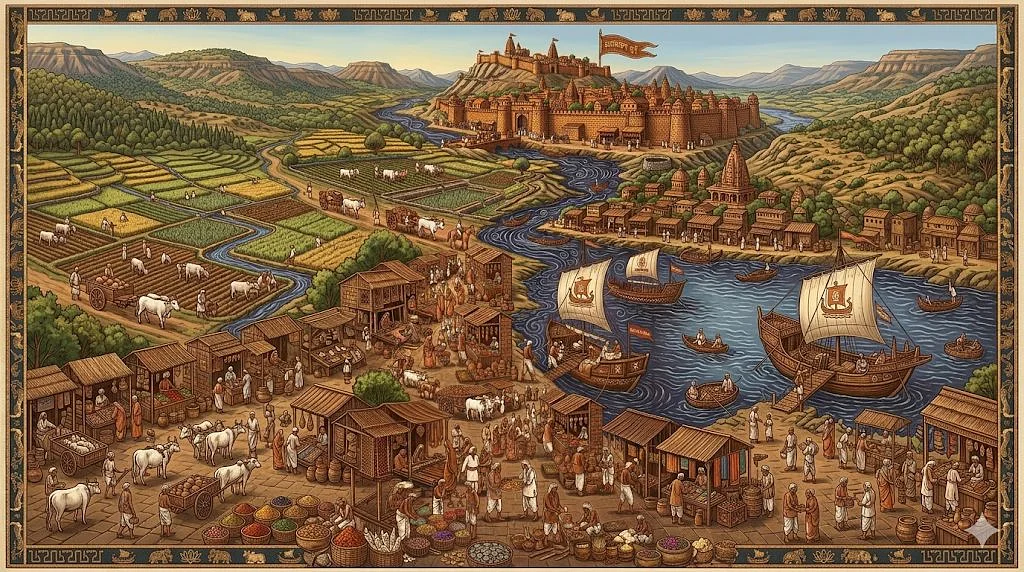
The study of ancient socio-economic structures is often hindered by a scarcity of primary sources. However, the Satavahana era emerges as a remarkable exception, defined by prolonged peace and prosperity. As noted by R.C. Majumdar, while the northwestern frontiers of India were being ravaged by Greeks, Sakas, and Kushanas, the Satavahanas established a formidable stabilizing force in the Deccan. Dominating the fertile peninsula between the Godavari and Krishna rivers, the empire operated from two strategic capitals: Pratisthan (modern Paithan) in the west and Dhanyakataka in the east. The abundance of water, minerals, and natural wealth in this region acted as a catalyst for a flourishing trade network.
The society was organized based on professional duties and administrative ranks. According to Rapson, this hierarchy comprised four distinct classes:
-
The Elite Class: High-ranking officials linked to the royalty.
-
The Administrative & Mercantile Class: Comprising Amātyas, Mahāmātras, and influential merchants or guild heads.
-
The Professional Class: Including physicians, goldsmiths, scribes, and cultivators.
-
The Artisan Class: Consisting of blacksmiths, carpenters, and fishermen.
The 'Gṛhapati' served as the authoritative head of the family unit, maintaining social cohesion at the grassroots level.
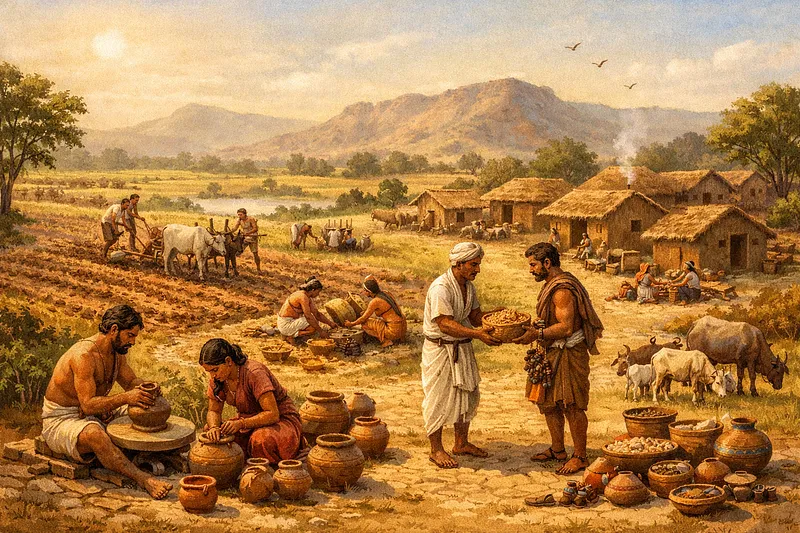
A defining feature of the Satavahana economy was the sophisticated system of Craft Guilds. Epigraphic evidence mentions organized guilds of weavers, potters, oil-millers, and corn dealers. These institutions reflect a highly evolved corporate life. This economic surplus directly fueled the artistic zenith of the Deccan, visible in the magnificent cave temples and architectural marvels of the region.
The economic landscape of the Satavahana period can be reconstructed by correlating literary records with epigraphic and archaeological findings. Excavations and numismatic (coin) evidence, in particular, provide a concrete basis for understanding the fiscal health of the empire.
Fiscal Administration and Revenue
The Satavahana administration was characterized by efficiency and fiscal prudence. Despite the inevitable costs of maintaining a standing army for constant warfare, the state avoided imposing heavy taxes on its subjects. Revenue was primarily generated through:
-
State-owned land domains.
-
Royal monopoly on salt production.
-
Standard land revenue and occasional levies.
-
Judicial fines and court fees.
-
System of Payment: Taxes and remunerations for officials and soldiers were frequently collected and distributed 'in kind' rather than cash.
Global Trade and Economic Superiority
The state’s tax and trade policies were instrumental in making the Deccan a global hub for textiles, ivory, and woodwork. During this era, India enjoyed a highly favorable balance of trade. The growth rate of South India often surpassed that of contemporary European regions. The rulers successfully integrated natural and human resources, employing innovative strategies that reshaped the regional economy.
Ethical Governance and Public Welfare
The hallmark of Satavahana rule was "Good Governance." Instead of focusing on personal glory, the rulers prioritized the standard of living of their people. They invested in infrastructure and human resource development, fostering a value-based economic environment. Their approach was selfless; they often sacrificed personal interests to ensure national security and social welfare. By opening "new vistas" of systematic development, they established an economic superiority that remained unchallenged in the contemporary world.
The Satavahana era was defined by a flourishing landscape of architecture and commerce, ensuring a high standard of living for the common man. This period witnessed a seamless fusion of Northern Indian technological elements with local Deccan innovations.
The Mauryan Legacy and Agrarian Growth
Building upon the foundations laid by the Mauryas, the Satavahanas enhanced their material life through:
-
Urban Innovations: The widespread adoption of coined currency, burnt brick construction, and the sophisticated use of ring wells.
-
Agriculture: The fertile delta between the Krishna and Godavari became a hub for rice and cotton cultivation. The extensive use of iron implements, particularly in the Carnatic region, and well-irrigation systems revolutionized crop yields.
Material Culture and Agrarian Prosperity
The Satavahanas inherited and improved upon several Mauryan advancements, such as the use of coined money, burnt bricks, and ring wells. Agriculture remained the backbone of the economy, with significant production of rice and cotton in the Krishna-Godavari delta. The widespread use of iron implements, particularly in the Carnatic region, and the use of wells for irrigation led to high agricultural yields.
Artisanship and Global Trade
The quality of Satavahana craftsmanship was world-class. A prime example is the ivory workers of Bhokardhan, whose skill was so renowned that they were commissioned to execute the intricate carvings on the Sanchi Stupa.
Internationally, the empire maintained a highly favorable balance of trade. Through major ports like Sopara, Kalyan, and Broach, India established healthy commercial ties with Rome, Arabia, and Egypt. The economic growth of South India during this time was arguably higher than that of contemporary European nations. Furthermore, Indian traders established settlements in the Far East, serving as ambassadors of Indian culture.
The economic prosperity of the Satavahana period led to a significant wave of urbanization across Maharashtra. Several major towns emerged as bustling hubs of commerce, most notably Pratisthan (Paithan), Nasik, and Junnar, which served as the primary markets of the region. In the south-eastern provinces, towns like Vijaypur and Narsela gained a reputation as essential trade nodes. To support this expanding commercial activity, the Satavahana administration introduced a sophisticated multi-metallic currency system, issuing coins in gold, silver, copper, and bronze to facilitate both local and long-distance transactions.
The Satavahana economic model was a well-balanced integration of agriculture, specialized industry, and maritime commerce. Their textile industry, in particular, reached such a level of excellence that it became a highly coveted luxury in Western markets. The influx of Indian high-quality textiles was so overwhelming that the Roman government was eventually forced to impose a ban on these imports to prevent the drainage of their own wealth.
By adopting a policy of free trade, the Satavahanas ensured that the balance of trade remained consistently in their favor. This strategic control over exports and the organized movement of trade groups (guilds) allowed the dynasty to amass immense wealth, effectively making Maharashtra one of the wealthiest regions in the ancient world.
The trade dynamics of the Satavahana period are best understood through the lens of their high-value export products, which were in immense demand across the Western world. Archaeological finds at Ter (ancient Tagarpura) and Bhokardhan (Bhogwardhan)—locations documented by Ptolemy—reveal the exceptional craftsmanship of Satavahana artisans.
The ivory figurines discovered in the Satavahana strata are of such superior quality that they have been compared to the famous ivory statuettes found in the Pompeii excavations in Italy. This connection underscores the direct reach of Deccani art into the heart of the Roman Empire.
-
Influence on Central India: An inscription at Sanchi reveals that the artisans of Bhokardhan were highly sought after by rulers in Malwa, Rajasthan, and Bundelkhand for their expertise in minute carvings.
Wealth of Antiquities
The sheer volume of Satavahana material culture is preserved in significant local collections:
-
Balasaheb Patil Collection (Paithan): Houses over 10,000 antiquities from this era.
-
Ramlingappa Lamture Collection: According to Prof. Jamkhedkar, this collection contains more than 26,000 pieces of Satavahana art and artifacts.
The excavation reports by R.S. Gupte and S.B. Dev confirm Bhokardhan's status as a magnificent trading emporium. Situated on the ancient caravan route connecting Naneghat to Paithan, Ellora, and Ajanta, Bhokardhan served as a vital commercial junction between these major cultural centers. These evidences collectively testifies to a period of unprecedented economic glory and artistic sophistication.

%20(6).png)