Introduction
The renowned anthropologist, Bronislaw Malinowski, had argued that “cultural change is a difficult subject to handle and control both regarding theory and method”. In the context of North East India, the issue of dealing with the changes wrought by Christianity poses certain challenges. The changes have been traced from the perspective of the agents, like the missionaries and colonial administrators, on the justification that the receivers had no sense of the civilized world hitherto. The receivers’ role in the transmission process is largely neglected. As a result, the transfer of the universal Christian faith into localized contexts is viewed in terms of rupture or break from the pre-existing worldviews. In other cases, concepts like ‘syncretism’, ‘indigenization’, etc., are used to argue towards a co-existence of both the existing and new worldviews. Such concepts, however, do not speak of a balance, the lack of which would ultimately create clashes between the natives’ traditional cultures and the new foreign culture.
This essay emphasizes on the concept of ‘contextualization’ to understand the incorporation of the universal faith of Christianity into diverse localized cultures. With special emphasis to the Christianisation of the north east Indian region, this paper analyses existing literature to trace the missionary efforts at contextualizing the gospel among the Nagas and the Mizos in the colonial period and further analyze the scope of contextualization in the transfer of Christianity in the northeast in the post-colonial period.
Contextualization as a Concept
The term contextualization as a concept in missiology “emerged out of the backdrop of the changing geographical scope of Christianity that arose as a consequence of political independence as well as the assertion of cultural identities in the emerging ‘third worlds’”. The term originated during the WCC "consultation on 'Dogmatic or Contextual Theology' in 1971 as a dialogue between Shoki Coe and Aharon Sapsezian. The idea of contextualization differs from indigenization because it is meant to incorporate all aspects of culture. Contextualising isn’t merely aimed at making Christianity native, but it refers to the ability to communicate the “never-changing word of God in ever-changing modes of relevance”.
The missionaries had to contextualize the gospel according to the worldviews and everyday life of the hill people. The varying strategies adopted in the process and the different outcomes received by them prove that people did not blindly accept the new faith, nor did they lose their pre-existing cultural and religious identities. In fact, traditional identities became more refined and pronounced as a result of their encounter with the new faith, as seen in the context of the Nagas and the Mizos in the post-colonial period. The literature addressed in the paper majorly focuses on the changing notions of ‘supernatural’ because in the traditional societies, like those of the Nagas or the Mizos, the supernatural assumes a central part of their worldview. As G. Kanato Chophy in his work, ‘Constructing the Divine’, asserted, “the belief in supernatural beings is at the heart of traditional religion, and the location of supernatural beings in social life had remained invariably the same when the Sumi embraced Christianity”.
Christianity and the Changing Concept of Worldview in the Northeast
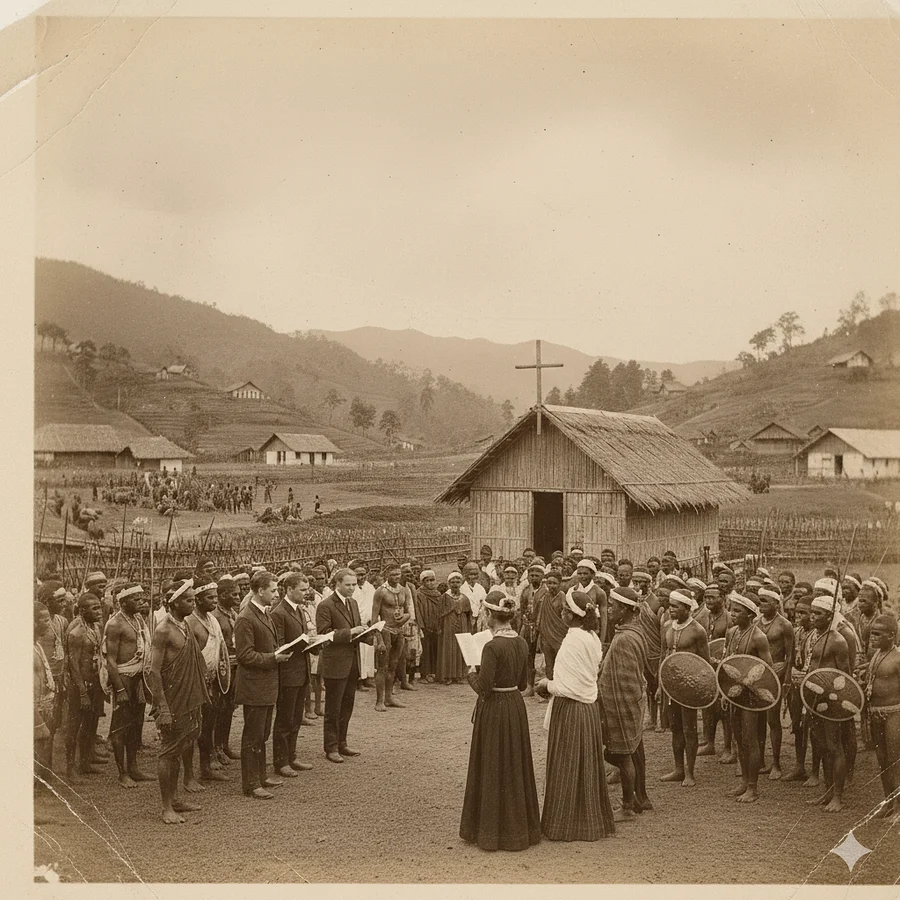
The history of Christianity in northeast India coincides with the colonization of the region in the nineteenth century. Among the hill people of the northeast, although catholic Christianity existed prior to the nineteenth century, widespread conversions began only after the colonial annexations of the Naga hills, Lushai hills and the Khasi hills. In the pre-colonial period, the cosmological worldview of the people of the northeast existed purely in rituals, customs, concepts of the divine, myths and legends. The ideals of rational or secular overlapped with the sacred or religious, and there was no strict separation between them prior to their engagement with the missionaries. Christianity introduced into the traditional societies the idea of dualism, which did not exist earlier. For instance, among the Sema Nagas, dualism was witnessed in the notions “of the saved and the unsaved, the churched and the unchurched, the Holy Spirit and the evil spirit, the revived and the non-revived”. Further, there was a distinction made between the Christians who called themselves ayemi (teetotallers), referring to those who have embraced a new way of life, and the non-converts as jishomi (non-teetotallers).
From the colonial/missionary perspective, the appeal of Christianity among the isolated people of the hills has been attributed to factors like the coming in of modern education, print, and health facilities, which brought ‘positive benefits’ for the hill people. Thus, the hill people were merely the beneficiaries of these changes and were perceived as the mindless subjects of Christianity. Further, the American Baptist missionary, E.W. Clark, while talking of the Nagas, said that they were ‘by far the most pure pagans’ who ‘are sitting in gross darkness’ … ‘and to whom we are under obligation to give it (the gospel)’. The “missionaries believed they were carrying out their divine call to win souls for God’s eternal kingdom”.
Colonial anthropologists, most notably John H. Hutton, James. P. Mills, Verrier Elwin and Christoph von Fürer-Haimendorf stressed the continuity of traditional values and traditions among the Hill people. J.H. Hutton, for instance, was critical towards the American Baptist Mission for eradicating the pristine Naga culture and imposing Christianity. Such views show that colonizers and missionaries were not always on the same page, contrary to the commonly held view that civilizing the savage was a common goal of both colonizers and missionaries. David R. Syiemlieh also critiques the connection between colonialism and missionaries by arguing that many administrators were actually against the Christianisation of tribes. For example, he points out that the Naga Hills Administration was actually concerned with the condemnation of practises like sleeping in the morungs or observance of genna. J.H Hutton, Verrier Elwin and others represent the group of colonial anthropologists who strongly believed that the tribals needed to be protected and isolated from outside influences.
An analysis of the missionary accounts as well as the records of the colonial anthropologists reveals that the contact between the missionary and the northeast people was seen as a one-way process; with the missionary agents transferring the gospel and converting the natives. How the natives perceive colonial agents and institutions has hardly been given the same importance as what the colonial masters, or in this case, the missionaries, have recorded about their subjects. To quote Chophy, “Knowledge systems like Christianity cannot impose itself without providing a more comprehensive and coherent (as the group sees it) view of the world”.
Such views do not justify why the native people would be willing to change their age-old worldviews. The Nagas or the Mizos could have rejected the new faith, like they rejected many other Western notions. Moreover, not everyone who came into contact with the missionaries and the disruptions caused by colonialism converted to Christianity. Some, in fact, stuck with their old traditions, while others, like the Zeme Nagas, chose to reform their religious beliefs along the lines of modernity but outside the Christian notions. Here, we refer to Robin Horton to argue that religious transformation or conversions cannot simply be understood as a by-product of socio-economic upheavals. They can be seen only as an “accelerator” or “stimulator” to the transformations in the cosmological framework that were already taking shape in the minds of the subjects.
Recent scholarship has moved beyond this simplistic understanding and looked for agents or factors within the existing worldviews of people which facilitated the acceptance of Christianity by the natives. Various scholars provide various narratives which further complicate the issue.
Richard Eaton, in his work, ‘Comparative History as World History: Religious Conversion in Modern India’, developing Robin Horton’s model, suggests an alternate way of understanding religious transformation among the Nagas, moving beyond the missionary or agents’ perspective. In the Naga context, the conditions which encouraged the adoption of a new faith, according to Eaton, were already situated in the local cosmology of the people. Hence, the pre-existence of certain elements facilitated the transfer of the new religion because it did not feel entirely alien to them. The conditions which Eaton talks of have been brought by the formerly isolated region’s exposure to global, cataclysmic events, including capitalism, the First World War and so on. Such events created cognitive disruptions and made the local, existing worldview inadequate to make sense of the larger world, paving the way for a new worldview to enter. Unlike the existing views, the new worldview, which in this case is Christianity, is of a global character, and this global worldview had to be fit into the local cosmology. However, the agency of transfer in this case does not lie with the missionaries but with the natives who assisted in the assimilation of Christian names, ideas and practises into the linguistic and religious universe of the Nagas.
In the Ao Naga cosmology, there exists a higher god, ‘Lungkijingba’, vague and largely distant and a lower god, ‘Lizaba’ credited as the world maker and the deity of crops. The Christian missionaries displaced the figure of the high god and instead alleviated the more familiar lower God to the position of the high God. The missionaries, however, do not adopt the words Lungkijingba, Lizaba or the foreign word Jehovah. Instead, they adopted the local term ‘Tsungrem’ for God, which in the Ao cosmological world meant ‘spirit’. By adopting this term for God, the missionaries effectively captured the most important element in the Ao pantheon, i.e., its “spiritness” or “Tsungrem-ness”, and made it relevant in understanding the notion of a universal and supreme Biblical deity. Such a strategy attests to Max Weber’s concept of religious rationalization which emphasized the supremacy of one deity at the expense of others.
The indigenous conception of God through existing worldviews was seen among the Angamis and the Semas, as well as pointed out by Eaton. Among the Angami Nagas, the acceptance of Christianity was slower because they were the least migratory among the other Nagas and hence their worldview was slower in accepting new cognitive changes. Moreover, the missionaries initially misinterpreted the concepts of divinity prevalent among the Angamis. For instance, they equated Ukepenopfu, the high goddess, with Jehovah, creating confusion. Eventually, the Angamis came to perceive Ukepenopfu as a male deity.
The Sema Nagas, on the other hand, converted to Christianity at a rapid rate because the idea of one supreme God, Alhou, was more sharply defined in the Sema cosmology owing to their migratory nature. Alhou was described by them as omnipresent and existing between heaven and earth. Thus, the missionaries in this case simply adopted Alhou as the high God, while the lower god, Tughami, which earlier played a more active role in the everyday lives of the Semas, was identified as an evil spirit in the Christian tradition. The transfer of religion in this case occurred more on a cognitive level, making it appear that there was no real transfer at all. Chophy also argued in his book that only the conception of the supernatural changed when the Sumi embraced Christianity. Thus, what binds Christianity and the traditional Sema belief system is their emphasis on the supernatural.
According to Richard Eaton, the two contrasting worldviews- the local and the global come together not because of their similarities but because of their differences. This dialectical relationship ultimately contributed to religious conversions.
Eaton’s assumption that the Nagas were isolated and insular and only got integrated into the global network through their encounter with the colonial agents needs to be reconsidered. The tribal people, including the Nagas, had been part of larger socio-economic processes way before the nineteenth century. Moreover, his work merely deals with the processes involved in the transfer of the new religion, and not enough importance has been accorded to the native agents who participated in the change. In some ways, Eaton conforms to the colonial anthropological concept of tribe as upheld by Hutton and others. Further, the dialectical relationship, which, according to Eato,n promoted conversions, does not take into account the possibilities of conflict and even schisms within the new faith.
Contrary to Eaton’s understanding, the clash between traditional beliefs and Christian beliefs actually created schisms, as evident in the rise of new Christian sects among the Semas. Chophy argues that such contentions are not a result of dogmatic differences but rather “a result of the divinity superimposition and the way in which they get constructed as group ideology, and which is expressed as a part of the group religious behaviour”.
The xukithe or ‘revival’ movement among the Sumi Christians emerged essentially as a spirit movement, with emphasis on divinity superimposition. The concept of xukithe was at the heart of the emergence of the Nagaland Christian Revival Church (NCRC) during the 1950s, which emphasized their separation from the Baptists. While earlier missionaries created distinctions in terms of ‘ayemi’ (believers) and ‘jishomi’ (non-believers), the revivalists, ‘xukithe’, mark themselves different from the non-revivalists, ‘xukimothe’. Chophy points out that conversions among the Sumis continued to take place in mass numbers after independence, even without the active involvement of foreign missionaries.
The continuity and change of worldviews among the Sumi cannot simply be understood in terms of syncretism or indigenizing of Christianity. As seen in the case of the Naga people, we see how the missionaries had to contextualize their message and their idea of God according to the local belief systems. Further, even within the Naga tribe, there exist different worldviews and ideas of the supernatural, which had to be taken into account. The mission strategy of the West had to be re-interpreted and even re-invented for the gospel to be effectively communicated to the local people. The receivers, only after contextualization, could interpret the message and internalize it according to their own beliefs. Hence, “the content of the knowledge was largely shaped by the existing social and cultural parameters”.
The concept of contextualization can be further applied to the case of the Mizo people, who have also undergone conversion at a rapid rate since the nineteenth century. Joy Pachuau and Willem Van Schendel, in their book, “The Camera as Witness: A social history of Mizoram”, argued in the context of the Mizo people that the openness of the people in accepting Christianity was because the missionaries contextualized the message in a way that was acceptable to the local people.
They argue that “the grafting of new concepts onto familiar ones took place in many other ways as well and often because Mizos rejected European forms”. In fact, when the Mizos first encountered the missionaries, they reacted with indifference and showed no interest in getting baptized. The locals coined the name, ‘the white vagabonds’ or ‘the two white fools’ for them.
Acceptance of Christianity was thus more a result of changing tactics adopted by the missionaries in attracting converts. For instance, the missionaries introduced educational and health services, to which people responded positively, and they integrated local leadership into the church hierarchy. Similarly, the monthly bulletin ‘Mizo Leh Vai’ (Mizo and Outsiders) combined the efforts of literacy and spreading the gospel. The idea was to induce the readers to critically look into their society and improve it. Additionally, the missionaries took other measures like equating the Mizo notion of self-sacrifice with the Christian notion of charity, or by allowing drums and traditional Mizo melodies in church services which they earlier banned because they ‘lacked reason and intellect’.
From the perspective of the converts, it can be argued that they found in Christianity certain elements that already existed in their own worldview. The missionaries’ replacement of the word Jihova with Paithan, the high god of the Mizos, could be easily conceptualized by the believers. In this context, the Mizo concepts of sakhua and saphun need to be analysed. Pre-Christian Mizo ideas of belonging and identity revolved around a sakhua or the ‘group guardian spirit’ but these ideas were fluid because people could adopt the sakhua of another group through a process called saphun. Conversion to Christianity was therefore also understood as a way of changing a sakhua, which eventually came to be translated as ‘religion’. Much like in the case of the Nagas, there emerged a Mizo Christian identity, through which the people were able to “retain their faith within traditional pre-Christian configurations, notably close-knit, communitarian and largely egalitarian principles”.
It can further be argued that cases of ‘backsliding’, which have been a common occurrence hint towards the failure of effective contextualization, leading to irreconcilable clashes between the existing and the new faiths.
Scope of Contextualizing Theology in the Post-Colonial Period
It is a commonly held view that the ‘euro-Christian’ imagination destroyed traditional customs, cultural beliefs and identity of the hill people. This idea needs to be reconsidered. It is true that colonialism and Christianity brought profound changes in the lives of people. Destruction of the traditional economy, political systems and even social units are few of them. However, it would be wrong to assume that people’s minds could be conquered so easily. The age-old worldviews, especially their ideas of the supernatural, did not get replaced so easily. They conceptualized the changes in their own terms, adapting to them and adopting elements of the new faith only when their own existing worldviews proved inadequate. The missionaries also had to reinterpret elements of their faith in the changing contexts of the target group, which remained a constant process. As evident in recent years, people of the northeast have been increasingly invoking their traditional identity, especially the Christians. In the post-colonial period, issues of identity have assumed utmost importance with regard to the northeast region, given its geographical peculiarities and ethnic diversities. The identity of being Christian has important political implications for some groups, like the Nagas, which explains the massive rate of conversions even after independence. A greater number of people from Nagaland have been demanding a separate nation, evoking a Christian identity. The demand for a ‘Nagaland for Christ’ has often been understood as an evangelical movement. Such developments have also been understood as a way of opposing the attempts of Hindu assimilation. Similarly, among the Mizos, evoking a pre-Christian past and including it within the present Christian context has been an attempt to prevent the advances of Hinduism into the region. Far from it being a foreign culture imposed upon the people, Christianity has become an intrinsic part of their socio-cultural and political identities.
From these instances, it can be argued that the notion of contextualization becomes even more necessary to ensure the relevance of Christianity in the post-colonial period while also enhancing the spirit of the traditional cultural values of people.
Conclusion
Recent scholarship in the northeast gives interesting insights into the process of Christianisation of the region. From the colonial/ missionary perspective, the hill people were simply the subjects of conversion, and the transfer of the new faith was something which was initiated and controlled by the missionaries alone. Their Western values, ideas of literacy and education appealed to the ignorant people, which attracted them to Christianity. However, such simplistic understandings cannot be held at face value when we look at the varied interpretations and cases of conversion among the Nagas and the Mizos. In the process of conversion, people’s agency and the understanding of their own spiritual and supernatural world were taken into account, which made acceptance of the gospel possible without alienating people from their existing cultural frameworks. Effective contextualization of the message thus led to successful conversions of the natives, without compromising their pre-existing notions.

%20(6).png)