A basic question comes to our mind when we study early Indian history: Did the early Indians think seriously about economic matters? Did they discuss things like wealth, trade, farming, and daily livelihood in a fair and thoughtful way? Or were their ideas only scattered sayings with no proper connection?
Today, economics is a modern subject. The way we study economics now was mainly developed in Europe in the 1700s by thinkers. But that does not mean that earlier people had no economic thinking at all. From the earliest times, human life has depended on economic activities. People always needed to produce food, share resources, exchange goods, and consume what they earned. So even if terms like “production” and “distribution” are new, the actual activities are very old.
In every civilization, such as Greece, Rome, and India. People have always dealt with wealth and livelihood. So economic life is ancient, and economic thinking is also very old, even if it was not written as a separate “science” like today.
Many outsiders feel that Indians were mainly spiritual and not practical. They think Indians only cared about religion, meditation, and philosophy, and not about real-world matters. But this is only half true. The truth is that Indian thought always accepted that life has different goals and values.
Ancient Indian tradition spoke about two worlds:
-
Vyavahārika – practical daily life (work, money, society)
-
Paramārthika – spiritual life (higher truth and salvation)
Indian thinkers also explained that human life has four aims:
-
Dharma – duty, moral values
-
Artha – wealth and livelihood
-
Kāma – desires and enjoyment
-
Mokṣa – liberation / spiritual freedom
So wealth (Artha) was not rejected. It was accepted as necessary for normal life. But it was not considered the highest aim of life.
In earlier times, the Indian subcontinent was characterized by a dynamic interplay between pastoral mobility and emerging agrarian settlements, rather than a linear transition from one to the other.
The prevailing social outlook was marked by a robust and life-affirming engagement with material prosperity. However, this should not be read as a contrast between ritual practice and spirituality; rather, the two were deeply intertwined. The pursuit of wealth, land, cattle, and domestic comfort through prayer and ritual coexisted with, and was often framed by, evolving metaphysical reflection. In this context, neither prosperity nor the enjoyment of life was regarded as inherently problematic, but as part of a broader, integrated vision of human flourishing.
Historical scholarship notes an economy in transition. We look for the shift from a cattle-centric pastoral lifestyle to a settled agrarian society where the acquisition of land and surplus resources became the primary drivers of growth. This optimistic approach to wealth building provided the essential cultural foundation for the trade networks and economic structures that would later expand across the Dakshinapatha and into the Deccan region.
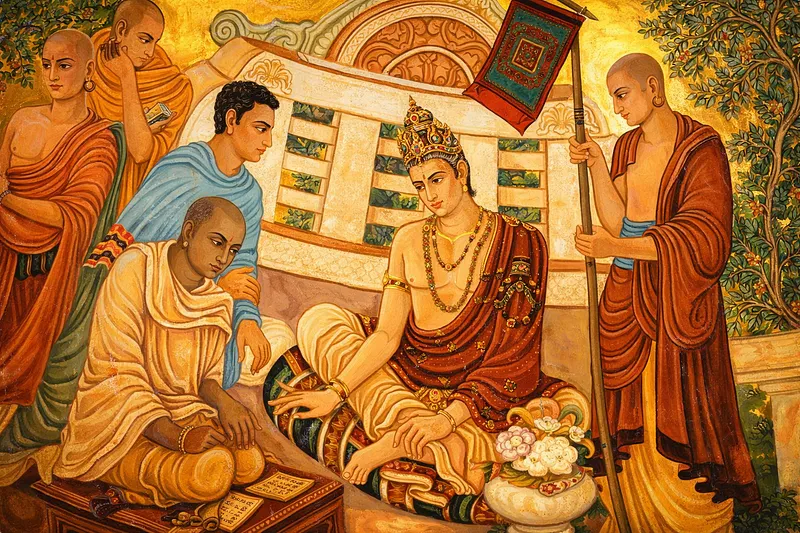
Later, the society started internalizing the meanings of earlier ritual practices, transforming them into vehicles for philosophical reflection. This period is marked by an intensified inquiry into ultimate reality, particularly the relationship between ātman and Brahman. Emerging within a “forest-academy” setting, these texts preserve dialogues that probe the nature of existence, karma, and Mokṣa, and in doing so, lay the metaphysical foundations for later Indian philosophical traditions.
Alongside earlier concerns with prosperity, an emerging emphasis took shape: material wealth was understood as limited and incapable of granting immortality. Rather than replacing earlier ideas, this perspective reflects a shift in emphasis within the same tradition, where greater attention was given to the enduring and the transcendent.
Then texts like the Mahābhārata gave a balanced view. They clearly said:
-
Wealth is important
-
Poverty is harmful
-
Without wealth, people cannot perform duties, live properly, or enjoy life
At the same time, ancient Indian society remained strongly moral and religious. It was mainly dharma-based, not wealth-based. That means wealth was seen as a tool, not the final goal. If wealth and morality ever came into conflict, then morality and duty were expected to come first.
So ancient Indian thinkers never believed that humans are only money-making creatures. They understood that humans have emotions, duties, values, and spiritual purpose. They respected wealth, but they also kept it under control through ethical thinking. This ethical framework acted as a stabilizer, ensuring that the pursuit of individual prosperity contributed to the collective stability of society. These ideas provided the intellectual background against which regional economic systems took shape.
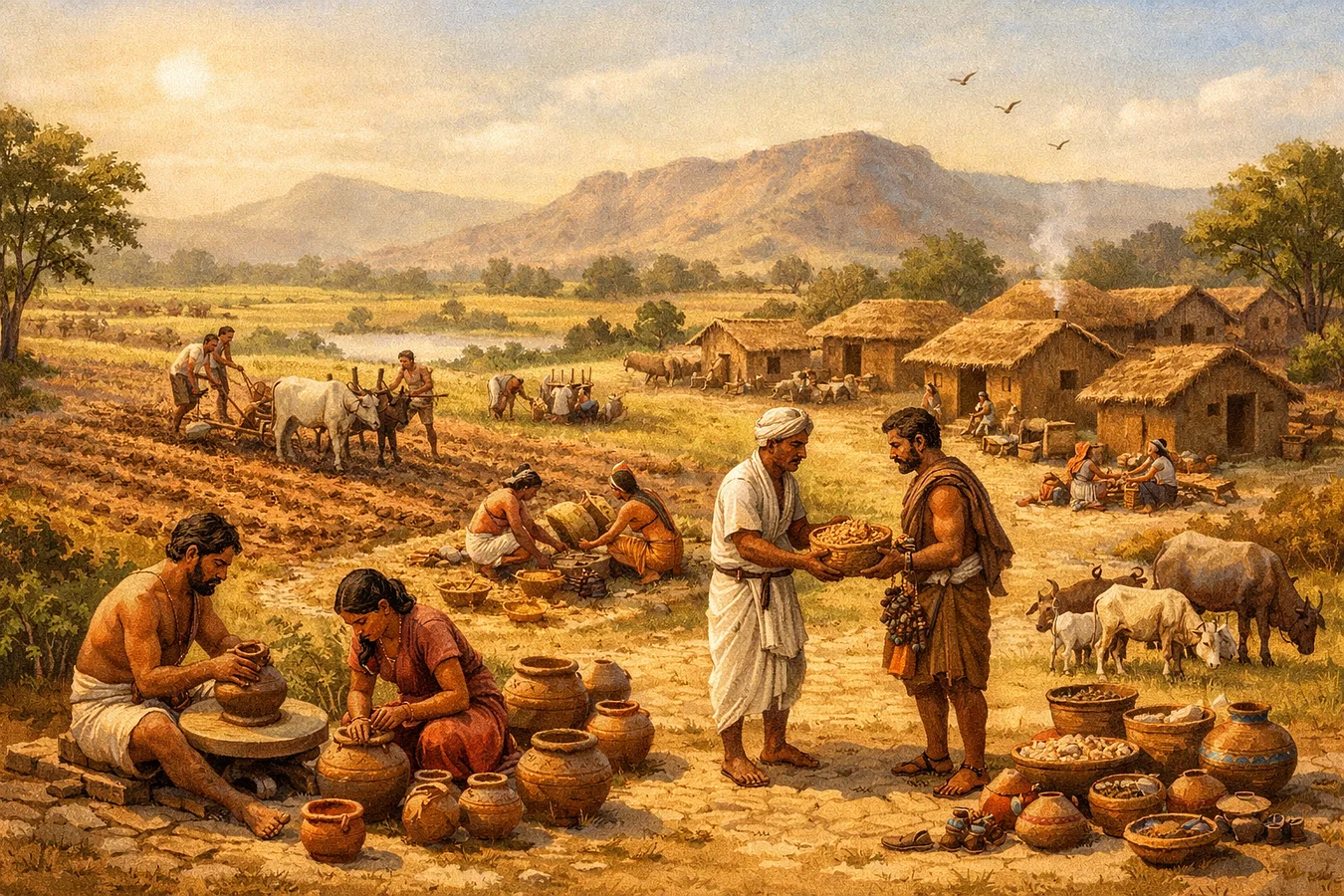
When we talk about the economy of ancient Maharashtra, we must first understand one important thing: Maharashtra’s economy did not suddenly become “historic” in the Satavahana period, as it is popularized. Long before famous dynasties and inscriptions appeared, the region already had people living settled lives, farming, herding animals, and developing village cultures. Maharashtra had a settled life from very early times. Archaeology shows that sedentary (settled) life in Maharashtra began quite early, at least from the second millennium BCE, when Chalcolithic (Copper Age) cultures were spreading in parts of the Deccan. Such communities were not just temporary camps; they were stable settlements where people could cultivate land and keep animals.
Most of these Chalcolithic sites are found in western Maharashtra, while the eastern side shows a somewhat different regional pattern.
The case of Asmaka (Assaka: real name, debated location, and timeline)
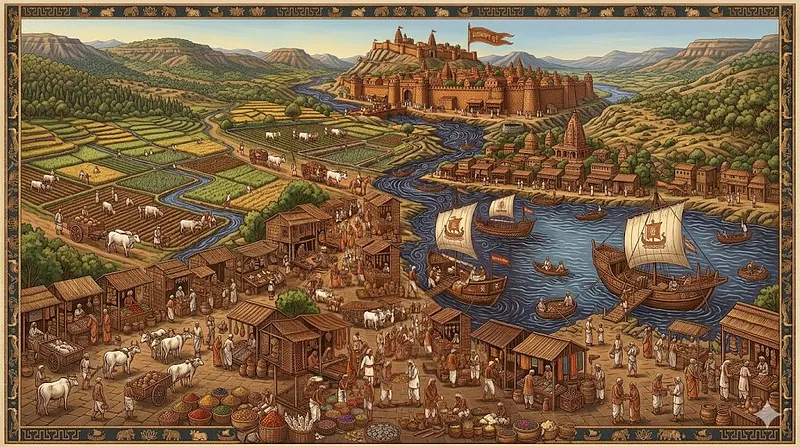
The Asmaka Janapada, also identified as Assaka in various Pali sources, represents the earliest documented political and economic entity in the history of Maharashtra. Existing between the 7th and 4th centuries BCE, it occupies a unique position as the only Mahajanapada located in South India, specifically south of the Vindhya mountains along the fertile banks of the Godavari River. This kingdom acted as a vital economic bridge between the northern urban centers of the Gangetic plains and the developing landscapes of the Deccan. Its territory, which included parts of modern-day Maharashtra, Telangana, and Andhra Pradesh, was strategically positioned to control the southern reaches of the Dakshinapatha, the great transcontinental trade route of ancient India.
The inclusion of Asmaka is vital to understanding the Satavahana rise, as it represents the only Mahajanapada located south of the Vindhyas, specifically in the Godavari valley. By establishing a link to Asmaka, we can trace the long-term economic continuity of the region; it was the foundational agrarian and political entity that prepared the soil both literally and metaphorically for the Satavahanas to later build their sprawling commercial empire.
The capital of Asmaka is variously named in ancient texts as Podana, Potali, or Paudanyapura. While many historical accounts associate this capital with Bodhan in Telangana, a significant number of scholars connect it with the ancient city of Pratishthana, known today as Paithan in Maharashtra. This connection is particularly important for the economic history of the region, as Paithan later served as the grand capital for the Satavahana dynasty, suggesting a long-standing tradition of urban administration and commercial activity. Literary sources like the Digha Nikaya and the Anguttara Nikaya describe the region as wealthy and prosperous, characterized by an abundance of food and precious gems, which indicates a sophisticated early economy supported by both stable agriculture and mineral trade.
From an academic perspective, reconciling the literary antiquity of Asmaka with archaeological findings remains a complex task. Buddhist sources suggest that the dynasty began as early as the 6th century BCE, yet excavations at Paithan have not yet uncovered clear cultural layers dating back to that specific century. This does not necessarily negate the existence of the kingdom at that time, but rather suggests that archaeology has yet to fully confirm the earliest phases of its urbanization. However, significant evidence was found at the site of Adam in the Nagpur district of Vidarbha, where archaeologists discovered a terracotta sealing inscribed with the words "Asakasa Janapadasa." Although this sealing is dated to approximately 150 BCE, it serves as a crucial physical confirmation of the Janapada’s name and its enduring presence in the regional consciousness of Maharashtra.
The history of Asmaka is further enriched by its interactions with neighboring kingdoms and its integration into the broader cultural fabric of the time. The kingdom expanded by annexing the smaller territory of Mulaka to its west, effectively becoming the southern neighbor of the powerful Avanti kingdom. This expansion helped consolidate trade routes that facilitated the movement of scholars and merchants, such as the Brahman guru Bavari, who reportedly traveled from Kosala to settle on the Godavari. These movements highlight a society that was not only economically thriving but also culturally connected to the major intellectual movements of North India.
They respected wealth, but they also kept it under control through ethical thinking. These ideas provided the intellectual background against which regional economic systems took shape. When we talk about the economy of ancient Maharashtra, we see how these foundational values influenced the development of trade, agriculture, and the early administrative structures of the Deccan. The legacy of Asmaka thus provides the essential framework for understanding how the early inhabitants of Maharashtra balanced material prosperity with social and ethical regulation, ultimately paving the way for the imperial grandeur of later dynasties.
The real turning point: Satavahana expansion (after ~200 BCE)
One of the most powerful and culturally luminous dynasties to have ruled the Indian subcontinent. Flourishing roughly between the 2nd century BCE and the 3rd century CE, the Satavahana empire left an indelible imprint on the Deccan plateau, and Maharashtra stood at the very heart of their civilizational achievement.
A few sites in Maharashtra show early historical growth from around 600 BCE, often described as Pre-Mauryan. Later, the Mauryan phase appears in places such as Kaundinyapura, Pauni, and Adam.
But the biggest change comes later.
Most archaeologists agree that the rapid spread of settlements across Maharashtra becomes very visible after ~200 BCE, and this is strongly associated with the Satavahana period, when:
-
old villages grow into towns,
-
new settlements multiply,
-
craft production and trade networks become stronger,
-
and the economy becomes more organised at a regional scale.
This is why, when we write about the ancient economy of Maharashtra, the Satavahana rule becomes a key chapter, but it must be understood as the result of a much older base of settlement development.
As we have seen, ancient Maharashtra's economic foundations were laid long before any major dynasty rose to power. The Chalcolithic settlements, the gradual spread of agriculture, and the development of early trade networks created the base upon which later kingdoms would build.
The mention of Asmaka in Buddhist texts and the archaeological hints from sites like Adam and Paithan suggest that organized political formations existed in this region, though their full story remains partly hidden. What we know for certain is that by around 200 BCE, Maharashtra entered a new phase of economic expansion and consolidation.
This brings us to the threshold of the Satavahana period, the first dynasty for which we have substantial evidence of economic organization, trade networks, urban development, and administrative systems. The Satavahanas did not create Maharashtra's economy from scratch; rather, they channeled centuries of gradual development into a more complex and far-reaching economic structure.
In the following articles, we will examine each major dynasty in detail, beginning with the Satavahanas, to understand how they shaped, expanded, and transformed the economic life of ancient Maharashtra. Each period built upon what came before, creating the rich economic tapestry that would define this region for centuries to come.

%20(6).png)