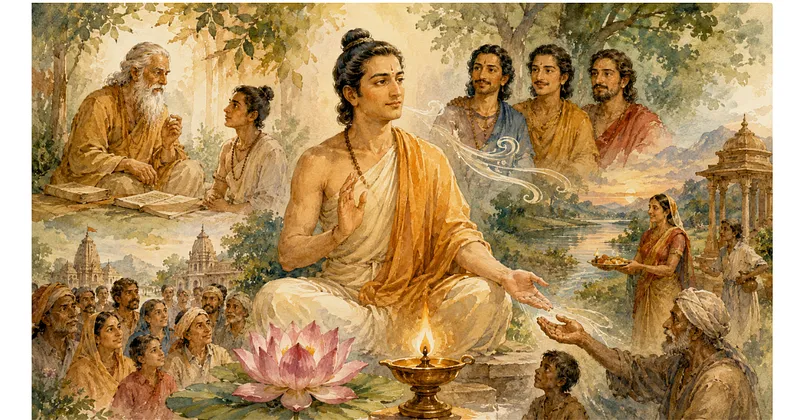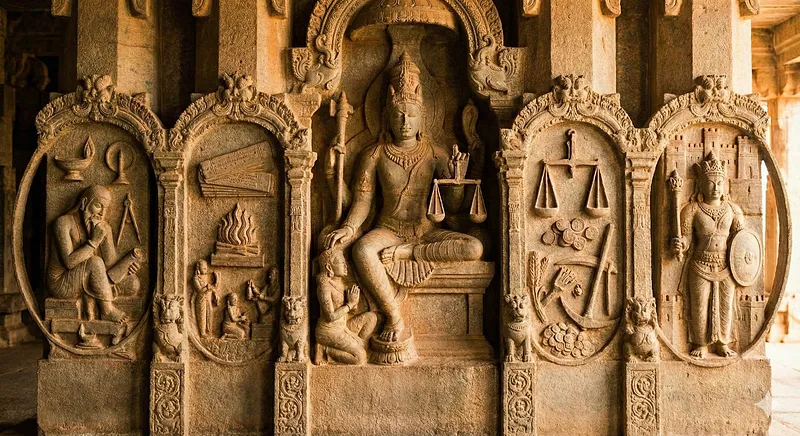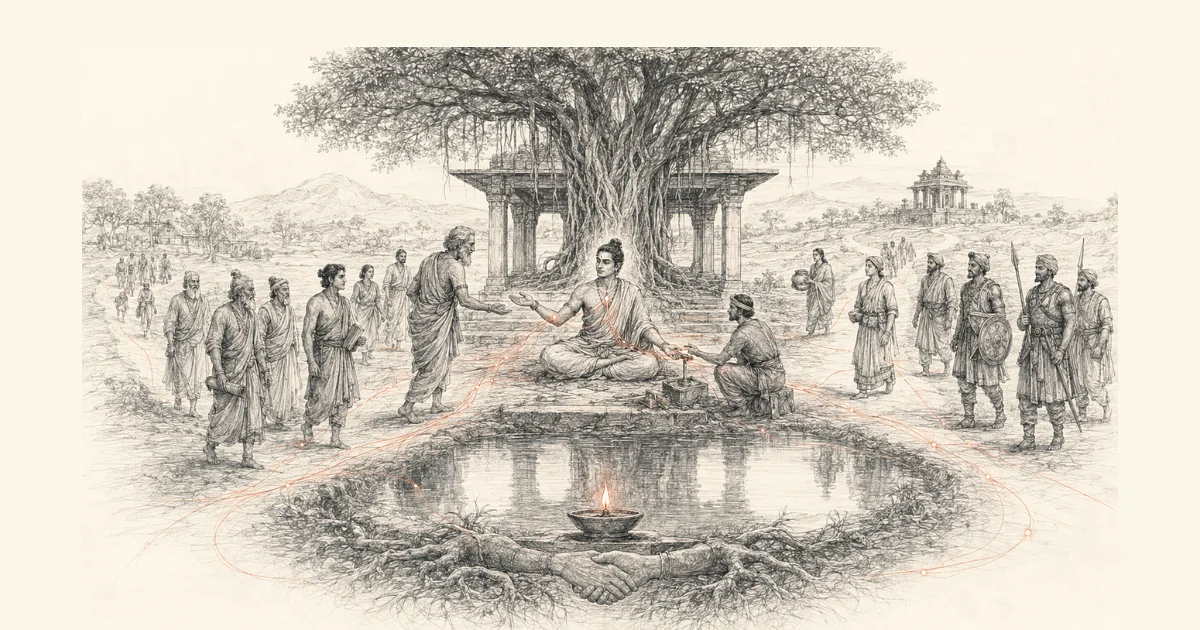
Modern leadership literature spends a great deal of energy on vision, strategy, and decisiveness — the qualities that let a leader act. It spends far less on a quieter question: why do people choose to come near a leader in the first place? Why do capable colleagues, allies, and subordinates gravitate toward one person and drift away from another of equal rank or resource?
The Kāmandakīya Nītisāra, a classical Sanskrit treatise on statecraft attributed to Kāmandaka and closely allied with the Arthaśāstra tradition, treats this as a matter serious enough to deserve its own technical category. In the fourth chapter of the text (verses 6–9), it names a cluster of virtues the ābhigāmika guṇāḥ — literally, "the qualities that cause one to be approached." These are not the private disciplines of self-mastery pursued for their own sake (what the commentarial tradition calls ātma-upakāri guṇāḥ, virtues that perfect the self). They are, instead, āśrita-upakāri guṇāḥ — virtues whose effect is social: they make others willing to trust, associate with, and place themselves under a person's leadership.
This distinction matters. The text is not romanticising charisma. It is arguing that trust-building is a describable, teachable competency — a set of twenty-one specific traits, spread across three verses, that a ruler (or by extension, any leader) can deliberately cultivate. Two classical commentaries on the text, the Jayamaṅgalā and the Upādhyāya-Nirapekṣā, gloss each term and, taken together, give us both the social effect of each virtue and its inner structure. Reading the verses through both commentaries lets us see the framework with some precision, rather than treating it as a vague list of "good qualities."
Verse 4.6: The Foundations of Personal Trust
The first cluster lists ten qualities: kula (noble lineage), sattva (steadiness of character), vayaḥ (youthful vigour), śīla (good nature), dākṣiṇya (kindness or courteousness), kṣiprakāritā (promptness), avisaṃvāditā (consistency between word and deed), satya (truthfulness), vṛddha-sevā (service to elders), and kṛtajñatā (gratitude).
What is notable here is how the commentators read kula and vayaḥ — qualities that look, at first glance, like accidents of birth rather than achievements of character. The Upādhyāya-Nirapekṣā commentary reframes kula as ubhaya-kula-viśuddhi, the purity of both paternal and maternal lines, and reads it primarily as evidence of inherited culture and early training — closer to what a modern reader might call formation, not pedigree. Vayaḥ, similarly, is glossed not as youth for its own sake but as the stage of life suited to implementation — a person neither too inexperienced to act (a child) nor too depleted to sustain effort (advanced old age). The emphasis, in both commentaries, falls on capacity for action.
The remaining eight qualities in this verse are more directly behavioural, and they cluster around a single idea that the commentaries make explicit through a shared illustration: avisaṃvāditā. Both commentators use the identical image of a deceitful man who promises gold and delivers copper plated to look like gold. The virtue being praised is not merely honesty in speech but congruence between word and outcome — a leader's promises should be redeemable at face value. Read alongside satya (truthfulness), kṣiprakāritā (acting without procrastination), vṛddha-sevā (deference to experience), and kṛtajñatā (remembering favours received), verse 4.6 describes a leader whose reliability is legible to others — someone whose future behaviour can be predicted from present conduct, which is precisely what trust requires.
Verse 4.7: Qualities That Secure Alliances
The second cluster is smaller — five qualities — but shifts register from personal trustworthiness to political and relational stability: daiva-sampannatā (the appearance of divine favour, i.e., effortless and consistent success), buddhi (sound intelligence), a-kṣudra-parivāratā (a noble, non-petty retinue), śakya-sāmantatā (the capacity to hold loyal, manageable allies and subordinates), and dṛḍha-bhaktitā (firm, unwavering devotion).
Two of these deserve particular attention for a contemporary reader. First, buddhi is not defined here as raw cleverness but, per the Upādhyāya-Nirapekṣā, as prājñā endowed with eight specific virtues — clarity, foresight, adaptability, discrimination, and steadiness among them. This is judgment under complexity, not quickness of wit; its stated function is that a leader possessing it "does not get deceived or outwitted." Second, a-kṣudra-parivāratā — the quality of keeping a retinue that is not petty or self-serving — is treated by the Jayamaṅgalā as a kind of reputational proof: people trust a leader partly by observing the company that leader keeps. A leader is known, in this framework, by whom they retain.
Dṛḍha-bhaktitā, firm devotion, is glossed with a memorable simile: loyalty that does not fade "like the colour of turmeric," which is vivid but transient. The virtue being described is not intensity of feeling but its durability under changed circumstances — constancy rooted in principle rather than convenience.
Verse 4.8: The Qualities of Vision and Restraint
The third verse names six further traits, explicitly framed by the commentators as the concluding set of sādhv-ābhigāmika guṇāḥ — qualities that make a person "worthy of noble association": dīrgha-darśitva (farsightedness), utsāha (enthusiasm or active energy), śucitā (purity), sthūla-lakṣatā (aiming at great rather than petty objectives), vinītatā (humility and self-discipline), and dhārmikatā (righteousness).
This cluster balances two forces that leadership literature often treats as being in tension: ambition and restraint. Sthūla-lakṣatā — literally "largeness of aim" — is glossed as mahecchā, the pursuit of grand rather than trivial goals, and is explicitly linked to the capacity to attract followers: a person of broad vision "is approached as one who seeks victory" (vijigīṣuḥ abhigamyate). Set directly against this is vinītatā, humility understood as jite-indriyatā, mastery over one's own senses and impulses. The commentary is blunt about the cost of its absence: "without humility, even dependents abandon a man." The framework's implicit claim is that ambition without humility does not sustain association — it may draw people initially, but it does not keep them.
Śucitā, purity, is worth flagging for its precise definition in the Upādhyāya-Nirapekṣā: not ritual purity but freedom from covetousness toward what belongs to others (para-dāra-ādi-nirīhā). It is an ethical claim about restraint of appetite, offered as a component of moral authority rather than piety.
Verse 4.9: The Synthesis — Virtue as the Ground of Approachability
The concluding verse states the thesis plainly: a person endowed with these qualities is su-vyaktam abhigamyate — "clearly and unmistakably approached" by others. The verse then issues an instruction, not merely a description: tathā tu kurvīta — "therefore, one should act" — so as to attain loka-abhigamyatām, being sought after by the world.
Both commentaries treat this as more than a summary. The Jayamaṅgalā frames the deliberate cultivation of these virtues as something that should be undertaken prādhānyena — as a chief priority, not a secondary concern behind wealth or military strength. The Upādhyāya-Nirapekṣā makes the political stakes explicit: "when the subjects trust and love their ruler, governance flows smoothly." Approachability, in this reading, is not a soft adjunct to power — it is treated as a precondition for power to function at all.
What This Framework Offers Contemporary Leadership Thinking
Three features of the ābhigāmika guṇāḥ framework are worth carrying into present-day discussions of leadership.
First, it separates self-cultivation from relational cultivation as distinct categories of virtue. Many modern leadership models collapse these — treating personal integrity and the capacity to build trust with others as the same achievement. The Nītisāra's distinction between ātma-upakāri and āśrita-upakāri virtues suggests they are related but separable competencies, and that a leader can be disciplined in the first while failing at the second.
Second, the framework repeatedly defines trust in terms of predictability rather than warmth. Avisaṃvāditā, satya, dṛḍha-bhaktitā, and dīrgha-darśitva all describe a leader whose future conduct can be inferred reliably from present conduct. This is a more testable, less sentimental account of trust than much contemporary leadership writing offers, and it travels well into institutional and organisational contexts far removed from classical kingship.
Third, the tension the text stages between sthūla-lakṣatā (large ambition) and vinītatā (humility) anticipates a genuine difficulty in leadership practice: that vision and restraint are both necessary and yet pull in different directions. The Nītisāra does not resolve this tension by subordinating one to the other; it simply insists a leader needs both, in the same list, in the same verse.
Taken as a whole, verses 4.6–4.9 offer something leadership frameworks rarely attempt: a structured, twenty-one-item account of why people choose to follow, built not from psychological theory but from centuries of accumulated observation about statecraft, and preserved through commentarial layers that repeatedly test the terms against concrete illustration. Read carefully — and with the evidentiary care of separating verse from commentary, and one commentator's gloss from another's — it stands as one of the more precise classical treatments of what contemporary language would call trust-based leadership.