Byung-Chul Han has always been a philosopher of fatigue. Few contemporary thinkers have written with such cold clarity about the sickness of modern life: the exhaustion of achievement, the tyranny of positivity, the violence of transparency, the noise of information, the loneliness hidden inside permanent communication. His books are slim, almost fragile objects, but they carry the density of compressed weather. They do not argue like conventional philosophical treatises. They arrive like small diagnoses. A sentence lands. Then another. By the end, one begins to suspect that the world one inhabits is not merely stressful, fast, and distracted, but metaphysically damaged.
In In Praise of the Earth: A Journey into the Garden, Han does something unexpected. He kneels.
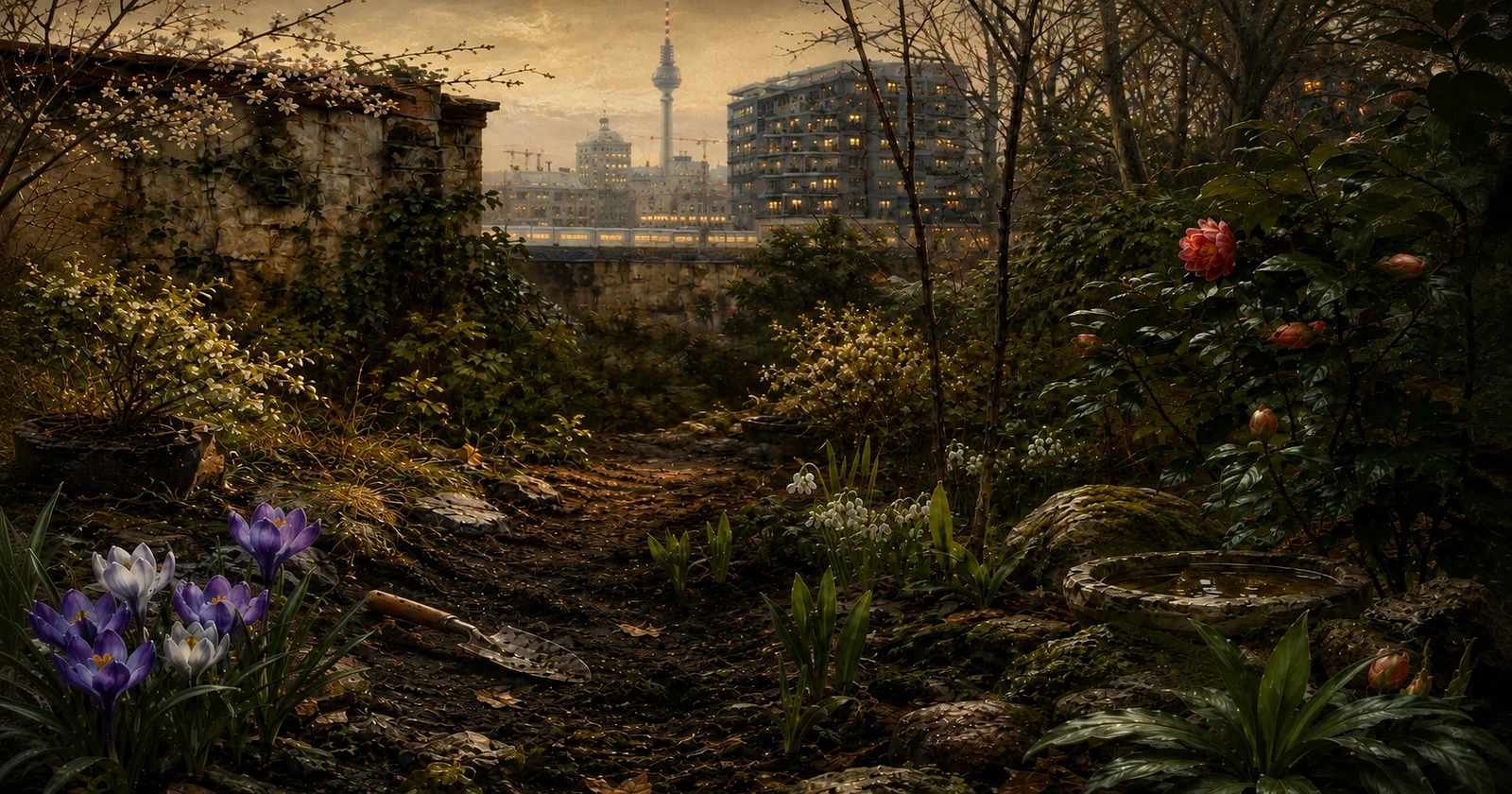
The philosopher who had spent years exposing the pathologies of digital capitalism turns toward soil, bulbs, rain, stones, leaves, and flowers. He begins to garden in Berlin. Not occasionally, not as weekend therapy, but with daily fidelity. For three years, through spring, summer, autumn, and winter, he tends to what he calls his secret garden. The result is not a horticulture manual. It is not a pastoral escape. It is a philosophical conversation.
Han enters the garden as a thinker and emerges as a witness.
The garden teaches him what no screen can teach: that time is not one thing. Time does not move uniformly. It does not arrive as a notification. It cannot be refreshed. The crocus has one time. The camellia another. The soil has a deeper time. A stone, for Han, is not inert. Even it participates in the breathing of being. Every plant has its own rhythm, its own inwardness, its own claim on attention. To garden is to surrender the fantasy that the world exists at the speed of the human will.
This is why the book feels so moving. Han does not merely admire the earth. He is corrected by it.
Modern life trains us to think of the world as material, stock, input, asset, property, zone, data, carbon unit, investment opportunity, or development potential. Han’s garden refuses this understanding. It does not behave like a resource. It cannot be scaled. It cannot be hurried. It cannot be known only through measurement. It must be touched, named, waited for, remembered, and mourned. A flower cannot be loved in general. It must be known in particular.
This is one of Han’s most beautiful insights: names matter. To have flowers in a garden without knowing their names, he suggests, is a kind of betrayal. Naming is not possession here. It is intimacy. It is a way of entering a relation. A flower without a name remains decorative. A flower with a name becomes addressable. It can be invoked.
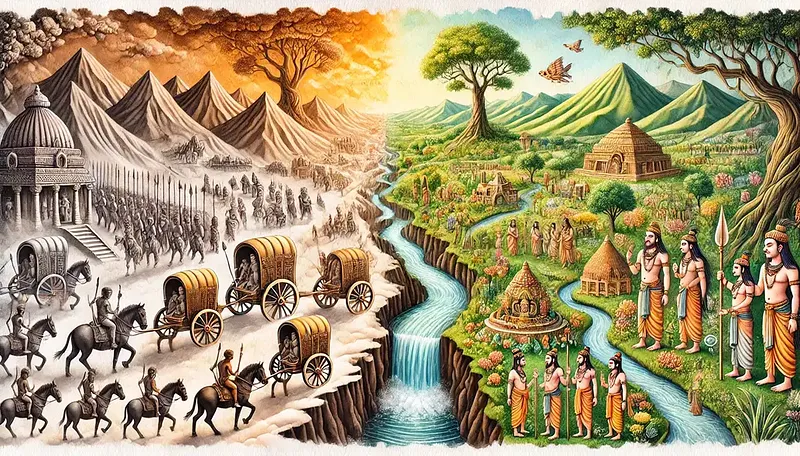
There is something deeply Indian in this, though not in the shallow civilizational way in which ecological memory is often advertised today. India has never lacked words for the living earth. Bhoomi, Prithvi, Prakriti, Van, Nadi, Jal, Jangal, Jeev. The old vocabularies knew that the earth was not mere surface. Rivers were not merely water channels. Forests were not merely timber. Trees were not merely biomass. Soil was not merely land. Animals were not merely fauna. The everyday religious and cultural life of India once carried countless small gestures of ecological recognition: the tulsi courtyard, the sacred grove, the village tank, the seasonal calendar, and the ritual attention to seed, rain, harvest, river, cattle, and shade.
But memory is not the same as practice.
Contemporary India speaks the language of reverence and often acts through the logic of extraction. We worship rivers and poison them. We call trees sacred, yet cut them for road widening. We celebrate the monsoon and build cities that flood after two hours of rain. We invoke Mother Earth and treat mountains as quarries, wetlands as vacant land, coasts as real estate, and forests as administrative obstacles. The contradiction is not uniquely Indian. It is global. But in India, it has a special sharpness because ecological reverence has not disappeared from language. It has been retained as sentiment while being expelled from planning.
Han’s book enters precisely at this fault line.
He is not asking us to become sentimental about nature. He is asking us to recover seriousness. The garden is not cute. It is demanding. It produces beauty, but it also requires labor. It asks for bodily knowledge. It asks for humility before the weather. It asks for the capacity to wait without guarantee. It asks for care without applause. In a world obsessed with performance, the gardener works for forms of life that may never thank him.
This is why gardening becomes, in Han’s hands, an ethical training. It teaches the time of the other.
That phrase should disturb us. Much of modern politics is built on the destruction of the time of the other. The forest must meet the project's deadline. The river must obey the schedule of the dam. The city tree must obey the geometry of the flyover. The child must follow the exam calendar. The worker must keep the platform's tempo. The farmer must adapt to market volatility. The citizen must obey the news cycle. The body must obey productivity. The mind must obey the feed.
Han’s garden refuses this obedience.
In the garden, one cannot command spring. One cannot bully a bud into flowering. One cannot conduct a performance review of a seed. One cannot convert waiting into inefficiency. This is the scandal of the garden in an achievement society. It makes visible the poverty of a culture that has confused speed with vitality.
India knows this confusion intimately. The public language of development is full of urgency: corridors, expressways, logistics, ports, airports, smart cities, data centers, industrial parks, energy targets, and global competitiveness. Much of this is necessary. A poor country cannot romanticize deprivation. Roads matter. Power matters. Jobs matter. Housing matters. Strategic infrastructure matters. The question is not whether India should build. The question is whether India knows how to build without becoming blind.
The debate around Great Nicobar captures this dilemma in its most intense form. The government presents the project as strategic, economic, and nationally necessary: a transshipment port, an airport, power infrastructure, and a stronger Indian presence near vital sea routes. Ecologists and critics warn of forest loss, habitat fragmentation, threats to leatherback turtles, coastal disruption, and risks to indigenous communities. Both sides speak the language of national interest, but they inhabit different senses of time. The state speaks in the time of strategy. Ecologists speak in terms of species, reefs, forests, and communities. Han would ask, "Which time is allowed to appear as real?"
The Western Ghats offer another lesson. For years, India has struggled to settle the question of ecological sensitivity in this mountain chain that nourishes rivers, forests, farms, biodiversity, and dense human settlements across several states. Draft notifications come and go. Committees propose. States object. People fear displacement, restrictions, and loss of livelihood. Environmentalists fear delay, dilution, and irreversible damage. Here again, the problem is not a simple battle between ecology and economy. It is a problem of political imagination. How does a democracy govern a living system that is not empty, not pristine, not merely human, and not infinitely available?
Han’s garden does not give a policy formula. It gives a discipline of perception.
That is what India’s environmental debate often lacks. We have laws, clearances, compensatory afforestation rules, expert committees, impact assessments, satellite maps, forest reports, and court orders. Yet the moral imagination of development remains thin. A forest is too often made legible only as an area. A tree becomes countable only as a plantation. A river becomes administratively visible only as flow, pollution load, or water allocation. A wetland becomes important only after it floods a city. The living world is translated into files, and once translated, something essential is lost.
This does not mean measurement is useless. Without measurement, power escapes scrutiny. Without maps, records, and data, ecological destruction can hide behind rhetoric. India needs better ecological science, stronger institutions, honest impact assessments, transparent public hearings, and serious enforcement. But data alone cannot produce care. A spreadsheet does not mourn a forest. A dashboard does not know the smell of the first rain on dry soil. A satellite can show canopy but not affection.
Han’s argument is that the crisis is not only environmental. It is civilizational. We have lost the ability to linger.
To linger is not to be lazy. It is to stay long enough for the world to disclose itself. A child lingering near an anthill is learning more than curiosity; she is learning scale. A farmer lingering over the soil is reading a text older than the state. A gardener lingering over a plant is practicing a form of attention that has become rare. Han’s garden is therefore not a retreat from politics. It is a critique of the attention economy at the root.
This is where his earlier work and this book meet. The same society that burns out the human subject also burns out the earth. The achievement society does not stop at the body. It extends its command to rivers, forests, oceans, seeds, animals, and seasons. Everything must produce. Everything must be available. Everything must be transparent. Everything must be put to work.
Digital capitalism intensifies this condition. It convinces us that reality is what appears on the screen, what circulates, what trends, and what can be captured and shared. But the garden is not viral. It resists spectacle. It rewards recurrence. Its miracles are quiet: a shoot appearing, a flower opening, a leaf rotting back into earth. Its drama is not breaking news. It is return.
This matters globally because the climate crisis is also a crisis of attention. The facts are no longer hidden. The world has just passed through the hottest eleven-year period on record. Climate reports grow more urgent. Biodiversity assessments warn of mass species loss. Emissions reports repeat, with increasing desperation, that present action is not enough. And yet the machinery of normal life continues. We scroll through catastrophe. We convert planetary warnings into content. Fire, flood, heat, drought, cyclone, glacier melt, coral bleaching, crop failure, school closure, and species loss: each arrives, glows briefly, and is replaced.
The ecological crisis has become continuous, but our attention remains episodic.
Han’s garden offers another temporality. It teaches recurrence, not novelty. It asks us to see that care is not an event. Care is repetition. Watering, pruning, waiting, protecting, naming, noticing, returning. This is the opposite of the politics of announcement. Much of modern governance loves the inaugural moment: the launch, the foundation stone, the campaign, the target, the dashboard, the scheme. But ecological repair belongs to another order. It requires maintenance. It requires boring fidelity. It requires institutions that can return to the same site again and again, not merely declare intentions from a stage.
A gardener-state would be very different from a project-state.
A gardener-state would still build, but it would ask what the building interrupts. It would know that the soil is not empty because it is not urban. It would treat shade as public infrastructure. It would see school design as a form of climate policy. It would understand that heat is not merely a temperature event but a social event: it closes classrooms, burdens women with care work, raises health risks for workers, reduces learning, and turns poor housing into punishment. It would not count plantations only by the number of saplings planted but also by survival, diversity, ecology, and community care. It would treat rivers as living systems rather than drainage channels. It would know that a city without birds, insects, trees, porous ground, and public shade is not modern. It is ill.
Ahmedabad’s Heat Action Plan remains an instructive example because it began from the recognition that heat kills unequally. Heat is never just weather. It is housing, labor, gender, age, class, water, electricity, urban design, school timing, and public health. A heat plan, in that sense, is a moral document. It asks whose body bears the cost of a warming city.
Han’s garden pushes this further. It asks not only how humans can survive the earth’s anger but also how humans can become worthy of the earth’s generosity.
There is a danger here. The language of reverence can become evasive. It can turn ecological politics into soft spirituality. India is especially vulnerable to this. We know how to aestheticize nature while ignoring the people who live closest to it. Janjatiya communities can be praised as guardians and displaced as encroachers. Farmers can be romanticized and abandoned. Pastoralists can be celebrated in cultural festivals and excluded from conservation regimes. Women can be called close to nature, only to be made to bear the unpaid labor of environmental breakdown. Sacredness without justice is decoration.
Han mostly writes from the solitude of a garden. India forces the question of society back into that solitude. Who owns the garden? Who labors in it? Who has time to linger? Who is paid to care? Who is evicted in the name of conservation? Who breathes polluted air so that others may enjoy clean enclaves? Who loses land so that cities may consume electricity? These questions do not weaken Han’s book. They make it travel better. They bring his philosophy into contact with power.
The garden is not innocent. It can be private, enclosed, aesthetic, and exclusionary. But Han’s garden is not valuable because it is pure. It is valuable because it retrains perception. And perception is political.
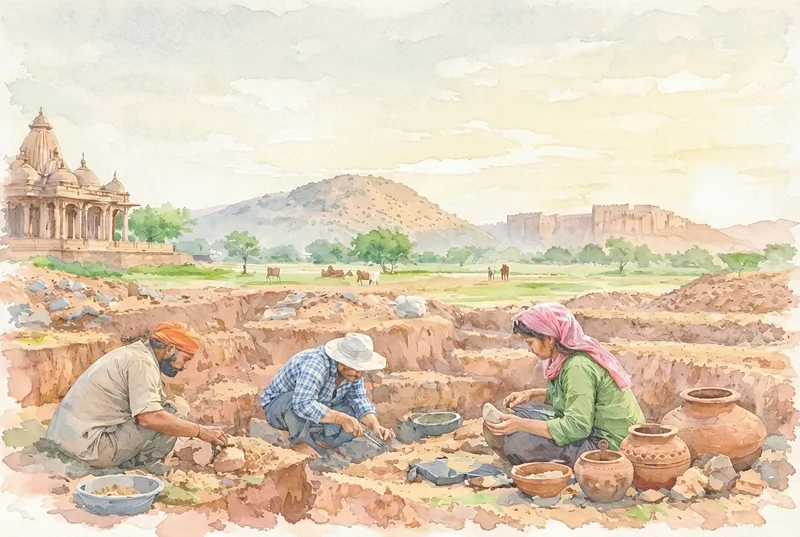
Consider the simple act of touching soil. For Han, it becomes almost devotional. He strokes the earth. The gesture may sound excessive to a secular reader, but its excess is the point. Modernity has made us embarrassed by forms of tenderness that do not produce value. To touch the earth without wanting to own it, mine it, pave it, sell it, or photograph it is already a minor rebellion.
In India, such tenderness exists, but it is often socially uneven. The person who touches soil is not always the person who owns land. The person who knows seeds is not always the person invited to policy consultations. The person who protects a forest may not have formal rights over it. The person who plants trees in a city may live in a settlement marked for removal. Serious ecological politics must therefore join Han’s ethic of care with questions of rights, labor, and democratic voice.
This is also where global climate politics must grow up. Too much of the global debate remains trapped between technocracy and despair. One side speaks in targets, markets, offsets, carbon capture, energy transition, adaptation finance, and loss-and-damage mechanisms. The other speaks in grief, collapse, anger, and betrayal. Both are necessary, but neither is sufficient. What is missing is a culture of planetary attention. We do not yet know how to make societies that can feel the meaning of what they know.
Han’s book is small, but it asks a large question: what would it mean to experience the earth as real again?
That phrase, reality regained, is one of the keys to the book. The garden restores reality by resisting the abstractions through which modern life floats. It brings back weight, smell, weather, decay, waiting, failure, and surprise. It reminds the philosopher that thought does not begin only in the mind. It begins in the hand, the knee, the back, the skin, the breath, and the eye, adjusting to small differences in green.
For an academic, this is humbling. For a policymaker, it should be unsettling. For a citizen, it is clarifying.
We have built systems that reward distance. The expert studies from above. The investor calculates from elsewhere. The bureaucrat files from the capital. The consumer clicks from the sofa. The algorithm predicts without belonging. The garden, by contrast, demands nearness. You cannot garden from nowhere. You must be there.
This may be the book's deepest political lesson. Ecological care begins with presence. Not presence as sentiment, but presence as responsibility. To be present is to be answerable to what one affects.
The great environmental struggles of our time are struggles over accountability. Who must answer to the island, the forest, the mountain, the bird, the river, the fisher, the child, the future? Who is allowed to decide that a place is expendable? Who gets to call destruction a trade-off? Who bears the burden of proof: the community trying to protect a living system, or the institution trying to transform it?
Han does not ask these questions in the language of activism. His mode is quieter. But quiet should not be mistaken for softness. The book is severe because it restores judgment. It tells us that a civilization unable to wonder at a flower will eventually be unable to protect a forest. A society that cannot wait for a plant will not wait for a river to heal. A culture that forgets names will accept disappearance more easily.
Han’s book does not treat the garden as a museum of the past. It is a practice in the present. It does not ask us to abandon modernity. It asks us to make modernity less stupid.
A less stupid modernity would know that speed has costs. It would know that every clearance is also a moral decision. It is known that compensatory planting cannot automatically replace an old forest. It would know that climate adaptation is not only about infrastructure but also about bodies and inequalities. It would know that children need shade as much as smart boards. It would know that the right to development cannot mean the right to ecological amnesia.
Han’s Catholic turn in the book may not persuade every reader. His conviction that the earth reveals divine creation will seem too theological to some, too European to others, too private to many. But the force of the book does not depend on accepting his theology. One may read him through Buddhist attention, through Gandhian restraint, through Tagore’s nature pedagogy, through J. C. Kumarappa’s economy of permanence, through Janjatiya cosmologies, through feminist care ethics, through ecological science, or through the ordinary wisdom of anyone who has kept a plant alive through a cruel summer.
The point remains: the earth is not mute. We have become hard of hearing.
In India, the future of ecological politics will not be decided only in forests, courts, ministries, or climate summits. It will also be decided in classrooms, housing plans, city budgets, school playgrounds, heat shelters, village commons, public transport, agricultural extension systems, and the design of everyday life. It will be decided by whether children learn the names of the trees around them. Whether urban planning treats shade as essential. Whether schools become climate-safe. Whether public works departments learn to think like watershed institutions. Whether environmental clearance becomes a democratic process rather than a ritual. Whether development can acquire manners.
"Manners" may seem too small a word for a planetary crisis. But Han would understand it. Gardening is, among other things, a school of manners toward the living world. One does not shout at a seed. One does not insult the season. One does not enter the soil without consequence. One learns restraint.
That restraint is not anti-development. It is anti-arrogance.
The spade in Han’s hand is therefore not a symbol of retreat. It is a philosophical instrument. With it, he breaks the surface of a world made hard by abstraction. Beneath that surface, he finds not an idea but a relation. Earth, plant, season, hand, body, decay, beauty, mortality. The garden does not save him from the world. It returns him to it.
Perhaps that is what makes the book so affecting. At a time when ecological writing often swings between terror and instruction, Han writes praise. Praise is not denial. Praise is attention ripened into gratitude. To praise the earth today is not to ignore its wounds. It is to remember that grief without love becomes sterile, and policy without wonder becomes management.
The question Han leaves us with is not whether everyone should garden. Many cannot. Many do not have land, time, water, safety, or leisure. The question is larger and more difficult: can a society recover the habits that gardening teaches?
Can we wait? Can we notice? Can we name? Can we care without immediate reward? Can we build without erasing? Can we treat the time of the other as real? Can we design institutions that protect slow life in a fast age?
The answer will not come from a philosopher alone. It will come from farmers, gardeners, teachers, forest communities, planners, children, scientists, judges, engineers, sanitation workers, monks, poets, and municipal officials. It will come from those who understand that the earth is not an object below us but the condition beneath every argument we make.
Han went into a garden and found reality again.
India, and the world, may have to do the same. Not by escaping history, but by touching the soil from which history still grows.