‘Karma will get you back.’
‘He is facing misfortune after misfortune. Must be karma paying him back.’
‘It is all karma. You cannot do anything but face it all helplessly.’
These are all statements that we hear rather often. In most cases, they pop up when someone finds themselves in a terrible situation. Especially when they believe they are helpless victims of circumstances that they do not quite deserve.
The term ‘Karma’ is all too often used as a partial synonym for ‘retribution’ or even ‘punishment’. A surprising number of people find comfort in the idea that this mysterious force called Karma will avenge the wrongs done to them by others.
But this is where we go dramatically wrong. Karma is serious business, to put it flippantly. But it is NOT retribution. It is NOT a tool of divine punishment, nor is it your personal avenging angel.
Look at it with a specific lens, and Karma is the great equalizer- that which restores and sustains balance, if you look at the big picture.
The ‘specific lens’ part comes because Karma is so much more- it encompasses our way of life, the path we follow and most of all, our choice.
To understand karma a little more, we need a quick glimpse at a very significant verse from the Bhagavad Geeta:
चातुर्वर्ण्यं मया सृष्टं गुणकर्मविभागश: |
तस्य कर्तारमपि मां विद्ध्यकर्तारमव्ययम् || 13|| (Chapter 4)
Perhaps quite aware of how Kaliyugi humans will confuse themselves about birth, status, varṇa and many other perfectly sensible topics, Kṛṣṇa lays it out clearly here.
The four varṇas have been created by me based on the guṇa and karma of men… (Line 1)
The family one is born in, the circumstances they grow up in the midst of, the experiences they are exposed to- these are related to past karmas. Meaning that we have decided this for ourselves in previous janmas.
When life coaches urge us to “Script our life journey” or “Write our own destiny”, we eagerly hang on to every word they utter. Yet, this is what the Sanatani is asked to do- script our own destiny through our karma and adherence to dharma.
So, Karma is CHOICE. The choice to follow specific pathways at different stages, as life unfolds; and the willingness to bear the consequences of those choices.
It is simple- If I choose to eat nothing but high-cholesterol foods, I also choose to open doors to probable heart disease. The menu is my choice, the heart disease is a direct consequence of my choice, and hence, scripted by me.
When I get heart disease, is it vengeance being wreaked upon me by someone I have wronged? No, it is a situation that I created or scripted with my own hands by making certain choices in my life. This IS essentially what Karma is- the path that you lay out for yourself by your own actions, behaviours or intentions. You lay out this path for your future self in this lifetime, right now, at present. The path you traversed until now was the result of past karma or past choices you made. Those may be from past janmas or from earlier years of your current lifetime.
Understanding this makes it very simple- I make the right choices and the appropriate dhārmika choices, and I live a good life in the current and future janmas. I make awful, adharmic choices, and I subject myself to unsavoury circumstances both in this and future janmas.
Now, here we come to a very crucial question. What happens when circumstances around me force me to do that which is not ‘good’? How can I be held responsible if it is my past karma that has foisted the circumstances upon me when, in this janma, I am striving my best to follow dharma and make the right choices?
Well, the Mahābhārata, as this itihāsa is wont to do, has the answer to this rather complex and confusing question. Let’s take a peek into this vast segment known as the Mārkaṇḍeya Samasyā Parva. This is set during the Pāṇḍava exile, towards the end, before the Pāṇḍava ajñāta vāsa. The great sage Mārkaṇḍeya is visiting the Pāṇḍavas while Kṛṣṇa and Satyabhāmā are also visiting them in the forest.
Yudhiṣṭhira asks the great sage several questions covering a range of topics. Mārkaṇḍeya muni answers him patiently, often narrating stories to elucidate his point. One of the most interesting and also popularly known stories is that of the butcher named Dharmavyādha. The story goes thus:
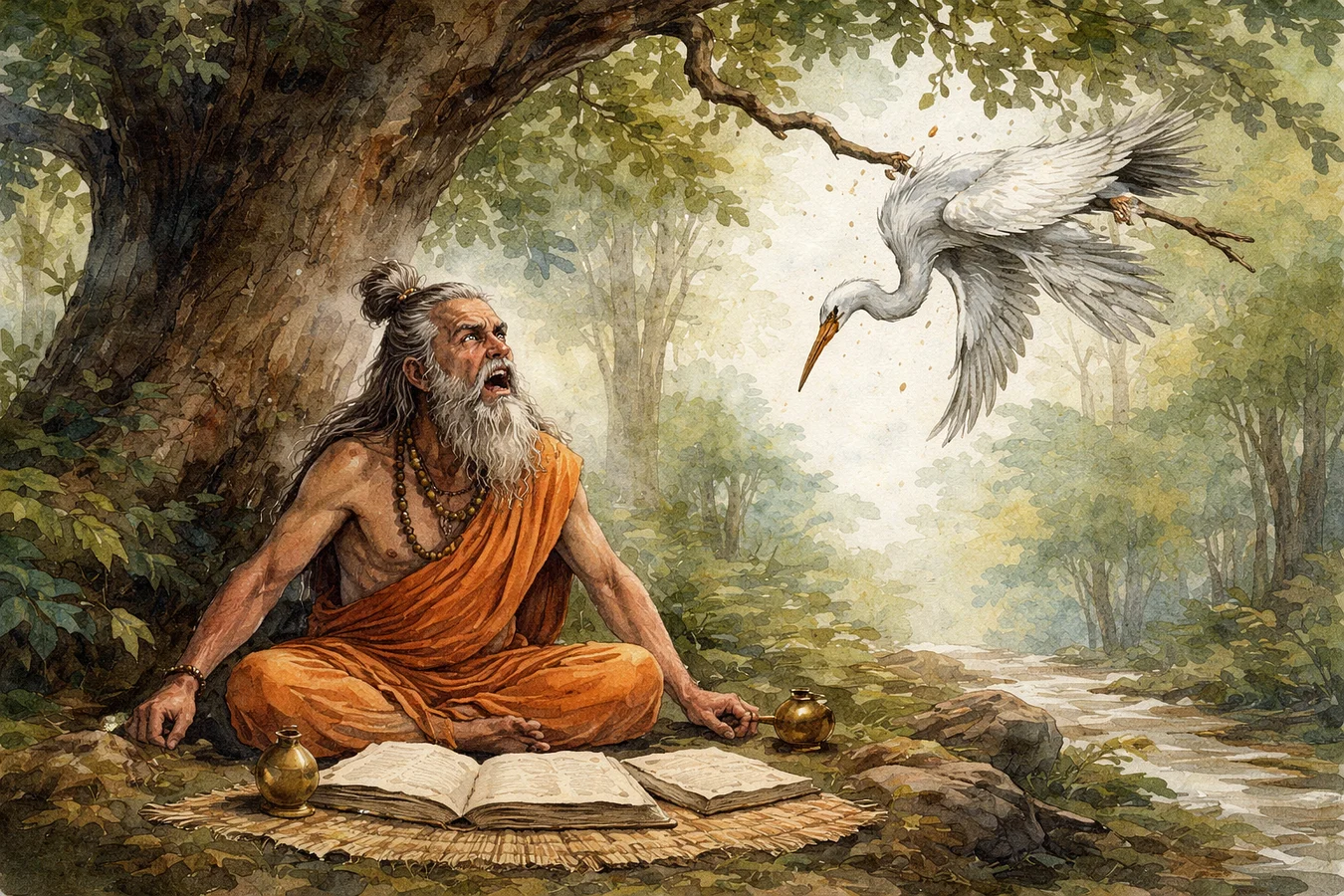
A knowledgeable brāhmaṇa named Kauśika was sitting in his forest abode under a tree, studying the vedas. Suddenly, bird droppings fell upon him, tainting him. The brāhmaṇa’s concentration and study were disrupted in a vile manner; he grew angry and shot a glare into the branches above him where the culprit, the bird, was perched. The brāhmaṇa’s tapo-shakti was immense, and it killed the poor bird.
Kauśika regretted his action immediately, but of course, there was no reversing the act. He sighed in dejection. Then realizing that he could not concentrate any longer, he set his books aside and went to the village to get bhikṣā. There, he came across a pativratā strī who delayed bringing bhikṣā for him. Kauśika grew angry again, and he declared that she did not know dharma because she had made a hungry brāhmaṇa wait after asking him to stay right there for bhikṣā. The lady calmly told him that she was no bird to be killed by his anger and that she was well aware of dharma and its many subtleties.
Understanding Kauśika’s shock about her knowledge of what had happened deep in the forest, she told him that her strict adherence to pativratā dharma gave her the insight to know what he had done.
Kauśika was humbled. He realized that he had not understood the nuances of dharma properly. The lady told him to go seek Dharmavyādha at Mithilā and learn from him about dharma. Kauśika obeyed, and he reached Mithilā, where he found Dharmavyādha in the marketplace.
To Kauśika’s great consternation, Dharmavyādha was not a teacher or a scholar. He was a hunter- butcher. When Kauśika arrived, he was busy measuring out the meat of pigs and buffalo for scores of customers. The brāhmaṇa was confused. How could a man engaged in such a job be knowledgeable about dharma? A hunter- butcher was inherently of a cruel disposition, wasn’t he? How could someone engaged in causing pain and death to innocent creatures give him a discourse on dharma?
But Kauśika had learned from his experience with the pativratā lady not to ‘judge a book by its cover’. He went to Dharmavyādha’s home, and there, he asked him several questions. Dharmavyādha was extremely knowledgeable about the nuances of dharma, and he clarified all of the brāhmaṇa’s doubts.
As he was about to take leave, Kauśika could not resist asking Dharmavyādha about his chosen profession.
“O Dharmavyādha,” he said, “I find it extremely inappropriate for someone as well versed with dharma to be engaged in a profession that is so cruel, so violent.”
Dharmavyādha had perhaps been expecting the question. He told Kauśika the following points to explain why he was a butcher- hunter:
-
This is the job of my kula- my ancestors were engaged in this task- It is my svadharma to follow the path laid by my ancestors and continue the profession
-
It is the result of past karmas that I was born in this family and in these circumstances, where my svadharma would be to carry out this profession- hence, to erase that past karma, I must carry out this task and not evade it, for this is my designated karma
-
BUT, what I can do is to see how I can minimize the cruelty or the incorrect aspects of this job, even as I follow the swadharma of doing it. I see what good karma I can do to set off the unsavoury aspects of my profession
-
In line with this, I do not myself hunt these animals, nor do I eat meat myself
-
I also give charity, serve my parents, and serve worthy brāhmaṇas as much as I can
-
I speak the truth always and follow dharma in all aspects of life where I can
-
In these ways, I set off the negative aspects of following this svadharma of mine
Dharmavyādha’s explanation tells us a very important thing- Karma is not this inevitable doomsday tool or a completely inflexible restriction imposed on us. We do not get to blame our poor decisions and the consequences on karma. While it is true that our past karma determines where we are born and how our life is shaped at that very initial point, every step taken thereafter is by our own choice, even if it is within a certain boundary that is necessitated by that past karma that we scripted.
Most importantly, karma is not a chain that an unforgiving God shackled us with as a punishment. It is a culmination of choices that we made in the past and that we continue to make every single day of our lives. Karma is a tool we can wield to script a better future, a better destiny, simply by making the right choices that keep us on the path of dharma.

.png)
.png)