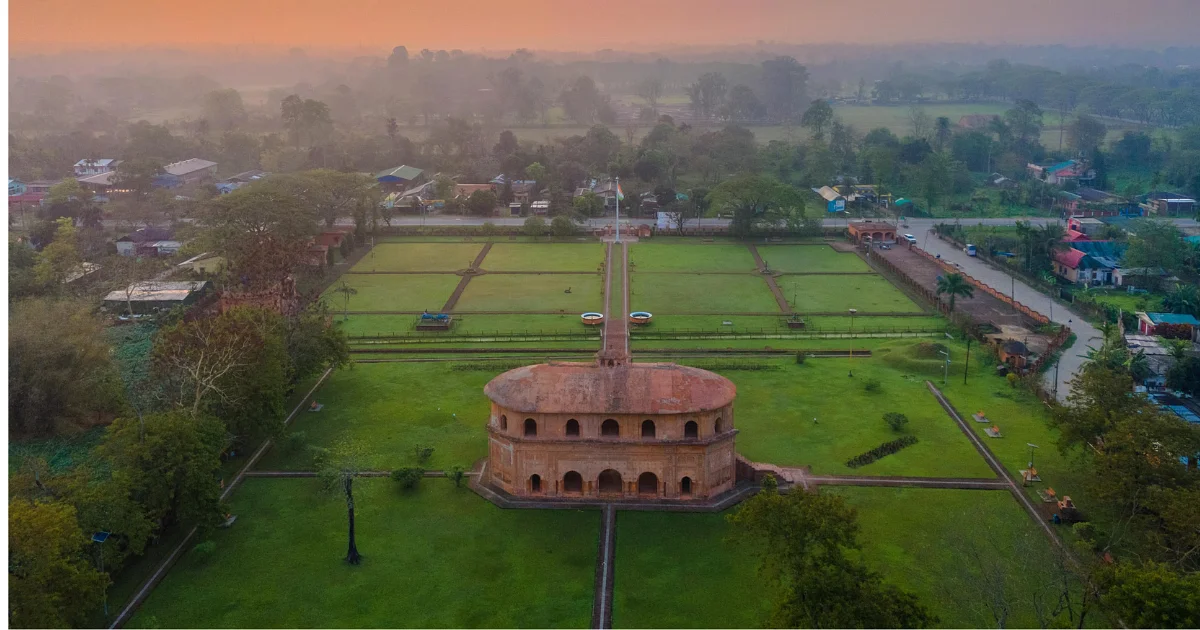
Sivasagar rises as the living soul of the Ahom legacy, where stone, water, and faith converse across centuries. From Charaideo’s sacred silence to royal palaces and vast tanks, the city embodies political wisdom, cultural harmony, and architectural genius, preserving the timeless rhythm of a civilization that shaped Assam’s enduring identity.
Beneath the misty folds of Assam’s hills and the rhythmic pulse of the Brahmaputra lies a legacy often overlooked, a dynasty that ruled not with brute force, but with vision, resilience, and cultural fusion. The Ahom dynasty (1228-1826), and valor shaped the soul of Assam for nearly six centuries. From resisting seventeen Mughal invasions to crafting architectural marvels and nurturing a pluralistic society, the Ahoms left behind more than monuments – they etched a living heritage into the land itself. This is the story of a hidden treasure, waiting to be rediscovered in the contours of Assam’s enduring landscape.

Trails of the Ahom Dynasty
The Ahoms traditionally and culturally belong to the Great Tai (Tai-Yai) ethnic group. In 1215, they migrated from Mong-Mao or Mong-Mao-Lung (present-day Dehong Dai Jinpho Autonomous Prefecture in south-western Yunnan, China), crossing the Daikham hills. He then entered the Naga country near Khamjang in the Patkai region. On his way, he encountered several tribes, whom he successfully defeated. Within present-day Myanmar, on the eastern side of the Patkai, he established the kingdom called Khamjang. Historical evidence shows that an old route existed from southwestern Yunnan to Assam, and that the Tais possessed knowledge of the topography of the route which Siu-ka-pha took. After that, he moved towards Daikaorang (a collection of nine hills) and conquered Namruk and Tipam. Here, he established his first headquarters.
This migration was led by the Mao-Shan prince Chau-lung Siu-Ka-Pha, who became the first Ahom ruler. He brought along eight nobles and around 9,000 followers, with 300 horses and two elephants. He also carried with him the idol of tutelary Deity called Chum Pha Rung Seng Mong, along with two family priests, into Assam. This movement occurred after conflicts with northern Chinese forces pushed Tai groups southeast in the 11th-13th centuries. On the personal front, his three wives, two sons, and a daughter had also accompanied him in his laborious journey.
Sukapha migrated from Yunnan to Assam along an ancient route passing through Myitkyina, Mogaung, and the upper Irrawaddy valley. Reaching Nan Yang Lake in 1227 after crossing the Khamjang River, where he subdued the Nagas and established a mong to secure the route. Crossing the Patkai Hills through the Pangsau Pass, he entered the Brahmaputra valley and reached Namrup in December 1228. This year is regarded as the founding of the Ahom kingdom, after a journey of nearly thirteen years from Mong Mao.
In search of suitable land for wet-rice cultivation, Sukapha explored several regions along the Burhi Dihing and Brahmaputra rivers. He repeatedly relocated due to floods and unsuitable terrain, from Tipam to Abhaypur, Habung, Dikhowmukh, Ligirigaon, and Simaluguri, before finally settling at Charaideo in 1253. While his advance through the Patkai hills was marked by severity, in Assam, he adopted a conciliatory and integrative approach. He forged alliances through marriages with local chiefs’ families, encouraging intermarriage, avoiding densely populated areas, and promoting a process of Ahomization that absorbed local communities into the Ahom polity.
The Barahi and Moran peoples referred to their followers as “Ha-Cham,” a term that evolved into “Assam,” while the people came to be known as the Ahoms. The new Tai state, named Mong dun Sum Kham (“Land of the Golden Garden”), emerged with “Che-Rai-Doi”- meaning “City on the Hills” which later became Charaideo, also called “Doi-Phi”-meaning “Sacred Hills” as its capital. The kingdom was bounded by the Doi-Kham and Buri-Dihing in the east, the Dikhow in the west, the Brahmaputra in the north, and the Naga Hills in the south.

After establishing his capital at Charaideo, Chao-lung Siu-ka-Pha ruled for 41 years and passed away in 1268 CE. He was laid to rest at Charaideo, marking the beginning of the Tai culture in North-East India. He was an enlightened and egalitarian leader who followed a policy of involving local communities in strengthening his envisioned kingdom. He respected the religious traditions of the indigenous people, and through intermarriage encouraged integration. This cultural blending gradually evolved into what Assamese culture is now popular for. By uniting the diverse small communities around Charaideo, Siu-ka-pha created a strong sense of collective identity. His successors continued this inclusive approach, fostering harmony and mutual understanding among different groups. The Ahom rulers also maintained friendly relations with neighboring communities such as the Bhutiyas, Akas, Daflas, Miris, Singphos, Nagas, Mikirs, Khasis, and Jaintiyas.

It has been said that the Ahoms brought their own religion, rituals, practices, and scriptures with them. Tai folk religion consists of ancestor worship and animism. There is no idol except for the titular God of the Ahom king. By the 17th and 18th centuries, the Ahom religion declined and was replaced by Hinduism. In the 1931 survey, all Ahoms listed Hinduism as their religion. Some honorable Gods of Ahom religion are: Khao Kham (Deity of water), Ai Leng Din (Deity of earth), Jai Chai Hung (God of all natural powers), Lengdon (Lord of Heaven), Chit Lam Cham (Deity of seven powers), Chao Ban (God of Sun), Chao Den (God of moon), Chai Phai (God of fire), and Tai Lang (God of death).

Siu-ka-pha is said to be a descendant of none other than Lengdon, the Lord of Heaven, who, in the distant past, sent down Khun-lung and Khun-lai, two brothers, who were his grandsons, to found a dynasty on earth. Lengdon also gave them an idol called Chum Pha rung-seng-mong, commonly referred to as Chom or Somdeo, and Sheng or Shengdeo in Assamese accounts, with instructions to preserve them with utmost care. It is believed that it was because of this precious possession and the reverence shown to it that the Ahom kingdom prospered and lasted for six hundred glorious years.
After establishing Charaideo as his first capital, Siu-ka-pha set up several places of worship, the most important of which was the Deo-shal, dedicated to Chum Pha. Priests known as Maw Sam, Maw Sai, and Maw Plong (later called Dodhai, Bailung, and Mohon) performed religious rituals according to Tai traditions. After Siu-ka-pha died in 1268 CE, he was buried at Charaideo, which is the first Maidam ever built. This introduced a new burial tradition that later became an important part of Ahom culture.

While Charaideo remained the sacred ancestral capital of the Ahoms, the political and cultural centre of the kingdom gradually moved westward. This shift gave rise to Sivasagar, a city that would later emerge as the most powerful and magnificent capital of the Ahom kingdom. As the fourth capital of the Ahom kingdom, Sivasagar, earlier known as Rangpur, rose as a prominent center where political power, cultural excellence, and spiritual traditions converged. It served as the royal seat of several distinguished Ahom rulers, including Rudra Singha (Sukhrungpha, 1696–1714 AD), Siva Singha (Sutanpha, 1714–1744 AD), and Pramatta Singha (Susenpha), whose seven-year reign following his elder brother was marked by peace and prosperity. The city’s landscape, adorned with magnificent temples, vast water tanks, and majestic palaces, continues to narrate the enduring story of Ahom resilience, architectural brilliance, and royal grandeur. Unlike ruins frozen in time, Sivasagar pulses with life. The word Sivasagar literally means “The Ocean of Lord Śiva,” derived from two Sanskrit words, “Śiva,” which means the Lord Śiva, and “Sāgara,” which means the ocean or great tank.

Whether you’re a history lover, a cultural explorer, or a curious traveler, Sivasagar promises an unforgettable journey into Assam’s living heritage. Rising gracefully against the skyline of upper Assam, the Sivasagar Shiva dol stands as a timeless symbol of spiritual devotion and Ahom architectural brilliance. Situated on the banks of the historic Borpukhuri, this magnificent temple dedicated to Lord Shiva dominates the heart of Sivasagar with its soaring śikhara and serene presence. Built in 1734 CE by Queen Ambika, wife of Ahom King Swargadeo Siva Singha, Shiva Dol in Sivasagar, standing at 104 feet tall with a 195-foot base circumference, ranks as Northeast India's tallest Śiva temple. Besides it, there is the expansive Sivasagar tank (Bor Pukhuri), excavated from 1731 to 1738. This pyramidal brick structure, featuring a corbelled śikhara, terracotta myth panels, and a golden dome, embodies the Ahom kingdom's Hindu assimilation during its cultural peak after the Battle of Saraighat (fought in 1617 between the Mughal Empire and the Ahom kingdom). Accompanied by Devi Dol (for Goddess Durga) and Vishnu Dol (for Lord Viṣṇu), these three temples on the tank's edge highlight Ahom religious syncretism, advanced engineering, and enduring spiritual allure for pilgrims.

The temple comes alive most vibrantly during Mahā Śivarātri, when thousands of devotees and tourists from not only across Assam and India but from beyond gather to offer prayers to Lord Śiva. The night-long vigil, rhythmic chanting of hymns, glowing lamps, and festive atmosphere transform the temple complex into a mesmerizing cultural spectacle. For travelers, witnessing Mahā Śivarātri at the Shiva dol is not just a religious experience but a powerful glimpse into Assam’s living traditions, making Sivasagar a destination where history, faith, and tourism beautifully converge.
Sivasagar is also home to legendary royal structures like Rang Ghar, Asia’s oldest surviving amphitheatre, served as the royal sports pavilion, where Ahom kings and nobles watched traditional games like buffalo fights, cock fights, elephant fights, wrestling, and other events on the adjoining Rupahi Pathar field, particularly during the Rongali Bihu festival, which celebrates the Assamese New Year and spring's arrival. Initiated by Swargadeo Rudra Singha around 1696-1714, who first patronized and celebrated Bihu there, the tradition continued through subsequent rulers like Pramatta Singha and until Purandar Singha, transforming the pavilion into a vibrant hub that reinforced community bonds, cultural heritage, and the social fabric of Ahom society.

Rang Ghar: Asia’s First Amphitheatre of Royal Leisure
Even today, Rang Ghar hosts modern Rongali Bihu festivities with cultural performances, processions, and sports, symbolizing its enduring role in Assamese festivity and communal harmony, while inspiring replicas like Bhela Ghars during related festivals. This elliptical two-story structure boasts an inverted boat-shaped roof with a central trefoil canopy, carved crocodile stone entrances, and intricate floral-geometric motifs. It blends Mughal arches and Southeast Asian influences, and innovative mortar from rice, duck eggs, and tamarind paste for longevity, with the lower floor for stables and upper levels for royalty. Historically, it symbolizes the Ahom dynasty's 600-year rule, architectural prowess, and sustainable craftsmanship, often dubbed the "Colosseum of the East", as one of India's oldest amphitheaters. It also culturally embodies Assam's vibrant heritage through royal festivities and Bihu traditions initiated by Rudra Singha, and continued until Purandar Singha, and its role in shaping Sivasagar's identity from ancient Rangpur. It is preserved today by the Archaeological Survey of India.

Talatal Ghar: An Underground Marvel of Ahom Military Architecture
Just a short distance from Rang Ghar rises the majestic structure of Talatal Ghar, forming the royal palace complex of the Ahom kings. While Rang Ghar reflected the recreational life of Ahom royalty, Talatal Ghar represented their seat of power and administration. It was originally built during the reign of Swargadeo Rudra Singha and later expanded by Swargadeo Rajeswar Singha.
It was initially built as an army base. The name “Talatal” means “lower levels” referring to its underground storeys, used as horse stables, store rooms, and servant quarters. The royal apartments were located on the upper floors. It has been said that it has a network of two secret tunnels: one of 3km connecting Talatal Ghar with the Dikhow River, and the other of 16km, which connects Talatal Ghar with Gargaon palace Kareng, used as an escape route during enemy attack. Today, Talatal Ghar stands as a powerful symbol of Ahom strategic brilliance and remains one of the most fascinating heritage monuments of Sivasagar.
The palace had as many as 21 small doors and was adorned with intricate interior sculptures known as Devo Kutho. The master architect (Raj Mistri) was Ghanashyam Khanikar, who was brought to the king Rudra Singha from Cooch Behar and entrusted with the duty of designing the city of Rangpur. The upper wooden chambers, built with timber and other impermanent materials, were later destroyed during the Moamoria rebellion, Burmese invasions, and British attacks, leaving the structure in a dilapidated condition today, though the ruins still reveal its former splendor. While entering Talatal Ghar, you will get to see the mighty Bor Tup (cannon or mountain gun), which was first made in the Tiru Hills in 1613 during the reign of Pratap Singha. Artisans known as Tiruwal, with names like Hatikhujia, Hatimuria, and Hatihuria Bor Tup, created this as a symbol of Ahom military power. Together, these features make Talatal Ghar not only a royal residence but a living testimony to the strategic, cultural, and artistic legacy of the Ahom kingdom.

The great tanks of Sivasagar
The great tanks of Sivasagar stand as remarkable symbols of the Ahom kingdom’s human ingenuity, collective labor, and visionary governance. Built not merely as water reservoirs but as carefully planned cultural landscapes, these massive tanks reveal the Ahoms’ advanced understanding of hydraulic engineering, environmental balance, and urban planning. The ability to construct vast water bodies like Joysagar within just 45 days, elevate water levels above surrounding land, and integrate temples into their design reflects extraordinary organizational skill and scientific knowledge. These tanks ensured water security, supported agriculture, regulated local ecology, and simultaneously served as centers of religious and social life. More importantly, they demonstrate how the Ahom rulers transformed human effort into lasting heritage, blending emotion, faith, and technology into monumental achievements. Today, these man-made marvels continue to narrate the story of a civilization that valued sustainability, unity, and architectural excellence, making the Ahom kingdom one of the most advanced and culturally refined powers of medieval North-East India.
Conclusion
Thus, Sivasagar today stands not merely as a historic town, but as a living chronicle of the Ahom dynasty’s extraordinary legacy. From the sacred hills of Charaideo to the majestic temples, royal palaces, amphitheaters, and monumental tanks, every stone of Sivasagar speaks of a civilization that mastered governance, engineering, cultural harmony, and spiritual depth. The Ahoms did not simply rule a kingdom; they shaped an identity that continues to define Assam’s social fabric. Their inclusive policies, architectural brilliance, environmental wisdom, and respect for diverse traditions created a heritage that remains relevant even in the modern world.
As travelers walk through Rang Ghar, Talatal Ghar, Shiva Dol, and the vast expanse of Sivasagar’s tanks, they are not just witnessing monuments, but stepping into a story of resilience, unity, and timeless vision. Sivasagar, therefore, is more than the former capital of a great dynasty—it is the eternal heart of Assam’s living heritage, inviting the world to rediscover the spirit of the Ahoms and the golden echoes of a civilization that continues to inspire generations.
References
-
Barua, S. L. (1985). A Comprehensive History of Assam. New Delhi: Munshiram Manoharlal Publishers.
-
Gogoi, Padmeshwar. (1968). The Tai and the Tai Kingdoms. Gauhati: Gauhati University.
-
Gait, E. A. (2015 Reprint). A History of Assam. Guwahati: Lawyers Book Stall.
-
Phukan, J. N. (1992). The Tai-Ahoms and the Stars. Guwahati: Publication Board Assam.
-
Baruah, Sanjib. (2005). Durable Disorder: Understanding the Politics of Northeast India. Oxford University Press.
-
Archaeological Survey of India. Monuments of Assam. ASI Publication.
-
Neog, Maheswar. (1988). Early History of the Vaiṣṇava Faith and Movement in Assam. Motilal Banarsidass.
-
Sarma, Suryya Kumar Bhuyan. (Ed.). Tungkhungia Buranji. Department of Historical and Antiquarian Studies, Assam.
-
Assam Tourism Development Corporation. Sivasagar Heritage Guidebook.
-
Nath, Dambarudhar. (2010). History of the Koch Kingdom. Mittal Publications.
-
Guha, Amalendu. (1991). Medieval Assam: History and Politics. Spectrum Publications.
-
UNESCO World Heritage Centre. Charaideo Maidams Nomination Dossier.
-
Saikia, Yasmin. (2004). Fragmented Memories: Struggling to be Tai-Ahom in India. Duke University Press.
%20(6).png)