Based on the arguments presented in Part Two of this essay series, we can make three assertions to help set the stage.
#1 – Western destinations are false. Western Liberty, given a long enough rope, eventually leads to a debased, narcissistic, my-life-my-rulez, society where ironically, liberty itself is in short supply (See OnlyFans, Cyborgism, Corporate control over mind and body, loss of Meaning, school shootings, and general mayhem). Similarly, Western Equality, given a long enough rope, eventually leads to a society that is unable to distinguish good values from bad, where ironically, a gargantuan centralized state is needed to coerce ordinary people into predetermined equal outcomes regardless of ability and/or commitment. No true Hindu can accept these destinations as dhārmika. And ironically, they are neither free nor equal.
#2 – Western roads to get to these false destinations were (and continue to be) adhārmika. Whether we are looking at Colonialism, the trans-Atlantic slave trade, the genocides of Native Americans, the ethnocide of native peoples around the world, re-education camps in Australia, forced sterilizations in Greenland, the Holocaust, the Khmer Rouge, Stalinist Gulags, Mao’s “great leap forward” and the continued decadal wars of America to secure and the retain control over natural resources that will ensure Western hegemony in perpetuity. No true Hindu can accept these roads regardless of which utopian destination they are supposed to lead to.
Which brings us to the reality today that there are indeed a vast number of Hindus who have forgotten those adhārmika roads that once ran red with the blood of their own ancestors, who have embraced the false Western destinations as the pinnacle of freedom and moral virtue while jettisoning their own ancestral traditions as “suffocating” and “depraved”. They do this while offering as their only justification the fact of Western material sophistication. “Look, we were so backward”. “Look, we too can be modern”. “Look, we too can be strong like them if we become like them.”
#3 – We see now that the only justification offered for the false Western destinations and adhārmika roads is the evidence of a growing material sophistication—“Look, all that is fine, just forget about it, all that killing and evil was inevitable, it is just history. It won’t happen again. Now you have internet and washing machine, no? Tomorrow we will live on Mars also”; and the all-time favourite strawman—“Infant mortality is down”.
Like Jesus before, who was sent to absorb the sins of all who turned to him, like a spiritual laundromat, the new Progress God is here to whitewash every sin of the adhārmika roads and destinations that the Progress cult has prepared for us. Genocide? No Problem. World Wars? No Problem. Political assassinations? Regime Change? No Problem. Gas Chambers? No Problem. Microplastics in breast milk? Poisons in food? COVID? Climate Change? Cyborgs? Social Credit Systems? Depression? Autism? Surveillance? I said No Problem, man!
What does it mean, actually? What is this strange new way of looking at the world and our place in it? Why do we allow mere gadgets to have the power to sanitize the most egregious acts of Mātsya Nyāya and unsustainability? Since when did mere technical sophistication become a stand-in for morality itself?
This is Progress Theology.
A system of justice has to answer in the affirmative three questions that are rarely asked of it today.
1. Does this system deliver well-being to individuals, families, communities, and the natural world that holds these in place?
2. Are the ideals that underpin the law so humane that people will self-identify with them and embrace them while seldom requiring them to be externally imposed?
3. Does the law stand on its own without the need for either constant external input to define itself (conquest, predation, parasitism) or for constant denouncement of third parties (external and internal fall guys/enemies) to legitimize itself? In other words, is it definitionally and practically stable, self-contained… self-assured, not constantly looking over its shoulder in insecurity?
Western law fails all three tests spectacularly. Abrahamic law only partially succeeds as per the first two metrics and fails dramatically as per the third.
The Abrahamic religions have been around for upward of one thousand years, and the so-called West for about three hundred years. As Hindus, we have always had a visceral reaction to both of these modes of organization, but regardless, we have found ourselves inexorably pulled into their orbit until many of their adhārmika underlying ideas are today internalized by Hindu society.
But for once, instead of lamenting this situation, let us look at it as a useful thing from an intellectual perspective. It means that we can now say two things:
1. We have had sufficiently long exposure to these foreign modes of organization to be able to observe their outcomes.
2. We are not mere outsiders commenting on something we do not understand, but can truly say that as of 2025 CE, we are so intimately entwined in them that our opinion based on our gathered knowledge can be regarded as a true internal critique.
Ultimately, no matter the intellectual or aesthetic beauty of an ideal, the true test of its efficacy and its humane character lies in the outcomes it generates for human society. Caught up as we are in the mirage of the ideals, we have lost sight of their connection with outcomes. So much so that every societal ill today is blamed on ordinary people being unable to “live up to the ideals” rather than on the inhumane nature of the ideals themselves that would produce laws so bereft of compassion for actual human nature and human purpose.
Why did “Jesus loves you” lead to the disenfranchisement of fifty million Native Americans from their traditionally held lands? Was that love?
Why did the call for Liberty lead to the forced incarceration and indenturement of twelve million African souls? Was that freedom?
Why did the call for Equality lead to the hundred million deaths of the 20th century? Was that equity?
Why did the call for Fraternity lead to centuries of colonial extraction and worldwide ethnocide that continues till today? Was that brotherhood?
But those very same faux ideals were embraced by the framers of constitutions around the world and used as the building blocks for the articulation of modern law. With every generation that passes, these ideals and the laws they have engendered are further internalized by the societies they control and their terrible outcomes explained away through hand-waving, even as hundreds of millions suffer the consequences both materially and psych-ically.
So, let us ask:
- Are individuals today less prone to depression and mental illness?
- Are families today less prone to divorce?
- Are communities today less prone to dissolution?
- Are traditions today less prone to erasure?
- Are human interactions today less prone to centralized control?
- Is human work more fulfilling than it used to be?
No, no, no, no, no, and no...
In other words, after the imposition of modern law, do human society and the human subject have more integrity or less?
The answer is unequivocally—“Less”. It is an entirely different matter that we have self-rationalized this disintegration as “we must all become modern, no?”
Psychologically, socially, culturally, aesthetically, and intellectually, our sense of self and our ability for meaning-making have been deeply eroded ever since we have adopted the faux ideals and the illegitimate law they have engendered as our guiding lights… and yet, we cling to them like they were a raft in the ocean.
We must return from this delusion of ideal-based morality to a time-tested outcome-based morality. Our internal disagreements on what those outcomes need to be can easily be solved in a decentralized way once we remember that the traditions are not impositions but inheritances, and there is no one-size-fits-all solution.
What we need is a system that recognizes different strokes for different folks (largely self-defined), and broad national brush strokes for the terms that define their collaborations and conflict resolutions.
So, let us return to the three questions posed at the start:
1. Can we imagine a system that delivers well-being to individuals, families, communities, and natural systems?
2. Can we imagine a system so humane that people are self-policing and the law seldom needs to be externally imposed?
3. Can we imagine a law that stands on its own, self-explanatory and seamless? A law that people adhere to even in times when there is no expansion through “growth” or conquest? A law that is legitimate in the eyes of the people, leading to peace and harmony, even without the need to create an external or internal enemy to self-define? A law that does not require rape and plunder to subsidize its peace?
Yes, there is such a system of organization. But it is only for people who would have it. It is not meant for people who will not have it, and it cannot accommodate people who despise it.
Dharma.
We might argue about what it constitutes… whether such and such smṛti has to be followed… if it has to be imposed… if it is universally applicable… if there are multiple interpretations… if there are multiple śāstras… if there are multiple non-śāstric traditions… we might spend all eternity arguing about these matters and so be it... But my intention is not to answer or even attempt to answer any of those questions. My interest is only in the broad brush strokes that will allow for that discussion to take place in a secure peace.
A message for revolutionaries of Hindu heritage—Dharma is not what they have told us it is. Dharma is what it says it is. Dharma is the bulwark against Mātsya Nyāya. Dharma is that which sustains.
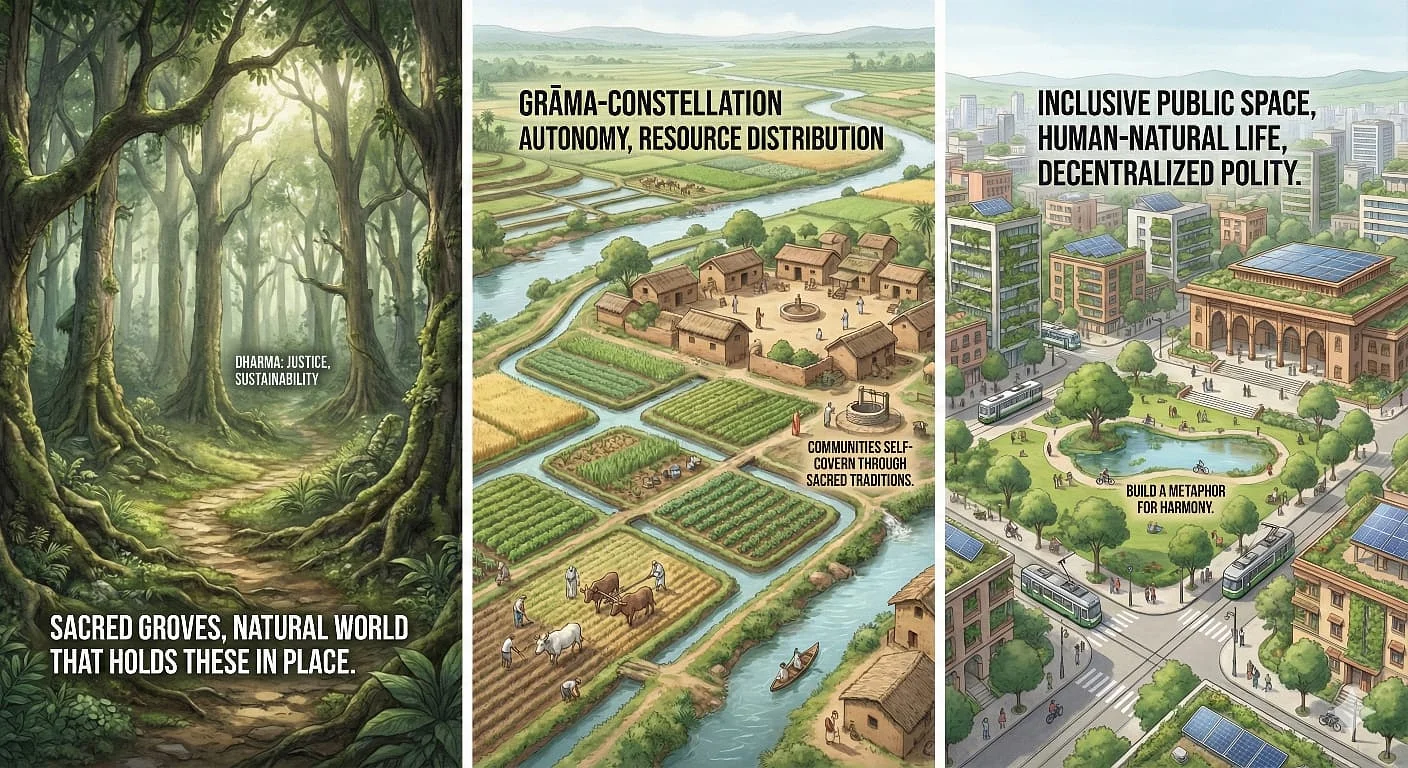
Justice. Sustainability.
I finally read Rohit De’s 2018 offering, A People’s Constitution. Contrary to my expectations that it would be filled with leftist talking points, it was not. Rohit De does not endorse or critique cultural Marxism, nor does he question the role that the constitution has played in making cultural Marxism the dominant paradigm of political discourse in the Indian Republic. He does not delve into deeper questions of what the Indian nation is and what the nature and need of a constitution is from a higher moral perch. He simply accepts the constitution as a given and reveals himself to be a liberal, albeit not a leftist.
Right from the get-go, on Page 7 in the Introduction, he acknowledges (and then proceeds to ignore over the course of the rest of the book) the elephant in the room:
“Despite the incorporation of universal adult suffrage and a bill of rights, the legal framework of the Indian Republic remained rooted in colonial laws and institutions that were designed for centralized control. The text that the new Constitution reproduced verbatim from the colonial Government of India Act included its controversial emergency power that allowed the central government to proclaim a situation of emergency and suspend fundamental rights, restrict access to courts, extend the life of parliament, and dissolve elected state assemblies. Contrary to constitutional traditions that sought to protect individuals from the state, the Indian Constitution empowered the state to transform society and the economy.”
One cannot write a book entitled “The People’s Constitution” without first attempting to understand “The People”—their lives, their aspirations, their identities, and expectations. The fact that he sees the constitution as being an emancipatory document that helps the common man navigate the complex injustices of the centralized state, is not so much a commentary on how wonderful the constitution is but rather on how anti-people the post-colonial state has been that the people would need to clutch at any constitutional straw to merely stay afloat in this foreign landscape that has been foisted upon them... ironically accompanied by the cynical incantation—“We the People”.
He even quotes Somnath Lahiri, the sole Communist Party member in the Constituent Assembly, who remarked that “many of these fundamental rights have been framed from the point of view of a police constable.” So, a mere 75 years ago, even a literal communist was alive to the draconian nature of the underpinnings of the document. Imagine how far (right or left, I do not know) we have moved that the same document is venerated as a civilizational smṛti by every political party today.
Even this red flag is ignored by De.
De is sympathetic to the small guy, the man or woman living happily who suddenly finds himself/herself thrust into the grey zone of illegality simply because of the push of a Babu’s pen. De reveals through his seemingly unbiased uncovering of details that he champions the fight for liberty that these small people engage in with the state, using the constitution as their sole weapon.
This is a very interesting framing. He posits that the constitution is on the side of the people in their fight/negotiation with the unfeeling state. And it is through this negotiation that the modern nation emerges. This kind of post-modern incipient emergence of identity sounds cool on paper and perhaps is one part of reality, but it is not how most people, and certainly most Hindus, see themselves as a nation at all.Why does he see the constitution merely as a bulwark that serves as a check on the excesses of the state, and not as the Gaṅgotrī that lends legitimacy to that self-same unfeeling state? On what basis does he pick apart the judiciary and the executive as two disparate camps engaged in a national churning with each other, while the poor citizen is supposed to be their buttermilk simply to secure livelihood and “create the emergent nation”?
“The constitutional courtroom thus becomes an archive of citizenship, a space in which the individual and the state can converse with each.”
What this buttermilk model of the Indian nation tells us is that both the judiciary and the executive believe they are here to churn the people and not to serve them. As recipients of this unasked-for benevolence, it now becomes important for the people to know what the principles and ideals are that underpin their churning. Do those ideals find resonance in the people’s hearts, or are they alien tropes? How do we suppose that those alien tropes will eventually come to be embraced by the people? Do we imagine that process of conversion would be a harmonious one or one fraught with pain and, ironically, injustice?
De goes on to reveal a thinking, very common in the Indian Left, that sees the Indian nation as non-existent, the traditional mores as unfit for legitimacy, and the Indian citizen as infantile and incapable of moral action unless he is led by the nose by the arms of the state. He writes,
“Unlike the West, where group rights emerged within established civic communities, in colonial India, rights were accorded to groups before the formation of a civic community, that is, the nation.”“The argument for non-interference with custom and tradition had been based on the fragmented authority between the alien state and its communities. However, with independence the state moved from the outer sphere to encompass all areas of life.”“The Constitution explicitly recognized religion and family as arenas for transformation. The right to practice and profess one’s religion was limited on several grounds, including public order, morality, and health.”
Okay, but excuse us, we, the actual people... we know that the nation already exists, that it is not emergent, and that it is the job of the constitution to recognize that nation in codified form so the state will know how best to serve the people from whom it draws its legitimacy. Anything less than this would be the very face of a massive centralized oppression that arrogates to itself a monopoly on violence… everything that our traditional decentralized and diverse systems strove to avoid (see Part One of this essay series). If we cannot even acknowledge this, then we are complicit in the continued colonial herding into debasement of those whose ancestors were once the most noble people in the history of the world.
It is the state that is created to serve the nation and not the nation that is created to serve the state.
Which leads us to the obvious next step, which is to ask the question—“What is the nature of the nation?”
Once that is answered in as abstract a way as is necessary to reach a reasonable consensus, those basic truths about the nature of the nation have to be acknowledged and honoured by the state. Anything else would, in fact, be oppression—people being forced by a monster-power to live at odds with their own inherited customs and civilizational ideals. Regardless of the excuses we may give to justify the opposite happening today, and there are many, many excuses, the fact remains that true freedom lies in alignment of state with society, not society with state. The state has been created to safeguard the freedom of the people to engage, as they see fit, with community, tradition, and the marketplace, not to force/brainwash people into being who they are not. For example, the police is here to help and protect people, not to harass them. This logic should be clear to all. A state that does not follow this logic is, in fact, oppressive, and the people are in fact not free. They do not determine their own destiny with free will.
A dhārmika state prefers to avoid monster centralization as far as possible. It does not want to be the biggest fish in the pond if its main intent is to prevent the emergence of big fish. This is the most important point to understand. People who do not get this will not get any of the downstream conclusions. People who are okay with the centralized tech-enabled-state simply because they have their Netflix subscription and annual vacation in Bali do not understand dhārmika Liberty at all and will likely not have a proper understanding of the obvious downstream effects of a monster centralized state —mass surveillance; control of mind through corporate advertising and media; growing loss of meaning; rising violence and substance abuse in society; growing incarceration; physical control of society through police, dole and eventually genetics; DNA-coded vaccines; social credit systems; travel bans; eugenics and human-replacement AI bots.
A dhārmika state, therefore, clearly prefers to govern over communities rather than individuals because communities do half the work that states do, all without an ounce of effort or policing or punishment. Communities self-govern through sacred traditions and self-police through intra-community negotiations, thereby reducing the need for the emergence of centralized big fish. This is the surest way to avoid Mātsya Nyāya and ensure limited but real Liberty for individuals and communities, both core dhārmika goals. Obviously, non-dhārmika communities will be welcome to participate in this society and state, but non-dhārmika ideals will be strictly disincentivized.
The conceptual basis for such a state-society relationship has been described by Shankara Bharadwaj in his Raja Dharma Series, published in Indica Today:
“In a Hindu rāṣṭra, ideals do not flow top down but society has the liberty to build collective morality upwards. This goes against state spelling out ideals for the nation, which is the reason smṛti-s do not spell out ideals. The institutions that reconcile the micro and macro, the vyaṣṭi and samiṣṭi ensure balance of liberty and accountability, and build a collective order. The complex matrix of institutions (the culture unit, extended family, knowledge tradition, spiritual tradition etc) trade each other off in ensuring checks and balances and prevent skewing in one direction, be it of liberty or lack of it, ensure against exploitation while ensuring fulfillment and productivity.”“An engineered society’s liberties and fulfillment are scuttled, and smṛti takes cognizance of this fact to limit state policy to ensure protection of those permanent institutions that in the long run ensure the dynamic equilibrium through the puruṣārtha of individuals and groups. Here again the smṛti reposes trust in human nature, craving for fulfillment, individual and collective tendencies and the inherently evolving nature of society, as explained in the Morality section. In the long run, a healthy mobility and dynamic equilibrium as was possible in Hindu society will be possible through a highly autonomous society, while an engineered society becomes dependent on systemic power structures and loses sight of higher goals, liberties and abhyudaya. Besides, an organic mobility involves rise of groups that are best positioned to lead the society in the given circumstances, unlike in an engineered society in which the collective abilities are throttled by least common denominator. This can be demonstrated by the simile of a vitalizing of body and immunity system to overcome disease versus an external medicine applied to the body which has side-effects as well as fails to develop the general health and strength of the body.”
One of the key concepts he develops further is the concept of orthogonality. He describes the unique characteristic of Bhāratīya state formation as not the separation of sacred and profane, but as the separation of geo-political structures and geo-cultural structures. Geo-political refers to the state (Rājya), and geo-cultural refers to the society (Rāṣṭra). The Bhāratīya rāṣṭra is seen as being divided into 56 deśas. Throughout history, over the rise and fall of kingdoms, the rājyas of various monarchs extended over varying permutations of deśas, but never interfered with, let alone attempted to change, their inherent character. Deśa autonomy (and the deeper grāma-constellation autonomy within the deśa) was left unhindered. It was only with the coming of the British that this balanced arrangement between the political and the cultural was damaged. The British brought the full force of their state-delivered universalist morality to bear on Hindu society, deliberately weakening its ability for autonomous self-management and self-reflection. This paved the way (along with the economic blows that they landed) for the shift from the original societal-corporatism of Hindu society to a quasi-feudalism. It is that feudal vision of Hindu society that has been accepted and institutionalized by the Republic post “independence,” thereby permanently trapping us in a false story about ourselves that we continue to tell ourselves to date.
The adharma of feudalism/colonialism has three possible responses:
1. Societal Corporatism
2. Capitalist “Growing the Pie”
3. Communist centralized resource distribution
The 20th-century horrors of Option 3 have already rendered it a non-choice. Option 2 currently has hegemony over the people’s imaginations, but can only work long-term if the pie can be grown indefinitely at faster and faster rates. The process of doing that has all kinds of poor outcomes for human society, which I do not have to go into in this essay. Thinking Hindus, and in fact thinking humans all over the world, have seen the trajectory of where that option is leading us and are once again looking at Option 1 in some form or the other as a possible exit from the treadmill. Only in Bhārata does the collective memory of such a moral working system continue to exist. In all other places, it will have to be built from scratch.
A comparison of the underlying characters of Western and Bhāratīya structures:
 Underlying characters of Western and Bhāratīya structures
A comparison of how the underlying character shapes state outcomes.
Underlying characters of Western and Bhāratīya structures
A comparison of how the underlying character shapes state outcomes.
 How the underlying character shapes state outcomes
Building a Non-Reactionary State
How the underlying character shapes state outcomes
Building a Non-Reactionary State
Once again, I will quote Shankara Bharadwaj for conceptual clarity:
“Human liberties are not bound by fundamental rights but become enablement for fulfillment of the highest order, the puruṣārtha-s. State does not provide these rights or liberties but they are “naisargika” or birth rights that nature endows on humans. State on the other hand, has the accountability to ensure against violation of natural liberties of humans. The fourth puruṣārtha-s of infinite happiness and freedom, is the ultimate human craving and the freedom of individuals, perceived and possessed are proportionate to the extent of manifestation of intrinsic nature. The fact of an ultimate human craving of boundless freedom is reconciled by limited outward binding of liberties on the basis of violations of collective spaces and the restrictions state ever imposes on individuals are limited to those violations.”
This understanding is the basis of our self-limiting ‘live and let live’ character. It is the reason why even diametrically opposed groups are able to live and work together every day in this nation. All ordinary Hindus are aware of the truth of this statement, but are unable to put it into words because they have been hamstrung by the alter-reality of the Western state that has been foisted upon them. A process of return would be painful and probably chaotic, but ancestral memory would return in a deluge once it is set in motion, leading to stability within a generation. The longer we wait, the more hazy our collective memory grows and the more difficult our choices.
How the clarity of that concept manifests in real-world institutions in the modern world needs a lot of intellectual and design work from the Hindu side. I may have some hazy ideas, but this is far from my area of expertise, so I will just ask the questions that need answering:
1. First and foremost, what kind of legal skeleton would be required to incentivize organic societal interaction (harmonious and nature-imitative) while disincentivizing or outright proscribing reactionary societal interaction (disharmonious, cancer-imitative). Within such a legal structure, both supremacism and victimhood mongering would automatically find themselves disincentivized. Without this in place, everything else falls apart.
2. Which responsibilities are of the Rājya (perhaps defence, strategic industry, international relations, law and order, public infrastructure and basic welfare), and which are of the Rāṣṭra (perhaps civil law, private economic activity, education and tradition)?
3. Similarly, how are responsibilities to be divided between Deśa and its grāma-constellations and communities? Which is more a question of figuring out the contexts in which conflicts will be resolved within the grāma, or at the level of deśa.
4. What are the mechanisms via which justice will be delivered at all levels – intra-community, intra-grāma-constellation, intra-deśa, rāṣṭra (inter-deśa), rājya (executive)?
5. How will the decentralized industry of such a dhārmika state compete with the centralized conveyor belt industries of the West?
6. How will the decentralized polity of such a dhārmika state compete with the centralized militaries of the West?
7. How will such a decentralized state build solidarity between communities and deśas? Maybe via a compulsory stint in national activities (military or otherwise), like in Singapore or Israel? Maybe via nationalized, traveling, multi-community Puruṣa festivals built on the template of the Kuṃbha Melās and the Poorams.
8. How will the law resolve the community-individual divide? Maybe by stipulating that all individuals (men or women or others) who want to leave their birth community must either join or form another community (modern, liberal, it does not matter, as long as the group can articulate a cohesive set of integral (not disintegrative) beliefs)? Inheritance practices will obviously be left entirely up to communities. What would be the official and/or ritual process to join or form such new non-inherited, intentional communities?
9. How would natural resources be distributed between rājya, deśa, grāma, and community stewards (for quarrying, herding, hunting, gathering)?
10. How would society genuinely meet the need for a larger, inclusive public space that modernity calls for? Sketches below depict a Hindu understanding of societal space and what needs to be done for us to re-imagine it for a Hinduized Modernity:
 The Classical Arrangement
 The Modern Arrangement
 A Hinduized Modern Arrangement
References
A Hinduized Modern Arrangement
References
- Rohit De, A People’s Constitution, Princeton University Press, 2018
- Shankara Bharadwaj Khandavalli, The Raja Dharma Series – Scope Of Smṛti And Nature Of A Dharmic State, INDICA Today, 2021
- https://www.indica.today/research/raja-dharma-series-iv-a/
- https://www.indica.today/research/raja-dharma-series-iv-b/
- https://www.indica.today/research/raja-dharma-series-iv-c/


.png)
.png)