Introduction
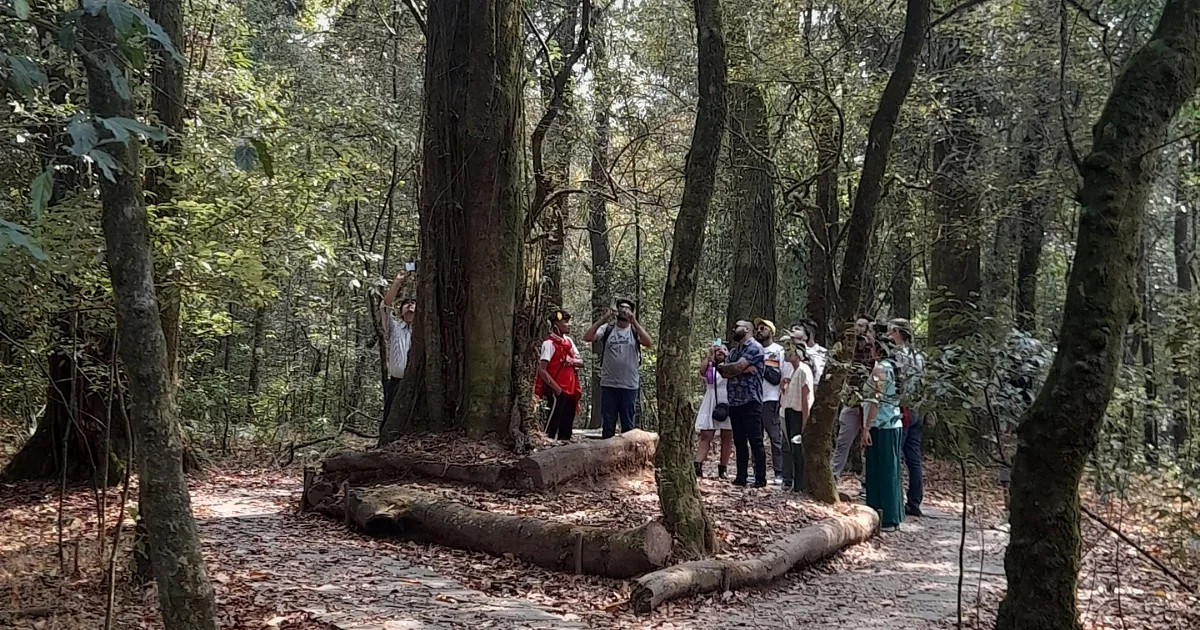
Sacred groves generally refer to forest areas preserved on religious grounds as the abode of forest deities, benevolent and malevolent spirits present in nature. Veneration of nature as a spiritual element has been an essential component of Indian culture since ancient times. Reference to nature worship can be found as early as the Indus Valley civilization. Mention of forest worship and preservation in the form of sacred groves can be found in the Ṛg Veda, and in the Buddhist and Jaina texts. Gautama Buddha found enlightenment under the Bodhi tree[1]. Thus, religion has an intimate connection with nature preservation that prescribes social and cultural norms of human habitation in harmony with nature. Since religion provides the fundamental codes of human behaviour towards others, ethical and judicious use and preservation of nature form an essential element in the religious scriptures and texts too[2]. India has a rich tradition of sacred groves, which is also an important part of tribal cultures in Kerala, Karnataka, Rajasthan, Himachal Pradesh, Andhra Pradesh, Chhattisgarh, Assam, Arunachal Pradesh, Manipur, West Bengal, Mizoram and Meghalaya, along with others[3]. In India, the highest number of sacred groves of around 5000 are reported to be found in Himachal Pradesh, followed by Kerala and Chhattisgarh[4]. These groves are the repositories of different plant and animal species, pure water bodies and other natural elements.
Like other parts of India, North East India also has a tradition of sacred groves. The easternmost part of India, usually referred to as North East India, consists of the eight states: Arunachal Pradesh, Assam, Manipur, Meghalaya, Nagaland, Mizoram, Tripura and Sikkim. The region shares its boundaries with countries like China, Myanmar, Bangladesh, Nepal and Bhutan. The residents of North East India have a tradition of preserving forests on religious grounds and recognize these forest patches as the abode of deities and spirits, and also as protected habitats of biodiversity. These forests are usually associated with the presiding deities of the communities in charge of the groves, who are thought to be the supervising authorities over the natural components within the forest areas. Hence, removal or felling of any natural element within the groves is perceived as a sacrilege. Hunting and timber felling in the sacred groves are prohibited on religious grounds. Until recently, the protection of these groves was not under legal sanctions. Therefore, cases of forest destruction within sacred groves were rampant in various parts of the country. Alison Ormsby, who has surveyed the Mawphlang sacred grove in the East Khasi Hills district of Meghalaya, has observed that rituals associated with the worship of forest deities and nature in sacred forests have considerably declined in the region. Most of the people being converted to Christianity show little faith in the forest deity ‘Labasa’ and fell trees for commercial purposes, repudiating the religious beliefs associated with the forest.[5]The introduction of protected area category community reserves under the Wildlife (Protection) Amendment Act of 2002 came up with legislation to provide government protection to community- held lands that also include sacred groves. [6]Hope such initiatives on the part of the government would preserve the environment-friendly traditions of the people.
Objectives and Methodology
The paper is an attempt to trace the tradition of sacred groves among the tribal communities of the north eastern states of Meghalaya, Arunachal Pradesh and Mizoram. It highlights the tradition of indigenous forest preservation among the tribal communities of the states under study. The paper also intends to inform us that the tradition of maintaining sacred groves, an important way towards sustainable use of nature, is on the verge of decline. Hence, protective measures should be undertaken to tackle the situation through governmental, non-governmental and indigenous agencies. The paper is based on the scholarly works by British administrators, government reports, gazetteers, and anthropological researches (Gurdon reprint 1987, Hunter reprint 1975, Pakyntein 1961, Rai 1981, Envis Report, Singh 2007, Hazra 1975, Allen 1906, Mizoram district gazetteer 1981), secondary literature (Goswami 1979, Nibedon 1980, Pachuau 1994, Bhattacharya 1995, Chatterjee 1995, Singh 1996, Jha 1997, Tripathy and Dutta 2008, Reilly and Murphy 2010, Krishna and Amirthalingam 2014, Kominko 2015) and journals (Singh Negi 2005, Shangpliang 2008, Singh and Shanpru 2010, Ormsby 2013, Murtem and Choudhury 2014, Kandari, Bish, Bharadwaj and Thakur 2014, and Kharkongor and Tiwari 2017,
Sacred Groves in Meghalaya
Meghalaya, one of the most picturesque/beautiful states of North East India, is a mountainous region with stretches of hills, valleys and plateaus. The region is also a repository of mineral resources like coal, limestone, uranium and sillimanite. Rivers like Someswari, Jinjiram, Ganol, and Myntdu flow through the territory that is rich in natural vegetation ranging from sub- tropical to tropical owing to its elevation, topographical and climatic conditions. The state experiences rainfall throughout the year, and hence the name Meghalaya has been kept for the region, which means abode of the clouds[7]. Meghalaya is primarily a tribal state where the Khasi, the Jaintia and the Garo tribes account for 89% of the total population, while other tribes like the Dimasa, Hajong, Hmar, Lakher, Mikir, Koch, Lalung, Baite, and Rabha, among others, compose a small part of it. Of the dominant tribes of the region, the origin of the Khasi and Jaintia, who inhabit the eastern part of the state, can be traced back to the first Mongolian overflow to India. The Garos are thought to have migrated from Tibet and occupy the western part of the state. The Khasi form the largest tribal group in Meghalaya and consist of five sub-groups, like Pnars or Syntengs, the Bhois, the Wars, the Khynriams, and the Lyngams[8].
Meghalaya has a heritage/tradition of preserving forests on religious grounds, which is an age- old practice among the communities of the region. The forest reports suggest that the region has around 1000 square kilometres of the state under sacred groves. There are roughly 111 sacred groves in the state at present[9]. Meghalaya houses significant tree varieties like Tectona grandis, Shorea robusta, Terminalia myricarpa, Gmelina arborea, Pinus khasiana, Michelia champaca, and Toona ciliata, etc. Apart from the timber varieties, minor forest produce like bamboo, cane, orchid, bay leaf, broom grass, packing leaf, medicinal plants, honey, wax and lac, among others, are also found in plenty. Around 325 species of orchids grow in the state, and the endemic pitcher plant (Nepenthes Khasia) that is unique to Meghalaya grows in the Jarrain areas of Jaintia Hills of the region[10]. These forest varieties are found amply in the sacred forests of the region, which are considered by the indigenous communities as relics of old vegetation in the region. Sacred groves of Meghalaya are specimens of environmental conservation practices by the indigenous communities of the territory. Religious sanctions attached to sacred forests have protected them for ages, which in turn has preserved the biodiversity of the area. Among the Khasi, Garo and Jaintia communities of the region, sacred groves are either under individuals, clans, communities, clan councils, or under local village bodies like Durbars, Syiemships, Dolloiships or Nokmaships. Gurdon has considered the sacred groves of Meghalaya as public or private forests set aside for religious purposes under the traditional land tenure system[11].
The Khasis believe in deities and spirits residing in forests and hence preserve a part of it in every village where the village uses; commercial utilization and exploitation in any form are not allowed. They worship the guardian spirits of the forests known as ‘U Ryngkew and U Basa’, whose reverence is thought to bring welfare to the people. These forests are locally known as Lawkyntang. The Jaintia hills district of Meghalaya has over 200 sacred groves covering about three to four hectares. The sacred groves in the Khasi hills region of the state can be categorised into three classes namely (a) groves under the administration of Lyngdoh (Khasi priest) is known as Law Lygndoh, (b) groves where traditional religion is followed is known as Law Niam and (c) some groves are also under the village headman who is also the ruler of the village. Religious rites are performed in reverence to forest gods by the village headman, along with the priest and members of the village Durbar, to maintain peace and tranquillity in the village. In the past, these groves formed an important part of every Khasi village. The maintenance of sacred groves has received legal status from the Khasi and Jaintia Hills Autonomous District Councils[12]. W.W Hunter considered the sacred groves of Khasi Hills as the repositories of trees like oak, chestnuts, Magnolia Schima, Cinnamum, Prunus, Engelhardtia, Castanopsistribuloidesvar, ferox (Fagaceae), Sal (Shorea robusta) and rubber tree (Ficus Elastica).[13]. Trees like (Castanopsis tribuloidesvar and ferox (Fagaceae) are not felled by the local people. Identifying the distinct character of vegetation in the Mauphlang sacred grove in East Khasi Hills, T.K Hazra observed;
“The Mauphlang sacred grove is kept in a comparatively undisturbed condition, due to the faith and regard of the local people and the belief that the sylvan deities would be offended if trees are cut, flowers and fruits plucked. The vegetation comprising the sacred grove is very different from that of the surrounding areas, which are marked by the dominating Khasi pine or Pinus Kesiya”[14].
Sacred groves exist in the Jaintia and Garo hills areas of the region. Out of 111 sacred groves found in Meghalaya, 8 are in East Garo Hills, 8 are in West Garo Hills, 3 are in Ri-Bhoi, 38 are in East Khasi Hills, 19 are in West Khasi Hills, and 35 are in Jaintia Hills district[15]. A study on the ethno-botanical plants in sacred groves of Meghalaya demonstrates ethno-botanical usage of 102 species that included 43 of medicinal importance, 28 species of wild edible fruits and seeds and 16 species of wild leafy vegetables. Besides, there are 7 wild species, whose tubers, roots, corms, rhizomes, inflorescences, flowers and flower buds are used for edible purposes by the local people. The study emphasizes the plant diversity richness in the sacred groves of the region[16].
Sacred groves in Arunachal Pradesh
The Indian state of Arunachal Pradesh, situated on the eastern border of India, is also known as the land of the rising sun of the country. It shares its international boundary with Bhutan, China and Burma and its national border with the Indian states of Assam and Nagaland. The state has 28 districts at present and about 26 tribal groups with around 100 subgroups. Arunachal Pradesh is the land of valleys, hills, rivers, forests, different flora and fauna and has all the forest types described in Indian Forestry. The tropical rainforests of Tirap and Lohit districts possess magnificent evergreen forests such as Terminaliamyriocarpa, Amoora wallichi, Cancrium resiniferum, Cedrela toona, Artocarpus chaplasha, Michella species, etc. The semi-evergreen and sub-tropical forests in Siang and Subansiri districts are also rich in various species of the genera Canerium, Ailenthus, Terminalia, Schima, and species of Magnoliaceae. Above this zone comes the massive temperate zone of blue pine, Silver fir and Tsuga, which extends between 1500 and 4000 metres. The extreme limit of the Lohit district is composed of Pine merkusii (Tennesrin Pine). Above the belt of around 4000 metres, the vegetation gradually merges into subalpine and alpine levels[17]. Several tribal communities reside in Arunachal Pradesh, among whom Adi, Aka, Apatani, Nyishi, Tagin, Galo, Khampti, Bugun, Mishmi, Monpa, Khampti Sherdukpen, and Singpho etc are some of the prominent tribes.
Maintenance of forests on religious grounds is a tradition among the tribes of Arunachal Pradesh. The tribes have different mechanisms for biodiversity conservation in the region, which are largely based on their religious practices. Arunachal Pradesh is a land of many religions practiced by different tribes inhabiting the region. The people profess Buddhism, Vaishnavism, Christianity and indigenous religion. The Monpas, Sherdukpens, Khamptis and Singphos are Buddhists; the Mishings and the Noctes practice Vaishnavism, some of the tribes practice Christianity, and the Adi, Nyishi, Tagins, Idus, Mijus, Taroans, Buguns, Hrussos and Mijis have their indigenous faiths. Hinayana or Theravada Buddhism travelled to Arunachal Pradesh with the Khamptis and the Singphos, who had migrated to the region under the patronage of the Ahom rulers of Assam via the upper Sindwin and Irawaddy rivers. Tibetan Buddhism influenced the people residing in the Tawang and Kameng districts of the region under Guru Padmasambhava. Vaishnava religious faith penetrated the region around 400 years ago. Christianity made its way into the region after the British advent in the area[18].
Since Arunachal Pradesh is the land of different religions practiced by the communities, sacred groves in the region are preserved under various religious beliefs. The Lower Subansiri district of the territory has two types of sacred groves. One is the traditional sacred grove conserved by the tribesmen for ages, while the other type is preserved under the influence of Hindu culture. The sacred groves are usually under the control of village authorities, where no form of external interference is permitted. Felling of trees and hunting are strictly prohibited in these forests, and the people with faith in traditional religion adhere to these restrictions. The Apatani tribes of the area believe that in case of non-adherence, a bad omen would fall on them, on the family of the person who had not abided by the restrictions. In such cases, rituals are performed by the priests who can only collect dead or living trees during the Myoko festival, which comes periodically every three years. Sacred groves in the Apatani region are under clan ownership. The Adi community of the region preserve patches of forests, certain trees and mountains, considering them as the dwelling place of ancestral and supernatural powers. Animals like tigers, toads and wagtails are believed to be their ancestral brothers and hence not killed. The place of habitation of these living beings is also kept unharmed[19].
Arunachal Pradesh houses several religious sites of the Hindus. Malinithan temple of goddess Durga, Akashiganga temple and natural Shiva Lingam in the Kardo forest of Lower Subansiri district are some of the pilgrimage sites visited by the Hindus during Makar Sankranti and other occasions. These religious places are surrounded by forests containing valuable tree species, which are maintained by the temple authorities on religious grounds. At the Kardo forest of the region, images of Shiva Linga, goddess Parvati and Lord Ganesh with a trunk turning leftward can be found. The people believe that goddess Ganga resided here with Lord Shiva. The natural vegetation surrounding the area is preserved on religious grounds. Malinithan is a temple of goddess Durga in West Siang district of Arunachal Pradesh and is considered pious and holy by the Hindus of Nepal, Assam and Manipur. The sacred grove situated in the temple premises is preserved by the temple authorities, where indigenous tree felling is prohibited. Another pilgrimage site for the Hindus is the Akashiganga temple, situated 12 miles from Malinithan. According to legends, this place is one of the locations where a body part of Sati had fallen. A sacred forest is situated bordering the temple and is believed to be associated with the legend narrated in the Kalika Purana (8th century A.D). The grove associated with the temple is a dense forest area covering around 7 to 8 hectares[20]. Another pilgrimage of great importance is the Parshuram Kund situated in the Lohit district of Arunachal Pradesh. It is a lake where the Hindus take a dip during Makar Sankranti to wash off their sins. The lake is situated within the Kamlang reserve forest, which grows Rudraksha trees in large numbers, which are considered sacred by the Hindus.
The Buddhist monasteries in the region protect forests in the form of religious groves. The monastery at Mechuka is one of the oldest monasteries in the region that preserves a grove containing fir and rhododendron forests. Monasteries are locally known as ‘Gompa’. The sacred grove at the Siddharth Vihar monastery at Itanagar is maintained by the Mahayana sect of Buddhism in the region. The Monpa community are the main believers and worshippers of this sect in the region. The Monpas who follow Mahayana Buddhism assign a position of religious sanctity to the Buddhist monasteries, usually located in high altitudes. Hence, the plants and living beings within the premises of the monasteries are protected by them as the sacred assets of the Buddhist order[21]. Another monastery named Kyong Theravada Buddhist Gompa is situated at Itanagar, where an area of 0.5 hectares of forests is maintained by the tribes following the Hinayana sect of Buddhism. The Khamti, Shingpho and Tsanga tribes of the region are believers of this sect. Sacred forests are often preserved in places considered sacred by the Buddhists. Such a sacred grove is the Potrang sacred grove near Sangestar Tso lake, adjacent to the Indo-China border in the Tawang district of the region. The Potrang sacred grove is spread over an area of 0.2 square kilometres having temperate and alpine vegetation[22].
Sacred Groves in Mizoram
Mizoram, the 23rd state of the Indian Union, is a landlocked country located in the north eastern corner of India that shares international boundaries with Bangladesh and Burma, and is surrounded by the Indian states of Tripura, Manipur and the Cachar district of Assam. About 70% of the Mizo territory is bordered by Bangladesh and Burma, with the total area of the region covering about 21, 081 sq kilometres. It lies roughly between 24.19 north latitude and 93.26 east longitude, with the Tropic of Cancer passing through it. Mizoram is a landmass with undulating hills, valleys, rivers and lakes. The state has around 21 major hill ranges, amongst which Phawngpuitlang, also known as the Blue Mountain, is considered the highest peak of the region. The province has a few stretches of plain areas, which are highly fertile and are considered the beds of silted-up lakes. The largest among these is the Champai Valley that covers an area of 11.27 km in length and 4.83 in width. The rich alluvial soil of the plain is suited for rice cultivation, and hence the region is also known as the ‘Rice Bowl’ of Mizoram[23]. Mizoram, situated in the tropical belt with high annual rainfall, has plant species of the moist tropical type. Botanically, the forests of the region can roughly be categorized into tropical wet evergreen, mixed deciduous and pine forests, often found mixed with broad-leaved species such as Quercus griffithii and Quercus serrata[24]. The distinguished forest types of the region consisted of manglistia, taulama, duabangasonneratioides, schima wallichii, khasiana, dipterocarpus turbinatus, mesua ferres, moora wallichii, dysoxylymbinectariferum, dysoxylym haniltonii, castonopsis species, quercusspesies, cham, and cinnamum seprum, etc. In the areas with high elevation, oaks (Quercus species) and chestnut (Castanopsis species) are more common[25]. The dominant population of Mizoram are the Mizo./ The latter, which is a blanket term that includes around 14 sub tribes like Lushei, Khawlhriang, Kiangte, Darlong, Punte, Renthlei, Chongthu, Ralte, Ngente, Poi, Paite, Hmar, and Thado. There are marginal communities like Lakhers, Chakma, and Lai who were not under the term ‘Mizo’[26].
Mizoram has a tradition of preserving forests on religious grounds. Each Mizo village has a sacred forest area locally known as Ngawpui. These forests are debarred from public entry, where no tree can be felled except those that are decayed. The people believe that spirits like Ramhuai, Lasi and Chawngtinleri reside in these forests, and any damage to trees and plants of the forests by external agencies would bring misfortune to the offender, although non-wood products and fallen leaves could be collected. These forests play an important role in preserving the biodiversity of the region and are also considered a repository of plant and genetic biodiversity. Sacred groves in Mizoram may vary in size from a few hectares to a few hundred hectares. The people believe that these forests are the possessions of forest gods and hence should not be destroyed by humans[27]. The people also preserved certain portions of forests adjoining villages as part of the indigenous tradition. Traditionally, some portions of forests are never cleared for cultivation as they are considered as abodes of supernatural beings who, when offended, would wreak vengeance on those who encroached upon them. The people do not dig jungle yams and roots indiscriminately, which are usually kept for exigencies. The people do not throw garbage in spring water, as it is thought by them to be haunted by evil spirits[28]. According to the indigenous faith of the Mizo, the people believed that certain trees, hills and streams are infested by malevolent spirits responsible for devastation of all forms and hence should not be damaged in any form. Such beliefs acted as a ring of preservation towards nature[29].
The Mizo people believed in taboos associated with certain natural elements present in forests. For example, if, while clearing forests for cultivation, a skull of a monkey was found, the owner would instantly withdraw from his fields for the fear of being prosecuted to death by the evil spirits. Similarly, a tree root lying across a brook would compel the cultivator to dismiss his plan to cultivate the area, as this was considered to be an unnatural occurrence[30]. The people believed that spirits, both good and evil, existed in almost all natural objects like the mountains, rocks, trees, caves and streams. Malignant spirits were considered responsible for misfortunes like death, sickness or incidents[31]. The hunters believed in a female forest spirit known as Lasi, who could predict the success or failure of the hunter in his hunting ventures. The hunters made sacrifices to propitiate this forest spirit before undertaking a hunting expedition[32]. Traditionally, there were no customary laws on the use of forest products and consequently, clashes on forest use were rare[33]. Apart from forests preserved on religious grounds, according to Mizo traditions, every village had a village safety reserve and a village supply reserve that catered for the regular forest-based necessities of the villagers[34]. The people also preserve bamboo forests locally known as ‘Mauhak’ to act as a protective ring around villages against external attacks and forest fires. These forests also provide housing materials to the villagers and protect the region and its biodiversity[35]. Certain trees, like banyan trees, are traditionally revered by the people and hence not felled. As Vomson has observed;
‘The Banyan tree, like Zu (rice beer) and mithun (tame bison), is very closely associated with the Zo culture, and Zo people were very proud to have evergreen Banyan trees growing on their ritual grounds or located near a Khan or a memorial stone’[36].
Conclusion
Thus, preservation of forests on religious grounds forms an important part of tribal cultures in North East India since ancient times. The tribes of Meghalaya, Mizoram and Arunachal Pradesh have protected forest areas either on religious grounds or as parts of taboos and prohibitions that have preserved the natural environment and biodiversity of the regions since early times. However, in recent years, the tradition of maintaining sacred groves among the tribes, as mentioned, has shown a conspicuous decline that has adversely affected the natural environment of the region, too. Commercial utilisation of forest products and changes in the religious beliefs of the tribes are predominantly responsible for the breakdown. Besides, anthropogenic factors like modern development, urbanisation, exploitation of resources and an increase in human population, etc., have also threatened the existence of sacred groves in Meghalaya, Arunachal Pradesh and Mizoram along with other parts of India. Hence, measures to preserve this environmentally friendly tradition of the tribes should be undertaken at the earliest. Apart from governmental legislations to conserve the tradition, there should be efforts to uphold indigenous faiths, which also emphasize on preservation of forests on religious grounds. The sacred groves should be brought under the protected area network for better preservation and conservation.
Endnotes
1. L. S. Kandari, V. K. Bisht, M. Bhardwaj, and A. K. Thakur, Conservation and management of sacred groves, myths and beliefs of tribal communities: a case study from north-India,” Environmental Systems Research, Volume 3, no. 1, 2014.
2. Chandra Singh Negi, Religion and Biodiversity Conservation: Not a mere Analogy, International Journal of Biodiversity Science and Management, Volume 1 Issue 2, 2005.
3. See Chandrasekhar U. M. and Sankar S. (1998). Structure and functions of sacred groves: case studies in Kerala in: Ramakrishnan P.S. et al. (eds), Conserving the Sacred for Biodiversity Management. Co, New Delhi, India, Oxford & IBH Publishing, pp. 323–336. Singh G.S. and Saxena K.G. (1998). Sacred groves in the rural landscape: A case study of Shekhala village in Rajasthan. In: Ramakrishnan P.S. et al. (eds), Conserving the Sacred for Biodiversity Management, New Delhi:Oxford and IBH publishing Co. Sinha B. and Maikhuri R.K. (1998). Conservation through socio-cultural religious practice in Garhwal Himalaya: a case study of Hariyal sacred site. In: Ramakrishnan P.S. et al. (eds), Conserving the Sacred for Biodiversity Management.New Delhi: Oxford & IBH Publishing Co. Swamy P.S., Sundarpandian S.M. and Chandrasekaharan S. (1998) Sacred groves of Tamil Nadu. In: Ramakrishnan P.S. et al. (eds), Conserving the Sacred for Biodiversity Management. New Delhi: Oxford & IBH Publishing Co. Gadgil, M. and Vartak, V.D. (1975) Sacred groves of India : A plea for continuedconservation. Journal of Bombay Natural History Society, 72 : 314-320. Jamir, S. A. and Pandey, H. N. (2002). Status of Biodiversity in the Sacred Groves of Jaintia Hills, Meghalaya. Indian Forester, 128, 738–744. Khiewtam R.S. and Ramakrishnan P.S. (1993). Litter and fine root dynamics of relic sacred grove forest of Cherrapunjee in northeastern India. Forest Ecology and Management 60: 327–344. Malhotra, K. C., Ghokhale, Y., Chatterjee, S. and Srivastava, S. (2001), Cultural and Ecological Dimensions of Sacred Groves in India, New Delhi: INSA.
4. L. S. Kandari, V. K. Bisht, M. Bhardwaj, and A. K. Thakur, Conservation and management of sacred groves, myths and beliefs of tribal communities: a case study from north-India,” Environmental Systems Research, vol. 3, no. 1, 2014.
5. Alison Ormsby, Analysis of Local Attitudes towards the Sacred Groves in Meghalaya and Karnataka India, Conservation and Society, Volume 11, No 2, 2013, pp 189-192.
6. BM Kharkongor and B. M Tiwari, Sacred Groves of Meghalaya: A Review, International Journal of Science and Research, Volume 6, Issue 3, March 2017.
7. E.H Pakyntein, Census of India, 1961, Assam, District Census Handbook, United Khasi and Jaintia Hills, Superintendent of Census Operations, Assam , Tribune Press, Gauhati ,p 11.
8. S.K Sharma and Usha Sharma edited, Discovery of North East India Geography History Culture Religion Politics Sociology Science Education and Economy, Meghalaya, Volume 7, Mittal Publications, New Delhi, 2005.
9. BM Kharkongor and B. M Tiwari, Sacred Groves of Meghalaya: A Review, International Journal of Science and Research, Volume 6, Issue 3, March 2017, p 346.
10. H.M Bareh edited, Encyclopaedia of North East India, Vol IV, Meghalaya, Mittal Publications, New Delhi, 2001, p 3.
11. P.R. T Gurdon, Gurdon P.R.T, The Khasis, Cosmo Publications: New Delhi, 1st published 1907, reprint 1987.
12. Rekha M Shangpliang, The Place of Nature in the Culture of the Khasis, Man in India, Oct-Dec 2008, Serials Publications, New Delhi, pp 549-550.
13. W.W Hunter, A Statistical Account of Assam, Vol II, 1st published1879, reprint 1975, B.R Publishing House, Delhi, p 212.
14. T.K Hazra, Botanical Survey of India, Shillong, 1975.
15. Singh, B., Sinha, B.K.,Singh, V.N. and Hynniewta, T.M. Meghalaya ke Pavan Van (Sacred groves): Ek Vigyanic Aadhdhyan, VanaspatiVaani, Botanical Survey of India, Kolkata. 2007. pp. 64-73
16. Singh, B. and Shanpru, R. 2010. Ethnobotanical plants in sacred forests of Meghalaya, Annals of Forestry-An International Journal of Forest Science 18 (2): 270-282 cited by BM Kharkongor and B. M Tiwari, Sacred Groves of Meghalaya: A Review, International Journal of Science and Research, Volume 6, Issue 3, March 2017, p 348.
17. M B Rai, Census of India, District Census Handbook, Director of Census Operations, Arunachal Pradesh, 1981.
18. B Tripathy and S Dutta edited, Religious History of Arunachal Pradesh, Gyan Publishing House, New Delhi, 2008, pp 17-20.
19. G Murtem and Pradeep Chaudhury, Sacred Groves of Arunachal Pradesh: Traditional Way of Biodiversity Conservation in the Eastern Himalayas of India, Journal of Bio diversity management and Forestry, Volume 3 Issue 2, January 2014, G Murtem and Pradeep Chaudhury, Sacred Groves of Arunachal Pradesh: Traditional ways of Bio Diversity Conservation in the Eastern Himalaya of India, Journal of Biodiversity Management and Forestry, January Volume 3, Issue 2, 2014, pp 2-3.
20. Ibid pp 3-5.
21. A.R Barbhuiya, M.L Khan, A Arunachalam, S.D Prabhu and V Chavan, ‘Sacred Groves: Informal Protected Areas in the high attitudes of Eastern Himalayas, Arunachal Pradesh, North East India: Traditional Beleifs, Biodiversity and Conservation in Angus O Reilly and Doram Murphy edited, National Parks: Biodiversity, Conservation and Tourism, Nova Science Publishers New York, 2010, pp 139-140. ,
22. IG Murtem and Pradeep Chaudhury, Sacred Groves of Arunachal Pradesh: Traditional Way of Biodiversity Conservation in the Eastern Himalayas of India, Journal of Bio diversity management and Forestry, Volume 3 Issue 2, January 2014, G Murtem and Pradeep Chaudhury, Sacred Groves of Arunachal Pradesh: Traditional ways of Bio Diversity Conservation in the Eastern Himalaya of India, Journal of Biodiversity Management and Forestry, January Volume 3, Issue 2, 2014, pp 6-10.
23. Rintluanga Pachuau, Geography of Mizoram, Aizawl, 1994, p 23.
24.B.C Allen, Lushai Hills District Gazetteer, 1906, p 4.
25. Mizoram District Gazetteers, Mizoram, Director of Art and Culture, Government of Mizoram, Aizawl, 1989, pp 7-8.
26. B.B Goswami,The Mizo Unrest, Aalekh Publishers, Jaipur, 1979, p 22.
27. Nanditha Krishna & M Amirthalingam compiled and edited, Sacred Groves of India A Compendium, C.P.R Environmental Education Centre, Chennai, 2014, p 324.
28. Nirmal Nibedon, Mizoram: The Dagger Brigade, Lancers Publishers, New Delhi, 1980, p 36.
29. L.K.Jha edited Natural Resource Management, Mizoram, Vol-1, A.P.H Publishing Corporation, New Delhi 11002, 1997, p 44.
30. Ibid
31. N.N Bhattacharya, Religious Cultures of North East India, Manohar Publishers, New Delhi, 1995, p 25.
32. Kyle Jackson, Hearing Images, Tasting pictures:making sense of christian mission photography in the Lushai Hills District North East India (1870-1920), in From Dust to Digital: Ten Years of the Endangered Archives Programme, Open Book Publishers, 2015, p 450.
33. Daman Singh, The Last Frontier: People and Forests in Mizoram, Tata Energy Research Institute, New Delhi -110003, 1996,p 16-17.
34. ENVIS Centre: Mizoram Status of Environment and Related Issues, Ministry of Environment, Forests and Climate Change, Government of India.
35. Rintluanga Pachuau, The Decline of Village Safety and Supply Forest Land Use in Mizoram: A Case Study of Kolasib District, IOSR Journal Of Humanities And Social Science, Volume 19, Issue 11, Ver. III (Nov. 2014), PP 58-62.
36. Vumson, Zo History, Aizawl, 1984, p59 cited by Suhas Chatterjee, Mizo Chiefs and the Chiefdom, M D Publication Pvt Ltd, New Delhi, 1995, p 53.
References
Allen B.C, Lushai Hills District Gazetteer, 1906.
Bhattacharya N.N, Religious Cultures of North East India, Manohar Publishers, New Delhi, 1995.
Chatterjee Suhas, Mizo Chiefs and the Chiefdom, M D Publication Pvt Ltd, New Delhi, 1995.
ENVIS Centre: Mizoram Status of Environment and Related Issues, Ministry of Environment, Forests and Climate Change, Government of India.
Goswami B., The Mizo Unrest, Aalekh Publishers, Jaipur, 1979.
Hazra T.K , Botanical Survey of India, Shillong, 1975.
Hunter W.W, A Statistical Account of Assam, Vol II, B.R Publishing House, Delhi, 1st published1879, reprint 1975.
Jha L.K. edited Natural Resource Management, Mizoram, Vol-1, A.P.H Publishing Corporation, New Delhi 11002, 1997.
Kandari L S, Bish V. K., Bhardwaj M, and Thakur A.K , Conservation and management of sacred groves, myths and beliefs of tribal communities: a case study from north-India,” Environmental Systems Research, vol. 3, no. 1, 2014.
Kharkongor BM and Tiwari B M, Sacred Groves of Meghalaya: A Review, International Journal of Science and Research, Volume 6, Issue 3, March 2017.
Kominko Maja, From Dust to Digital: Ten Years of the Endangered Archives Programme, Open Book Publishers, 2015.
Krishna Nanditha & Amirthalingam M compiled and edited, Sacred Groves of India: A Compendium, C.P.R Environmental Education Centre, Chennai, 2014.
Mizoram District Gazetteers, Mizoram, Director of Art and Culture, Government of Mizoram, Aizawl, 1989.
Murtem G and Chaudhury Pradeep, Sacred Groves of Arunachal Pradesh: Traditional Way of Biodiversity Conservation in the Eastern Himalayas of India, Journal of Bio diversity management and Forestry, Volume 3 Issue 2, January 2014.
Nibedon Nirmal, Mizoram: The Dagger Brigade, Lancers Publishers, New Delhi, 1980.
Ormsby Alison, Analysis of Local Attitudes towards the Sacred Groves in Meghalaya and Karnataka India, Conservation and Society, Volume 11, No 2, 2013.
Pachau Rintluanga, Geography of Mizoram, Aizawl, 1994.
The Decline of Village Safety and Supply Forest Land Use in Mizoram: A Case Study of Kolasib District, IOSR Journal Of Humanities And Social Science, Volume 19, Issue 11, Ver. III (Nov. 2014).
Pakyntein E.H, Census of India, 1961, Assam, District Census Handbook, United Khasi and Jaintia Hills, Superintendent of Census Operations, Assam , Tribune Press, Gauhati.
Rai M B, Census of India, District Census Handbook, Director of Census Operations, Arunachal Pradesh, 1981.
Reilly Angus O and Murphy Doram edited, National Parks: Biodiversity, Conservation and Tourism, Nova Science Publishers New York, 2010.
Shangpliang Rekha M, The Place of Nature in the Culture of the Khasis, Man in India, Oct-Dec 2008, Serials Publications, New Delhi.
Singh, B. and Shanpru, R. Ethno botanical plants in sacred forests of Meghalaya, Annals of Forestry-An International Journal of Forest Science 18 (2), 2010.
Singh, B., Sinha, B.K.,Singh, V.N. and Hynniewta, T.M. Meghalaya ke Pavan Van (Sacred groves): Ek Vigyanic Aadhdhyan, VanaspatiVaani, Botanical Survey of India, Kolkata. 2007.
Singh Negi Chandra, Religion and Biodiversity Conservation: Not a mere Analogy, International Journal of Biodiversity Science and Management, Volume 1 Issue 2, 2005.
Singh Daman, The Last Frontier: People and Forests in Mizoram, Tata Energy Research Institute, New Delhi -110003, 1996.
Tripathy B and Dutta S edited, Religious History of Arunachal Pradesh, Gyan Publishing House, New Delhi, 2008.

.png)
.png)