Looking at the religious history of North-East India, especially in the context of colonial rule, we realize that there is a strong tendency to either analyse it in terms of the animist beliefs of the tribes, their assimilation into the mainstream Hindu society, or their conversion into Christianity. This framework has been largely inherited from colonial ethnography and later reproduced in administrative and academic discourse of the post-independence period. Thus, it fails to capture the indigenous or local narratives that refused to be confined within such binaries. It situates cultural traditions into rigid categories and overlooks the intellectual and political agency of indigenous communities.
In this context, the Heraka movement, originating in the North Cachar Hills of colonial Assam, differs in its goal and ideologies because it incorporates the elements of animism, Hinduism, and Christianity, but at the same time, it also acts as a rival to all three of them. Arkotong Longkumer, who has produced an extensive ethnographic account based on his study and experiences of the Zemem Nagas in the North Cachar Hills, has argued that movements like Heraka should be understood not simply as “revivals,” but as a creative reorientation of identity under conditions of colonial modernity. Their intervention was not merely spiritual, but also intellectual and political.
To understand the Heraka, one must first understand the ethnic identity of the people who initiated it. The Zeliangrong are a major indigenous Naga community comprising three distinct but ethnically and linguistically linked tribes: the Zeme, the Rongmei, and the Liangmai. Spread across the mountainous tri-junction of present-day Assam, Manipur, and Nagaland, the Zeliangrong have historically been linked through kinship, ritual networks, and shared cosmologies. They inhabited what the British called a "frontier space", a term that implies isolation but in reality was a landscape deeply connected through ancient trade routes, shifting sovereignties, and sacred ritual geographies.
Thus, the Zeliangrong movement cuts across the geographical boundaries of three states today, highlighting a conflicting relationship between how boundaries are perceived by the outsiders, i.e., the colonial state, and how the natives have historically imagined them.
A Civilizational Response:
Emerging from the North Cachar Hills (present-day Dima Hasao) in the early 20th century, Heraka was not merely a localized reform movement. It was a profound civilizational response to the layered disruptions brought about by British colonial rule and the broader changes occurring in the region as it got integrated into the imperial world. A backdrop into the origins and development of the Heraka movement is necessary to understand its implications on society during that time.
The seeds of the movement were sown around 1905, with the birth of Haipou Jadonang, a Rongmei Naga mystic and visionary. By the 1920s, the Naga hills were undergoing a radical transformation.
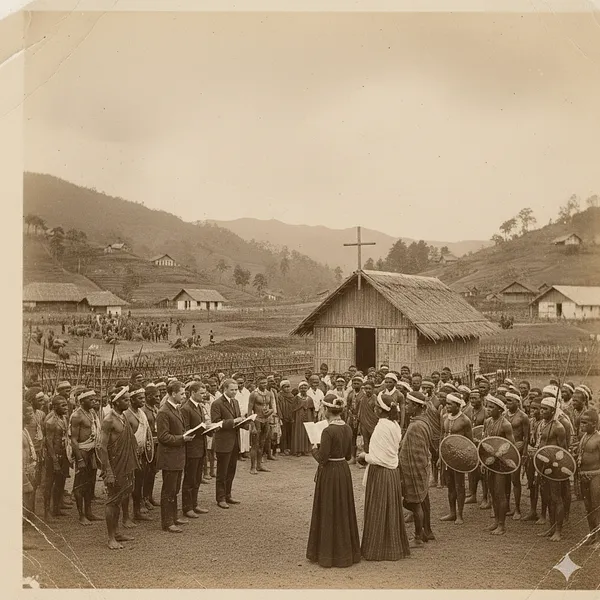
The British Raj had brought more than just administrative maps; it ushered in what may be called the "Age of the Bible and the Bullet." The Raj initially followed a policy of non-interference with regard to religious and social lives of the Indian people. The North-East was not treated any differently in this regard. Missionaries were discouraged from the colonies due to apprehensions that it might create further hostilities among the people against the colonial rulers. After much debate and discussion, and following the charter of 1813, missionary activity was allowed within the British colonies in India. In North-East India, however, evangelism was guided more by practical than spiritual concerns. The conflicts and political instability of the region made the officials request missionaries with the hope that they could elevate “the character of the people" of this newly acquired ‘frontier’ region. As Christian missionaries moved into the hills with promises of healthcare and sanitation, schools, and a printing press, they launched an epistemic assault on the indigenous worldview. The Nagas showed a positive response to the missionaries’ attempt at conversion, albeit on their own accounts and without eliminating their cosmological beliefs. Despite this, the region itself was undergoing a massive transformation. By the early 20th century, other factors, like World War I, had exposed the Nagas to the imperial battles of the world. Labour recruitment, military service, and increased mobility exposed sections of the population to new political imaginaries and forms of organization.
It was within this period of rapid transformation alongside the gaining momentum of the freedom struggle that the Heraka movement took shape among the Zeliangrong communities, under the leadership of Haipou Jadonang (1905–1931), and later Rani Gaidinliu (1915–1993).
The Economics of the Sacred
A key dimension of this response was an internal reform of what may be described as the "economics of the sacred." Before the movement, the traditional Zeliangrong practices, known as Paupaise, involved elaborate animal sacrifices that were economically burdensome. These sacrifices were crucial for feasts of merit that were intrinsically tied to the social rank of a person or a community. Sacrifices often occurred through the intervention of a shaman, who decided whether to sacrifice a mithun or a fowl. Sacrifices were also linked with neube, a rite carrying a certain prohibition from performing certain functions like traveling outside the village. With the advent of education, these prohibitions became a hindrance as most of the schools were located outside the village boundaries. Further, colonial extraction in the form of forced labour and taxes, land policies, and rising costs had driven people into poverty. Jadonang believed that progress is unavoidable; however, that should not require an abandonment of age-old beliefs.
He realized that resistance to the rapid incursion of Christianity and colonialism required internal spiritual and social reorganization. He spent years in meditation, notably at the Bhuban Hills and its sacred caves. Around 1925, he began articulating a reformed version of the ancestral faith. He called this movement "Heraka", meaning "Pure" or "the religion that has been cleared of the debris of superstitions."
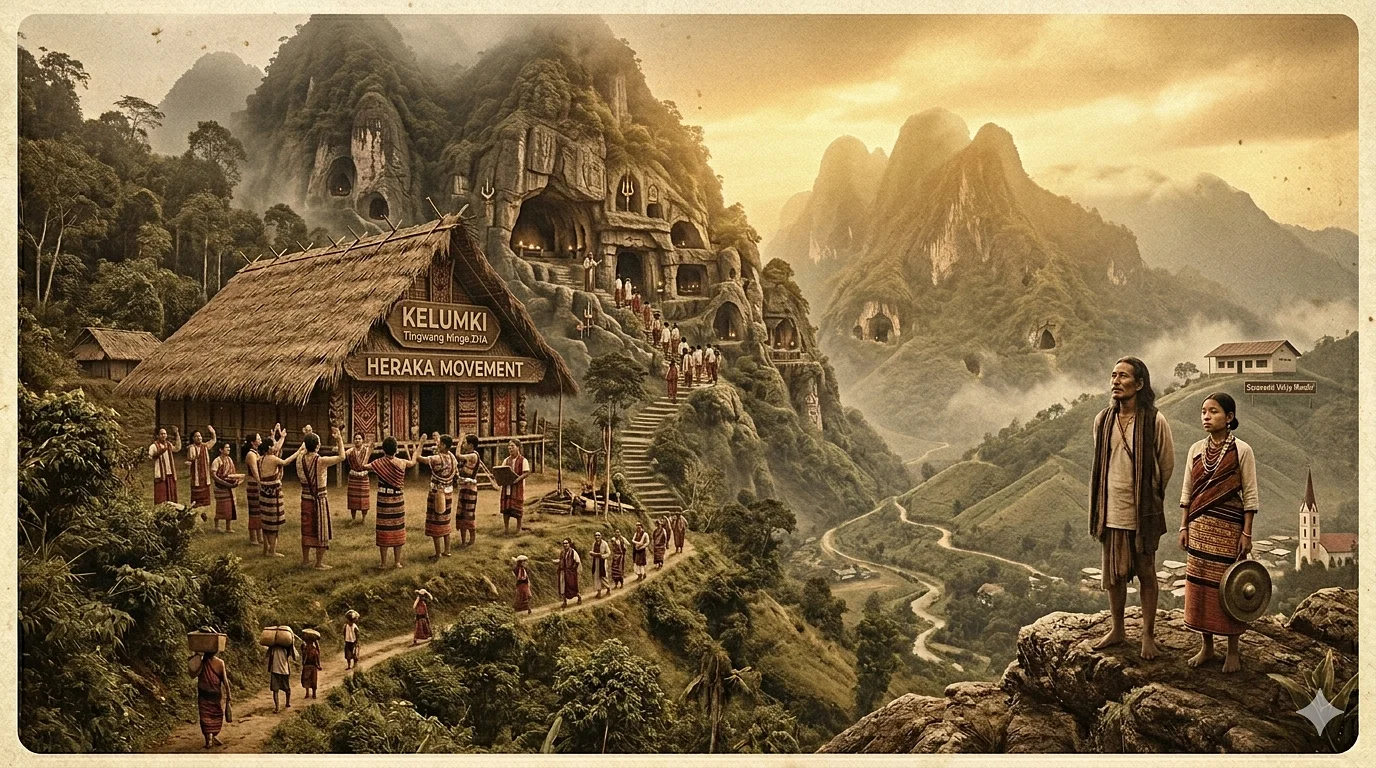
Around 1927, Jadonang began building prayer houses, known as Kelumki, which provided a physical and spiritual center for the Heraka community. He urged the followers to pray with empty hands, thus prohibiting animal sacrifices and reducing ritual expenditures. Thus, he introduced a more sustainable form of ritual practice that preserved cultural continuity while alleviating economic strain. This pragmatic reform revealed the movement’s acute awareness of the interplay between economy and belief.
By 1930, the movement had assumed a clear political character. Jadonang envisioned a Makam Gwangdi or "Naga Raj", a sovereign space for his people free from British rule. He began organizing a military force and collecting tributes from villages, which the British viewed as a direct challenge to the crown.
The colonial state responded with punitive measures. On August 29, 1931, Haipou Jadonang was executed by the British in Imphal on charges of murder of four betel leaf traders and rebellion against the Crown. The colonial government believed that the execution of Jadonang would put a definite end to the Heraka movement. However, the movement gained a new momentum under Jadonang’s 16-year-old cousin, Gaidinliu.
Gaidinliu transformed the movement into a fierce guerrilla resistance. She led her followers through the dense jungles of the Northeast, evading the British for over a year. She was eventually captured in October 1932 in the village of Pulomi. Because she was a minor, she was sentenced to life imprisonment rather than death. It was during her long incarceration that Jawaharlal Nehru visited her and, struck by her indomitable spirit, gave her the title ‘Rani’ and ‘Daughter of the Hills’.
Hingde and Tingwang
To understand Heraka through the lens of indigenous traditions, we must discard the Western category of "religion" as a universal and natural phenomenon. In the Zeliangrong worldview, there is no exact equivalent for religion; instead, there is Hingde.
Hingde refers to the "rules governing everyday life". It encompasses ethical conduct, social obligations, ecological relationships, and the moral responsibilities of the individual within the cosmic order.
Jadonang’s theological reform centered on the worship of a supreme creator, Tingwang (or Tingkao Ragwang), meaning the ‘Lord of Sky’ or ‘Lord of the Universe’. This replaced the worship of several minor Gods and the rituals associated with them. While some colonial scholars misread this as a borrowing from Christian monotheism, it was actually a strategic consolidation characterized by a "shrinking of the pantheon." By focusing on a singular, omnipresent, omniscient, and supreme divinity, the Heraka movement created a renewed theological front that was adaptive to the changing world order. It allowed the Zeliangrong to retain their cosmological beliefs while also engaging with the ideological pressures of colonial modernity and missionary conversion efforts.
Sacred Geography and Everyday Resistance
The endurance of Heraka lies significantly in its anchoring to a sacred geography. The Bhuban Hills, located in present-day Dima Hasao, Assam, are more than just a physical landscape. They are the holy sites associated with the spiritual leader Jadonang, who meditated in the caves. The caves associated with Jadonang and Gaidinliu are understood as liminal spaces where the human and the divine meet.
In the face of colonial mapping that sought to fragment the Zeliangrong into different administrative units, these sacred sites provided a "cosmological map" that ignored colonial borders. However, the followers of Heraka have shown resistance through preservation of the sacred geographical site of Hangrum, which serves as a center for the Zeliangrong Heraka Association and rituals like the Hangrum parade and sunrise prayer. According to Longkumer, this represents a “nascent nationalism imagined through the sheer force of their emotions and their latent power.” Further, the Bhuban Hills and the cave are an important site for not just the Heraka but also for the Poupei Chapriak, the Rongmei indigenous practice. The symbolic importance of this geographical location is reflected in the way these different groups exercise their rights over these perceived ‘original sites,’ claiming a common historical narrative.
Beyond the organized rebellion, the movement survived through what James Scott calls the "everyday forms of resistance." The persistence of indigenous food habits, the consumption of zao (traditional rice beer), and the wearing of ancestral brass ornaments were conscious choices. These were subtle but powerful refusals to disappear into the modernity offered by the missions.
Post-Independence: The Struggle for Identity
When Rani Gaidinliu was released from Tura Jail in 1947 after India’s independence, she returned to a landscape that had changed drastically. The Naga national movement, spearheaded by the Naga National Council (NNC) and later the NSCN-IM, had gained momentum. This movement increasingly adopted a "Nagaland for Christ" identity, viewing the Heraka as an obstacle to Naga political unity.
This placed the Heraka in a complex, two-way struggle, first against Christian hegemony. The Heraka refused to accept that "Naga-ness" required conversion. They stood as a buffer against the totalizing vision of an exclusive Christian Naga state. Second, they also resisted the influence of Hindutva. In the 1970s and 1980s, organizations like the RSS and VHP began to see Heraka as a natural ally, an indigenous "Dharmic" faith resisting Western proselytization. They established schools (Saraswati Vidya Mandirs) and hostels to support the community. However, the Heraka opted for a third way, i.e., through the preservation of autonomy. Although from time to time they accept the support from Hindu nationalist groups, the Heraka have largely maintained a distinct identity. They do not adopt Puranic idol worship, nor do they fully align with mainstream Hindu rituals. They retain the flexibility of Hingde.
Today, the Heraka movement is highly organized under the Zeliangrong Heraka Association (ZHA). Its functioning has transitioned from a purely oral tradition to a formalized structure, centering around the physical structure, Kelumki, which is found in every village; the Tingwang Hinge, i.e., codified text and hymns, ensuring that the younger, urban generation can access their heritage; and lastly, the Hingdepaupeus i.e., the trained preachers who travel between villages to encourage revival of the old faith and strengthen the Hingde.
Rani Gaidinliu, who passed away on February 17, 1993, remains the ultimate icon of this struggle. To the Indian state, she is a Padma Bhushan-winning freedom fighter. To the Heraka, she is a spiritual guide who navigated a moment of profound civilizational crisis with both conviction and adaptability.
Conclusion
The Heraka movement stands as a symbol of how modernity and progress can co-exist with one’s traditional belief systems. What started as a reform movement under Jadonang has assumed various meanings over time and under different leadership. To some, the Heraka stands as a resistance to Christianity and colonialism. To others, it's a call for Makam Gwandgi. Yet, several others have tried to understand the Heraka within the broader frameworks of Independence Movements. However, there is little denying that it was an effort to preserve the indigenous Zeliangrong faith while also promoting socio-economic welfare during a period of rapid transformation. At the same time, the Heraka transcends reductive binaries that position indigenous spiritual traditions as static or regressive, instead revealing a dynamic and adaptive consciousness.
Sources:
Longkumer, Arkotong (2010). Reform, identity and narratives of belonging: The Heraka movement of northeast India. Continuum International Publishing Group.
Scott, James C. (1976). The Moral Economy of the Peasant: Rebellion and Subsistence in Southeast Asia. New Haven and London: Yale University Press.
%20(6).png)