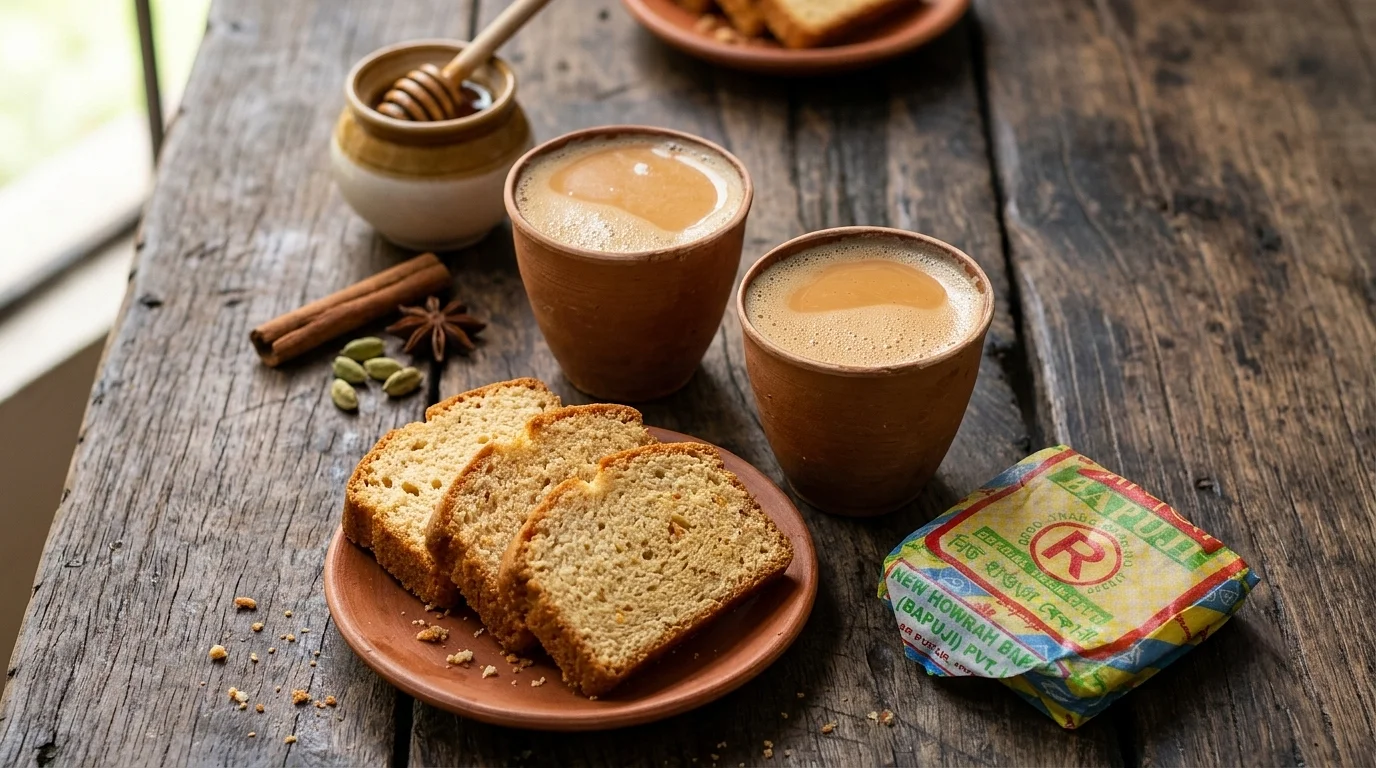
If you were a school going child in West Bengal between the 1970s and the 2000s, your tiffin box probably had a small secret of a square cake wrapped in slightly oily, brightly printed paper with a big red R on it. You just unwrapped it between classes, took a bite of soft vanilla cake dotted with tutti frutti and shiny pieces of petha and felt for a moment that the world was exactly as it should be! That cake was Bapuji, and for many Bengalis it is not just a food item but a kind of edible childhood itself. Bapuji Cake of West Bengal is a humble, everyday tiffin cake that has quietly become a cultural symbol for generations. It is not a luxury dessert or not even something you normally order at a fancy bakery. It is the kind of cake that hawking hands sell on local trains, that sits on shelves of small neighbourhood grocery stores. The story of this small square of cake is the story of ordinary life in West Bengal. It is how something simple and affordable can become a shared memory that binds people across decades. There is no royal kitchen, no ancient family recipe passed down in whispers, no dramatic tale of a confectioner who discovered it by accident. Instead, there is an industrialist named Alokesh Jana and a bustling street in Howrah. In 1973, Alokesh Jana looked around the busy markets of Howrah and noticed a simple gap. Schoolchildren, workers, and commuters needed a quick, affordable snack that could be eaten at tea stalls, or at bus stops. Fancy cakes were available for occasions, but there was nothing regular, reliable and pocket-friendly for everyday life. So he set up New Howrah Bakery, later which came to be known as Bapuji, in the Pallabpukur area of Howrah and launched a square-cut vanilla fruit cake priced at just sixty paisa.
That was the beginning. The very first Bapuji Cake was not born from any dramatic moment but from an observation. People wanted something simple, consistent and cheap. From students it quickly spread to workers, office-goers and anyone who needed a quick bite between meals. The rest of the story is how one small idea became a decades-long habit across Bengal. As the demand grew, the company expanded its production by opening additional factories in locations such as Laketown in Kolkata and Srirampur in Hooghly. Even as the brand expanded into biscuits and other products, the core cake remained recognizably the same, a soft, lightly sweet fruit cake that could be carried easily in a tiffin and eaten without fuss. If you have never tried it, picture a soft, slightly spongy vanilla cake,

not too sweet, with a light, comforting fragrance! It is cut into neat squares, and inside you will find colourful bits of tutti frutti, soft sweet pieces of petha (which is an ash gourd preserve also known as chalkumra morabba) and occasionally roasted peanuts and a few raisins. Each slice is wrapped in thin, oily wax paper, usually in red, yellow, green or blue, with a bold red R trademark. The wrapper often leaves a faint, greasy stain on your fingers. The taste is gentle. It is not rich or buttery. It is light, moist and easy to eat in a few bites. You can eat it with your hands, and it fits perfectly into a small tiffin box alongside biscuits or savouries. Bapuji’s popularity is not about being the most gourmet or the most trending cake. It is about being just right for the way life was lived in West Bengal for decades. From sixty paisa in 1973 the price slowly rose to three rupees in the 1980s, five rupees later, and now around seven or eight rupees per slice. Even then it remained much cheaper than most bakery cakes. This made it accessible to students, labourers and middle-class families alike. The recipe has stayed largely the same. If you bought a Bapuji Cake in 1990 and another in 2010, they would taste recognizably similar. That consistency created trust. People knew exactly what they were getting: a soft, mildly sweet fruit cake they could depend on. It was the kind of snack you could carry in a dabba, buy at a tea stall, or get from a train hawker. It did not need special occasions. It was as ordinary as a bus ticket or a school notebook, and that ordinariness made it loved.

The choice of the name Bapuji invites a quiet cultural reading. Bapuji is a familiar way in which many Indians have historically referred to Mahatma Gandhi, and so the name carries that cultural weight without the company ever having to make a formal statement about it. For ordinary people in West Bengal, the name would have felt close, respected, and deeply Indian, and in that sense the cake itself became part of a larger everyday story about identity and belonging. In 1973, West Bengal was in a difficult time. The economy was strained, industries were changing. The city still carried the weight of its colonial past. The baking world was mostly dominated by large, old‑fashioned houses that cooked for the elite with cakes that felt expensive, imported, and distant from most people’s lives. Bapuji entered this space as something simple and near. It offered a cake that did not ask you to dress up, to spend heavily, or to pretend to be someone else. It was for the student, the worker, the commuter, anyone who wanted something sweet without needing to justify it.
That sense of closeness also showed in the ingredients. Traditional British fruit cakes often relied on imported candied peels and berries with ingredients that felt foreign and costly. Bapuji, on the other hand, used petha, an ash gourd preserve that many Bengali families already knew, and a locally made tutti‑frutti that fit the way people ate and cooked. It was not a political slogan, but it felt Indian in a natural way. In that small decision, the cake became more than just food. It became proof that something produced locally and made for ordinary life could still carry a sense of dignity and identity.

In a time before branded snacks and global fast food, Bapuji filled the everyday gap between basic bread and expensive bakery treats. It became the default cake for people who did not think of cake as a luxury, but as a normal part of their day. For many Bengalis today, the name Bapuji is not just a brand. It is a trigger for memory. They are all now sensory symbols that bring back school days, local train rides, family picnics and chai-stall conversations. For many Bengalis, Bapuji Cake is tied to specific moments in life. For commuters and workers, Bapuji was also the go-to snack. Local train hawkers sold it, roadside tea stalls kept it, and small kiosks near bus stops stocked it. If you were travelling, you might pick up a Bapuji Cake for a quick bite. So, over time, Bapuji became more than a product. It became a shared memory. Bengalis who grew up in West Bengal often talk about it in the same way others talk about their favourite college days, their first bicycle, or their grandmother’s dishes. It is all now part of a cultural story that many people carry with them, even when they have moved to other cities or countries.
In recent years, the way we experience Bapuji Cake has changed. In the 1970s, 1980s and even the 2000s, Bapuji was everywhere: small grocery stores, train platforms, tea stalls, near schools. Today it is less visible in some of these places. Many people say that Bapuji is no longer as easily available in neighbourhood shops as it once was. Younger generations, with access to a wider range of snacks and branded products, may not feel the same attachment. Yet the cake has not disappeared. Reports suggest that even now, around fifty thousand Bapuji cakes are sold every day, mostly through smaller channels like local grocery stores, bus terminus kiosks, school-side vendors and small stalls, rather than large malls. The brand has expanded into biscuits and other products, but the core cake remains. The price has increased, of course, but it is still relatively cheap compared to other bakery items. For students, small families and those who remember its taste from earlier years, Bapuji is still a familiar, comforting choice. For many Bengalis today Bapuji Cake is more about memory than taste. It is a taste that instantly brings back school days, local train rides, family picnics, chai-er dokaner adda, and the feeling of being a child with a small, simple joy in a tiffin box. In recent years, social media posts, YouTube recreations, and even comedic videos have celebrated Bapuji Cake as a nostalgic icon. People talk about it with affection, sometimes with a hint of sadness, as if remembering a world that has slowly changed. The oily wrapper, the red R, the square slice, all of these are now part of a shared cultural story that many people carry with pride. The legacy of Bapuji Cake is carried forward by Alokesh Jana’s sons, Amitabha and Animesh Jana, who continue to manage the business while keeping the original recipe largely intact. Their commitment to maintaining the traditional taste and texture has helped preserve the cake’s identity across generations, even as the market evolves. The brand has also faced challenges, including trademark disputes and court cases, which ultimately strengthened public loyalty when the Jana family successfully defended their claim. These legal battles underscored how deeply the Bapuji name and its iconic packaging were tied to public memory and regional identity.
Perhaps the most fascinating chapter in the modern story of Bapuji Cake is how it managed to break out of its geographical borders. For decades, the cake was tightly bound to the soil of West Bengal. To taste it, you either had to live there or know someone traveling from there. Today, however, the digital revolution has completely rewritten the supply chain of nostalgia. You no longer need to wait for a generous relative to pack a few crumpled packets in a suitcase. Through niche e‑commerce platforms and regional food curation services that specialise in Bengali nostalgia, Bapuji Cake now travels across the length and breadth of India. A tech professional in Bengaluru or a family in Mumbai can order a box from them. Though the transition was not simple. Shipping a product that is famous for its delicate, traditionally preservative‑light composition brings logistical challenges. The classic single‑slice cake, wrapped in its familiar oily wax paper, is known to have a relatively short shelf life, often understood to be around a few weeks. To ensure that the signature soft texture and the moist, the brand and its partners have begun adapting packaging and delivery methods. Alongside the iconic single‑use tiffin packs, smaller family packs and sturdier slice‑cake boxes are now being used in some channels, helping the cake survive longer journeys while still trying to preserve its original feel. This cautious adaptation rather than a fully documented corporate overhaul shows how a regional nostalgia product quietly learns to travel across new distances without losing its essential character.
If you try Bapuji Cake today you might find it simple, even a little plain. But if you have grown up with it the taste will do more than satisfy hunger. It will take you back to a time when life was slower, when a small red-wrapped square of cake could feel like a genuine treat, and when something so ordinary could carry so much meaning. Bapuji Cake is a quiet reminder that not all cultural symbols need to be grand or elaborate. Sometimes the most enduring memories are baked into the most humble things: a small vanilla fruit cake wrapped in oily paper, shared in a classroom, carried in a train, eaten at a tea stall. That is the real story of Bapuji Cake of West Bengal, not just what it is, but what it meant to the people who ate it, and still do. Bapuji Cake is less about ingredients and technique than about presence. It was there when you were a child, and it is still there, however less visible, for those who remember. And perhaps that is why it continues to matter. Not because it is the most sophisticated cake, but because it is the cake that many people grew up with, the cake that belonged to them, the cake that in its own small way helped shape the taste of their childhood and the memory of their home.

.png)
%20(3).png)

%20(1).png)