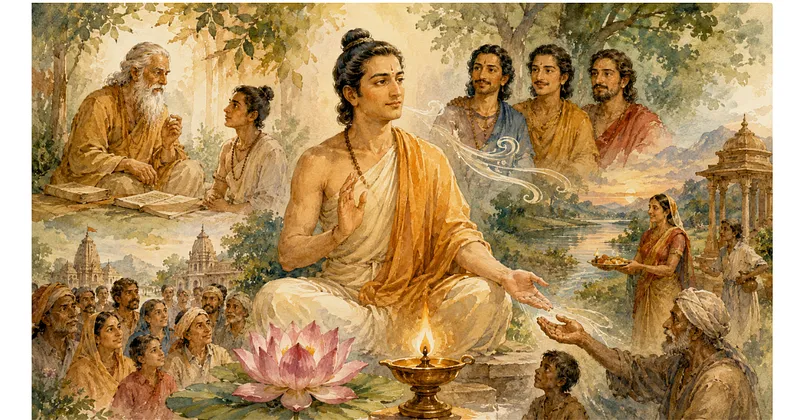
Introduction
We tend to imagine leadership and domestic life as separate worlds — one lived in boardrooms, war rooms, and parliaments; the other in the quiet, unglamorous rhythms of home. The Kāmandaka Nītisāra, an ancient Indian treatise on statecraft, suggests otherwise. In its section on ācāra-vyavasthāpana (the establishment of right conduct), the text moves seamlessly between describing the ideal gṛhastha (householder) and the ideal nṛpati or avanipati (ruler) — as though the two were not separate subjects at all, but two expressions of the same underlying discipline.
This is a striking claim, and worth sitting with: the qualities that make someone a good head of household are, almost without modification, the qualities that make someone fit to lead. Verses 36 through 40 (in the 3rd Sarga) lay out this vision with unusual clarity. Read together, they form less a manual for kings than a meditation on what it means to hold power — over a family, a team, a kingdom — without letting that power curdle into arrogance.
Humility as the First Discipline of Power
The section opens not with a lesson on strategy or strength, but with a lesson on restraint: