Most of what a leader knows arrives through other people. The report, the recommendation, the visitor who was let in and the one who was told the diary was full: each passed through someone's hands first. A leader may be able and well-meaning, but the picture they act on has been shaped by the people around them.
Classical Indian writing on statecraft noticed this early. In the fourth sarga of the Kāmandakīya Nītisāra, verses 10 to 13 deal with the parivāra, the circle of attendants around a king. Two classical commentaries, the Jayamaṅgalā and the Upādhyāya-nirapekṣā, unpack them. The message is blunt: choose the people around you as carefully as you choose your own conduct, because they will decide how your rule turns out.
Four Qualities Worth Looking For
The first verse says a ruler who wants his own welfare should surround himself with people who are prakhyāta-vaṃśa, akrūra, loka-saṃgrāhin and śuci.
Prakhyāta-vaṃśa literally means a family of good repute. In a court, that meant inherited standing. Today the nearest equivalent is a track record that anyone can check. A person who has built a reputation over years has something to lose, and that makes them more reliable than a stranger who arrives with only a confident manner.
Akrūra, "not cruel", is glossed by the Jayamaṅgalā as apāpāśaya: a heart free from harmful intent. The Upādhyāya-nirapekṣā reads it as ahiṃsra, one who does not injure others. The modern test is simple: watch how a person treats those who can do nothing for them. Someone who is gracious to the boss and harsh to the intern will eventually be harsh to the boss's customers too.
Loka-saṃgrāhin describes someone who can gather people and keep them together. The Jayamaṅgalā adds a telling gloss, guṇavatām avakāśa-dāyin: one who gives room to the worthy. Popularity is not the point. What matters is whether capable people grow around this person or quietly leave. Some individuals make a team larger. Others make it smaller and safer for themselves.
Śuci, "pure", is where the two commentators agree most firmly. The Jayamaṅgalā says upadhā-śuddha: clean of fraud and hidden crookedness. The Upādhyāya-nirapekṣā is more concrete, asking for someone who is apuṃścala and asteya, not morally loose and not a thief. In any organisation this means honest dealing with money, honest numbers in the report, and no double game.
How Company Changes the Way a Leader is Seen
The second verse offers two images. A flawed king can become bhogya, tolerable and serviceable, through the quality of his attendants. But a king whose retinue is wicked is like a tree wrapped in snakes: vyālākrānta iva drumaḥ. People stay away from it.
The Upādhyāya-nirapekṣā sharpens both pictures. A vulture surrounded by swans becomes bearable. A sandalwood tree coiled by poisonous snakes is enjoyed by no one, however fine the wood.
Anyone who has worked in an organisation will recognise both cases. Some leaders have obvious flaws, such as impatience, poor memory for names or a weak grasp of detail, yet people work happily under them because the people at the centre are competent and decent. Others are personally admirable, but their inner circle is so full of intrigue and self-service that talented people decide the risk of approaching them is not worth it.
The verse is not a comfort for flawed leaders. It says a good team can make a weak leader usable, and it makes no claim that this is a good arrangement. It does warn that the reverse is more common and more damaging.
The Gate
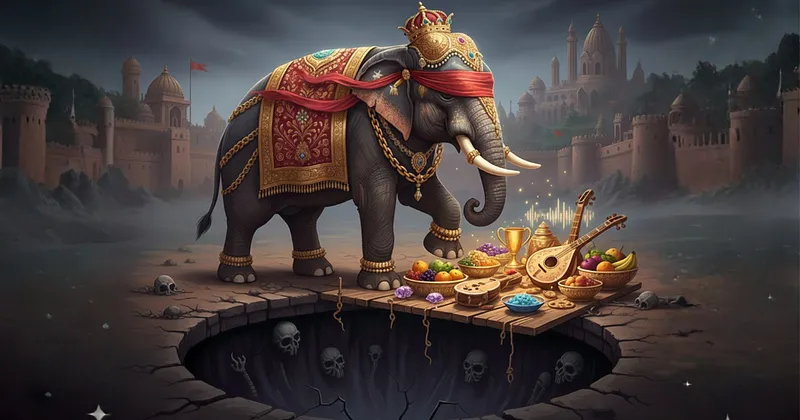
The third verse is the sharpest. Wicked ministers, it says, block the path of good people and devour the king.
The commentators read mārga, "path", as access. The Jayamaṅgalā describes ministers who keep worthy people away from the ruler and then use him for their own ends. The Upādhyāya-nirapekṣā is more specific about the damage: barriers and controlled channels shut out honest visitors, while the treasury and revenue are drained. The king is "eaten" because his prosperity is eaten.
Nothing in this needs updating. Every leader has someone who manages the diary, filters the email, decides which concern becomes an agenda item and which is dealt with before it arrives. A good gatekeeper protects a leader's time. A bad one protects their own position and calls it protecting the leader. The result is a leader who hears only reassuring news and meets only agreeable people, and who is often the last to find out what has gone wrong.
The old epics show the pattern. In the Rāmāyaṇa, Mantharā works on Kaikeyi's fears until a settled decision is overturned. In the Mahābhārata, Vidura's counsel at Hastināpura is heard and then set aside. In both stories the trouble does not begin with a wicked ruler. It begins with who has the ruler's ear.
A leader can test this in a few ways:
-
Who can reach me without asking anyone's permission?
-
When did someone last tell me something unwelcome, and what happened to them afterwards?
-
Which good people used to come to me and no longer do?
What Prosperity is For
The last verse in the set turns from protection to purpose. Having attained great prosperity, a ruler should make it fit for the enjoyment of the good. Prosperity in which the good do not stay is vṛthā, in vain.
The Jayamaṅgalā reads this ethically: power and wealth are valuable through their worthy use, and prosperity that serves only oneself is hollow. The Upādhyāya-nirapekṣā reads it as a practical test: if worthy people cannot stay and share in what has been built, it has failed at its purpose.
For a modern institution the test is easy to apply and uncomfortable to answer. A company may post strong results, a university may grow its budget, and a public office may gain influence. But if capable, honest people do not stay in it, something has gone wrong that the figures will not show. Who has left, and why, tells you more than the results slide.
Character Before Loyalty
One point deserves attention because it runs against instinct. The verses do not tell a leader to surround himself with loyal people. They list character, gentleness, the ability to hold people together, and honesty. Loyalty without those qualities is exactly what Mantharā offers: complete devotion to the person and no care for the good of the person or the realm.
A leader's own virtues are only part of what holds an institution up. The rest is the people standing next to him, and he chooses them.