A Portrait in a Hangar
द्यौः शान्तिरन्तरिक्षं शान्तिः पृथिवी शान्तिरापः शान्तिरोषधयः शान्तिः ।
Peace in the sky, peace in the mid-air, peace on the earth, peace in the waters and the healing plants.
(Śukla Yajurveda, Vājasaneyi Saṃhitā 36.17)

Image Attribution: By India Post, Government of India - [1], GODL-India, https://commons.wikimedia.org/w/index.php?curid=74675186 and
Indian Air Force, GODL-India, via Wikimedia Commons-https://en.wikipedia.org/wiki/Nirmal_Jit_Singh_Sekhon#/media/File:Nirmal_Jit_Singh_Sekhon_2000_stamp_of_India.jpg
All my life I have thought about war, the one within and the one without, and about peace, within and without. I grew up among soldiers and airmen, men who trained for war so that the rest of us would never have to see one.
I was due in mid-December 1971. My father, an officer of the Indian Air Force (IAF), was in the Western Sector defusing bombs, among other dangerous duties. I delayed my arrival and met my parents in January 1972, well after peace had returned.
I was thirteen when I saw a large portrait of Flying Officer Nirmal Jit Singh Sekhon in a hangar at 5 Base Repair Depot, Air Force Station Sulur, near Coimbatore (Tamil Nadu). No. 18 Squadron had just moved in from Srinagar, and the whole station was abuzz with stories of the only IAF squadron to have earned a Param Vir Chakra (PVC). That was the day I learnt the word ‘posthumous’, not its meaning so much as its weight. A man had given up his life for me, my country and its people. I could run about humming ‘Poongatru Thirumbuma’ because of men like him (those were the 80s, and Ilaiyaraaja ruled).
On 14 December 1971, flying a Gnat over Srinagar against heavy odds, Sekhon hit one Pakistani Sabre and damaged another before he was shot down. His actions forced the enemy to turn back. He remains the only member of the IAF to receive the PVC, India’s highest wartime gallantry award [1].
In an age without internet or streaming, such stories were not merely thrilling, they also raised questions, do Indians fight differently? Is there a Hindu code for waging a war? How do our men in uniform measure up to it? And so on.

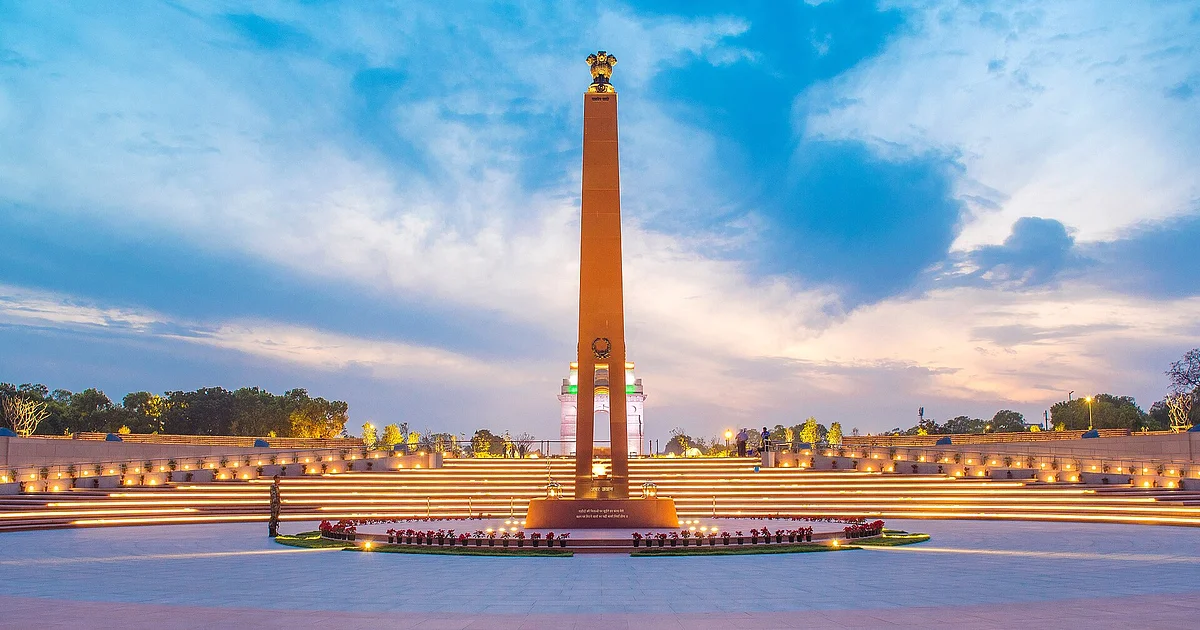
A recent visit to the National War Memorial in New Delhi brought back those questions to the fore. In the works for many years, the much needed Memorial was finally inaugurated by Prime Minister Narendra Modi on 25 February 2019 [2]. In its Param Yodha Sthal stand busts of all twenty-one PVC recipients, and I went to meet Flying Officer Sekhon in his resting place.
The gift shop near the exit sells Operation Sindoor fridge magnets and the illustrated Param Vir Chakra comics from Roli Books, a fine retelling for the young. I bought all thirteen of them and left the men at the counter with a ‘Jai Hind’.

But what about my questions as a thirteen-year-old?
Peace Before Battle
साम्ना दानेन भेदेन समस्तैरथवा पृथक् । विजेतुं प्रयतेतारीन् न युद्धेन कदाचन ॥
Let him try to overcome his enemies by conciliation, gifts and division, together or singly, and never by battle. (Manusmṛti 7.198)
Our texts do not encourage the sword. Manu places war last among the means of statecraft and gives his reason in the verse: “in battle, victory and defeat are uncertain for both sides, so war is to be avoided” (Manusmṛti 7.199). Kauṭilya also agrees. “When peace and war promise equal gain, choose peace, for war brings losses, expense and long absence from home” (Arthaśāstra 7.2.1–2).
In the Mahābhārata, before a single arrow flew at Kurukṣetra, the Pāṇḍavas had tried everything else. Yudhiṣṭhira, owed half a kingdom, offered to settle for five villages (Udyoga Parva 31.19–20). Kṛṣṇa himself went to Hastināpura as an envoy and told the Kuru court, "I have come, O Bhārata, to ask that there be peace between the Kurus and the Pāṇḍavas, without the destruction of heroes" (Udyoga Parva 93.3). Duryodhana's arrogant reply was that he would not yield even as much land as the point of a needle could pierce (Udyoga Parva 125.26).
Only when every road to peace was closed did the Pāṇḍavas take the road to war.

When War Becomes a Duty
धर्म्याद्धि युद्धाच्छ्रेयोऽन्यत्क्षत्रियस्य न विद्यते ॥
For a kṣatriya there is nothing better than a war fought for dharma. (Bhagavad Gītā 2.31)
On the field, Arjuna lays down his bow at the sight of teachers and kinsmen across the lines. Kṛṣṇa does not tell him that war is good. He teaches him that this war, forced on the Pāṇḍavas after every offer of peace was spurned, is dharmya, in keeping with dharma, and that walking away would abandon those a warrior must protect.
The cause must be just so that an avatāra takes birth "to protect the good, to destroy the wicked and to establish dharma" (Bhagavad Gītā 4.8). The fighter must be free of hatred and greed, "treating alike pleasure and pain, gain and loss, victory and defeat, gird yourself for battle so that you will incur no sin" (2.38). And the end must be peace: "to one without peace, where is happiness?" (2.66).
The Rāmāyaṇa exemplifies protection of the one who seeks refuge. When Vibhīṣaṇa deserts Rāvaṇa for Rāma's camp and the advisers urge caution, Rāma replies:
सकृदेव प्रपन्नाय तवास्मीति च याचते । अभयं सर्वभूतेभ्यो ददाम्येतद्व्रतं मम ॥
To anyone who comes to me even once and says, "I am yours", I grant safety from all beings. This is my vow. (Vālmīki Rāmāyaṇa, Yuddha Kāṇḍa 18.33)
War thus is justified when peace has been refused, when it defends those who cannot defend themselves, and when it is fought without hatred.

Fighting Within Limits
न कूटैरायुधैर्हन्याद्युध्यमानो रणे रिपून् । न कर्णिभिर्नापि दिग्धैर्नाग्निज्वलिततेजनैः ॥
In battle let him not kill his foes with concealed weapons, nor with barbed or poisoned arrows, nor with arrows whose points blaze with fire. (Manusmṛti 7.90)
A just war has rules. On the eve of Kurukṣetra both armies agreed on a code. Chariot-warrior would fight chariot-warrior, horse with horse, foot-soldier with foot-soldier. No one was to strike a man who had left the fight, surrendered, lost his weapons or his armour. And charioteers, draught animals, weapon-bearers, drummers and conch-blowers were never to be targets (Bhīṣma Parva 1.27–32). Manu spares the sleeping, the wounded, the fleeing, the onlooker and the man who folds his hands and says "I am yours" (Manusmṛti 7.91–93).
These ideals are not limited to the ancient texts. Every officer commissioned from the Indian Military Academy, Dehradun, learns the Chetwode motto: "The safety, honour and welfare of your country come first, always and every time. The honour, welfare and comfort of the men you command come next. Your own ease, comfort and safety come last, always and every time." [3] In December 1971 about 93,000 Pakistani soldiers laid down their arms at Dhaka. They were held as prisoners of war and, in time, sent home. Without holding them as a bargaining chip as any other nation would.

The same discipline is seen under the UN flag too. Since 1950, when an Indian field ambulance served in Korea, more than 2,86,000 Indians have served in UN missions, and nearly 180 have died in them, more than from any other country [4, 5]. Captain Gurbachan Singh Salaria won his Param Vir Chakra in the Congo in 1961, the only one earned on a UN mission.
In October 2026 the Bhairav Battalion of the Assam Regiment, one of the Army's newest units, won gold at Exercise Cambrian Patrol in Wales against more than 100 teams [6]. In what is called the Olympics of military patrolling, its eight-member team carried about 35 kg each over some 60 km of hills in under 48 hours [7].
The Price of Victory
Victory in the Mahābhārata does not end in celebration. In the Strī Parva, Gāndhārī walks the field among the bodies of her sons. In the Śānti Parva, Yudhiṣṭhira, crowned at last, laments that this victory looks to him like defeat and longs for the forest. The epic insists that even a just war must be paid for, and that those who pay most are rarely those who decide to wage wars.
Our highest wartime award, the Param Vir Chakra, effective from 15 August 1947, is given for most conspicuous bravery and self-sacrifice in the presence of the enemy. Designed by Savitri Khanolkar and cast in bronze, it bears the State Emblem surrounded by four replicas of Indra's Vajra, flanked by Shivaji's sword, on a purple ribbon [8]. The Vajra recalls sacrifice: the Mahābhārata tells how the sage Dadhīci gave up his life so that the gods could fashion the weapon from his bones and destroy Vṛtra (Āraṇyaka Parva).

PVC has been awarded 21 times, 14 of them posthumously; 20 to the Army and one to the Air Force. An old Doordarshan's series on them is also available on YouTube [9]. These men fought in Kashmir in 1947–48, against China in 1962, against Pakistan in 1965 and 1971, on the Siachen Glacier and in Sri Lanka in 1987, and at Kargil in 1999. The 1971 war ended in surrender at Dhaka, Kargil with every peak retaken.
Keeping the Memory Alive

The National War Memorial in Delhi, with its Amar, Veerta, Tyag and Rakshak Chakras, carries 25,942 names [2, 10]. Other memorials include the National War Memorial of the Southern Command in Pune, the National Military Memorial in Bengaluru, the Kargil War Memorial at Dras, the War Heroes' Memorial and Museum in Amritsar, and the National Police Memorial in Delhi for those who keep the peace at home.
For one of the world's largest film-producing nations, we make too few films on the wars we have fought and won. There have been a few, such as 1962: The War in the Hills [12] and 120 Bahadur [13], both drawn from the stand at Rezang La. We need many more, on every key battle.
We, as a nation, have never initiated any of these wars. Battles were thrust upon us even before independence, and since 1947 there have been many attempts to break our morale and our nation. Our men in uniform have met every challenge with bravery that is not only commendable but exemplary. Unless we tell these stories to the young, they will not value the lives that were lost to an ideal, nor value the ideal itself. Our texts give us that ideal: seek peace first, fight only for dharma, and fight within the boundaries of dharma. Safekeeping and peace is not a job for just a few. It is the duty and responsibility of each one of us who loves this land as one does a mother, and there can be no other!
Bharat Mata ki Jai!

|
# |
Param Vir Chakra Recipient |
Unit |
Action |
Posthumous |
|
1 |
Major Somnath Sharma |
4 Kumaon |
Badgam, 1947 |
Yes |
|
2 |
Naik Jadunath Singh |
1 Rajput |
Naushera, 1948 |
Yes |
|
3 |
Second Lieutenant Rama Raghoba Rane |
Corps of Engineers |
Rajouri, 1948 |
|
|
4 |
Company Havildar Major Piru Singh |
6 Rajputana Rifles |
Tithwal, 1948 |
Yes |
|
5 |
Lance Naik Karam Singh |
1 Sikh |
Tithwal, 1948 |
|
|
6 |
Captain Gurbachan Singh Salaria |
3/1 Gorkha Rifles |
Congo, 1961 |
Yes |
|
7 |
Major Dhan Singh Thapa |
1/8 Gorkha Rifles |
Ladakh, 1962 |
|
|
8 |
Subedar Joginder Singh |
1 Sikh |
Bum La, 1962 |
Yes |
|
9 |
Major Shaitan Singh |
13 Kumaon |
Rezang La, 1962 |
Yes |
|
10 |
CQMH Abdul Hamid |
4 Grenadiers |
Khem Karan, 1965 |
Yes |
|
11 |
Lieutenant Colonel A B Tarapore |
17 Poona Horse |
Sialkot sector, 1965 |
Yes |
|
12 |
Lance Naik Albert Ekka |
14 Guards |
Gangasagar, 1971 |
Yes |
|
13 |
Flying Officer Nirmal Jit Singh Sekhon |
No. 18 Squadron, IAF |
Srinagar, 1971 |
Yes |
|
14 |
Second Lieutenant Arun Khetarpal |
17 Poona Horse |
Basantar, 1971 |
Yes |
|
15 |
Major Hoshiar Singh |
3 Grenadiers |
Basantar, 1971 |
|
|
16 |
Naib Subedar Bana Singh |
8 JAK Light Infantry |
Siachen, 1987 |
|
|
17 |
Major Ramaswamy Parameswaran |
8 Mahar |
Sri Lanka, 1987 |
Yes |
|
18 |
Lieutenant Manoj Kumar Pandey |
1/11 Gorkha Rifles |
Kargil, 1999 |
Yes |
|
19 |
Grenadier Yogendra Singh Yadav |
18 Grenadiers |
Kargil, 1999 |
|
|
20 |
Captain Vikram Batra |
13 JAK Rifles |
Kargil, 1999 |
Yes |
|
21 |
Rifleman Sanjay Kumar |
13 JAK Rifles |
Kargil, 1999 |
|
Source: Bharat Rakshak [1]; ranks at the time of the action.
References and Notes
-
Bharat Rakshak, The Gallant 21: Param Vir Chakra recipients.
-
Business Standard (PTI), PM dedicates National War Memorial, 25 February 2019.
-
President Ram Nath Kovind, speech quoting the Chetwode motto.
-
The Week, India among the biggest contributors to UN peacekeeping missions, 29 May 2024.
-
Drishti IAS, India's commitment to UN peacekeeping, 20 May 2025.
-
SSBCrack, Bhairav Battalion of the Assam Regiment wins gold medal at Cambrian Patrol 2026 in UK, October 2026.
-
Post on X on the Cambrian Patrol result, October 2026.
-
Wikimedia Commons, Param Vir Chakra medal.
-
Doordarshan, series on the Param Vir Chakra recipients, YouTube playlist.
-
Wikipedia, National War Memorial (India).
-
Wikipedia, Nirmal Jit Singh Sekhon, 2000 stamp of India.
-
Wikipedia, 1962: The War in the Hills.
-
Wikipedia, 120 Bahadur.