Introduction: Returning to the Foundations
In an age where governance is often reduced to policy mechanics, electoral strategies, and bureaucratic management, we rarely pause to ask the foundational questions: What is the essential purpose of government? What makes authority legitimate? Why do societies need enforcement mechanisms at all? These are not merely academic inquiries—they are questions that determine whether a state serves its people or exploits them, whether power uplifts or oppresses, whether civilization flourishes or crumbles.
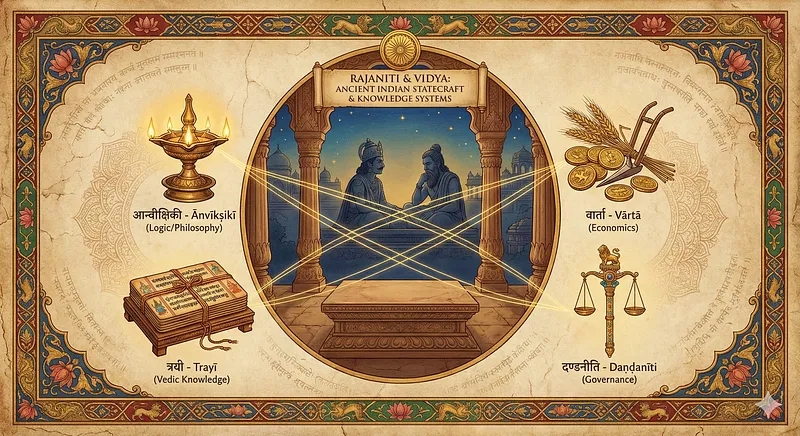
Ancient Indian political philosophy, particularly as articulated in the Arthaśāstra tradition, offers us a remarkably sophisticated framework for understanding these first principles. The Kāmandaka Nītisāra, a classical Sanskrit text on statecraft, provides a crystalline exposition of these ideas. At its heart lies the concept of daṇḍanīti—a term that encompasses far more than its common translation as "the science of punishment. It represents a complete theory of governance, one that begins with the hard realities of human nature and social order, yet aspires toward the highest ideals of justice and collective welfare.
What makes this...