A layered ambition has always marked India's engagement with local democracy. The 73rd Constitutional Amendment, enacted in 1992, sought to reimagine the relationship between the state and society fundamentally. By constitutionally mandating a three-tier Panchayati Raj system, regular elections, reservations for Scheduled Castes, Scheduled Tribes, and women, and the creation of Gram Sabhas as deliberative bodies, it attempted to institutionalize what had long existed in dispersed and uneven forms: local self-governance as a democratic right rather than an administrative concession.
In formal terms, the architecture is formidable. India today has over 2.66 lakh Gram Panchayats, representing one of the largest experiments in decentralization anywhere in the world. Millions of elected representatives participate in this system, with women alone constituting over 45% of Panchayat representatives, a transformation that has few parallels globally. Panchayats are expected to prepare Gram Panchayat Development Plans (GPDPs), implement a wide array of centrally and state-sponsored schemes, and serve as the first point of contact between citizens and the state.
However, this institutional density coexists with a persistent analytical thinness. Panchayats are everywhere in policy discourse but rarely understood in their operational reality. A complex interplay mediates their everyday functioning:
-
overlapping departmental mandates,
-
uneven fiscal devolution across states,
-
dependence on line departments for technical and administrative support,
-
and deeply embedded social hierarchies that shape participation and decision-making.
The constitutional promise of decentralization thus unfolds within a field of constraints, producing a system that is at once visible and elusive. Panchayats are invoked as the cornerstone of grassroots democracy, yet their actual capacities, practices, and outcomes remain unevenly documented and poorly theorized.
It is precisely this gap between institutional presence and epistemic clarity that the Panchayat Advancement Index (PAI) 2.0 seeks to address. Its intervention is both technical and conceptual. At the technical level, it introduces a comprehensive framework for assessing Panchayat performance. At the conceptual level, it attempts to resolve a long-standing problem in Indian governance: how to make local institutions legible to the state.
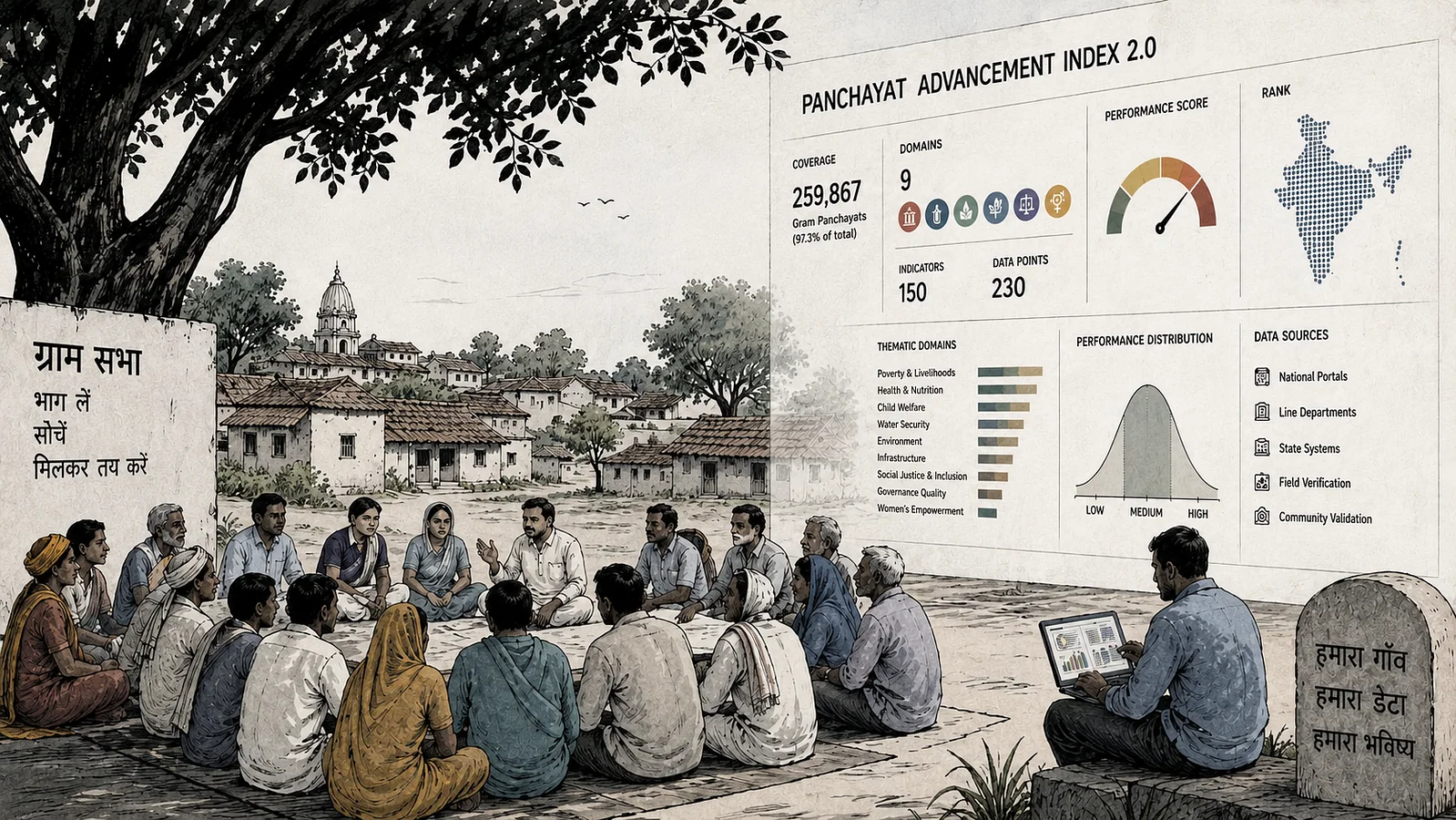
The scale of this effort is unprecedented. PAI 2.0 brings 259,867 Gram Panchayats—97.3% of the total 266,999 Panchayats—within a single evaluative system, spanning 33 States and Union Territories. This represents a significant expansion from earlier iterations, both in coverage and in methodological coherence. The index is built on a framework of 150 indicators and 230 data points, organized across nine thematic domains aligned with the localization of Sustainable Development Goals (SDGs). These domains include:
-
poverty alleviation and livelihoods,
-
health and nutrition,
-
child welfare,
-
water security,
-
environmental sustainability,
-
infrastructure,
-
social justice and inclusion,
-
governance quality,
-
and women's empowerment.
Each Panchayat is thus transformed into a composite profile of measurable attributes, its performance expressed through numerical scores and categorical rankings.
From an administrative standpoint, this is an extraordinary accomplishment. Few states, particularly those governing populations and geographies as vast and diverse as India's, have attempted to construct such a comprehensive and standardized system of local-level measurement. The logistical challenges alone—data collection across remote regions, integration of information from multiple ministries, and validation through administrative and community processes—are immense. The shift from earlier frameworks, which relied on over 500 indicators, to a more streamlined and usable set of 150 indicators also reflects an attempt to balance ambition with feasibility.
More importantly, PAI introduces a new governance infrastructure. It is not merely a report but a system. Through real-time dashboards, integrated data platforms, and automated data flows from national portals, it embeds Panchayats within a broader informational architecture. Governance, in this model, becomes increasingly data-driven, continuous, and comparative.
Nevertheless, to fully understand PAI, one must move beyond its administrative features and consider its epistemic implications. For what it does is not only to measure Panchayats but also to reconstitute them as objects of knowledge.
Traditionally, Panchayats have been understood as political and social institutions. Their functioning has been shaped by local histories, social relations, and patterns of negotiation that are often informal, contested, and context-specific. Decision-making in a Gram Sabha, for instance, is a social process involving speech, persuasion, hierarchy, and sometimes conflict. Authority emerges not just from formal rules but from legitimacy within the community.
PAI introduces a different way of seeing. In its framework, the Panchayat is no longer primarily a site of lived governance. It becomes a measurable entity, defined through indicators, scores, and rankings. Local realities are translated into:
-
quantifiable metrics,
-
standardized categories,
-
and comparable performance outcomes.
This transformation is significant. It shifts the language of governance from one rooted in experience and negotiation to one grounded in measurement and evaluation.
The implications of this shift are far-reaching. On one hand, it enables a level of visibility that was previously absent. Policymakers can identify disparities, track progress, and allocate resources with greater precision. Panchayats can benchmark themselves against others. Citizens, at least in principle, gain access to information that can enhance accountability.
On the other hand, this process of translation inevitably involves reduction. Complex social phenomena are simplified into measurable indicators. Aspects of governance that resist quantification—such as the quality of deliberation, the distribution of voice within the Gram Sabha, or the subtle dynamics of inclusion and exclusion—remain outside the frame.
In this sense, PAI produces a particular representation of the village: one that is standardized across regions, aligned with global development frameworks, and amenable to intervention through policy instruments. It neither denies nor fully engages with social complexity.
What emerges, then, is a dual movement. The Panchayat is simultaneously
-
made more visible to the state,
-
and rendered more abstract in its representation.
This duality lies at the heart of PAI's significance. It is both a tool of administrative clarity and an instrument of conceptual transformation.
To say that PAI redefines the Panchayat is not to suggest that it replaces existing forms of governance. Rather, it overlays them with a new layer of meaning. The Panchayat continues to function as a political and social institution, but it is now also constituted as a data-bearing unit within a national governance system.
This redefinition carries both promise and tension. It opens the door to more informed policymaking, more transparent governance, and more systematic evaluation. At the same time, it raises questions about what is gained and what is lost when governance is mediated through metrics.
The paradox with which India began—of building a vast system of local democracy while struggling to understand it—does not disappear with PAI. It is, in many ways, reframed.
For the first time, the state can see the village with a clarity previously unimaginable. The question that follows is more demanding: what kind of village does this clarity reveal, and what remains outside its field of vision?
A nation of the almost
However, when one moves from design to distribution, from framework to outcomes, the picture that emerges from PAI 2.0 is far more restrained than its ambition. The index does not reveal a landscape of dramatic success or systemic failure. Instead, it presents something more complex and more telling: a system that is functioning but not quite transforming.
The grading structure itself is straightforward. Panchayats are classified into five categories, from A+ (scores above 90) to D (scores below 40). What is worth noticing, however, is not the existence of this hierarchy, but its empirical distribution. Across 259,867 Gram Panchayats, not a single one achieves an A+ grade in the overall composite score. Only 3,635 Panchayats fall into the A category (front runners), while an overwhelming majority—over 2.4 lakh Panchayats—cluster within the B (118,824) and C (123,719) categories. At the lower end, 13,689 Panchayats remain in the D category, signaling persistent developmental deficits.
This distribution has a diagnostic value. It suggests that the system has reached a baseline level of functionality but has not entered the zone of consistent excellence. Panchayats, in aggregate, appear capable of delivering moderate outcomes across multiple sectors but struggle to achieve high-quality, integrated performance across the board.
Even when disaggregated by thematic areas, the pattern holds. In domains such as health and sanitation, there are pockets of excellence—over 1,000 Panchayats have achieved A+ grades in specific themes, demonstrating strong performance in preventive healthcare, nutrition awareness, and sanitation practices. Similarly, in areas related to livelihoods and poverty reduction, several thousand Panchayats perform well, reflecting the cumulative impact of targeted welfare schemes and employment programs.
However, these successes remain uneven and isolated. They do not translate into a broader systemic shift. Instead, they exist as "islands of performance" within a sea of moderate outcomes.
This pattern of clustering in the middle—what might be called a "thick middle distribution"—is quite revealing. It suggests that Indian rural governance has moved beyond the phase of basic institutionalization. Panchayats are no longer dormant or inactive. They are engaged, operational, and embedded within the machinery of development. Nevertheless, they have not yet transitioned into institutions capable of consistently high-quality, context-sensitive, and transformative governance.
To understand why, one must look beyond the index and into the structure of public policy itself. Over the past two decades, the Indian state has significantly expanded its capacity to deliver schemes at scale. Flagship programs in areas such as rural employment (MGNREGA), sanitation (Swachh Bharat Mission), housing (PMAY-G), and livelihoods (NRLM) have created extensive administrative pipelines. These programs are designed with clear targets, defined outputs, and measurable indicators.
Panchayats, in this architecture, often function as implementation nodes, responsible for executing centrally or state-designed interventions. This has yielded tangible results. Infrastructure has expanded. Service delivery has improved. Basic amenities have reached previously excluded populations. The B-category Panchayats—constituting the largest group—reflect precisely this level of achievement: stable, satisfactory performance across core indicators.
However, this model of governance also has inherent limits. Scheme-based delivery systems are effective in producing outputs—roads built, toilets constructed, and beneficiaries enrolled. Nevertheless, they are less effective in producing outcomes that require sustained social transformation, such as the following:
-
reductions in entrenched inequalities,
-
shifts in gender norms,
-
improvements in collective decision-making,
-
or deepening of participatory governance.
These outcomes are relational and political. They depend on local contexts, social negotiations, and the capacity of institutions to mediate competing interests. PAI, in its design, captures the former more effectively than the latter. It is well-suited to measuring what has been delivered. It is less equipped to assess how that delivery is experienced, contested, or sustained.
The predominance of B and C categories, therefore, should not be read as a failure. It reflects a system that has achieved a certain level of administrative consolidation but has yet to achieve institutional depth.
The persistence of the D category, on the other hand, is equally instructive. The 13,689 Panchayats in this bracket are not randomly distributed. They are often concentrated in regions characterized by
-
historical marginalization,
-
difficult geographies (tribal, hilly, or conflict-affected areas),
-
weaker administrative capacity,
-
and entrenched social inequalities.
Their continued presence underscores the unevenness of India's development trajectory. Even within a system designed for universal coverage, structural disparities continue to shape outcomes.
At the upper end, the relatively small number of A-category Panchayats suggests that high performance is possible, but not yet replicable at scale. These Panchayats often benefit from a combination of the following:
-
proactive local leadership,
-
better administrative support,
-
higher levels of community engagement,
-
and favorable socio-economic conditions.
Their existence points to potential pathways forward but also highlights the challenges of scaling such performance across diverse contexts.
Collectively, this distribution produces what might be described as a "nation of the almost." Panchayats are almost effective, almost inclusive, and almost transformative. They operate within a zone of partial achievement—far removed from failure, yet equally distant from excellence.
This condition is not unique to Panchayati Raj. It mirrors a broader pattern in Indian governance, where systems can reach scale but struggle with depth, quality, and consistency. The state can mobilize resources, design programs, and ensure implementation across vast geographies. However, translating these efforts into enduring social change remains uneven.
In this sense, PAI functions as a mirror. It does not create these conditions but reflects them. By bringing together disparate indicators into a single evaluative frame, it makes visible the limits of a model that is heavily oriented toward delivery but less attuned to transformation.
There is also a temporal dimension to this "almost." The index captures a snapshot—a moment in time where systems are still evolving. Panchayats are relatively young institutions in their constitutional form. Their capacities are still being built, their roles are still being negotiated, and their relationships with higher levels of government are still stabilizing.
The absence of A+ Panchayats may not simply indicate failure. It may also signal that the system is still in transition, moving from institutionalization toward consolidation and, perhaps, eventually toward maturity.
However, the risk lies in normalizing this middle ground. When the majority of institutions cluster in moderate performance categories, there is a danger that "adequacy" becomes the benchmark, rather than excellence or transformation.
This is where the interpretive power of PAI becomes crucial. If read narrowly, it may encourage incremental improvements—moving Panchayats from C to B and from B to A. Nevertheless, if read more critically, it can provoke deeper questions:
-
What prevents Panchayats from achieving consistently high performance?
-
How do structural constraints—financial, administrative, and social—shape these outcomes?
-
What kinds of interventions are required not just to improve scores but also to transform institutions?
The index, in its unique way, opens up these questions. In doing so, it reveals not just the state of Panchayats but the state of governance itself: capable, expansive, and increasingly measurable, yet still grappling with the challenge of moving from delivery to transformation, from adequacy to excellence, and from performance to deeper democratic substance.