%20(3).png)
Note: Read Parts Two, Three and Four Here.
Introduction
A Civilizational Invitation
A yātrā in Bhārata is an invitation.
To step into the layered stories of the world's oldest living civilization,
To immerse in wonder at the treasures that open up,
To allow one's consciousness to expand in communion with this ancient land.
A yātrā pushes our imagined boundaries. Civilizationally, it is designed to transform and elevate. When we come out on the other side, we are no longer the same.
In this series of evocative photo essays, join Shubham Pal on his journey across Bhārata—through its hallowed millennia-old history, monuments, kṣetras, art and craftsmanship, regional delicacies passed down through generations, and relish with joy his encounters with the large-heartedness of her people and culture.
Come, learn of Bhārata with a yātrī who has chosen to traverse the lesser-known paths.
Author's Introduction & Context Setting
I am Shubham Pal, originally from Varanasi and currently living in Delhi, where I work as an Electrical Engineer. For months, one question stayed with me: How well do I really know Bharat? I had read about its history, traditions, and diversity, but I wanted to experience them firsthand rather than through books or social media. I wanted to meet people from different communities, learn about their crafts, taste local food, understand their way of life, and experience the land at the pace of a bicycle.
Like many young professionals, I had both professional and family responsibilities. Funding a months-long expedition meant that leaving my job was not an option. Fortunately, my job allowed me to work remotely, making it possible to pursue this dream without stepping away from my career or neglecting my responsibilities at home. Carrying my laptop throughout the journey, I balanced my office work with the expedition.
Maintaining both commitments was the most challenging part of the journey. Most days began early in the morning with long hours of cycling, often lasting until evening or sometimes until nights. After reaching my destination and finding a place to stay, I would open my laptop and complete my office work, frequently working late into the night. Most nights, I slept for only four to five hours before beginning the next day's ride. The journey tested not only my physical endurance but also my discipline, resilience, and ability to balance adventure with my professional and family responsibilities.
My interest in Indian Knowledge Systems (IKS) also shaped this journey. I have always been fascinated by the idea that knowledge is not confined to classrooms but is gained through observation, travel, dialogue, and lived experience. I wanted to understand Bharat by experiencing it directly—through its landscapes, its people, its traditions, and its living culture.
This photo essay series is a reflection of that journey. Beginning with Gujarat and continuing along India's coastline, these photo essays showcase the story of the places I visited, the people I met, and the lessons I learned. For me, this expedition was an attempt to understand Bharat not as a tourist, but as a learner. Every kilometre became a lesson, every conversation a classroom, and every village a chapter in understanding the country I call home.

14th December 2025
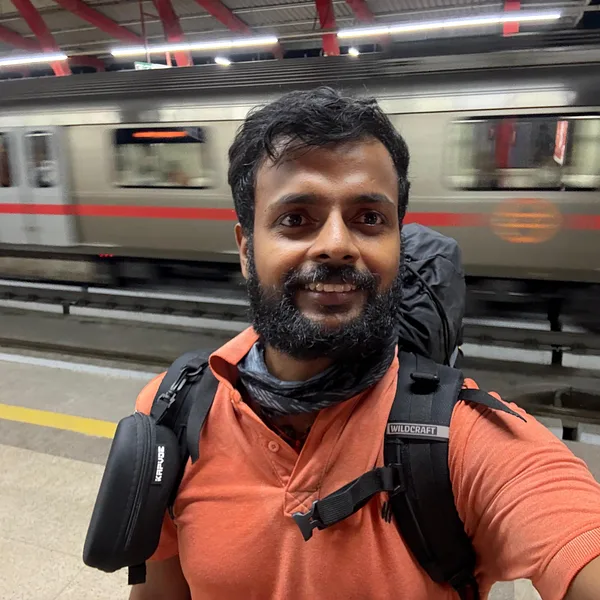
I stood at Old Delhi Railway Station with nothing but a backpack full of essentials and a dream that felt much heavier—to cycle the entire coastline of India.
As the train to Bhuj waited on the platform, I had no idea what the coming months would bring. There were no guarantees, no sponsors, and no certainty of success. Just a burning desire to explore my country, push my limits, and discover what lay beyond the horizon.
That train wasn't just taking me to Bhuj—it was taking me to the starting point of a journey that would change my life forever

15th December 2025
After reaching Bhuj, I checked into my hotel and took some time to relax after the long train journey. Once I had assembled my bicycle and organized my luggage, I headed out to explore the city.
The first thing I did was treat myself to two of Gujarat's most famous snacks—thepla and dabeli. It was the perfect welcome to Kutch, and every bite reflected the local flavors and hospitality.
With my hunger satisfied, I visited the magnificent Prag Mahal and the beautiful Aina Mahal. Walking through these historic landmarks gave me a glimpse into the rich heritage of Bhuj. Their architecture and history made for a memorable first day before my cycling expedition officially began.
As the sun set, I returned to my hotel feeling excited. The preparations were complete, and the next morning would mark the real beginning of my dream—to cycle the entire coastline of India.


16th December 2025
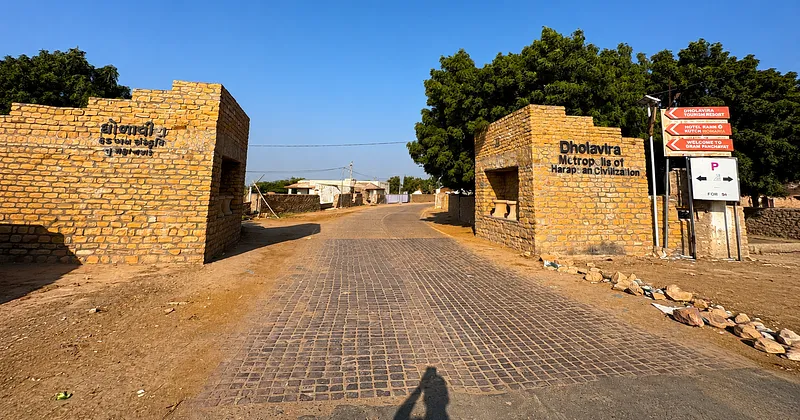
The day had finally arrived. After months of planning and preparation, I began my coastal cycling expedition from Bhuj. But before following India's coastline, I wanted to visit one of the world's oldest civilizations—the ancient Harappan city of Dholavira.
The ride was far from easy. It was my first time cycling in Gujarat, and the scorching sun of the Kutch region was far harsher than I had imagined. The heat drained my energy, but I kept reminding myself that every long journey begins with a difficult first day.
Slowly, kilometre by kilometre, I pedalled through the vast and barren landscapes of Kutch. After covering around 128 kilometres, I finally reached Dholavira. Exhausted but happy, I checked in for the night, knowing that I had completed the first day of a journey that would take me around the entire coastline of India.


17th December 2025
I woke up early in Dholavira and spent some time with a young local artisan named Haresh Bhaiya. He told me about his work, creating beautiful leather goods and handmade traditional textiles. It was inspiring to meet someone from the younger generation who was keeping the local craftsmanship alive. Our conversation gave me a deeper appreciation for the culture and heritage of Kutch.
Later, I visited the ancient city of Dholavira, one of the best-preserved sites of the Harappan Civilization. As I walked through the ruins, I tried to imagine what life must have been like over 4,000 years ago. I wondered how people lived, how they planned such a well-organized city, managed water so efficiently, and built a civilization that was far ahead of its time.
Standing among those ancient remains, I felt connected to a history that had survived for thousands of years. It was an unforgettable experience and a reminder that my journey was not just about cycling—it was also about discovering the stories, people, and civilizations that make India so extraordinary.


To be continued……
.png)
%20(19).png)