Vasanta Pañcamī signals the arrival of spring, ushering in the preparations for the festival of Holī, when Spring is in its full form.
The puranic lore and seasonal symbolism of the festival together narrate this civilizational movement from ascetic stillness to aesthetic fullness.
Legends Associated with Vasanta Pañcamī
- Kāmadeva was sent by the Devatās to disturb Lord Śiva’s penance after Satī’s demise to awaken love within him for Pārvatī, because only their son could destroy Tārakāsura.
- Sarasvatī appeared (or was manifested) on this day from Brahmā’s mind.
Scriptural References
Through the destruction and restoration of Kāma, the scriptures trace the necessary tension between ascetic withdrawal and creative engagement.
Sarasvatī embodies śabda, order, articulation, and knowledge, while Kāma represents impulse, movement, and desire.
Vasanta harmonizes these forces, ensuring that knowledge does not remain sterile and desire does not become chaotic.
These narratives provide the theological foundation for understanding Vasanta Pañcamī as a moment when disciplined stillness (tapas) begins its gradual transformation into expressive vitality (rasa), both cosmically and ritually.
Śiva Purāṇa – Adhyāya 51: Kāmasya Punaruṭṭhānam
Following the self-immolation of Satī, Śiva withdraws into intense meditation, embodying the absolute culmination of tapas. Recognizing that cosmic balance cannot be sustained (as Tārakāsura could only slain by Śiva's son), Brahmā commissions Kāma to awaken in Śiva a desire for marriage with Pārvatī.
To assist this task, Vasanta who is the deity/season of fertility and renewal—is created as Kāma’s constant companion, ensuring that love arises not as a disruption but as a natural response to a world prepared for regeneration.
Śiva Purāṇa – Adhyāya 8: Vasantasya Rūpavarṇanam
It is stated that after disturbing Śiva’s meditation, Kāma is reduced to ashes by Śiva’s anger through his third eye. However, at that very moment, a spark of desire did take birth (through Kāma's attempts) in Śiva, and thus, the union of Śiva and Pārvatī takes place.
Now, due to Kāma’s destruction, the world became devoid of love and passion, and Vasanta no longer manifested its charm as the 'King of seasons'. The Devatās also mourn the loss.
A grieving Rati approaches Śiva, carrying the ashes of her husband, stating that her husband was only performing his duty as ordained by Brahma deva. Through Rati’s prolonged tapas, Śiva then realizes the cause of all of this, and resuscitates Kāma from the ashes, much to the joy of Rati, Vasanta and all beings.
Celebrations ensue, and Śiva instructs Kāma to remain eternally close to Viṣṇu.
Śiva’s injunction that Kāma abide near Viṣṇu signifies the Purāṇic conviction that desire, once purified by tapas, must thereafter operate under the aegis of dharma and preservation, transforming from a disruptive impulse into a sustaining cosmic principle.
These events may be symbolically traced from Vasanta Pañcamī, through Mahāśivarātri, culminating in Holī.
This episode affirms that rasa must emerge organically from tapas, not in opposition to it, and rasa should always be in the service of Viṣṇu, the one who balances.
Skanda Purāṇa – Ayodhyā Māhātmya (Khaṇḍa 8, Adhyāya 8)
The Skanda Purāṇa states that one should bathe in the sacred tīrthāni, the Rati-kuṇḍa and Kandarpa-kuṇḍa on Māghaśuklapakṣa Pañcamī (Vasanta Pañcamī) to please the divine couple and receive blessings for unending dāmpatya-sukha.
Couples who bathe in both kuṇḍas are said to become renowned like Rati and Kāma and remain perpetually handsome and charming.
Thus, those who desire Dharma should observe the holy bath in accordance with śāstric injunctions and offer dāna according to their capacity for the propitiation of Rati and Kāma.
This episode establishes that Vasanta Pañcamī is a ritual calendar, in which Kāma’s destruction and restoration are ritually remembered between Vasanta Pañcamī and Holī.
Sarasvatī Pūjā on Vasanta Pañcamī
The convergence of Sarasvatī Pūjā and Kāma-related worship on Vasanta Pañcamī is neither incidental nor contradictory.
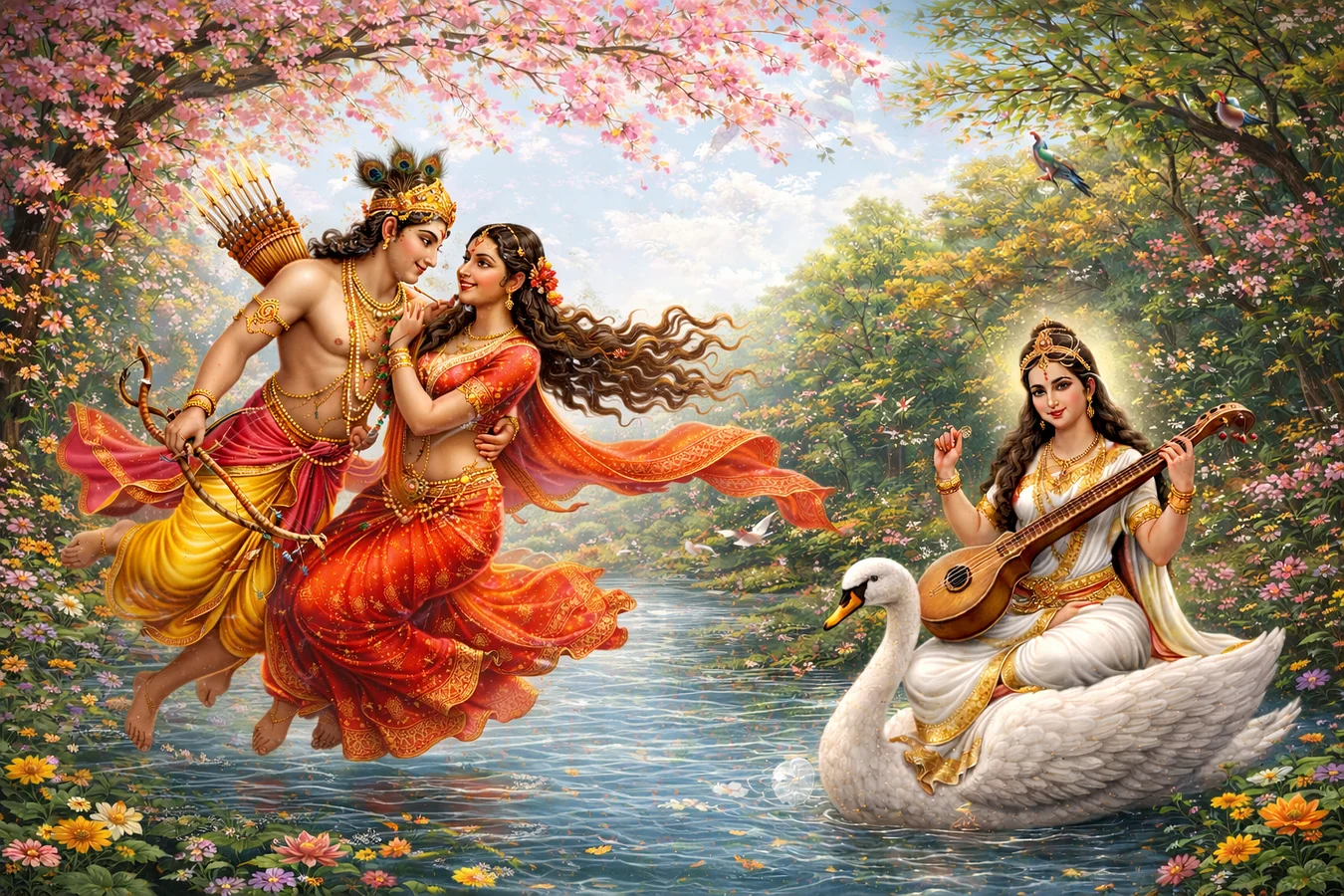
Sarasvatī is the creative and sustaining force behind Brahmā’s creation, Vasanta is the season of procreation, and the presiding lord of the Vasanta season is Kāma, inciting desire and passion in all beings.
Together, Sarasvatī and Kāma represent the twin conditions of meaningful creation, viz. structure and vitality, both of which are ritually activated on this day.
Current Observances
The regional observances of Vasanta Pañcamī across the subcontinent reveal how a shared symbolic core is articulated through diverse cultural idioms. While the theological framework remains consistent, celebrating knowledge, fertility, and renewal with each region emphasizes a particular dimension of the festival, whether aesthetic play, educational initiation, communal celebration, or seasonal joy.
In some regions, Vasanta Pañcamī is also known as Madana Pañcamī, Madana being another name for Kāma.
In Kaccha (Gujarat), people dress in saffron, pink, or yellow. Bouquets and garlands adorned with mango leaves are prepared and exchanged. Songs celebrating Kṛṣṇa’s playful līlās with Rādhā are sung, symbolizing the romantic union of Kāma and Rati.
In Madhya Pradesh, Maharashtra, Uttar Pradesh, and Chhattisgarh, devotees take a ritual bath at dawn and worship Śiva and Pārvatī, offering mango blossoms and ears of wheat.
Rituals
On this day, Goddess Sarasvatī is worshipped during Pūrvāhna-kāla, the period before midday. The deity is adorned with white garments and flowers, as white is considered her preferred colour. Sweets prepared from milk and white sesame are offered and distributed as prasāda.
In North India, yellow flowers are offered due to the abundance of blooming mustard fields and marigolds (gaṇḍā-puṣpa).
Vasanta Pañcamī is especially significant for Vidyārambha, the initiation of young children into formal education. Many schools and colleges organize Sarasvatī Pūjā on this day.
Vasanta Pañcamī – Regional Variations
Brajamaṇḍala
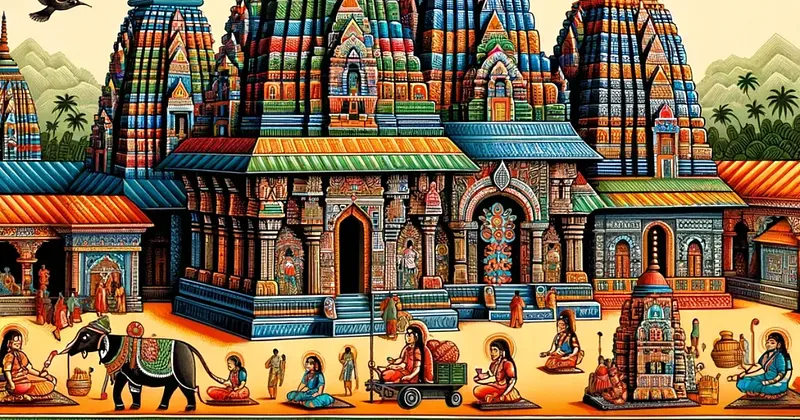
In Mathura and Vrindavan, Vasanta Pañcamī marks the commencement of Holī celebrations. Temples are decorated with yellow flowers, and deities are adorned in yellow vastra.
At the Saha Bihari Mandira, the Vasanta-kakṣa is opened for devotees. At the Śrī Bake Bihari Mandira, priests begin Holī festivities by tossing abīra and gulāla. Preparations for Holikā-dahana also begin with the installation of the Holī-daṇḍa.
West Bengal
In West Bengal, Vasanta Pañcamī is celebrated as Sarasvatī Pūjā, primarily by students. Girls wear a yellow Basanta-sāṛī, while boys wear dhoti–kurta.
Books, musical instruments, brushes, canvases, inkpots, and bamboo quills are placed before the deity and worshipped. Añjali is offered in the morning, and offerings include bilva-patra, marigold, palāśa, guldāudī, and candana.
Naivedya includes kola (jujube), apples, dates, and bananas. Many refrain from eating kola until it is offered to the Goddess on Māgha Pañcamī. Special dishes such as Topā-kola-cūrṇa, khicṛī, and labṛā are prepared.
The ceremony of Hāte-khaṛī (Vidyārambha) is also performed. The idol is immersed either on the same day or on the third day with a grand procession.
Punjab and Haryana
Here, the festival is known as Basanta Pañcamī and is largely secular, celebrating the joy of spring.
Kite flying (pataṅgotsava) is the hallmark of the day. The sky fills with colourful kites, and kite makers experience peak demand.
Schoolgirls wear traditional attire and perform Gidda, a folk dance, while dressed in yellow Basanta-varṇa garments.
Maharashtra
Newly married couples visit Śiva–Pārvatī mandiras and offer mango blossoms to seek blessings for marital harmony.
Conclusion
By situating Sarasvatī, Kāma, and Vasanta within a single ritual frame, the tradition affirms that true knowledge flowers only when it culminates in joy and creativity. The festival thus serves as a cultural pedagogy, guiding consciousness from avidyā to vidyā, and from solitary tapas to shared rasa, culminating in the collective ecstasy of Holī.
References:
Chapter 51 - The resuscitation of Kāma
Chapter 8 - The description of the form and features of Vasanta
Chapter 8 - Ratikuṇḍa and other Holy Tīrthas
Vasant Panchami Poojan - aapkapandit.com
Vasant Panchami Saraswati Puja
Shodashopachara Saraswati Puja Vidhi
The author can be reached on X/Twitter - https://x.com/TanyaBrahmvadni