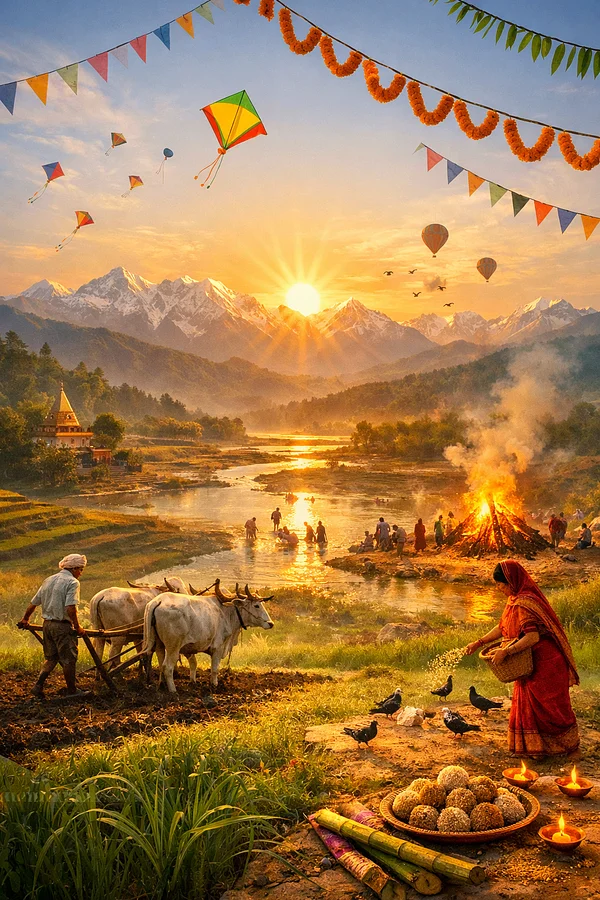
Uttarāyaṇa (Winter Solstice) and Makara Saṅkrānti
We see, in many of our ancient texts, Uttarāyaṇa and Makara Saṅkrānti are used interchangeably.
This is so because at one point, Uttarāyaṇa (Winter Solstice) and Makara Saṅkrānti coincided in the distant past. According to scholarly studies, both last coincided on the same day approximately around 1,700 years ago.
In fact, the centre-stage that Makara Saṅkrānti as a community festival occupies in comparison to all the other Saṅkrāntis in the entire year is because it used to be the very starting point of the Sun's movement upwards/northwards symbolizing strength, auspiciousness, renewal, prosperity, and hope.
But today, the Sun is at its southernmost point on December 21, which is known as the Winter Solstice (Uttarāyaṇa), marked by the shortest day and the longest night of the year. After this, the Sun begins its northward journey (Uttarāyaṇa), which lasts for six months until June 21 (Summer Solstice), and then it begins its journey southwards (Dakṣiṇāyana).
This gradual separation of the Uttarāyaṇa (Winter Solstice) and Makara Saṅkrānti is explained by the astronomical phenomenon known as the precession of the equinoxes, which causes the fixed zodiac (sidereal) to drift approximately one degree every 72 years relative to the tropical calendar.
So, at present, the celebrations of Makara Saṅkrānti are limited to the auspicious movement of the Sun's movement into the first zodiac, Capricorn, signifying new beginnings.
The reverence to Uttarāyaṇa during the celebrations is purely symbolic as that phenomenon has now moved into the Dhanu Rāśi due to the precession of the equinoxes over time.
Scriptural Basis
Bhārata has always been a land of agriculture. Agriculture depends on favorable seasons, which in turn are contingent on the grace of the Sun. Therefore, immense reverence is given to the Sun God (Sūrya Deva).
The Mahābhārata (Vana Parva) describes the Sun as the ultimate source of food and life, drawing water, enabling rainfall, and sustaining vegetation—thus portraying Sūrya as the “father of all creatures.”
Ṛṣi Dhaumya says to King Yudhiṣṭhira:
In days of old, all living beings that had been created were sorely afflicted with hunger. And like a father unto all of them, Savitṛ (the Sun) took compassion upon them. Going first into the northern declension, the Sun drew up water by his rays, and returning to the southern declension, stayed over the earth with his heat centered in himself. While the Sun stayed over the earth, the lord of the vegetable world (the Moon), converting the effects of solar heat into clouds and pouring them down as rain, caused plants to spring up. Thus, it is the Sun himself who, drenched by lunar influence, is transformed into holy vegetables endowed with the six tastes. These constitute the food of all creatures upon the earth. Therefore, food that sustains life is imbued with solar energy, and the Sun is the father of all creatures. O Yudhiṣṭhira, take refuge in him…
Ṛṣi Dhaumya instructs Yudhiṣṭhira to perform austerities for the Sun God by standing in the Gaṅgā River and reciting the 108 names of Sūrya along with hymns of praise, seeking blessings, prosperity, and sustenance. Pleased, the Sun God grants Yudhiṣṭhira and Draupadī a copper vessel that provides an inexhaustible supply of fruits, roots, and vegetables.
The 116th chapter of the Uttaraparva of the Bhaviṣya Purāṇa records a detailed dialogue between Yudhiṣṭhira and Lord Kṛṣṇa on the profound significance of Saṅkrānti and its associated rituals, believed to cure illnesses, cleanse sins, and bestow prosperity in both worldly and spiritual realms. Lord Kṛṣṇa advises that these rituals be performed on all twelve Saṅkrāntis in a year.
Lord Kṛṣṇa further explains that Saṅkrānti rituals may be observed during Uttarāyaṇa (the Sun’s northward journey), Dakṣiṇāyaṇa, and Viṣuva (equinoxes), emphasizing their year-long spiritual importance.
The same ritual descriptions are repeated in the Matsya Purāṇa. Our texts also mention that one is extremely fortunate to pass away from this mortal world during Uttarāyaṇa as it is sure to lead to the upper realms/svarga by the devatās themselves.
Sūrya deva has been revered immensely in the Vedas, Upaniṣad, Purāṇas, and all texts. He is the father of important figures like Yama, Manu, and Śani, among others.
The Gāyatri mantra is attributed to Sūrya deva.
In the Ramayana, on the battlefield, Sage Agastya teaches Lord Rama to chant the Ādityahṛdayam before he takes on Ravana.
There are numerous temples dedicated to Sūrya deva. Even in other cultures, we note the significance granted to the Sun as a deity and His movement northwards is celebrated and revered immensely as a 'rebirth'.
Saṅkrānti Rules (Cancer & Capricorn – Makara Implied)
Devala, as quoted in the Parāśara Mādhavīya, states that only on the Cancer and Capricorn Saṁkrāntis during eclipses, marriages, Saṁkrāntis, and childbirth are certain rituals permitted.
The Parāśara Mādhavīya further adds that only on the Cancer and Capricorn Saṁkrāntis are gifts allowed to be made at night.
Special gifts are prescribed on Makara Saṅkrānti. One who donates tila-dhenu on Uttarāyaṇa (i.e., Makara Saṅkrānti) attains all desired objects and the highest happiness.
Rituals
On Makara Saṅkrānti, ritual bathing at sunrise and offering salutations to the Sun God are customary. Sesame seeds (tila) are mixed into the bathing water or river as a purificatory rite. After bathing, devotees offer arghya (water libation) to the Sun while reciting the Gāyatrī Mantra.
Acts of charity follow, including the distribution of sweets made of sesame and jaggery, lentils, rice, and other first-harvest (kharif) crops. Bathing in the Gaṅgā at Prayāgraj during the Māgha Melā or at Gaṅgāsāgara, where the Gaṅgā meets the Bay of Bengal is believed to remove suffering, as mentioned in the Vana Parva of the Mahābhārata.
Traditional foods such as khicṛī, sesame-jaggery sweets, and kite flying are integral to celebrating the first harvest and seasonal transition.
Importance of Sesame (Tila) and Offering of Arghya
In the Garuḍa Purāṇa, Lord Viṣṇu says to Garuḍa:
O Garuḍa! Sesame is sacred, born from my perspiration. Sesame destroys evil spirits. Whether white, black, or tawny, sesame burns away all sins.
Regional Celebrations
- Tamil Nadu & Puducherry: Pongal is a four-day festival dedicated to Sūrya Deva, celebrating rain, fertile land, and harvest.
- Telangana & Andhra Pradesh: A four-day Saṅkrānti celebration featuring rice-powder rangolī, Gobbemmarituals, and communal dances.
- Karnataka: Ellu Biroḍu exchanges, Pañcāyatana Pūjā, kite flying, and Kiccu Hāyisuvudu.
- Gujarat: Uttarāyaṇa with kite flying, fasting, and foods like undhiyū, khicḍo, and sesame sweets.
- Uttar Pradesh: Known as the Khicṛī festival with ritual bathing and charity.
- Punjab: Lohṛī with bonfires and offerings to Agni Deva.
- Haryana & Delhi: Saṅkrānt with Yamunā baths and sesame sweets.
- West Bengal: Pauṣa Saṅkrānti with pīṭhā, khejurer gur, and Lakṣmī worship; Māgey Saṅkrānti in Darjeeling.
- Assam: Māgha Bihū or Bhogālī Bihū celebrating harvest and communal feasting.
- Rajasthan: Sun worship, river baths, and ritual gifting.
- Uttarakhand: Uttarāyaṇī, Ghughutiyā, and Khicṛī Saṅkrānti with offerings to birds.
- Goa: Newly married women offer sughaṭas to deities.
- Jammu: Māghī Saṅgrānd with Devikā River baths.
- Maharashtra: Extended celebrations culminating in Ratha Saptamī; foods include bājrā roṭī and seasonal vegetables.
- Odisha: Makara Saṅkrānti with makara cāuḷa offerings and Sun worship at Koṇārka.
- Kerala: Makara Saṅkrānti at Sabarimalā marked by the Makaravilakku.
Conclusion
Makara Saṅkrānti celebrates the Sun as the giver of life, abundance, and cosmic order. Rooted in agriculture, astronomy, and sacred tradition, the festival marks renewal of seasons, sustenance, and spiritual aspiration, uniting communities across Bhārata in gratitude and hope.
References:
-
Bhishma Parva of Mahabharat Verse 94 - 100, https://archive.org/details/rIdP_mahabharat-bhishma-parva-by-damodar-satvalekar-svadhyay-mandal/page/n805/mode/2up?view=theater
-
Ch- 98 of Matsya puran, https://archive.org/details/matsya-puran-gita-press-gorakhpur/page/n347/mode/2up?view=theater
-
Makara Samkrānti and Uttarāyana, https://www.indica.today/long-reads/makara-samkranti-uttarayana/
-
Saura Samhita (Skanda Puran), https://archive.org/details/SaurSamhitaAlm18Shelf43912DevanagariSkandaPurana/mode/2up
-
Pg 12, Vana Parva of the Mahabharata (Section II), https://archive.org/details/in.ernet.dli.2015.46692/page/n35/mode/2up?view=theater&q=dhaumya
-
Chapter 116, Uttarparva of the Bhavishya Purana https://archive.org/details/BhavishyaPuranPart1/Bhavishya%20Puran%20Part%203%20%20/page/n443/mode/1up
-
Ch- 98 of Matsya puran, https://archive.org/details/matsya-puran-gita-press-gorakhpur/page/n347/mode/2up?view=theater
-
Vana parva of Mahabharata, Sec-85, Pg 281, https://archive.org/details/in.ernet.dli.2015.46692/page/n289/mode/2up?view=theater&q=ganga
-
Vana parva of Mahabharata, Sec-114, Pg 352, https://archive.org/details/in.ernet.dli.2015.46692/page/n373/mode/2up?view=theater&q=ganga
-
Garuda puran, Ch 2, Verse 16-25, https://archive.org/details/GarudaPuranaEnglishMotilal3VolumesIn1/page/n733/mode/2up?view=theater&q=sesame
Ayurvedic benefits of Sesame: https://cas.indica.in/the-benefits-of-sesame-seeds/#:~:text=Sesame%20seeds%20are%20also%20beneficial,dal%2C%20vegetables%2C%20or%20rice. -
Vishnu Puran, Book 2, Ch-8, verses 44-54, https://archive.org/details/vishnu-purana-sanskrit-english-ocr/page/188/mode/2up?view=theater&q=sandhya
-
https://templesinindiainfo.com/about-bogi-festival-bhogi-festival-bhogi-celebrations/
-
Pongal: Festival Of India By Priyanka Verma, https://books.google.co.in/books?id=_R8WBQAAQBAJ&pg=PAPP4&redir_esc=y#v=onepage&q&f=false
-
https://vedicwaves.wordpress.com/2019/01/29/indian-festivals-based-on-the-concept-of-yajna-part-ii/
-
Skanda Purana, Ch 42, https://archive.org/details/dli.bengal.10689.20756/page/n247/mode/2up
-
P. V. Kane, History of Dharmaśāstra, Vol. II, Part II (1941), p. 853.
-
P. V. Kane, History of Dharmaśāstra, Vol. V, Part I (1958), p. 219.
- https://jyotishtek.com/blog/makar-sankranti-is-not-uttarayan/
The author can be reached on X/Twitter - https://x.com/TanyaBrahmvadni