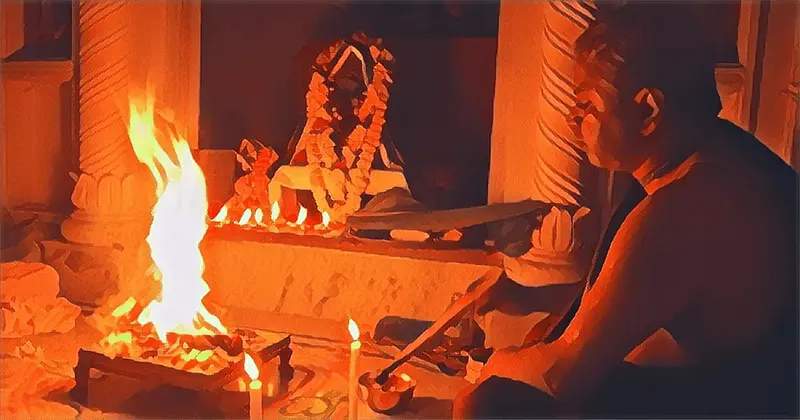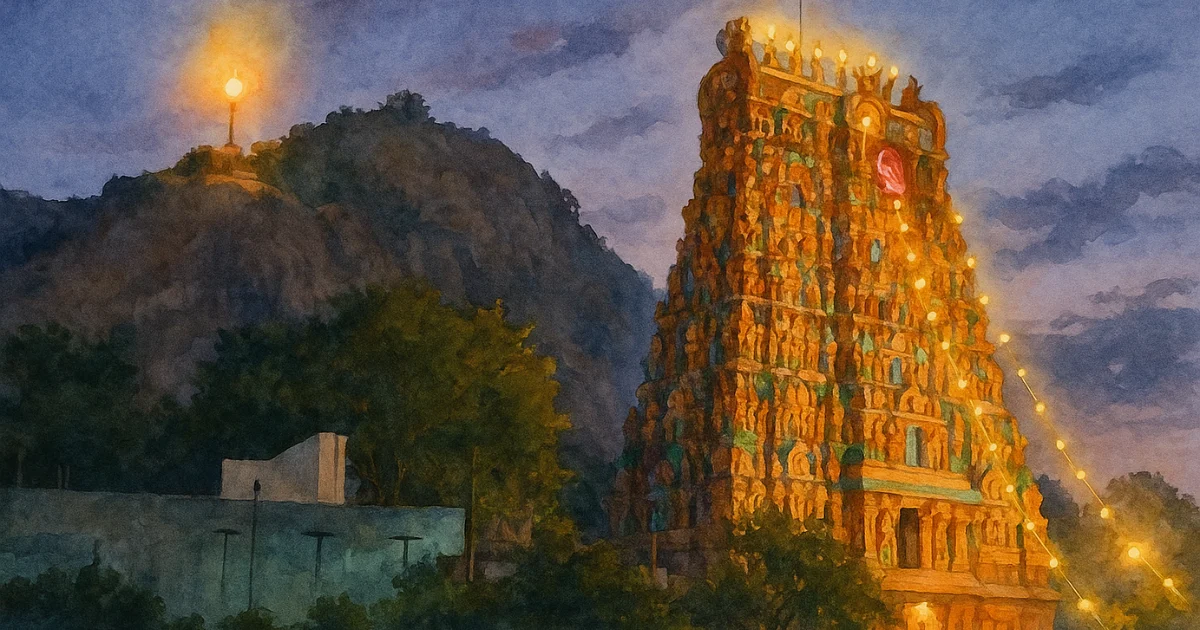
The Thirupparankundram issue has become an exemplar of the manner in which temples managed by the State under the Hindu Religious and Charitable Endowments (HRCE) framework can drift into systemic prejudice against the very community they are mandated to serve. What should have been a straightforward matter of temple autonomy in the aid of local religious practice has instead revealed deeper structural failures: the HRCE’s institutionalized hostility toward Hindu tradition, the chronic mismanagement of temple resources and activities, and the persistent prejudice against Hindu devotees and a flagrant disregard for Hindu ritual traditions and the sanctity of this ancient site.
The issue points to a larger systemic rot, and certainly does not occur in a vacuum. It is indicative of the broader anti-Hindu political establishment in Tamil Nadu, where the ruling DMK’s long-documented hatred of Hindu religious identity continues to shape administrative actions, at the blatant expense of constitutional neutrality. The recent decision by MPs from DMK and across India to file a motion for the impeachment of a sitting judge, ostensibly for his legal pronouncement, further underscores a troubling level of anti-constitutionalism. It signals not only a disregard for democratic functioning and judicial independence but also a willingness to deploy institutional power to bend the law to their will or exert pressure. Taken together, these elements situate the Thirupparankundram issue as much more than a simple localized conflict or topical Hindu-Muslim tension; it is a case study in how ideological governance can undermine the rights of ordinary citizens, how the abuse of power by the religious administration and the state government acting in concordance can undermine public trust and erode the principles that should ideally anchor a pluralistic democracy.
The Thirupparankundram HillThe Thirupparankundram Hill occupies a central place in Tamil sacred geography and has been continuously revered as a Murugan kṣetra from deep antiquity. Its sanctity is attested by some of the earliest extant Tamil literary sources, particularly Sangam literature, which firmly situates the hill within an uninterrupted continuum of Hindu worship extending over two millennia.
The Akanaṉūṟu, one of the oldest anthologies of classical Tamil poetry, provides early and unambiguous references to Thirupparankundram as the abode of Lord Murugan. Akanaṉūṟu 59, attributed to Madurai Marutaṉ iḷanākaṉār, describes Murugan as the divine warrior who vanquished Sūrapadman and took residence upon this cool, cave-filled hill. Akanaṉūṟu 149 further reinforces this identification by explicitly referring to a Murugan temple at Thirupparankundram. The poem recounts how the Pāṇḍya king Ceḻiyaṉ, after his victory over the Cēras, returned to Madurai while the peacock flag of the Murugan temple at Thirupparankundram flew high. The Paripāṭal, another Sangam-era text, contains eight hymns dedicated to Murugan, several of which exalt Thirupparankundram as a site of exceptional sanctity, equating it with the Himalayas in spiritual stature. Nakkīraṉãr’s Tirumurugāṟṟuppaṭai, traditionally associated with Thirupparankundram, elevates the hill as the foremost among Murugan shrines and establishes that the Thirupparankundram Hill itself is revered as a Śiva Liṅga, giving rise to the practice of giri prākāra—the circumambulation of the entire hill by devotees. Any contemporary intervention that disregards this depth of historical, cultural, and religious continuity at the hill, therefore, is not merely an administrative misstep, but a profound and deliberate disrespect of some of the Tamil land’s oldest sacred traditions.
History of the SiteDespite the hill and temple possessing an antiquity exceeding two thousand years, Thirupparankundram has remained entangled in legal disputes for over a century, largely due to competing claims over land, usage, and ownership. During Muslim rule in Madurai, the summit of Thirupparankundram Hill came to be occupied, and a dargah for a Muslim fakir named Sikandar was constructed on the hilltop. This intervention did not displace the pre-existing Hindu sacred geography of the hill, nor did it extinguish the continuous worship of Murugan and Śiva that had defined the site for centuries prior. Early colonial records provide critical clarity on this matter. The Olugu accounts of 1802 explicitly record that the British Government recognized Thirupparankundram Hill as the property of the presiding deity. In 1879, when the British administration attempted to initiate quarrying operations on the hill, strong opposition from the temple authorities and the local Hindu community led to the abandonment of the quarrying effort.
The dispute took a more complex turn in the early twentieth century. In 1915, the dargah authorities began occupying the Nellithoppu area by erecting new structures. Moreover, Muslims had extended their usage to Nellithoppu, which had come to function as a burial ground. The judge personally inspected the site and observed multiple tombs. He explicitly noted that the burial of the dead within the sacred precincts of a Hindu temple is fundamentally incompatible with Hindu religious sensibilities. This prompted prolonged litigation, culminating in a civil suit filed in 1920 (O.S. No. 4 of 1920). The Tirupparankundram Devasthanam, as plaintiff, asserted that the entire hill constituted endowed temple property and that no construction—religious or otherwise—was permissible without its consent. The dargah representatives countered by claiming that the hill comprised two distinct portions, asserting ownership over the upper segment, which they referred to as Sikandar Malai, and extending this claim to include Nellithoppu. The Government, for its part, entered the proceedings contending that the hill was state property. After extensive examination of historical records, religious usage, and administrative precedent, the Madurai Court delivered a detailed judgment on 25 August 1923. The court decreed that the plaintiff Devasthanam was the owner and possessor of the entirety of Thirupparankundram Hill and the Giri Veedhi, except for: the Nellithoppu area, the flight of steps leading from Nellithoppu to the mosque, and the rock summit upon which the mosque and its flagstaff stood, for which the Muslim community's title was upheld. Crucially, the judgment drew upon a 1909 Government Order affirming that the entire hill was worshipped by Hindus as a Śiva Liṅga, and that the Murugan temple was not an independent superstructure but carved directly into the living rock—indeed, the rock itself forming the back of the deity’s image. The court also cited an 1863 British notification referring to the “Tirupparankundram Subramanya Swami temple and its four sides, including the Malai Prakaram,” reinforcing the integrated sacred character of the hill.
The learned judge observed that Hindu reverence for the hill predated Islam by centuries, noting that its sanctity is recorded in Hindu literary sources older than the advent of the Prophet in Arabia. The court found no evidence that the hill itself had ever been seized during the Muslim conquest, nor that the British Government had dispossessed the Devasthanam at any point. On the contrary, successive regimes had allowed uninterrupted temple possession, even explicitly excluding Thirupparankundram Hill from notification under the Madras Forest Act. When quarrying was again proposed under colonial rule, sustained Hindu opposition ensured its termination.
The judgment also carefully documented the physical geography of the hill. Thirupparankundram contains two prominent peaks: the Murugan shrine is located at the base of the lower peak, while the mosque—known as Sikandar Pallivasal—stands atop the higher peak, separated by a valley that, while deep, remains elevated above the hill’s base. The court opined that the placement of the mosque at a higher elevation than the Hindu shrine may have been motivated by religious fervour, rivalry, or assertion. It further noted that what may have originated as a small memorial structure was later expanded to occupy the entirety of the upper hillock.
The dargah authorities appealed the Madurai court’s ruling to the Madras High Court in 1923. Although initially hesitant, the Government was impleaded as a party, and the High Court ruled that the hill vested with the state. The Devasthanam then appealed to the Privy Council. In 1931, the Privy Council overturned the High Court’s ruling and substantially upheld the Madurai judgment, affirming that ownership of the entire hill vested with the Tirupparankundram temple, subject only to the three specific exceptions already identified. Notably, the Privy Council described the presence of the dargah as an “infliction which the Hindus might well have been forced to put up with,” a striking acknowledgement of the asymmetry imposed upon the original custodians of the site.
This legal position remained largely stable until the mid-twentieth century. By this time, the Tirupparankundram Devasthanam had come under the administrative control of the Madurai Meenakshi Temple. In 1958, renewed attempts by the dargah authorities to quarry rocks near Nellithoppu for further construction prompted fresh litigation (O.S. No. 111 of 1958). While the dargah claimed quarrying rights on the basis of proximity to Nellithoppu, the temple authorities challenged this assertion. The court ordered a detailed survey to demarcate boundaries and, based on its findings, restrained the dargah from cutting stones anywhere beyond the flat expanse of Nellithoppu.
Taken together, these judicial proceedings conclusively establish that Thirupparankundram Hill has, across centuries and regimes, been recognized as an essentially Hindu sacred space, with limited and explicitly circumscribed exceptions—exceptions that contemporary administrative actions repeatedly seek to expand, often in defiance of settled law and historical record.
Legal History of the Present IssueLocal tradition holds that the Karthigai Deepam was historically lit at the summit of Thirupparankundram Hill. Over time, however, the practice was shifted to a Deepam Mandapam near the Uchipillayar temple, located on a smaller hillock behind the Murugan shrine. This structure, according to residents, was originally intended for lighting the Mokṣa Deepam rather than the Karthigai Deepam, marking a significant deviation from established ritual practice.
In the early 1990s, the Thirupparankundram issue resurfaced amid renewed public agitation led by the Hindu Munnani organization, with its state president, Thiru Rajagopalan, playing a prominent role. His brutal assassination in October 1994 marked a turning point in the movement. In the aftermath, Hindu Munnani requested the temple Devasthanam to resume lighting the Deepam atop the hill so that households in the surrounding areas could continue the traditional observance. This action was legally challenged by V. Thiagarajan, who had broken away from Hindu Munnani to form the Hindu Bakthajana Sabhai, through Writ Petition No. 18884 of 1994, seeking to restrain the temple authorities from lighting the lamp. Through this, the Hindu Religious and Charitable Endowments (HR&CE) maintained that the lamp would continue to be lit only at what it termed the “traditional place.” Pending adjudication, the Deepam was temporarily shifted to the top of the Deepam Mandapam, where a copper vessel was used to light the lamp.
In 1996, as the festival approached, the High Court permitted the Devasthanam to light the Karthigai Deepam at the Uchipillayar temple for that year alone, while granting the Devasthanam discretion to choose an alternative suitable location in subsequent years as long as a minimum distance of fifteen metres was maintained from the dargah. Despite this latitude permitting the Devasthanam to light the Deepam anywhere on Thirupparankundram Hill in future years, no initiative was taken by the temple administration (HR&CE), which stubbornly continued the practice of lighting the lamp exclusively at the Uchipillayar temple. To the consternation of devotees, the Hindu Religious and Charitable Endowments (HR&CE) neither honored temple tradition nor the expressed wishes of devotees. Instead, in the name of a distorted and selective notion of “secularism,” it consistently shirked from its statutory duty, privileging Muslim appeasement over Hindu religious practice. This decision underscores how the administrative authorities, in cahoots with the DMK, have deliberately suppressed Hindu religious expression even where no legal or communal objection exists.
At a peace committee meeting held in December 2005 in the office of the Revenue Divisional Officer, a resolution was adopted in which the dargah management formally recorded its no objection to the lighting of the lamp at the Deepathoon, formally agreeing that the Deepam could be lit at any location situated beyond fifteen metres from the dargah. The dargah authorities signed the minutes of this meeting, thereby placing their consent on record. While this resolution may not be legally enforceable in itself, it clearly demonstrates that opposition to the lighting of the Deepam at the Deepathoon does not arise from any genuine inter-religious dispute, but rather from the intervention of vested interests. Notably, even an earlier judicial order dated 21 November 1996 refers to a similar understanding reached on 4 November 1994, reinforcing the consistency of such consent over time.
The matter resurfaced once again in 2014 through a writ petition seeking restoration of the Deepam at the hilltop. The petitioner argued that the existing location was meant only for the Mokṣa Deepam and that the continued deviation hurt Hindu religious sentiment. It was also pointed out that the 2005 peace agreement had never been implemented. The HR&CE Department opposed the petition, and the court dismissed it. An appeal met the same fate, primarily on the ground that the proposed location lay too close to the dargah.
In 2024, the hill once again became the subject of litigation: when a Muslim family attempted to bring goats and roosters to the hilltop dargah for ritual sacrifice, Hindu devotees, who regard the whole hill sacred, raised vehement objections. The matter was heard by a Division Bench of the Madras High Court, which delivered a split verdict—one judge ordering a ban on animal slaughter on the hill, and the other dismissing the petition. The issue was consequently referred to a third judge, who upheld the ban and affirmed that animal slaughter on Thirupparankundram Hill was prohibited.
In January 2025, tensions at Thirupparankundram intensified following allegations that DMK Manapparai MLA Abdul Samad conducted an unauthorized survey around the temple with the intent of asserting control over the hill. On the same day, Indian Union Muslim League MP from Ramanathapuram, Navas Kani, not only ate biryani on the hill to deliberately offend Hindu sentiments, but also stated in a media interview near the site that the hilltop dargah was under the Tamil Nadu Waqf Board. These developments further heightened local concerns by reopening questions of jurisdiction despite long-settled judicial rulings.
The most decisive development has been the recent one, wherein Thiru Rama Ravikumar and others filed a petition before the Madurai Bench of the Madras High Court seeking a direction to the temple authorities to light the Karthigai Deepam at the Deepathoon (stone lamp pillar). The HR&CE opposed the plea despite its avowed function to carry out temple rituals and protect temple property from encroachment. After examining the submissions and personally inspecting the site, the learned judge ruled in favor of the petitioners and directed that the lamp be lit at the Deepathoon. In his detailed judgment, the court made several critical observations. First, it recognized the petitioners as bona fide worshippers of Lord Murugan with a legitimate interest in the matter. Second, it rejected the contention that the petitioners should pursue a civil suit, noting that property rights over the hill had been conclusively settled as early as 1923. Third, the court distinguished the present case from the 2014 litigation: whereas the earlier petition sought permission to light the lamp at the hilltop, the 2025 petition concerned the Deepathoon, located on a lower peak, which belongs exclusively to the temple.
The court further underscored that lighting lamps atop hills is an ancient Tamil tradition, citing the Tamil epic Cīvaka Cintāmaṇi, which refers to “Kundril Karthigai Vilakkittanna.” Protection of temple property, the judge observed, is not merely a religious concern but a legal obligation. Drawing an analogy with the Madras High Court’s annual closure of its gates to prevent easement claims, the court held that temple authorities must remain vigilant against encroachments. Lighting the lamp at the Deepathoon was thus necessary both to honor tradition and to safeguard temple property.
Clarifying the geography and layout of the site, the judgment noted that Thirupparankundram Hill has two peaks: the mosque stands on the higher peak, while the Deepathoon is located on the lower peak, at a distance of not less than fifty metres from the dargah. The trial court in O.S. No. 4 of 1920 had itself recognized that Lord Subramaniya is situated at the base of the lower peak. The Privy Council had further held that all unoccupied portions of the hill belong to the temple. The respondents conceded that the dargah compound was fenced, and it was undisputed that the Deepathoon lies outside this compound. The court defined the Deepathoon as a circular stone oil lamp mounted on a stem and base, noting that the structure on the lower peak perfectly matched this description. It rejected attempts to conflate the Deepathoon with a flagstaff, which serves an entirely different ritual function. That the Deepathoon constituted temple property was further evidenced by the temple management’s recent act of covering it in order to prevent unauthorized attempts at lighting the lamp.
While the respondents argued that Section 63 of the HR&CE Act required the Joint Commissioner to determine whether a custom existed—asserting that the lamp had not been lit at the Deepathoon for over a century—the court decisively reframed the issue. The contest, it held, was not one of custom but of right. A right encompasses not only “what is” but also “what ought to be.” The very existence of the Deepathoon signified its intended ritual purpose, and the petitioners were justified in reminding the authorities of this Tamil tradition. The court further held that lighting the lamp at the Deepathoon did not violate any legal prohibition. The structure lay beyond the prohibited distance from the dargah, the steps, and the Nellithoppu area. Citing P.R. Murlidharan v. Swamy Dharmanandha Theertha Padar (2006) 4 SCC 501, the court affirmed that police protection could be granted to enforce a civil court decree. Given the existing decree and injunction in favor of the temple, access to the Deepathoon through certain steps was legally permissible. The court held that the Devasthanam is under a legal duty to light the Karthigai Deepam at the Deepathoon in addition to the customary locations. The court rejected the applicability of the Places of Worship Act, observing that lighting a lamp—a sacred and non-intrusive act—could not offend any community’s sensibilities. Accordingly, it directed that the Karthigai Deepam be lit at the Deepathoon from this year onwards and ordered the police and authorities to ensure strict compliance with the judgment.
Non-Compliance with the Order and DMK’s Defiance The judgment was initially celebrated by Hindu groups, and subsequently, Murugan devotees on the auspicious day attempted to light the lamp at the Deepathoon. However, they were rudely prevented from doing so by the Tamil Nadu State Police, due to whom, the learned judge noted, his earlier directions had not been complied with. Consequently, on 3rd December, he issued a further order permitting the devotees themselves to light the lamp and directed that adequate protection be provided to the petitioners and other devotees by the Central Industrial Security Force (CISF) attached to the Madurai Bench of the High Court. In strong remarks from the Bench, the court noted a discernible pattern of non-compliance and observed that district-level officials would not ordinarily dare to defy judicial orders so openly unless acting under external influence. Emphasizing that the duty of officials is to enforce the law and not adhere to informal or oral dictates, the court expressed serious concern over the conduct of the State machinery.
As the issue appeared to extend beyond a single district, the court stated that it required clarification from the highest officers of the State on whether appropriate directions or circulars would be issued to guide district authorities. Accordingly, Justice Swaminathan directed the Chief Secretary to the Government of Tamil Nadu and the Additional Director General of Police (Law and Order), Chennai, to personally appear before the court to explain the State’s position.
The 3 December order was subsequently challenged by the District Collector and the City Police Commissioner before a Division Bench of the High Court. The appeal was dismissed, with the Bench comprising Justices G. Jayachandran and K.K. Ramakrishnan holding that there was no illegality in directing CISF protection, particularly in light of the single judge’s finding that the State machinery had wilfully failed to implement the directions issued on 1 December. The decision was appealed and is pending before the Supreme Court, which stated that the plea would be considered for listing before an appropriate Bench.
Ideologically Motivated Impeachment Motion The controversy over the lighting of the Karthigai Deepam on the Thirupparankundram Hill culminated in an entirely unwarranted impeachment motion against Justice G.R. Swaminathan of the Madurai Bench of the Madras High Court, driven not by allegations of corruption or misconduct but by political displeasure with his order allowing the Karthigai Deepam to be lit at the Deepathoon and protecting the temple devotees’ rights. That this motion was spearheaded by the DMK and supported by allied parties is telling: DMK parliamentary party leader Kanimozhi, Lok Sabha leader T.R. Baalu, Samajwadi Party leader Akhilesh Yadav, Supriya Sule from NCPSP, AIMIM’s Asaduddin Owaisi and Congress leader Priyanka Gandhi Vadra personally submitted the impeachment notice to the Speaker Om Birla, underscoring the political and ideological motivations behind the move. The motion attempts to characterize controversial judicial reasoning as “misconduct,” a stance widely criticized by legal experts and former judges as a blatant misuse of the impeachment process and a dangerous affront to judicial independence and to the constitutional democracy in itself. The impeachment effort lacks any credibility whatsoever and is illustrative of a broader pattern in which the DMK-led government and its allies are willing to penalize a judge for affirming a traditional Hindu rite, signalling an open hostility to public expressions of Hindu faith and normalizing political retaliation against judicial norms and religious freedoms.
Such politicization of temple traditions, objection to public Hindu ritual practice, exposure of the incompetence and bias of the HR&CE, and the failure to protect temple rights against encroachment and interference reflect both State administrative overreach and ideological prejudice. It is a clear effort to suppress public religious expression under the guise of secular governance, where there arise profound concerns about the erosion of democratic safeguards and the rights of the Hindu community to practise its faith without state intimidation.
- https://www.livelaw.in/articles/impeachment-motion-against-judges-and-judicial-independence-critical-analysis-312999
- Tirupparankundram: Two Millennia of Worship and a Century of Litigations by T. Krishnan
- https://substack.com/inbox/post/181386498
- https://thecommunemag.com/ramanathapuram-iuml-mp-navaskani-claims-dargah-at-thirupparankundram-hill-belongs-to-waqf/
- https://www.deccanherald.com/india/tamil-nadu/deepam-row-madras-high-court-directs-chief-secretary-adgp-lo-to-appear-on-december-17-3825597
- Judgment: https://www.verdictum.in/pdf_upload/ramaravikumar-v-the-district-collectorwatermark-1757646.pdf
- https://www.casemine.com/commentary/in/-the-deepathoon-doctrine:-madras-high-court-mandates-temple%E2%80%99s-duty-to-assert-property-rights-through-karthigai-deepam-rituals-at-thirupparankundram-/view
- https://www.thehindu.com/news/national/tamil-nadu/thiruparankundram-row-hc-permits-fasting-in-support-of-lighting-lamp-at-deepathoon/article70385466.ece
- https://www.deccanherald.com/india/tamil-nadu/row-over-lamp-lighting-at-temple-supreme-court-agrees-to-consider-hearing-plea-of-tn-against-hc-order-3820711