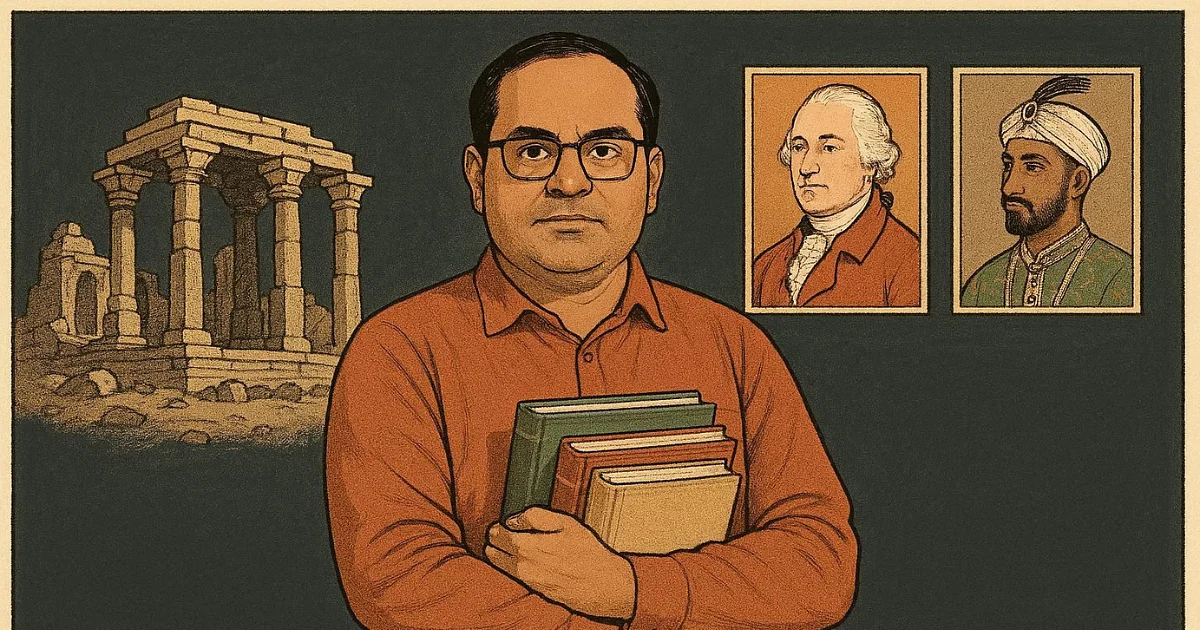
His Story of Itihaas is a Hindi film written and directed by Manpreet Singh Dhami, inspired by a true story. It is about a physics teacher who unlearns and relearns about his country, stands up to the system, and demands answers for the distorted history taught to generations of Indians. Clocking 2 hours and 24 minutes, the movie is realistic, grounded, and true to what it wants to present. It is not a potboiler with gravity-defying stunts. It is rooted in everyday lives. The dialogues are meaningful, informative, and hard-hitting without being melodramatic.
The movie starts with quotes by Western philosophers on the wall and introduces us to the main character, a physics teacher named Namit Bharawaj, running a coaching center in Noida. The class is nothing different from what we all learn at school—gravity was discovered by Sir Issac Newton, and how important this discovery is to mankind.
As the scene shifts, we get a glimpse of Namit’s personality—his dislike for eating with hands, his love for modernity, his zeal for quality education, progress, and success—things many of us can relate to on some level. He is not just a character, but a teacher and a parent representing an entire group. However, one aspect that sets him apart from others is his quest for knowledge and truth. Though Namit scoffs at the news debates between a ‘Hindu’ political leader and an ‘eminent historian’, it ignites a tiny spark of doubt in him. The ‘what if’ urges him to question statements that have been presented as facts for decades.
This spark flames into a fiery obsession that devours everything around him. However, it is neither random nor unrealistic. Early in the film, Namit tells one of his students, “to bring something out, you have to go in.” That is exactly what he does, even when it threatens to disrupt his family, career, and social life.
Before we explore further, let us circle back to the dialogue. This is important because there will be people who dismiss the movie as propaganda or Hindu Nationalism. However, this film is not about chest-thumping our greatness; it is not about glorifying the past. It is about asking questions and digging deep. It is about listening to the questions and answers and reading between the lines. It is about realizing that our idols (whoever they are) are far from perfect. It is about being open to the possibility that something taught for decades does not make it a fact. Most importantly, it is about the willingness to make an effort to learn a topic in depth, rather than claiming expertise after watching a TikTok video and opposing every counterpoint as propaganda or fake.
The Man Who Inspired It
Neeraj Atri—the man who fought against the systematic distortion of history in the NCERT syllabus and the inspiration for this movie. A physics teacher by profession, he exposed how our school textbooks have been feeding incorrect history to generations of Indians. He is also the co-author of Brainwashed Republic and the president of the National Centre for Historical Research and Comparative Studies in Chandigarh. He educates the public and creates awareness on the topic through his YouTube channel, Politically Incorrect.

The Setting and Actors
The visuals, actions, dialogues, and background music are aligned with the movie’s theme, and the setting is very much what we see in our everyday lives: a middle-class home, busy roads, classrooms, a university campus, cafés, etc. The clothes are what people in respective professions wear based on their personalities. This allows the characters to truly become one of us rather than being limited to actors mouthing scripted dialogues.
Every artist ‘lives’ their part in the film. Watching them, one feels that they truly understood what the story demanded from them, and they became that. Subodh Bhave, as Namit, goes from being a modern Indian to an obsessed man to a teacher determined to right the wrongs, but with a sense of grounding. Akanksha Pandey plays his wife, Kanchan, a woman who loves her family above everything else.
Ankur Vikal gives such a compelling presence to his character as historian Ishaan Kabir. The character is not likable, but not ignoreable either, not even for a second. From the slight raise of his brow to a subtle smirk, Ankur shows what makes these ‘eminent historians’ appear credible. Vasanti Sundaram, as historian Chaya Mukherjee, immediately reminds us of a few ‘renowned’ women historians and activists with her acting skills. Yogendra Tikku is another historian, Kamal, but the one who teaches students that itihāsa is not history, jāti is not caste, and dharma is not religion. He brings out the tentativeness, vulnerability, and pretended nonchalance bordering on helplessness that a person goes through when they choose to go against the tide. Even the actors who play Namit’s friends, Ashish and Faraz, feel apt for their roles.
It would be an injustice not to mention the young artists who played Namit’s daughter and Vikas’s son. Vikas is an assistant in Namit’s coaching center, belonging to a lower-middle-class brāhmaṇa family. Through his family, we see the layers of internalization of prejudice, bias, and self-hate. It is telling how inferiority and superiority complexes co-exist in the same person without him even realizing it!
The Undercurrents and Experiences
His Story of Itihaas has many undercurrents. These flow beyond the central plot that deals with the distorted history taught in textbooks. On one side, we see what obsession with truth can do to a person and their relationships. In modern society, how do we learn to draw the line? Where do we find the balance between what is accepted and what is not? How do we unlearn to relearn? When do we say no to Western approval being a benchmark for quality? What role do politicians play? How effective is activism, with and without support from the masses and the powerful?
The movie does not answer all the questions. That is not its intention. Itintends to make us think, and it achieves this objective with grace. The answers are supposed to come from us.
Common events play out across supermarkets, bakeries, food courts, shopping malls, and even roadside stores. Parents speak in English with their toddlers who can barely walk yet or say their own names aloud. Mothers order their little ones to ‘stop running and be a good boy/ girl’, in a posh accent. Kids learn English before they learn their mother tongue. Schools offer Spanish, French, Chinese, German, and other ‘popular’ languages as part of the syllabus. Learning the vernacular is considered low-brow.
Many school children opt for Special English or ‘foreign’ languages as their second language, as it is easier to study and to score a higher overall percentage. Saṃskṛta is taught with the same intention in high school and undergraduate studies. It is nothing more than a subject to score easy marks with over 70% of the answer sheet written in English. Years later, one may realize what the easy options took from them. We can certainly learn Saṃskṛta today, but what we lose is the expertise we would have had by now and the sense of belonging and pride that comes with it.
One of the favorite scenes comes almost at the end of the movie. It artfully shows how hard the journey back to our roots is when we go far, far away toward the West. And what are we without the roots we discard and ridicule without a thought! Has a tree ever survived for long when its roots are cut off?
We know the answer. Yet, not many want to admit it.
Speaking about the movie, Lakshmi Sivaraman, Senior Research Associate working with IKS Education at Bṛhat, says,
“The movie, His Story of Itihaas, offers a research-backed and power-packed insight into the stark lie that generations have been subjected to, in the name of history. It also raises a question on the state of education in this country—will we rise to seek and speak the truth and cultivate civilizational pride in our children or continue to allow seeding of diabolical, ideological interests in our curriculum?”

From the Director’s Heart
Manpreet Singh Dhami is a mechanical engineer-turned-writer-director from Uttar Pradesh. His love for creativity made him write and direct his songs as music videos. His first film, Bulbule (2021), showcases an interfaith story of two friends affected by the differences in their political ideologies. Both Bulbule and His Story of Itihaas are written, directed, and produced by Dhami under his banner, Panchkarma Films.
He describes His Story of Itihaas as a “story that resonates deeply with the questions we face today about who we are, where we come from, and who controls the narrative of our past,” adding that the film asks the most important questions of:
What happens when the history we are taught feels fundamentally at odds with a deeper truth? Why were we taught so many falsehoods and lies? Are we brainwashed by our books?
Dhami met Neeraj Atri four years ago and began his own journey to find the truth about our history. During his research, Dhami realized that the distorted history taught in his childhood had influenced his thinking, personality, and actions. He vowed to present the same to others as a movie and worked on the script.
When asked about His Story of Itihaas, Dhami says,
“My vision for this film is to ground this intellectual and societal conflict in the intensely personal journey of a physics teacher, Namit, an ordinary man pushed to extraordinary action by the simple pages of his daughter's school history book. The emotional core lies in the relationship between Namit and Riya, and the very real stakes for their family as his hunger for truth consumes him.I hope this film prompts audiences to question the narratives they have been given, to understand the massive impact that history, as it is taught, can have on identity, and to appreciate the quiet courage of individuals who dare to seek a deeper understanding of the past for the sake of the future. It is a film about history, yes, but more importantly, it is a film about truth, conviction, and the enduring fight for a genuine understanding of who we are and why we were lied to in our history books.”
The Struggle is Real
His Story of Itihaas has an average of 8.9 stars (over 1.2K user ratings) on IMDb, with many viewers expressing their delight and gratitude for making such a movie. Some users even shared their personal experiences, which indicate that the film resonated with many. Bṛhat was present at the launch of the trailer and screening of this film in Chennai, along with Madras Sanskrit College, in September 2025. The film had a houseful screening and a wonderful reception from the audience.
Despite such a response, the movie was screened only for a limited time in the Multiplexes before it was taken off, citing ‘low numbers’ and other reasons. Moreover, without an OTT release yet, the common audience is deprived of experiencing this remarkable film, while the producer faces financial strain that makes it difficult to create more such powerful content. Neeraj Atri, too, spoke about this on his social media post, exposing the pattern in how such movies are sidelined and silenced, limiting their opportunity to reach a broader audience.
Wrapping Up
His Story of Itihaas feels relatable because it shows what we see in society around us, so much so that the challenges faced by the characters also align with the director’s struggle of screening it for a longer duration.
The slightly slower pace allows the viewer to absorb the context without a sensory overload. While it is tempting to ask for a more in-depth exploration of the topics, it would be too much for a regular moviegoer. Moreover, this film is supposed to be a stepping stone. A nudge to be more open and to think independently. To remember that not every proclaimed fact is true.
That is why the characters are also flawed. Namit has a long way to go, despite his quest for truth and change; Kamal, too, despite his determination to teach proper history. They are real and relatable. Real is messy. Real is discomfort. Real is painful growth. Real is the realization that change demands dedication, not just individually but collectively. It asks for sacrifice, too, never of our morals and ethics, but of our past selves and prejudices.
The day we are willing to accept that we need to change is when the real journey begins. The path is long, and we are just getting started.



.png)