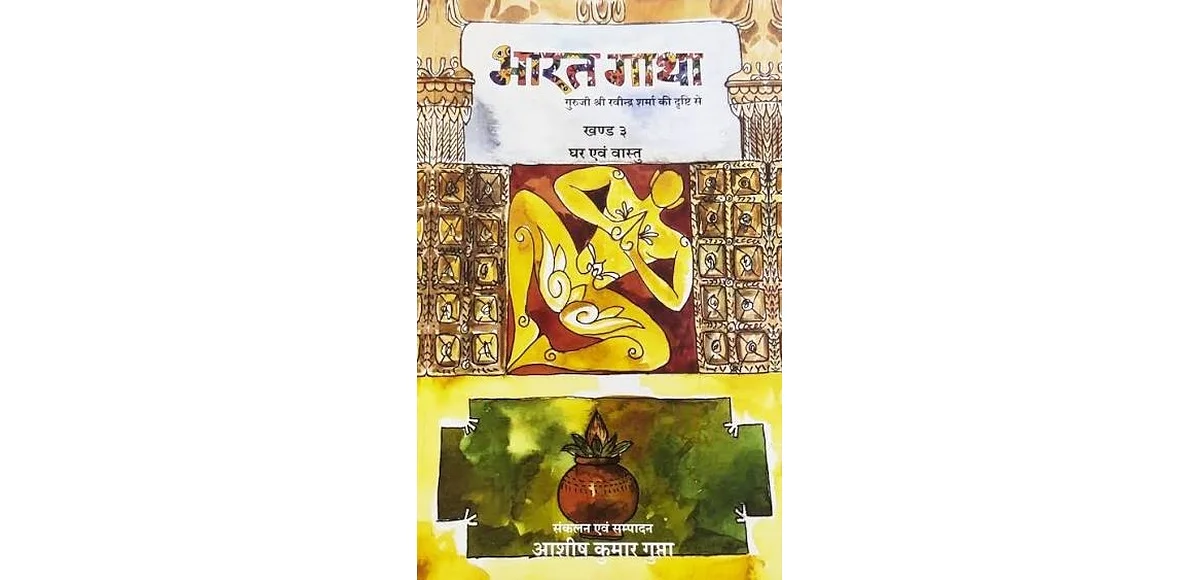
Creation, Nature, and the Five Elements
The book opens with a graceful foreword that reflects on the nature of creation itself. All beings, sentient and non-sentient alike, exist in harmony with the natural order of the Pañca Mahābhūta, the five great elements. They accept this cosmic arrangement instinctively and live within its balance. Human beings, however, take these same elemental foundations and reshape them according to their own imagination, preferences, and needs. From this impulse arise our homes, our architecture, our cities, and the structures of society.
Across the world, wherever humanity has settled, people have adapted their dwellings to geography, climate, and environment, shaping communities, economies, and cultural forms. In India, with its vast diversity of landscapes and traditions, this has given rise to a rich, nuanced tradition of Vāstu which is rooted in nature, refined by science, and shaped by civilization. Vāstu here is not a rigid formula but a living system, molded by regional differences and ecological realities.
Guruji’s Vision of the Home
This book is dedicated to Guruji’s profound ability to illuminate these principles. He consistently emphasized that every arrangement we make whether social, economic, architectural, or environmental, they all must honor the delicate balance between human needs and the larger natural order. For him, the design of a home was not merely a matter of construction but a deeply elevated act. A home, he taught, should nurture vitality and health, support economic stability, never cause harm or distress, uplift the spirit toward spirituality, strengthen social harmony, and embody reverence for nature.
Guruji also explores the contrast between straight lines and curved forms, examining the modern architectural preference for rigid geometry in light of traditional Vāstu Śāstra. Through these insights, the reader is gently guided into a deeper understanding of space, form, and meaning.
Thus, this volume invites us to rediscover the home not just as a shelter, but as a living, breathing expression of harmony between humanity, nature, and the cosmos.
The Illusion of ‘Modern Traditional’ Architecture
Ashish Gupta ji raises a deeply pertinent observation about contemporary trends in architecture. In recent times, there has been much discussion about returning to traditional methods of building. This movement has been given many names like vernacular architecture, eco-friendly homes, natural houses, neo-traditional dwellings, sustainable houses, climate-smart structures, low-cost housing, energy-efficient buildings, and more.
Yet, he points out that in most cases, the change is largely superficial. Instead of commercial materials such as cement, concrete, iron, and industrial bricks, builders now use mud, chuna (lime), bamboo, wood, kiln-fired or baked bricks, and similar alternatives. While the materials may differ, the core design remains unchanged. The same 1, 2, 3, or 4 BHK layouts persist, along with villas and bungalows modeled on colonial architectural ideals. Only the outer appearance is given a vaguely traditional look; the underlying structure, logic, and inspiration remain the same.
The Problem of Disconnection from Place
Even more troubling, he notes, is that many of these so-called “natural” materials are not sourced locally. Instead, they are transported from distant regions as far as 500, 700, or even 1,000 kilometers away, thus, making them ill-suited to the specific topography, geography, and environmental conditions of the area in which they are used. This disconnect undermines the very ecological and contextual sensitivity such designs claim to embody.
True transformation, he argues, is not merely about substituting materials or reshaping appearances. Architecture must also be guided by aesthetic harmony, spiritual depth, social usefulness, and meaningful contribution to the local economy. All these dimensions must be thoughtfully integrated when designing a home or any built space.
This book delves deeply into these essential questions, inviting the reader to reflect more profoundly as we move forward.
Misinterpretations and Mechanical Use of Vāstu
The book also draws attention to the blind and mechanical application of Vāstu that has become common today, often diluted by the indiscriminate mixing of external cultural influences such as Feng Shui. Ashish Gupta ji reminds us that authentic Vāstu rests on three fundamental principles: Gādho, Sādhana, and Vāstu itself, principles that belong to the ancient tradition of Śilpa and Śilpakārī, the science and art of engineering. Yet, these deeper foundations are largely ignored in contemporary practice.
Wisdom of Vernacular Dwellings
In contrast, he praises the humble jhopadis built by farmers and villagers which are simple, time-tested structures known as Śiva Kulla, so named because they resemble the cap or crown of Lord Śiva. These small, rounded huts with conical thatched roofs are remarkably resilient. No matter how fierce the storms or how heavy the rains, they endure, shaped by generations of lived wisdom and intimate knowledge of nature.
Such dwellings are profoundly natural in both form and function. Their builders instinctively understand balance, climate, and material harmony, sourcing everything from the surrounding landscape itself. Gupta ji explores these examples with keen attention, illustrating how true Vāstu arises organically from place, purpose, and people.
The Symbolism of the Vāstu Puruṣa
He also delves into the concept of the Vāstu Puruṣa, its origins, symbolism, and enduring significance, revealing how essential this foundational idea is to understanding the deeper spirit of Vāstu Śāstra.
Stories from Lived Experience
Finally, the book is richly interwoven with anecdotes from Ashish Gupta ji’s personal interactions with Guruji, as well as his lived experiences with people from diverse walks of life. He reflects on how their homes were built, how they aligned with direction, environment, and occupation, and how seamlessly they supported the rhythms of daily living.
These narratives offer an experience that is both exhaustive and deeply grounded, rooted in observation, practicality, and fact. Through them, the book presents a clear vision of where we ought to be heading in our understanding of Vāstu in its true sense: not as a set of rigid prescriptions, but as a living tradition informed by timeless practices and the enduring wisdom of classical texts.
Toward Architecture as Harmony
This volume is a must-read for anyone drawn to these subjects, and especially for those engaged in architecture and related professions, who seek to build not just structures, but harmony itself.
The author can be reached on X/Twitter - https://x.com/TanyaBrahmvadni



.png)